 How to resolve AdBlock issue?
Recreation
- Details
- Written by: California Department of Fish and Wildlife
Question: Over the years I’ve spoken to many people who are certain that the use of trail cameras during hunting season is a violation of California Fish and Wildlife regulations. Is this true? (Josh)
Answer: It is not a violation to use trail cameras during hunting season in California. The use of cameras can be described as “digital scouting,” meaning hunters might post a camera in an area to identify what type of game may be present, or a non-hunter may simply want to determine the level of wildlife activity. The cameras are motion-activated and are generally used to help hunters plan their trips. Some of the newer models allow hunters to check images remotely. Older cameras required the hunter to physically travel to the camera and check the chip inside for images.
Please be aware though, that if you’re on land managed by the California Department of Fish and Wildlife (CDFW), visitors are required to remove all personal equipment and belongings on a daily basis. Gear left behind will be considered litter and disposed of accordingly, per California Code of Regulations, Title 14, section 550(v). Other agencies could have similar restrictions, if you’re on their land.
Collecting starfish?
Question: Am I allowed to collect starfish from tidepools in California? (Amy)
Answer: The take of sea stars (commonly known as “starfish”) is prohibited in tidepools, per California Code of Regulations, Title 14, section 29.05. Sea stars are an important predatory species in the marine ecosystem and historically have been an iconic resident of many tidepools. They help control populations of species such as urchins and mussels, which in turn allows other species to thrive.
Unfortunately, in 2013 and 2014, sea star populations experienced massive die-offs due to a wasting disease which is still affecting them today. Some species of sea stars on the West Coast have seen drastic declines in abundance. Given the health of sea star populations and their importance to the marine ecosystem, CDFW encourages coastal visitors to not disturb sea stars if they are encountered.
Reduced-fee sport fishing licenses
Question: I’m 94 years old and still enjoy fishing, but the license cost is a very big chunk out of my fixed income. Why doesn’t CDFW issue free licenses for us old geezers? I only am able to fish once or twice a year and the one-day fee limits me severely. (Don)
Answer: CDFW does indeed offer a Reduced Fee Sport Fishing License (currently $7.73) for low-income California residents, 65 years of age and older, who meet the specified annual income requirements. Normally applicants are required to present their proof of eligibility in person in order to apply. Because offices are currently closed, you may submit an application by mail to any CDFW License Sales Office. Your application must be accompanied by verification of your currently monthly Social Security benefit and verification of your currently monthly income from all other sources.
Reduced-fee sport fishing licenses are also available to those who meet any of the following requirements:
– Any person, with central vision acuity of 20/200 or less in the better eye with the aid of the best possible correcting glasses, or central vision acuity better than 20/200 if the widest diameter of the remaining visual field is no greater than 20 degrees. Certification of blindness by an optometrist or an ophthalmologist is required.
– Any California resident who is so severely physically disabled as to be permanently unable to move from place to place without the aid of a wheelchair, walker, forearm crutches or a comparable mobility-related device. Verification by a licensed physician or a copy of the previous year's free fishing license is required.
– Any developmentally disabled person. Certification by a licensed physician or the director of a State regional center is required.
– Any Native American who is a resident of the state and is financially unable to pay the fee required for a resident sport fishing license. The Free Sport Fishing License Application for low income Native Americans can be found on CDFW’s website.
More information about these licenses, including the documentation required to establish eligibility for each, can be found on CDFW’s website.
- Details
- Written by: CALIFORNIA DEPARTMENT OF FISH AND WILDLIFE
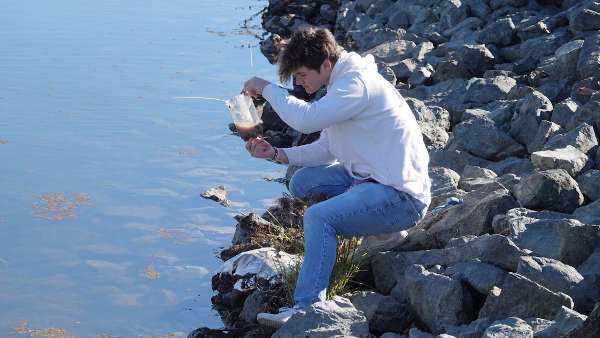
Can I use a homemade plastic bottle trap in lakes?
Question: Is it legal to use a homemade plastic bottle trap in lakes and other freshwater bodies? (Anonymous)
Answer: The 2020-2021 Freshwater Sport Fishing Regulations state “Except as otherwise authorized, all fish may be taken only by angling with one closely attended rod and line (or with two rods if the angler is in possession of a valid two-rod stamp).”
However, there are two exceptions: 1) Traps can be used to catch bait fish, but only certain kinds of bait fish can be taken or used in particular bodies of water in the different fishing districts (see sections 4.05 – 4.30 of the Freshwater Sport Fishing Regulations for bait fish capture methods and bait fish use). 2) California also allows the taking of crayfish with traps that are not over three feet long. Homemade traps made from soda bottles can be very effective.
Additionally, several closures designed to protect Shasta Crayfish are mentioned in California’s Freshwater Sport Fishing Regulations in Title 14 section 5.35. Fall River upstream of Spring Creek Bridge, Lava Creek, Tule River and all connected waters upstream of Little Tule River, Sucker Springs Creek, Crystal Lake, Rising River and Rising River Lake are closed to take and possession of crayfish. (See Title 14 section 4.30 for prohibition against crayfish use for bait in sections of the Pit River).
Bonito regulations
Question: I have a question regarding Pacific Bonito. California Code of Regulations, Title 14, section 28.32 (b) says the minimum size is “24 inches fork length or five pounds except that: Five fish less than 24 inches fork length or weighing less than five pounds may be taken and possessed.” Does that mean I can take and possess five Pacific Bonito or less if they are any length less than 24 inches fork length? For example, could I legally keep two 12-inch Pacific Bonito per day? (Arthur)
Answer: Your interpretation of Title 14 section 28.32 is correct, so long as you possess five or fewer Pacific bonito less than five pounds or 24 inches fork length. Should you catch six or more bonito, you may only keep five fish under five pounds or 24 inches fork length and you cannot catch or possess more than 10 total.
So, assuming you did not already have more than three Pacific bonito shorter than 24 inches in your possession (which includes those at home), your example of two bonito with a length of 12 inches per day would be legal as long as the total number under five pounds or 24 inches in your possession did not exceed five and the total number in your possession did not exceed 10.
Bowfishing in Kern County?
Question: What fish are legal to bowfish for in Kern County? (Sam)
Answer: Generally speaking, bow and arrow fishing is permitted year-round in Kern County for the following species: carp, goldfish, western sucker, Sacramento blackfish, hardhead, Sacramento pikeminnow and lamprey. However, the regulations differ when bowfishing at Isabella Lake in the Kern River Valley. Bow and arrow fishing is permitted in Lake Isabella for the taking of carp, goldfish, western sucker, Sacramento blackfish, hardhead, Sacramento pikeminnow, lamprey, bullheads and catfish, per California’s Freshwater Sport Fishing Regulations in Title 14 section 2.25.
Bringing a non-hunter along on a hunt
Question: Is it all right for me to bring a companion with me for quail hunting? They would not be assisting me in any way (flushing birds, calling, etc.) and would be merely shadowing me for the experience. (Kraig)
Answer: Yes, you’re fine having a companion along for the hunt, as long as they don’t participate in the actual attempt to take a bird. The California Department of Fish and Wildlife (CDFW) recognizes that many non-hunters join licensed hunters in the field while hunting to get an idea of what it is all about. We encourage the practice and consider it a vital part of passing along the tradition of hunting. If your friend is interested in getting involved in hunting, please have them check out the Hunter Education page on the CDFW website.
Auto-renewing a fishing license
Question: I recently bought my 2021 fishing license at a sporting goods store. I found out after the fact that CDFW is now offering an auto-renewal option. I don’t remember being offered that option when I bought my license. When I buy my hunting license, can I sign up for auto-renewal of both licenses? (Arnold)
Answer: CDFW recently began offering auto-renewal for sport fishing licenses. If you choose this option, the credit card you provide will be charged annually in November and the next year’s fishing license will be mailed to you. This convenient option means that anglers no longer need to worry about lapses in licensure occurring during transitions to new license years. At this time, the option is only available for sport fishing licenses. CDFW expects to expand the program to include hunting licenses and related items in the future.
The only way to enroll in auto-renewal is through our Online License Sales and Services website. License agents, CDFW sales offices and telephone sales representatives cannot set up the required Customer Record Security Settings and credit card information for a customer’s record. However, regardless of how you purchased your license, you have the ability to enroll in auto-renewal at a later date by logging into your customer record through our Online License Sales and Services website.
You can find more information about the new auto-renewal option on CDFW’s website.
If you have a question for the California Department of Fish and Wildlife, email
- Details
- Written by: Elizabeth Larson
More than 99 percent of the 245 million surface acres managed by the agency are currently open to recreational shooting, and this guidance will help ensure that these activities are allowed to continue wherever possible.
“Recreational shooting is a longstanding tradition for millions of Americans, and the department is proud to support this popular pastime as a key component of the BLM’s multiple-use mission,” said Casey Hammond, principal deputy assistant secretary for Land and Minerals Management. “Working with local communities, our state agency partners, and other key stakeholders, we will continue to ensure that public lands remain open to recreational shooting, allowing Americans to pass down our nation’s rich outdoor heritage to future generations.”
The BLM has long prioritized recreational shooting as an important part of its land management mission under the Federal Land Policy and Management Act, including on many lands under the National Conservation Lands umbrella: national monuments, national conservation areas and similar designations, national scenic and historic trails, wilderness, and wilderness study areas.
The guidance issued Thursday provides additional clarity for federal land managers evaluating recreational shooting activities as part of land use planning decisions and regarding the agency’s implementation of Public Law 116-9, the John D. Dingell Jr. Conservation, Management, and Recreation Act.
“This guidance from the Bureau of Land Management is enthusiastically welcomed by America’s sportsmen and women. It will help to ensure and increase recreational shooting access and opportunities on public lands and preserve the important gains for sportsmen and women achieved during the Trump Administration through the leadership of Interior Secretary David Bernhardt,” said Lawrence G. Keane, senior vice president and general counsel for the National Shooting Sports Foundation, the firearm industry’s trade association. “This guidance will enable our American hunting and shooting tradition and heritage as well as wildlife conservation to thrive for generations to come. Recreational shooting on public lands is directly tied to increased funding for wildlife conservation through the firearm industry’s growing Pittman-Robertson excise tax contributions to the Wildlife Restoration Trust Fund.”
“The Congressional Sportsmen’s Foundation is grateful for the efforts undertaken by the BLM to protect recreational target shooting opportunities by following the intent of Congress as provided in the Dingell Act (S.47),” said Congressional Sportsmen’s Foundation President Jeff Crane. “With 99 percent of the 245 million acres of public land managed by the BLM open to recreational shooting, this guidance will ensure that America’s 32 million recreational shooters continue to have a place to safely participate in this outdoor tradition.”
“This is a great initiative from the administration to encourage and preserve our culture and our rights,” said Dianna Muller, founder of the DC Project, Women for Gun Rights and retired police officer. “With upwards of 8 million brand new gun owners in 2020, it’s going to be important that they have a place to practice their skill set and enjoy the outdoors with their family. Recreational shooting is great because the whole family can participate, and the injuries are substantially less than other organized sports.”
Subject to site-specific considerations, the BLM’s general policy is to enhance shooting opportunities, or at least avoid a net loss, in its land use planning decisions. State, district and field offices have been directed to incorporate specific evaluation standards into their land use planning decisions to ensure nationwide consistency in how recreational shooting is managed on public lands.
- Details
- Written by: California Department of Fish and Wildlife
CDFW worked closely with recreational stakeholders to develop the following changes, effective Jan. 1, 2021. See CDFW’s summary of recreational groundfish regulations for Management Area boundary definitions.
– Elimination of sub-bag limits for black rockfish, canary rockfish and cabezon within the 10-fish Rockfish, Cabezon, Greenling, or RCG, complex daily bag limit.
– A new sub-bag limit of five vermilion rockfish within the 10-fish RCG complex daily bag limit.
– The Rockfish Conservation Area, or RCA, boundary will increase to 30 fathoms (180 feet) in the Mendocino Management Area during the regular open season (May 1-Oct. 31).
– The RCA boundary will increase to 50 fathoms (300 feet) in the San Francisco Management Area during the open season (April 1-Dec. 31).
– The RCA boundary will increase to 100 fathoms (600 feet) in the Southern Management Area during the open season (March 1-Dec. 31).
– For consistency with federal regulations, the legal method of take for California scorpionfish has been updated such that no more than two hooks and one line may be used when angling for this species.
– The “All Depth” fishery in the Northern and Mendocino Management Areas will continue each November and December, unless modified by an in-season action.
The new regulations were adopted by the California Fish and Game Commission in mid-October and the Pacific Fishery Management Council in July.
Anglers should check CDFW’s website for the current regulations before fishing for groundfish and are advised that regulations printed in the 2020-21 ocean regulations book will be out of date starting Jan. 1, 2021.
The 30, 50 and 100 fathom depth contours are defined by straight lines connecting the waypoints as adopted in the Code of Federal Regulations, Title 50, Part 660, Subpart C.
Many of these changes were made in response to the outcomes of recent stock assessment science. Populations of yelloweye rockfish and cowcod, which were declared overfished in 2002 and 2000 respectively, are increasing faster than anticipated and the cowcod population was declared rebuilt based on the 2019 stock assessment.
“The good news for 2021 is groundfish populations are rebounding,” said CDFW Senior Environmental Scientist Caroline McKnight. “Of the eight stocks that were declared overfished in the early 2000s, all but one, yelloweye rockfish, has been declared rebuilt today. The improved status of these species allows fishery managers to recommend management measures that provide additional fishing opportunity, including access to deeper depths that have been off limits to anglers for more than a decade.”
The implementation of a new five-fish sub-bag limit for vermilion rockfish within the 10-fish RCG complex daily bag limit may come as a surprise to some anglers. Recreational catch of vermilion rockfish has increased significantly in recent years, but stock status information is dated. While a new stock assessment for vermilion rockfish is planned for 2021, the results won’t be available for use in management until 2023. In the interim, the new five-fish vermilion rockfish sub-bag limit has been implemented as a precautionary measure to slow catches.
Take and possession of bronzespotted rockfish, cowcod and yelloweye rockfish remain prohibited statewide.
For more detailed information on the new 2021 recreational groundfish regulations and to stay informed of in-season changes, please call the Recreational Groundfish Hotline at (831) 649-2801 or visit CDFW’s summary of recreational groundfish fishing regulations for 2021. For background information on groundfish science and management, please visit CDFW’s Marine Region Groundfish webpage.