 How to resolve AdBlock issue?
Recreation
- Details
- Written by: Lake County News Reports
PG&E is committed to providing safe and reliable energy and ensuring business continuity in these challenging times.
For the safety of the public and staff, PG&E has temporarily closed its 38 campgrounds and day-use sites, and reduced maintenance associated with the specific risks of restroom cleaning and trash collection.
From the Pit River country in the Cascade Range to the King's River region in the southern Sierra Nevada, PG&E’s recreational facilities have been available for the public to enjoy for many decades.
Locations such as Lake Almanor, Lake Spaulding and Lake Britton are engineered to create clean energy through a large hydroelectric system.
These sites feature PG&E campgrounds and picnic areas. Most of the lakes also offer fishing, swimming and boating.
The only PG&E parks in the North Bay and North Coast are in Mendocino and Lake counties. There are three campgrounds and 3 day-use areas: Trout Creek Campgrounds in Mendocino County, and Pogie Point, Pillsbury Pines, Fuller Grove Campgrounds and Fuller Grove Day use area and boat ramp, and Navy Campgrounds in Lake County.
The window to make camping reservations usually opens in April, but it has now been pushed to June, with the potential to be pushed out further.
The PG&E camping season is generally Memorial Day through Labor Day. At present, the opening date for campgrounds is set for June 29.
For updates and information about PG&E facilities, please visit www.pge.com/recreation .
Editor’s note: This story has been corrected to show that Pogie Point, Pillsbury Pines, Fuller Grove Campgrounds and Fuller Grove Day use area and boat ramp, and Navy Campgrounds are in Lake County, not Mendocino County.
- Details
- Written by: Lake County News Reports
The meeting will take place beginning at 8:30 a.m. Thursday, April 9.
Members of the public will have the opportunity to comment on the proposed emergency regulation by calling 877-402-9753 or 636-651-3141; access code 832 4310.
Webinar details are on the agenda. The meeting agenda and documents are available on the commission's website at https://fgc.ca.gov/Meetings/2020 .
Due to the global COVID-19 pandemic, the commission will discuss whether or not to temporarily grant authority to California Department of Fish and Wildlife to decide whether to delay, restrict or suspend sport or recreational fishing in order to prevent and mitigate public health risks that may arise when people travel for fishing trips or congregate while participating in available fishing opportunities.
CDFW and the commission have received requests from county representatives and local health authorities requesting delays to recreational fish openers such as the Eastern Sierra trout
opener scheduled for April 25.
- Details
- Written by: California Department of Fish and Wildlife
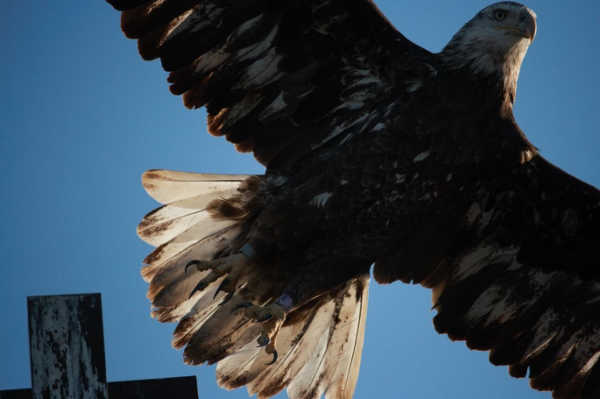
Question: I have been photographing a pair of bald eagles near Perris for about six months, including the banded eagle in the attached photo. Can you tell me anything about the eagle? From what I can gather the band number is 7vj-7vj. (James R.)
Answer: You're in luck! Biologists at the Bird Banding Laboratory in Maryland were able to research the eagle's backstory based on the information you provided and other sighting reports they received. The eagle you photographed was banded as a nestling in May 2017 near Hemet in Riverside County. In January 2018, the eagle was found injured and taken to a Riverside County rehabilitation facility. It looks like the eagle's recovery was successful because there was a reported sighting in March 2018 at the San Jacinto Wildlife Area, and another reported sighting in January 2019 in Riverside County.
The band on this eagle is called a Visual Identification Number, or VID. This type of band is easily visible using binoculars, spotting scopes or camera lenses, making the collection of re-sighting data even more possible. This data is used to understand species ranges, movement, survival and other ecological factors of interest to researchers.
You can find a lot of interesting information about bald eagles on the California Department of Fish and Wildlife website. We also encourage birders and other nature lovers to report sightings through our California Natural Diversity Database.
Can you put a camera on a hoop net?
Question: For crab and lobster fishing, is there a regulation saying that someone using a rigid hoop net cannot attach an underwater camera to the float above the trap? That would be much easier to know when to pull up your nets. (Rich)
Response: There's no regulation in California that would prohibit placement of an underwater camera on a rigid hoop net. However, remember that your hoop net must be inspected at least every two hours per California Code of Regulations Title 14, section 29.80. To count as an inspection, the person who placed the net into the water must raise the net to the surface and inspect its contents. Any hoop net that is left unchecked for more than two hours is considered abandoned and could be seized by law enforcement. Also, note that the fisherman's GO ID number must be displayed on the buoy of the trap being fished.
Would California ever reintroduce the grizzly bear?
Question: Is CDFW in favor of, or opposed to, reintroducing grizzly bears to the California Wilderness areas of the Sierras, or the coastal redwoods of Humboldt and Del Norte counties? It would be a shame not to reintroduce our state animal to its native environment. (Scott)
Answer: While we find it interesting, we are not entertaining the reintroduction of grizzly bears to the state. The idea has been a nonstarter for CDFW. The department is decidedly pro-science and pro-study, which would be required before even suggesting an action like this. But this kind of study is not a priority for CDFW. It's unlikely that CDFW would take on the burden and extra cost of engaging in a study for the following reasons:
– Grizzly bears traditionally would roam oak woodlands and even beaches, sometimes eating whale carcasses. We have no reason to assume that grizzlies would stay within some arbitrary boundary we set in a remote area of the Sierra or Coastal Redwoods, or that they wouldn't wander from remote areas into less remote ones near people and livestock.
– Salmon and other wildlife that grizzly bears feasted on 150 to 200 years ago are not as abundant as they used to be.
– We have 40 million people in this state. Reintroducing grizzly bears would suggest bringing them into places where people are now.
Reintroducing grizzly bears potentially into places where people live, recreate and raise livestock would likely prove counterproductive as it would necessitate further management of human/wildlife conflicts. We already struggle enough as it is to manage human and livestock conflicts with the animal species that are here, such as black bears, wolves, coyotes and mountain lions.
When transporting turkeys, which parts are required for ID?
Question: What portions of a turkey is a hunter required to retain for identification purposes? I'm not sure that "plucking a turkey in the field but leaving the beard attached" is sufficient to stay legal when transporting. While keeping the beard would certainly help identify, I believe a fully feathered head or wing is the actual requirement. In fact, if a hunter chooses to pluck both wings and leave the "fully feathered head" attached, would that be enough proof for identification purposes? (Blake)
Answer: Hunters are not required to retain the turkey's beard. However, "all birds, including migratory game birds, possessed or transported within California must have a fully feathered wing or head attached until placed into a personal abode or commercial preservation facility or when being prepared for immediate consumption" (CCR Title 14, section 251.7).
Since the law only authorizes the take of bearded turkeys during the spring season, CDFW recommends leaving the beard attached during the spring season (CCR Title 14, section 300).
If you have a question for the California Department of Fish and Wildlife, email
- Details
- Written by: Lake County News Reports
Notifications to those who reserved sites through www.recreation.gov will be made as soon as possible and refunds will be processed.
While designated recreation sites are closed, the general forest area including the extensive trail and road system remains open at this time.
“As we work through an unpredictable and rapidly changing situation, health and safety is our number one priority. We are committed to continuing to support our communities and fulfill our mission as we all work together to minimize the impacts and spread of COVID-19,” Forest officials said in a Friday statement.
A full list of current closures can be found below.
Upper Lake Ranger District
Bear Creek Campground
Deer Valley Campground
Lower Nye Campground
Middle Creek Campground
Navy Camp Campground
Oak Flat Campground
Penny Pines Campground
Pine Mountain Lookout
Pogie Point Campground
Sunset Campground
Covelo Ranger District
Atchison Campground
Eel River Campground
Green Springs Campground
Grizzly Flat Dispersed Campground
Hammerhorn Campground
Howard Lake Campground
Howard Meadows Campground
Little Doe Campground
Grindstone Ranger District
Big Springs Picnic Area
Cedar Camp Campground
Chico Seed Orchard and day-use area
Davis Flat Campground
Dixie Glade Campground
Fouts Campground
Fuller Grove Campground
Fuller Grove Group Campground
Gray Pine Group Campground
Green Springs Campground
Kingsley Glade Campground
Letts Lake Campground
Little Stony Campground
Masterson Group Campground
Mill Creek Campground
Mill Valley Campground
North Fork Campground
Old Mill Campground
Camp Discovery Group Campground
Plaskett Meadows Campground
Plaskett Meadows Picnic
Rattlesnake Memorial
Red Bluff Recreation Area
Red Bluff Boat Launch
South Fork Campground
Sugar Spring Campground
Sugarfoot Glade Campground
Sycamore Grove Campground
Sycamore Grove Picnic
Three Prong Campground
Wells Cabin Campground
Whitlock Campground
Customers needing information, passes and maps are encouraged to call the Mendocino National Forest Supervisor’s Office at 530-934-3316 Monday through Friday from 8 a.m. to 4:30 p.m., visit the forest website at https://www.fs.usda.gov/mendocino/ , and check for updates on Facebook https://www.facebook.com/MendocinoNF/ or Twitter https://twitter.com/MendocinoNF .