 How to resolve AdBlock issue?
Recreation
- Details
- Written by: California Department of Fish and Wildlife
However, anglers are reminded to abide by all state and local health guidelines regarding non-essential travel and physical distancing. Staying home in order to stay healthy is still the best way to keep yourself and others safe.
Anglers are also advised to check with local authorities on the status of harbor services and access points as many site closures and access restrictions exist and may change daily.
The ocean salmon fishery will open May 1 in the Fort Bragg, San Francisco and Monterey areas [Horse Mountain (40°05'00" N. latitude) to the U.S./Mexico border], while the boat-based groundfish fishery in the Northern and Mendocino management areas [Oregon/California state line to Point Arena (38 °57.5" N. latitude)] will open as well.
The groundfish fishery in other California management areas remains open. The Pacific halibut fishery also will open statewide on May 1.
Federal regulations establish recreational fishing seasons for California's ocean salmon, groundfish and Pacific halibut fisheries, following recommendations made by the Pacific Fishery Management Council. The California Fish and Game Commission adopts regulations for state waters to match the federal season dates.
Please check the following resources for more information on these fisheries:
– CDFW's Ocean Salmon webpage, Ocean Salmon Hotline, 707-576-3429, or the National Marine Fisheries Service Ocean Salmon Hotline, 800-662-9825.
– CDFW's Recreational Groundfish Regulations webpage or Groundfish and Pacific halibut regulations hotline, 831-649-2801.
– CDFW's Pacific halibut webpage, Groundfish and Pacific halibut hotline at 831- 649-2801, or the NMFS Pacific halibut hotline, 800-662-9825.
- Details
- Written by: California Department of Fish and Wildlife
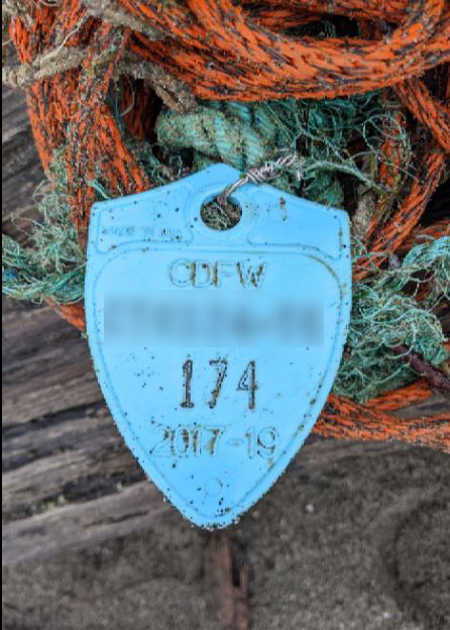
California tag found in Washington
Question: Here's a photo of a tag that was found attached to rope entangled in kelp near the New Dungeness Lighthouse in Washington State. Can you identify what the tag is for and where it might have originated? (Mark)
Answer: You found a commercial Dungeness crab buoy tag for the biennial period of 2017-2019. Tags like these are attached to floating buoys on commercial crab pots. How interesting that it floated all the way up to Washington! Tags can become dislodged from lines for a variety of reasons. Sometimes they are cut by boat propellers, kelp stands or from floating logs dragging on the line. The tag you photographed originated in northern California. It isn't of any use to the original permit holder, so we would consider it marine debris at this point. You can feel free to dispose of the tag.
Fall hunting seasons and COVID-19
Question: I was happy to see that the 2020-21 hunting licenses and tags are now available for purchase! Is there any talk of canceling hunting opportunities, though? Would I get a refund if I was successful in the Big Game Drawing, but then couldn't hunt? (Andy)
Answer: There are no plans to close fall hunting seasons or restrict opportunities at this time. Some properties managed by other government agencies are closed to hunting this spring. Big game seasons are still several months away, and we are hopeful that most or all restrictions related to COVID-19 will be lifted by then.
You can find the 2020 Big Game Hunting Digest on the California Department of Fish and Wildlife (CDFW) website. The deadline to apply for the Big Game Drawing is June 2, 2020 at 11:59 p.m.
We are also hopeful that all successful applicants will have the opportunity to hunt. That said, these are unprecedented times, and we can't predict the future with certainty. We are closely monitoring direction from the Governor's office as well as local health and safety orders, and at this time, we have made the decision to proceed with the Big Game Drawing. If a situation arises in which a successful applicant is unable to travel due to COVID-19, we will evaluate that request within the bounds of the law and make a case-by-case decision.
Can I fish from a power boat below the Feather River Fish Hatchery?
Question: I have been fishing the Feather River in downtown Oroville just below the Feather River Fish hatchery for years. I was under the impression you couldn't use a motorized boat to fish that section. However, I have been seeing a lot of motorized boats fishing that area recently, and I can't find any regulations on this. Can you take a motorized boat up the river below the hatchery? (Michael)
Answer: There are no laws prohibiting the use of motorized boats on the Feather River below the hatchery. In fact, you will often see CDFW employees and California Department of Water Resources employees out on motorized boats doing various work on that portion of the Feather River.
With regard to fishing, you'll want to make sure you are fishing for a legal species during its open season. Please note that the section of the Feather River closest to the hatchery - from the Fish Barrier Dam down to the Table Mountain bicycle bridge - is closed to fishing all year.
Carrying two rods?
Question: Is it legal to carry two fly rods in case one breaks? (Mike)
Answer: You can carry as many rods as you'd like as long as there's not more than one line in the water at the same time. California law would prohibit you from fishing with two rods in inland waters without first obtaining a second rod validation, unless you are under 16. The second rod validation does not apply to waters where anglers are required to use only barbless hooks and artificial lures.
Can I have a javelina as a pet?
Question: Are javelina legal to keep as pets in California? (Gregg)
Answer: The javelina (Tayassu tajacu) also known as collared peccary, is restricted under California Code of Regulations Title 14, section 671. They can only be kept in California under a Restricted Species Permit issued for scientific or educational purposes. They are not legal to keep as pets.
If you have a question for the California Department of Fish and Wildlife, email
- Details
- Written by: Mendocino National Forest
The USDA Forest Service’s highest priority is ensuring our employees and visitors remain safe as we support mission-critical functions for the people and communities we serve.
This closure order is effective through April 30. If you do plan on visiting the Mendocino National Forest please be aware that:
– No trash removal is currently offered, please pack out all trash and waste.
– All toilet facilities are currently closed, please plan accordingly.
– Avoid high-risk activities, law enforcement and search and rescue operations may be limited.
– If an area is crowded, please search for a less-occupied location.
Closing any site for any reason is not one forest officials take lightly, but protecting visitors and employees remains the highest priority.
Forest officials said they are working with state and local partners to determine the best path forward to safely reopening closed sites.
Thank you for your cooperation.
Please remember that OHV trails are closed effective April 17, 2020, under Forest Order 08-20-03.
- Details
- Written by: California Department of Fish and Wildlife
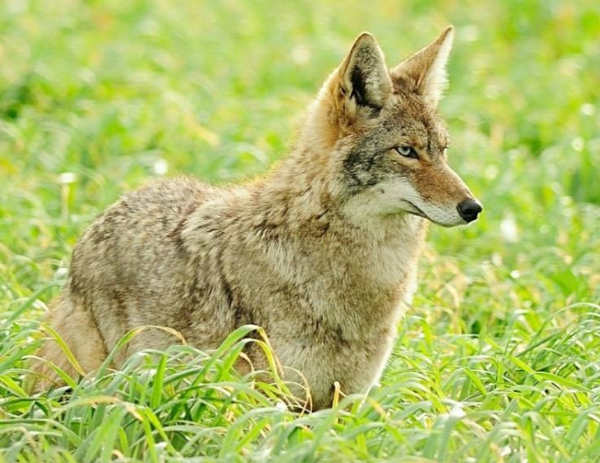
Dealing with nuisance coyotes
Question: I have lived in Aptos for 25 years and have never seen the coyote problem as bad as it is now. They are killing animals in the area, including beloved pets. We won't let our dog out at night alone because we hear them yipping nearby, and they wake us up three to four times a week. Is it possible to trap, neuter and relocate (preferably somewhere else)? (Shelly)
Answer: Living with wildlife can bring challenges. Coyotes have adapted to diverse habitats across California, including urban and residential areas. They avoid humans by nature, but their behavior can change when they are allowed access to food sources, either intentionally or inadvertently. When coyotes become habituated to humans, they lose their fear and can cause property damage. Human-coyote conflicts can arise when a coyote goes after a pet or small livestock for food.
It is important to identify and remove potential attractants, or access to those attractants, from your property. This includes securing garbage and removing access to pet food and water, especially at night. Keep pets indoors at night and small livestock or poultry in fully secured enclosures. Eliminate areas on your property that coyotes could use for shelter such as openings under porches, dense bushes or low vegetation that provides cover. Also consider installing motion-activated lights and "coyote rollers" on fences to prevent coyotes from entering an enclosed yard. (A "coyote roller" is a rolling device installed at the top of a fence that prevents coyotes from using their front legs to hook over the fence to scale it. They have been shown to be effective if coyotes are coming into your property over the top of your fence.)
As per California Fish and Game Code, section 4152, you do not need a hunting license to take a coyote that has damaged your property. Nor do you need to apply for a depredation permit to remove a coyote that's injured or killed your pets or livestock. If you plan to legally remove an animal because of damaged property, please check with your city or county to ensure you're following all local ordinances, laws and regulations. Coyotes that are trapped may not be released elsewhere. You can also submit a wildlife incident report using the "Report a Wildlife Incident" tool on the California Department of Fish and Wildlife (CDFW) website.
Unfortunately, the trap, neuter and release model is not a feasible or effective method of population control for wildlife. Coyotes have an important role in our ecosystem and help control rodent populations. Safe coexistence with wildlife is possible.
Making your own barbless hook?
Question: Is there a test to see if "mashed" barbs are mashed enough? Also, is it an offense to be in possession of barbed flies while on no-barb water? (George)
Answer: A barbless hook is defined as a "hook from which the barb or barbs have been removed or completely bent closed, or which is manufactured without barbs," per California Code of Regulations, Title 14, section 1.19. Barbless hooks are often required in coastal waters where protected species like steelhead come upstream. Further inland, barbless hooks are designated to protect trout, salmon and sturgeon from harm that can come from ingesting hooks or from losing scales due to being handled or netted. "Barbless requirements allow an angler to get the fish off the hook quickly with minimal handling," said CDFW Capt. Todd Tognazzini.
If you're attempting to create a barbless hook by bending the barbs, make sure the barbs are smooth enough so there are no protrusions. While there is no official test, try rubbing a piece of nylon or fabric along the barbed area. If the hook snags it would likely be considered barbed. If there's no snag, you probably have a permissible barbless hook. The bottom line is that the bent barb should be so smooth that the hook can be removed from the fish without impediment.
There is no prohibition against possessing a barbed hook on your person or in your tackle box while angling in barbless only waters. A wildlife officer can issue a misdemeanor citation if they witness an angler fishing with a barbed hook in waters that prohibit using them.
If you have a question for the California Department of Fish and Wildlife, email