 How to resolve AdBlock issue?
Recreation
- Details
- Written by: California Department of Fish and Wildlife
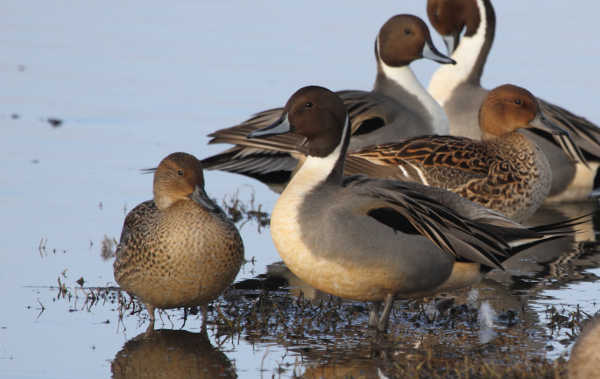
Pintail limit for next season
Question: I have heard the pintail limit for this upcoming season (2020-21) will be one per day. Is this true? Is it possible we could have a two pintail limit? (Rob)
Answer: The 2020-21 waterfowl hunting season regulations were adopted at the April Fish and Game Commission meeting.
States must set their waterfowl hunting regulations within the federal frameworks. These frameworks describe the earliest dates that waterfowl hunting seasons may open, the maximum number of days hunting can occur, the latest dates that hunting seasons must close and the maximum daily bag limit.
The frameworks for the 2020-21 season only allow for a pintail daily bag limit of one.
Pintail bag limits are determined by the pintail harvest strategy – mathematical models that predict the most appropriate bag limit to ensure the pintail population is sustainable into the future while providing hunting opportunity.
The current strategy does allow for a two-bird daily bag limit, but current data, including the 2019 population estimate, mandate that the bag limit remain at one per day for the 2020-21 season. The pintail population has declined every year since 2011.
Shed hunting
Question: Is shed hunting allowed in California? If I am hiking, scouting or hunting during an open season, am I allowed to pick up and take antlers or skulls found on state or federal lands? If I'm on a friend's private property, can I take antlers or skulls? (Jeremiah)
Answer: Shed hunting is a great way to get out and observe wildlife in the off season. It can also provide insight into the number and size of bucks/bulls that survived winter and may be around for next hunting season. Unfortunately, your options for shed hunting in California are somewhat limited.
The collection of sheds on California Department of Fish and Wildlife lands is prohibited.
This includes state wildlife areas, ecological reserves and other types of land managed by CDFW. California Code of Regulations (CCR) Title 14, section 550(g) states that "except for the take of fish or wildlife in compliance with general and site-specific hunting and fishing regulations ... no visitor shall take any entire or parts of plants, animals or minerals from department lands."
However, you can pick up deer and elk sheds from some public lands not managed by CDFW (please check with the managing agency for the property you are planning to visit).
You can collect sheds on private property if you have written permission to be there. Shed hunting is generally allowed on National Forest Service and Bureau of Land Management land.
For regulations on selling sheds, please see Fish and Game Code, section 3039(c).
Lingcod limits?
Question: Do lingcod count toward the 10-fish limit for rockfish? (Anonymous)
Answer: No. The lingcod bag limit is two fish of at least 22 inches total length. The rockfish bag limit falls within an aggregate bag limit called the RGC Complex that includes rockfish, greenling and cabezon.
Generally speaking, when fishing in the ocean you may take no more than 20 finfish, with no more than 10 of a single species, per CCR Title 14, section 27.60. There are a number of laws that aggregate several species into a limit such as the RGC Complex limit of 10.
Within the RGC Complex, there are smaller limits sometimes referred to as sublimits, and there are three protected rockfish species that cannot be taken: cowcod, yelloweye rockfish and bronzespotted rockfish. Sublimits include only three canary rockfish and only four black rockfish within the 10 total RGC Complex allowed daily.
Although no rockfish have a size limit, the cabezon has a three fish sublimit and must be 15 inches long and greenling must be 12 inches long.
What to do with a gopher snake?
Question: Is it legal to kill a gopher snake in California? Is it legal to take a gopher snake from the wild and keep it as a pet? I have a neighbor who has one on his property and does not want it there. If he can capture it, he's either going to kill it or give it away. (Sharla)
Answer: A valid sport fishing license is required to capture or kill gopher snakes in California, per CCR Title 14, section 5.60. The bag limit is four and the possession limit is four. Gopher snakes can be taken by hand, lizard noose, tongs or a snake stick, year-round.
A gopher snake caught in the wild can be kept as a pet, but once it's been in captivity, you can't release it back into the wild without authorization from CDFW (CCR Title 14, section 40).
Wild gopher snakes also can't be sold, although they can be bred with a Native Reptile Captive Propagation Permit, and any offspring born in captivity can be sold to people and pet stores to be kept as pets (CCR Title 14, section 43).
If you have a question for the California Department of Fish and Wildlife, email
- Details
- Written by: Lake County News Reports
“We continue to recommend that you recreate close to home,” said Mendocino National Forest Supervisor Ann Carlson. “All visitors should practice self-sufficiency during their visit to the Mendocino National Forest. Recreating responsibly will help ensure that expanded access to recreational facilities, services, and opportunities continues. All services may not be available, so please plan accordingly.”
While recreating on the Mendocino National Forest remember to maintain at least six feet from others, avoid gathering in groups, pack out your trash, and bring your own water, soap, sanitizer and toilet paper.
Please check the forest website and social media pages for the most up-to-date information on what is open so that you can plan your visit.
You can call the Supervisor’s Office at 530-934-3316 during regular business hours Monday to Friday, 8 a.m. to 4:30 p.m.
Forest Order No. 08-20-07 is available on the forest website.
The following sites remain closed under Forest Order No. 08-20-07:
– Sycamore Grove Campground;
– Camp Discovery Group Camp;
– Masterson Group Camp;
– Bear Creek Campground;
– Fuller Grove Campground;
– Navy Campground;
– Oak Flat Campground;
– Pogie Point Campground;
– Sunset Campground.
In addition, the following remain closed by the Ranch Fire, Forest Order No. 08-20-02:
– Cedar Camp;
– Dixie Glade;
– Main Letts Lake;
– Saddle Camp loop;
– Spillway;
– Stirrup;
– Big Springs;
– Summit Springs Trailhead;
– OHV trails on Upper Lake Ranger District.
For more information, visit the Mendocino National Forest website, Facebook page and on Twitter.
- Details
- Written by: California Fish and Wildlife News
Hosting some 80,000 visitors each year, Gray Lodge is one of the most heavily visited and used wildlife areas in the state, and construction work will restrict some public access over the next several months.
Work is scheduled to begin the week of June 15, 2020, on the auto tour loop on the west side of the wildlife area near Parking Lot 14.
The auto tour loop and some nearby hiking trails will be closed during this construction period, which is expected to conclude around the first week in October, reopening in time for bird watching during peak fall and winter migrations.
Crews will regrade the steep slopes on the auto tour roadway to improve safety and add additional turnouts for wildlife viewing and passing. The pond bottoms along the auto tour loop will be reshaped to improve water movement and habitat management. The work is being funded through a $1.4 million grant from the state Wildlife Conservation Board.
Over this same period, crews will also construct a mobility-impaired fishing pier on the pond adjacent to Parking Lot 14 thanks to another $310,000 Wildlife Conservation Board grant.
The pier will provide fishing access to the public throughout the spring and summer months when the wildlife area is open to fishing.
For questions or additional information, please contact Gray Lodge directly at 530-846-7500.
CDFW reminds Californians to abide by all state and local health guidelines regarding non-essential travel and physical distancing.
- Details
- Written by: California Department of Fish and Wildlife
This is not a special hunt, but rather a drawing to control the number of hunters on popular public land during opening weekend.
Locations for this hunt include Upper and Lower Cottonwood Creek and the San Luis Reservoir wildlife areas.
Reservations are required to access the wildlife areas during opening weekend and only 30 permits will be issued for each day, Saturday, Aug. 8, and Sunday, Aug. 9.
Hunters can download the application online at www.wildlife.ca.gov/lands/places-to-visit/cottonwood-creek-wa .
Hunters can also request an access permit application by calling CDFW’s Los Banos office at 209-826-0463 between 8 a.m. and 4 p.m.
Applications may be submitted via email to
Only official applications will be accepted and must be received before 4 p.m. on July 3.
Reservations will be selected by a computerized drawing at 11 a.m. on July 6. The drawing will be open to the public. Successful applicants will be notified by mail within five working days of the drawing. Results will not be given over the phone.
Up to three people may apply for the hunt as one party by including all required information on the 2020 Zone A application form. Junior license holders who are 12 years of age or older may also apply if accompanied by an adult hunter.
Applicants may apply for a one-day hunt on one area only. An individual’s name may appear in the drawing only once and additional or duplicate applications will be disqualified from the drawing.
All hunters are required to use non-lead ammunition when hunting with a firearm anywhere in California.