
Recreation
Corvina in the Salton Sea?
Question: I was under the assumption that there are no longer corvina in the Salton Sea. Opening weekend of duck season, I caught a small corvina stuck in the shallows around my duck blind. Are they making a comeback? (Robert)
Answer: The last time corvina was observed in the Salton Sea was in the spring of 2003 during a routine gill netting operation conducted by the California Department of Fish and Wildlife (CDFW). What you saw was very likely a tilapia, which looks very similar to a small corvina. Both have elongated bodies and a dorsal fin that spans the length of the body.
Corvina, croaker and sargo were successfully introduced into the Salton Sea between 1950 and 1956. These planted fish produced successful populations and supported a vibrant recreational fishing industry for several decades. Their demise likely came from a combination of poor water quality characteristics, such as high salinity coupled with high temperatures and low oxygen concentrations. Once corvina, croaker and sargo were no longer in the Salton Sea, the tilapia population took off as they were released from predation and competition pressures. But they overshot the sea’s carrying capacity, which led to historic die-offs in the 2010s.
Declining water quality has contributed to die-offs of tilapia and other remaining Salton Sea fishes, such as sailfin molly and the desert pupfish. Currently, the Salton Sea supports a small population of reproducing tilapia that tolerates these poor conditions, but it’s hard to determine how long the population will be sustained.
Foraging in tidepools?
Question: I would like to know if foraging in tidepools, specifically in the Bay Area and surrounding coastal counties, is legal. I’d like to forage for invertebrates – mussels, goose neck barnacles and the like. Do I need a special fishing license to harvest? (Jerry)
Answer: There is a specific list of “tidepool” or “tidal” invertebrates that can be taken between the high tide mark and 1000 feet seaward. This list is described in California Code of Regulations (CCR) Title 14, section 29.05(b)(1). Animals that are not included on this list — including barnacles — may not be harvested.
In order to forage for any of the invertebrates on this list, you will need a fishing license, and you may need a measuring device if the species you’re after has a size limit (see CCR Title 14, section 29.05(c)).
Be aware that there are additional regulations that apply in specific foraging areas. Most notably, the take of invertebrates is prohibited in state marine reserves and may be prohibited in areas described in CCR Title 14, section 632(b).
Importing stingrays?
Question: My company imports tropical fish. I have a client who wants me to sell freshwater stingray from South America. I would like to know if the State of California has any prohibition on these fish. (Jonas)
Answer: California’s restricted species laws and regulations are very clear. According to the CCR Title 14, section 671, it is unlawful to import, transport or possess certain live animals not normally domesticated in this state without a permit from CDFW. Cartilaginous fishes in class Elasmobranchiomorphi, family Potamotrygonidae (river stingrays) are specifically listed in section 671, (c)(6)(B), with a note that the Fish and Game Commission has deemed them to be potentially detrimental to native wildlife, the agriculture interests of the state, or to public health and safety.
Individuals and organizations that meet certain specified conditions (the animal is for public exhibition or research, for instance) may apply for a restricted species permit, but importing stingrays for sale to private collectors would not be allowed.
Night driving with flashlights
Question: My wife and I are outdoors lovers and we don’t want to break the law. We often drive back roads or dirt roads in and around Butte County armed with only a flashlight and no weapons to view and enjoy wildlife that wouldn’t be possible to enjoy in the daylight. Is this legal? (Dan)
Answer: Yes, as long as you do not have a method of take (weapon intended for hunting) with you. You may, however, attract the attention of wildlife officers that are on the lookout for poachers using spotlights to find game. These officers may pull you over and detain you to inspect your vehicle to ensure you do not have a method of take. There are also some vehicle code provisions that prohibit the use of a flashlight or headlight on a public highway if it is shone into oncoming traffic or prevents other vehicles from seeing traffic control devices.
Shooting a white tail?
Question: If white-tailed deer were to migrate into California from Oregon or Idaho, could they be shot here on sight since there is no season or provision for that species? (Scott H.)
Answer: No. Since Fish and Game Code, section 3950(a) defines deer as genus Odocoileus, which includes white-tailed deer, white-tailed deer can only be taken under the normal deer hunting provisions for the area in which it wandered.
If you have a question for the California Department of Fish and Wildlife, emailThis email address is being protected from spambots. You need JavaScript enabled to view it. . While they cannot answer every question, they will answer a few in each column.
Question: I was under the assumption that there are no longer corvina in the Salton Sea. Opening weekend of duck season, I caught a small corvina stuck in the shallows around my duck blind. Are they making a comeback? (Robert)
Answer: The last time corvina was observed in the Salton Sea was in the spring of 2003 during a routine gill netting operation conducted by the California Department of Fish and Wildlife (CDFW). What you saw was very likely a tilapia, which looks very similar to a small corvina. Both have elongated bodies and a dorsal fin that spans the length of the body.
Corvina, croaker and sargo were successfully introduced into the Salton Sea between 1950 and 1956. These planted fish produced successful populations and supported a vibrant recreational fishing industry for several decades. Their demise likely came from a combination of poor water quality characteristics, such as high salinity coupled with high temperatures and low oxygen concentrations. Once corvina, croaker and sargo were no longer in the Salton Sea, the tilapia population took off as they were released from predation and competition pressures. But they overshot the sea’s carrying capacity, which led to historic die-offs in the 2010s.
Declining water quality has contributed to die-offs of tilapia and other remaining Salton Sea fishes, such as sailfin molly and the desert pupfish. Currently, the Salton Sea supports a small population of reproducing tilapia that tolerates these poor conditions, but it’s hard to determine how long the population will be sustained.
Foraging in tidepools?
Question: I would like to know if foraging in tidepools, specifically in the Bay Area and surrounding coastal counties, is legal. I’d like to forage for invertebrates – mussels, goose neck barnacles and the like. Do I need a special fishing license to harvest? (Jerry)
Answer: There is a specific list of “tidepool” or “tidal” invertebrates that can be taken between the high tide mark and 1000 feet seaward. This list is described in California Code of Regulations (CCR) Title 14, section 29.05(b)(1). Animals that are not included on this list — including barnacles — may not be harvested.
In order to forage for any of the invertebrates on this list, you will need a fishing license, and you may need a measuring device if the species you’re after has a size limit (see CCR Title 14, section 29.05(c)).
Be aware that there are additional regulations that apply in specific foraging areas. Most notably, the take of invertebrates is prohibited in state marine reserves and may be prohibited in areas described in CCR Title 14, section 632(b).
Importing stingrays?
Question: My company imports tropical fish. I have a client who wants me to sell freshwater stingray from South America. I would like to know if the State of California has any prohibition on these fish. (Jonas)
Answer: California’s restricted species laws and regulations are very clear. According to the CCR Title 14, section 671, it is unlawful to import, transport or possess certain live animals not normally domesticated in this state without a permit from CDFW. Cartilaginous fishes in class Elasmobranchiomorphi, family Potamotrygonidae (river stingrays) are specifically listed in section 671, (c)(6)(B), with a note that the Fish and Game Commission has deemed them to be potentially detrimental to native wildlife, the agriculture interests of the state, or to public health and safety.
Individuals and organizations that meet certain specified conditions (the animal is for public exhibition or research, for instance) may apply for a restricted species permit, but importing stingrays for sale to private collectors would not be allowed.
Night driving with flashlights
Question: My wife and I are outdoors lovers and we don’t want to break the law. We often drive back roads or dirt roads in and around Butte County armed with only a flashlight and no weapons to view and enjoy wildlife that wouldn’t be possible to enjoy in the daylight. Is this legal? (Dan)
Answer: Yes, as long as you do not have a method of take (weapon intended for hunting) with you. You may, however, attract the attention of wildlife officers that are on the lookout for poachers using spotlights to find game. These officers may pull you over and detain you to inspect your vehicle to ensure you do not have a method of take. There are also some vehicle code provisions that prohibit the use of a flashlight or headlight on a public highway if it is shone into oncoming traffic or prevents other vehicles from seeing traffic control devices.
Shooting a white tail?
Question: If white-tailed deer were to migrate into California from Oregon or Idaho, could they be shot here on sight since there is no season or provision for that species? (Scott H.)
Answer: No. Since Fish and Game Code, section 3950(a) defines deer as genus Odocoileus, which includes white-tailed deer, white-tailed deer can only be taken under the normal deer hunting provisions for the area in which it wandered.
If you have a question for the California Department of Fish and Wildlife, email
- Details
- Written by: California Department of Fish and Wildlife

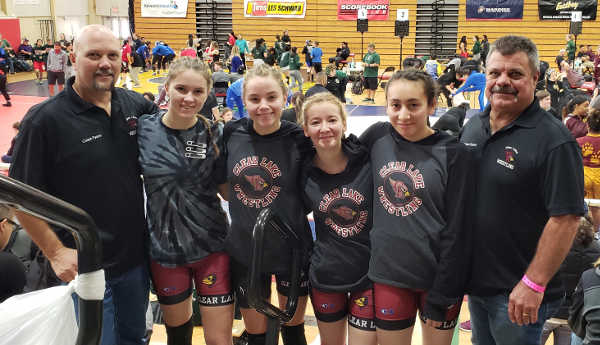
UNION CITY AND ALBANY, Calif. – On Friday, Feb. 21, and Saturday, Feb. 22, the Clear Lake Cardinals ended up qualifying 12 wrestlers to compete at the North Coast Section Championships.
The 12 qualifying wrestlers included eight boys, among them two alternates, and four girls.
In the end, two Cardinals wrestlers would make the second day, Elijah Alvarez (138 lbs.) for the boys and Mavis Pyorre (116 lbs.) for the girls.
Alvarez, a sophomore, was 3-2 with two pins against opponents from Las Lomas, Eureka and an injury default from California. His only losses were against the fourth-place medalist from Casa Grande and the eighth-place medalist from Petaluma.
Pyorre, a senior, went 2-2. Her wins included beating the fifth-seeded wrestler from Newark Memorial and a strong wrestler from Fortuna. Her losses were close battles against the eventual silver medalist from Castro Valley, along with another top 12 wrestler from Heritage (Brentwood).
Three Cardinal wrestlers finished 1-2: Ashley Pyorre (106 lbs.) for the girls, and Mohammad Akbari (120 lbs.) along with Hayden Fowler (132 lbs.) for the boys.
Freshman Ashley Pyorre pinned her first opponent from San Leandro and had hard-fought losses against the eventual silver medalist from James Logan, along with a top 12 wrestler from Benicia.
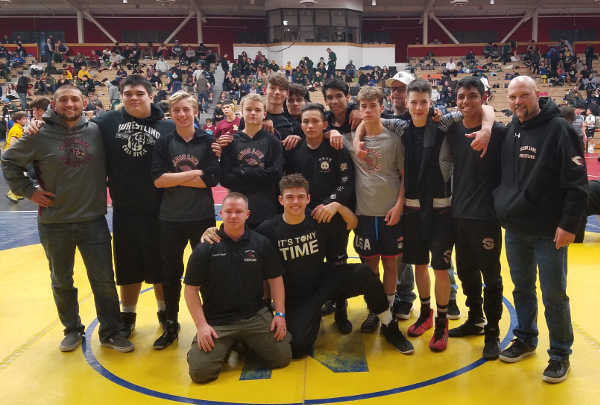
Sophomore Mohammad Akbari lost his first match to the eventual silver medalist from Heritage then pinned his opponent from Pittsburg and lost to an Amador Valley opponent.
Freshman Hayden Fowler won his first match against an opponent from Elsie Allen, then lost to a top 12 finisher from Newark Memorial and an opponent from San Ramon.
Also wrestling some close hard fought matches for the cardinals but going two and out was:
For the boys, Freshmen Nathan “Bubba” Pyorre (106 lbs.), also was battling that nasty cold but still showed up and gave it his all, coming up two points shy of moving on.
Vicente Ortega (152 lbs.), giving up almost 14 pounds to his competitors, fought valiantly and Anthony Gersalia (170 lbs.) came out strong but fell to the eventual fourth-place medalist, along with alternate’s freshman Asher Reese (113 lbs.) who battled to the end of each match. Senior Dominic Legendre (285 lbs.) had two close points matches that could have gone either way.
For the girls, it was Sophomore Tara Wong (101 lbs.) who dominated her Fort Bragg opponent until getting caught right at the end of the match. Her other loss was to the seventh-place medalist.
Junior Ximena Soto (121 lbs.) went out scrapping and gave her opponents a run, but fell to the eventual sixth-place medalist and a top 12 finisher.
“It was great watching this young team have so much success, with the challenges they each faced on and off the mat. Keep up the hard work – do great things!” said Coach Rick Pyorre.
- Details
- Written by: Lake County News Reports





 How to resolve AdBlock issue?