 How to resolve AdBlock issue?
Recreation
- Details
- Written by: Lake County Public Services
Pool hours are as follows:
Saturday, Aug. 24: Noon to 5 p.m.
Sunday, Aug. 25: Noon to 5 p.m.
Thursday, Aug. 29: Noon to 5 p.m.
Friday, Aug. 30: Noon to 5 p.m.
Saturday, Aug. 31: Noon to 5 p.m.
Sunday, Sept. 1: Noon to 5 p.m.
Monday, Sept. 2: Noon to 5 p.m.
For more information, please contact the Public Services Department Monday through Thursday from 8 a.m. to 5 p.m. at 707-262-1618.
- Details
- Written by: Clear Lake State Park
Angelo promises there will be “scientific silliness for the whole family.”
The hour-long program will be held at the Education Pavilion at Clear Lake State Park.
Visitors are encouraged to bring their own lawn chairs and maybe even some bug spray if desired.
Rain will cancel the program.
Clear Lake State Park is located at 5300 Soda Bay Road in Kelseyville. Admission to the park is free to those attending the program.
Anyone having special needs should contact Clear Lake State Park staff Monday through Friday at 707-279-4293.
For further information on California State Parks go to www.parks.ca.gov .
- Details
- Written by: California Department of Fish and Wildlife
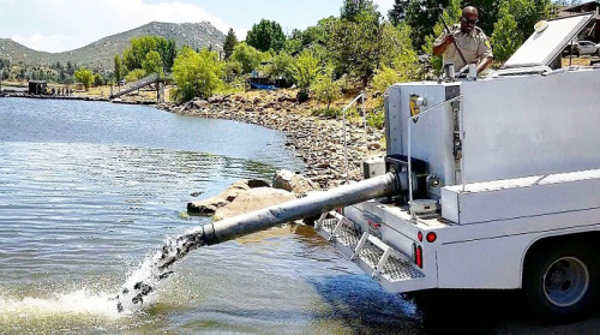
Why aren't all fish plants listed in the fishing guide?
Question: I read your recent news release about stocking salmon into California reservoirs. It states that Kokanee were released into New Melones Reservoir. However, I never see salmon plants on the California Department of Fish and Wildlife (CDFW) online Fishing Guide. Can you tell me why the salmon plants aren't on there? (Zach K.)
Answer: That's a great question. Inland salmon (Kokanee and Chinook) are released as "fingerling" size fish into productive lakes and reservoirs that promote their growth and contribution to recreational fisheries.
We don't advertise these "put and grow" stocking events on our website, since it might mislead anglers to believe that a fishery is ready for recreational angling – which it may be (from prior years of fingerling stocking), or may not be; if fish were not released in previous years.
Fingerling stocking for put and grow fisheries for both inland salmon and trout may occur every year, every other year, or have gaps in years, depending on water conditions and availability of fish.
The current year fish stocking plans on our website do include inland salmon (both Kokanee and Chinook) and other put and grow fisheries. And our map-based Fishing Guide on our website also lists lakes with inland salmon fisheries.
Why plant sterile fish?
Question: I have heard that most fishes (trout) being planted these days are non-breeders. Is this true? Why would you not want these fish to be self-sustaining? I am particularly interested in Spicer Meadow Reservoir. Does this lake get planted? (James R.)
Answer: CDFW hatcheries stock both fertile and sterile fish for recreational angling in order to be in compliance with environmental regulations and best ecological principles.
Before stocking a water body, CDFW goes through an extensive pre-stocking evaluation in which our fisheries biologists use current and historical data to evaluate the potential for our stocked fish to impact state or federally listed species.
This pre-stocking evaluation is done as part of the Environmental Impact Statement and Environmental Impact Review preparation process, which is required in order to comply with the federal and state Endangered Species Acts.
Pre-stocking evaluations must be done at least every five years for each of the more than 850 waters that CDFW stocks for inland recreational fisheries.
If, during the evaluation process, our biologists determine there could be potential for our stocked fish to breed with a listed species (thus potentially impacting the genetic makeup of those fish), we can circumvent that potential impact by stocking sterile (triploid) fish.
Let's say, for example, that in one of our Central Valley rim dam reservoirs (such as Oroville), a domesticated, stocked strain of rainbow trout got through or over the dam. It could potentially breed with threatened Central Valley steelhead.
We acknowledge this possibility, so when stocking these waters, we use triploid fish that don't have the ability to reproduce. It is important to note that triploid fish are not genetically modified organisms; triploidy simply results in an organism that cannot reproduce. Bananas and seedless watermelons are other examples of triploidy.
On the other end of the spectrum, there are examples such as Eagle Lake trout that are stocked back into Eagle Lake, or Golden trout, Lahontan Cutthroat trout, Red Bands and other fish native to California that are stocked into waters that are within their native range. These fish are planted as diploids – which can reproduce because there is no threat or impact to listed or native fish assemblages if they reproduce.
Spicer Meadows Reservoir does get planted with diploid Eagle Lake trout. It was determined through the pre-stocking evaluation process that stocking fish with the ability to reproduce would not cause any impacts to listed or other native fish in the reservoir.
Planting Kokanee and Coho?
Question: When I was young, I remember Kokanee being planted in Lake Arrowhead, and Coho in Big Bear Lake. This all ended a few decades ago. Can you tell me why this happened and if there is a chance it could ever occur again in the near future? (Gabe P.)
Answer: CDFW no longer plants Lake Arrowhead with any fish because Lake Arrowhead is a private lake. Access and use of the lake is restricted to homeowners who belong to the Arrowhead Lake Association.
CDFW no longer stocks any lake or reservoir with Coho salmon because they are listed as either threatened or endangered on the federal and state endangered species lists. Commercial sources of a semi-domesticated strain of Coho from captive populations are available but often have a bacterial pathogen detrimental to trout and salmon and prohibited for importation into California.
Inland salmon fisheries for recreational angling are provided by strains of Chinook salmon native to California, and Kokanee salmon, which are the landlocked version of Sockeye salmon native to the Pacific Northwest.
If you have a question for the California Department of Fish and Wildlife, email
- Details
- Written by: Nadine Strauss

ROSEBURG, Oregon – The North State Modified Series, or NSMS, presented by Protect the Harvest, will be venturing out-of-state for the first time in its six-year history to be a part of the annual West Coast Modified Shootout at Douglas County Speedway in Roseburg, Oregon on Saturday, Aug. 24.
The event will feature a 75-lap feature race that pays $2,000 to the winner and $200 to take the green flag.
In addition to the $2000 prize money, the winner will be presented with a 3-foot tall hand-carved eagle trophy, courtesy of Mort Houston.
Also on the modified racing card will be the Lucas Oil Dash for Cash. The race is sanctioned by and will be officiated by NSMS.
“There will be over $15,000 in cash and prizes given to the modified drivers,” said representatives from the Pacific Racing Association, the organization that promotes the speedway. “We are very excited! Plus we should have around 100 bags of school supplies to hand out to kids attending thanks to our racers, sponsors, and good hearted people who have donated for this.”
The event is open to any legal North State Modified, Lucas Oil Modified, Inter-Mountain Modified or PRA Sports Modified. The cars will all be running Hoosier 970 tires.
The top 15 in NSMS points will receive Lucas Oil tow money, and any driver towing 100 miles or more will get a $100 PRA tow bonus.
There will be a Friday practice and social beginning at 3 p.m. Gates open at 10 a.m. on Saturday and racing begins at 6 p.m. Douglas County Speedway is a four-tenths of a mile paved oval located at the Douglas County Fairgrounds, I-5 exit 123.