 How to resolve AdBlock issue?
Recreation
- Details
- Written by: California Department of Fish and Wildlife
CDFW's Iron Gate Hatchery along the Klamath River, the Klamathon Road fishing access below Iron Gate Hatchery, and the Horseshoe Ranch Wildlife Area north of Yreka between Interstate 5 and Iron Gate Reservoir have been closed to protect public safety.
Although closed to the public, CDFW's Iron Gate Hatchery remains staffed and operational for the time being.
Due to the uncertain nature of the fire it is unknown when these areas and facilities will reopen to the public.
To monitor the status of the Klamathon Fire, please visit http://cdfdata.fire.ca.gov/incidents/.
- Details
- Written by: California Department of Fish and Wildlife
With the cooperation of the Pacific States Marine Fisheries Commission, the E-tix application has been adapted to allow electronic reporting of all California landing records.
Since 1933, CDFW has relied on paper landing receipts that over the years expanded to 16 different paper forms.
CDFW staff have been responsible for manually entering the data and managing it in data systems that have evolved over the decades.
Using E-Tix allows fish receivers to record both federal and state fisheries landings through one application.
Electronic reporting using E-tix has been required for all federal sablefish landings since 2017 and Individual Fishery Quota trawl fisheries landings since 2011.
Between November 2016 and October 2017, CDFW worked with fish businesses and the California Fish and Game Commission to propose and adopt electronic reporting regulations.
The regulations allow for voluntary use of the E-tix system to report landings during a one-year transition period, allowing fish receivers to adapt business practices from the old paper system to E-tix.
Approximately 74 percent of respondents to a December 2016 survey said one year or less was adequate for this transition.
Effective July 1, 2019 all commercial fishery landings must be recorded and submitted electronically using E-Tix (California Code of Regulations Title 14, section 197).
In addition, CDFW's Data and Technology Division is in the process of replacing the outdated Commercial Fisheries Information System to house and manage the landings data with a new, modern Marine Landings Data System.
All data submitted using the Pacific States Marine Fisheries Commission’s E-Tix will be automatically transferred to CDFW's Marine Landings Data System nightly.
CDFW encourages all fish receivers and fishermen with a fishermen's retail license to begin using E-Tix well in advance of the mandatory electronic reporting date of July 1, 2019.
The E-Tix Login can be found at https://etix.psmfc.org/Account/Login. Resources to assist in this transition are available at www.wildlife.ca.gov/Fishing/Commercial/Landing-Resources.
- Details
- Written by: BoatUS
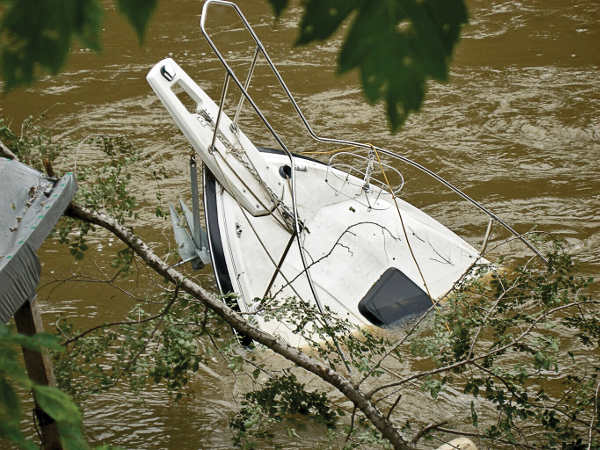
For the majority of recreational boaters, a boat insurance claim won’t be in their future this summer – but you can never predict when something will happen.
Is your boat insurance policy up to snuff? With the boating season just begun, Boat Owners Association of The United States (BoatUS) suggests boaters do a quick “checkup” on their boat’s insurance policy to ensure they have three important coverages.
1. Consequential damage coverage: Big, bad things like sinkings, often happen to boats as a result of some small part below the waterline failing. Think cracked rubber outdrive bellows or broken thru-hulls. Check your policy now to ensure it includes consequential damage coverage that pays for losses that often begin with a failed part that may be excluded under the policy. This means the leaky rubber outdrive bellows or broken thru-hull itself may not be covered, but with consequential damage coverage, the rest of the repairs or total loss – your sunken boat – will be (up to the limits you have selected). One caveat: This consequential damage coverage often applies only to major or total losses. It’s typical, for example, to cover the immediate consequential damage resulting from any sinking, fire, explosion, demasting, collision or stranding.
2. Salvage coverage: A windstorm collapses your marina’s shed roof onto your boat. You run hard aground and damage the running gear. You are now in a salvage situation: The boat is not a total loss and needs to be recovered and brought to a repair facility. Most boaters assume the cost of removing the boat to a safe location is covered by their insurance policy, but some policies will first subtract salvage costs from the insured value of the boat, reducing the funds available to repair the boat, or the amount paid to the boater in the event of a total loss. Or worse yet, some policies pay only a small percentage of that insured value – perhaps just 5 to 10 percent – to pay for salvage costs, again forcing you to pay more out of pocket. Make sure your policy has salvage coverage that is separate but equal to the limit of your boat’s hull-value coverage. For example, a boat with an agreed value of $40,000 should have another separate $40,000 available just for salvage expenses.
3. Hurricane haulout coverage: For boats in hurricane zones, hurricane haulout coverage is a must. This coverage helps a boat owner make the decision to haul his or her boat before the storm as it helps pay a portion of the labor costs to have a boat hauled, prepared and tied-down by professionals, or moved by a licensed captain. While hauling out in preparation for a storm costs the boater some money, it’s potentially far less than if the boat sustained damage or became a total loss. The BoatUS Marine Insurance Program pays 50 percent of the cost of labor, up to $1,000, to have the boat hauled or moved to the safety of a hurricane hole, and the haulout does not penalize the policyholder.
If your marine insurer can’t help you with these coverages, the experts at BoatUS can. Get a free quote at www.BoatUS.com/Insurance or call 800-283-2883.
- Details
- Written by: California Department of Fish and Wildlife
The Knoxville-Berryessa Road, which runs through the wildlife area, is currently closed.
Due to the uncertain nature of the fire it is unknown when the wildlife area will reopen.
A followup press release will be issued regarding the reopening of the wildlife area when ground conditions warrant.
To monitor the status of the County fire, please visit www.fire.ca.gov/current_incidents.