 How to resolve AdBlock issue?
Recreation
- Details
- Written by: California Department of Fish and Wildlife
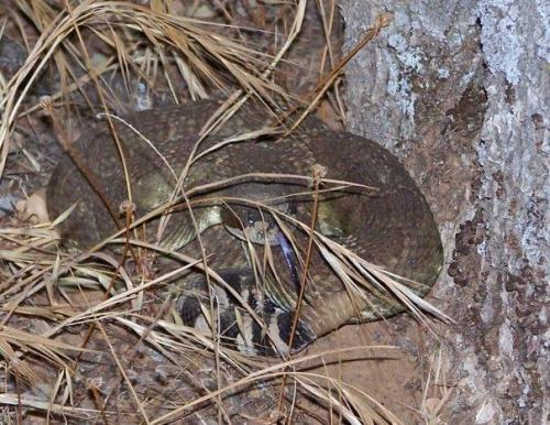
What can I do about rattlesnakes?
Question: The late spring and early summer always seem to bring out rattlesnakes on my property. I have two dogs and I am worried about them and myself. I have heard you need a fishing license to kill one, even if it is on your own property. Is that true? (Linda)
Answer: Spring and summer are peak seasons for rattlesnake activity.
Like all reptiles, rattlesnakes are ectothermic ("cold blooded") and cannot regulate their internal body temperature, making them sensitive to outside temperatures.
To protect themselves from the cold, they often hibernate in the winter and emerge in the spring to eat and warm themselves.
When the weather warms up, they are also susceptible to overheating. As a result they are most active at dawn and dusk, even night during the hottest part of the summer.
During the day, they will take refuge in burrows and rocky crevices or any suitable cover they can find to protect themselves from the heat.
You do not need a fishing license to "take" rattlesnakes in California (Fish and Game Code, section 7149.3). For most other reptiles, as well as amphibians, a fishing license is required for individuals 16 years of age or older. FGC, section 86 defines "take" as hunt, pursue, catch, capture or kill, or attempt to hunt, pursue, capture or kill.
Although rattlesnakes may be killed without a license, other approaches may be better. In some cases, conservation status of the species could be an issue (for example, the red diamond rattlesnake is a species of special concern in California).
And frequently, killing a single snake is a short-term solution. Prevention and awareness are much more effective. Keeping tall grass mowed and brush piles removed will help keep rattlesnakes from getting too close to your home. Close off access points into your garage and home. Consider rattlesnake-proof fencing.
Precautions should also be taken when walking about in rattlesnake habitat. Wear closed-toe shoes or boots and long pants. Know that snakes are active at night during summer hunting rodents. Teach children to leave snakes alone.
Rattlesnakes are normally not aggressive unless provoked and are an important part of a healthy ecosystem. However, all rattlesnakes are venomous and bites can be potentially dangerous (in some cases, fatal) to humans and pets.
For this reason, we emphasize caution, but keep in mind that most rattlesnake bites occur when snakes are being threatened or people are attempting to handle them.
Rattlesnakes will display a series of warning behaviors such as crawling away, coiling and using rattling sounds. Biting is typically a last resort or in quick defense.
Off-leash dogs roaming in rattlesnake habitat are at risk, as they can roust up a snake while exploring smells, holding their nose to the ground.
Bites on the leg can result when a dog inadvertently brushes a snake – the same can happen to unsuspecting people walking through fields and grasslands. We recommend speaking to a veterinarian about whether a rattlesnake vaccine is an option for your dog.
If you see a rattlesnake in its natural habitat, give it a wide berth and it will usually crawl away or try to hide. If you find it necessary to remove a rattlesnake from your home or property, you may want to seek the assistance of a private wildlife service. People can easily get bitten trying to kill or remove a rattlesnake on their own.
More information about living with rattlesnakes can be found on the California Department of Fish and Wildlife Web site, and information about snakebite first aid can be found on the California Poison Control System Web site.
Education opportunities for a longtime hunter
Question: Does CDFW still offer classes for experienced hunters? I've had my license for years, so I'm not looking for the basic hunter ed stuff. (Chris)
Answer: Yes! There are opportunities around the state.
The CDFW Law Enforcement Division's Advanced Hunter Education Program has upcoming classes listed online, including Hunting with Air Guns (Los Angeles County), Basic Game Processing (Santa Clara County), Waterfowl Hunting (Solano County and Butte County) and Upland Game Hunting (Los Angeles County).
These are great opportunities for experienced hunters to explore hunting a new species or to brush up on technique. New classes are added all the time, so we encourage you to keep checking the Advanced Hunter Education webpage.
If you have a question for the California Department of Fish and Wildlife, email
- Details
- Written by: California Department of Fish and Wildlife
The special dove hunting opportunities will take place at the Cosumnes River Preserve in Sacramento County, the China Island and Salt Slough units of the North Grasslands Wildlife Area in Merced County, the Los Banos Wildlife Area in Merced County, the Pilibos Wildlife Area in Fresno County, the Carrizo Plains Ecological Reserve in San Luis Obispo County and the Oak Grove Unit of the San Felipe Valley Wildlife Area in San Diego County.
Other dove hunting opportunities are also available on CDFW wildlife areas without reservations.
The special dove hunt descriptions and application instructions are available at CDFW's Upland Game Wild Bird Hunts Web page. Hunters need to apply through the Automated License Data System for these opportunities as well as other special wild upland bird hunts for quail, chukar, pheasant and turkey as they become available later in the fall.
A non-refundable $2.42 fee will be charged for each application. Hunters may select their top three hunt choices per application and may apply in parties. Hunters may only apply once for each available hunt date. Duplicate entries will be disqualified.
Applications may be purchased online, at CDFW license sales offices, at retail license agents or by phone at 800-565-1458.
All hunters must abide by California's nonlead ammunition regulations. Currently, nonlead ammunition is required when hunting doves on any CDFW wildlife area or ecological reserve, but is not required when hunting doves on private property or other public lands.
Starting on July 1, 2019, nonlead ammunition will be required when taking any wildlife with a firearm anywhere in California.
The purchase of an Upland Game Bird Stamp/Validation supports these special dove hunting opportunities. The stamp/validation is required for all upland game bird hunters except those with Junior Hunting Licenses.
- Details
- Written by: California Department of Fish and Wildlife
The portion of the Knoxville Wildlife Area west of the Berryessa-Knoxville Road has reopened to all authorized public use.
The portion of the Knoxville Wildlife Area east of the Berryessa-Knoxville Road will remain closed to public use due to the County fire, which has burned more than 6,000 acres of the wildlife area.
It is unknown when the eastern portion of the wildlife area will reopen to the public.
CDFW said the entire wildlife area is being evaluated to determine when and if additional closures or reopenings will occur.
That fire, which began on June 30, was fully contained on Saturday at 90,288 acres, according to Cal Fire.
- Details
- Written by: California Department of Fish and Wildlife
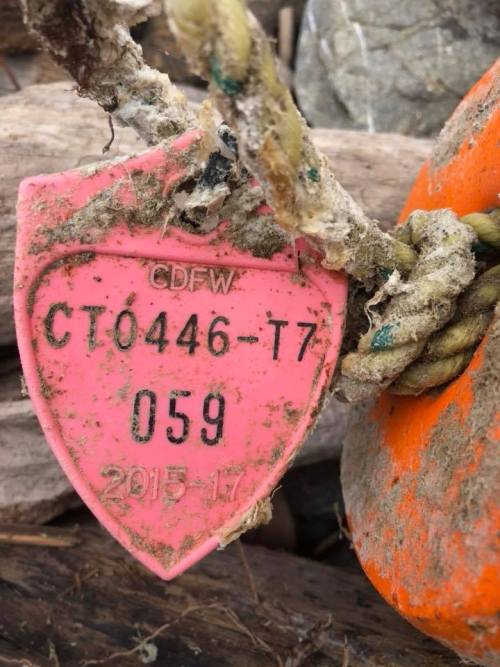
Mystery tag washed ashore
Question: My Boy Scout troop was recently hiking at Pirate's Cove in the Marin Headlands, and we found this tag washed ashore. We packed it out, but we're still wondering what it is. Do we need to return it to the department, or report that we found it? (Hunter Pinkstaff, Boy Scout Troop 227)
Answer: What you've found is a buoy tag issued by the California Department of Fish and Wildlife. Permit holders in the Dungeness crab commercial fishery use these tags to mark the buoy of each of their traps to show that they are fishing within their trap limits. The tags can be used for up to two seasons and mark the buoy of each of their Dungeness crab traps. Permit holders are issued the total number of tags that are in their trap limit tier, ranging from 175 to 500 traps.
When a tag expires at the end of the two seasons, the permit holder will purchase a whole new set of tags and switch out the expired tags for newly issued ones. Commercial fishermen are not required to return the expired tags at the end of the validation period.
Tags and fishing gear can get detached or dislodged from the trap for a variety of reasons, such as rough ocean conditions or vessel propellers. Since these are expired commercial tags and not research tags, there is no need to report your find to the department. But we appreciate and applaud your troop's efforts to keep the beaches clean of garbage and litter. We are glad to have the opportunity to solve your mystery!
Fishing with a youth angler
Question: My 15-year-old wants to go fishing. I want to take him, but I cannot afford a fishing license for myself. Do I have to have one for my boy to fish? (Traci)
Answer: We thank you for taking the time to take your son fishing. We think it is one of the best activities families can do together – it's great bonding time and generates lasting memories. Any child or young adult 15 years of age or younger does not need a fishing license to fish. All other regulations still apply, such as bag and possession limits. If fishing for sturgeon, abalone, lobster or steelhead (which all need additional report cards), then they will have to purchase those.
To answer your question, you may assist your son with things like setting up gear and teaching how to use the rod and reel but you must be careful to distinguish that you are not actively fishing by avoiding acts like reeling in fish (for that, you would need a fishing license yourself).
If you would like to try your hand at fishing alongside your son, you might consider a one-day sport fishing license, which is a less-expensive alternative to an annual license. A one-day license is $15.69, while an annual license is $48.34.
You could also take him to a public pier (where you would not need a license) or fish with him on one of CDFW's two Free Fishing Days (July 7 and Sept. 1 this year). Read more about this below. Enjoy your fishing trip and good luck to you and your son!
There's a typo on my license!
Question: The license agent who sold me my fishing license entered my birthday incorrectly. When I tried to correct him, he refused to change it, so now I'm stuck with a fishing license with the wrong birthday on it. What can I do? (Anonymous)
Answer: You shouldn't have any problem getting your license corrected if you go through a CDFW license sales office, and there is no charge to correct information. You can find a list of offices online. To fix an incorrect birthday, all you need is a state ID showing your birth date. Name changes require a marriage certificate or court documentation of the name change.
If you have a question for the California Department of Fish and Wildlife, email