
Recreation
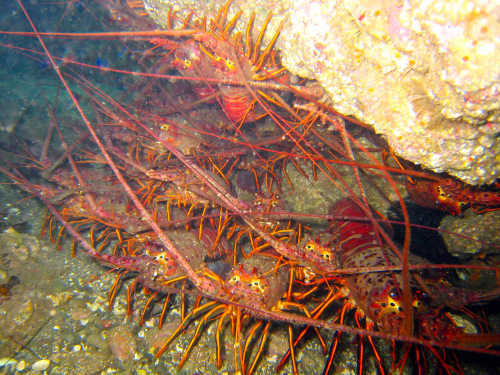
Question: I jumped on an open party lobster trip recently (their counts were high!). The crew members were measuring while all of us were watching up close.
The 3 ¼" tool would drop over the carapace and if fairly tight, they claimed it to be a "keeper."
When I politely asked them about this, they were adamant that these were legal bugs.
Can you please describe proper measuring at the edge of a lobster's carapace? Can the tool drop in over the carapace edge, and if it's tight, then it's a legal bug? (Jim Kelley)
Answer: The crew members were correct – an accurate measuring gauge should fit tightly in a straight line measurement on the lobster carapace from the rear edge of the eye socket to the rear edge of the body shell.
When the lobster gauge is placed on the carapace, there should be no space at all between the gauge and the carapace.
Please make sure the part of the gauge that is placed on the rear edge of the eye socket is on the hard part of the shell, not on the soft fleshy part where the eyes are.
If there is any gap at all between the lobster carapace and the gauge, no matter how small, the lobster is too short and a citation could be issued. See California Code of Regulations Title 14, section 29.90(c) for specific language.
Can I use my drone as a jig?
Question: I have a drone that is set up for fishing. I have a Cannon downrigger quick-release that I can attach to my drone. I would like to use my drone to troll or as a jig.
When the fish strikes, the line would be pulled free from the drone, and I would fight and retrieve the fish with my rod and reel. Is that legal? (James K.)
Answer: Under existing law, using a drone to jig tackle that remains connected to your rod and reel is not illegal so long as the drone is being legally flown in a legal area.
Recognizing that regulations on drones are becoming tighter, especially in sensitive areas, you need to be familiar with all local ordinances or special jurisdictions as well.
The U.S. Fish and Wildlife Service has issued citations to drone operators for "harassing wildlife" in some areas of the state, so use common sense when flying and be aware of your fellow anglers.
Can a restaurant prepare my ducks?
Question: Duck season just ended and although the last weekend was slow due to the unseasonably warm weather, the prior two weekends were good.
I would like to take several friends to a restaurant where they will prepare my own ducks for us to eat. I have heard this is legal to do but I don't know what the requirements are to stay within the law. (Jake M., Sacramento)
Answer: Fish and Game Code, section 2015 provides the legal authorization and requirements.
Although it is generally unlawful to possess a bird, mammal, fish, amphibian or reptile, that may not be legally sold, in a restaurant or other eating establishment, there are specific exceptions that would apply in your situation.
Those exceptions include: (1) A person who lawfully took or otherwise legally possessed the bird, mammal, fish, amphibian or reptile, (2) a person preparing the bird, mammal, fish, amphibian or reptile for consumption by the person who lawfully took or possessed it, or by that person and others, if the person who took or possessed it is present on the premises, or (3) a bird, mammal, fish, amphibian or reptile tagged with a signed statement from the person who took the bird, mammal, fish, amphibian or reptile. The statement must include that person's name and address, the date it was taken and the total number and kind taken.
You can enjoy your duck dinner at your favorite restaurant with your friends.
Hunting from a float tube between California and Arizona
Question: Is it legal to hunt from a float tube for ducks and geese in Blythe? (Anonymous)
Answer: Yes, during the season, you can hunt from a float tube for ducks and geese in Blythe, but you must mind where the state boundary is within the river so that you do not float into Arizona with unlawfully taken birds.
There are some places where you may be on what appears to be the California side of the river while you are actually standing in Arizona.
The belt-and-suspenders approach is to buy both a California resident hunting license and an Arizona non-resident hunting license, with each respective state duck stamp, and the federal migratory bird stamp.
If you have a question for the California Department of Fish and Wildlife, email them at
- Details
- Written by: California Department of Fish and Wildlife
California anglers interested in the recreational Pacific halibut fishery are invited to provide input to the California Department of Fish and Wildlife via an online survey.
The short survey, which will be open through Feb. 23, will help inform CDFW biologists about angler preferences for open fishing dates during the upcoming 2018 season.
Results of the survey will be used to develop recommended season dates that will be provided to the National Marine Fisheries Service.
The survey link is online at www.surveymonkey.com/r/LHHYJXG.
The Pacific halibut fishery takes place off the Northern California coast.
In 2017, the fishery was open May 1 to June 15, July 1 to 15, Aug. 1 to 15 and Sept. 1 to 10.
The fishery closed Sept. 11 due to projected attainment of the California quota.
For more information on the Pacific halibut fishery in California, please visit CDFW's Pacific Halibut Web page at https://www.wildlife.ca.gov/conservation/marine/pacific-halibut.
The short survey, which will be open through Feb. 23, will help inform CDFW biologists about angler preferences for open fishing dates during the upcoming 2018 season.
Results of the survey will be used to develop recommended season dates that will be provided to the National Marine Fisheries Service.
The survey link is online at www.surveymonkey.com/r/LHHYJXG.
The Pacific halibut fishery takes place off the Northern California coast.
In 2017, the fishery was open May 1 to June 15, July 1 to 15, Aug. 1 to 15 and Sept. 1 to 10.
The fishery closed Sept. 11 due to projected attainment of the California quota.
For more information on the Pacific halibut fishery in California, please visit CDFW's Pacific Halibut Web page at https://www.wildlife.ca.gov/conservation/marine/pacific-halibut.
- Details
- Written by: Editor





 How to resolve AdBlock issue?