 How to resolve AdBlock issue?
Recreation
- Details
- Written by: Carrie Wilson
Explosive numbers of wild turkeys causing havoc
Question: I live in the San Francisco East Bay and in my neighborhood there has been an explosion in the numbers of wild turkeys roaming freely and they are causing havoc wherever they go!
These birds destroy flower beds and yards with their endless search for food. They relieve themselves frequently leaving a mess able to be tracked into peoples’ residences and family vehicles. A small child’s toys may even come into contact with their biological waste.
These turkeys travel in large groups. I have even counted two separate groups numbering 25 large turkeys.
They don’t have many natural predators except maybe larger dogs, but the turkeys steer clear of those yards. Cats only fear them. The only predator that can make a difference is man.
Any suggestions? (Jimmy W.)
Answer: There are a few things that you and your neighbors can do.
First of all, do whatever you can to discourage them from getting too comfortable on your property and becoming permanent residents.
Talk to all of your neighbors to make sure no one is feeding or providing them water (e.g. fountains, dog dishes, bird baths, etc.).
Also, make sure no one is leaving pet food out. You and your neighbors can always try hazing them with nonlethal methods, such as a quick spray with a hose or a motion-detecting sprinkler.
To curtail the problems with unwanted droppings under their roosts, remove the areas where they perch or else use bird spikes to make perches inhospitable. You can also try stringing visible lines to disrupt their flight paths.
If none of these actions prove effective and the turkeys continue causing substantial property damage, and if you’ve exhausted all other methods, your last option may be to contact the California Department of Fish and Wildlife (CDFW) for issuance of a depredation permit to authorize the lethal removal of the turkeys. Relocating turkeys is not an option.
Can shore anglers use a kayak to drop baited lines over fish?
Question: While my wife and I were camping at Lake Comanche last week we observed two young men arrive in a pickup with a small kayak in the back.
As they prepared to fish in the pond section, one of the guys took the kayak out to look for fish using his polarized sunglasses while the other set their rods up on the bank.
Once the guy in the kayak found where the fish were hanging out, he went back to the bank and prepared four very large baits. One of the baits looked like roe and three others looked like chicken intestines.
He then loaded them one at a time into his kayak and rowed back out to drop the baited lines over the fish he'd found while his friend held the rods on the bank. They repeated this action until all four baited lines were fishing.
We didn't stay around to see what they caught, but when they were leaving in the dark I asked them how they did. Their reply was that they’d caught several fish.
Were these men fishing legally? If not and we observe this action again, should we call CalTIP? (Robert H.)
Answer: Each angler could use bait to fish with two rods if they both had second-rod validations. If one of them handled all four rods while the other dropped the baits, it could be a problem because one person would then be angling with four rods.
To comply with the letter of the law, they would have to switch roles after two of the lines were set. They could also only use up to three baited hooks on each line.
What’s wanton waste of fish?
Question: What would be considered deterioration or waste of fish?
I understand that leaving them on the shoreline or in a garbage can would be waste, but would it also apply to using the whole fish as fertilizer or something like that? (Zach T.)
Answer: Anglers are expected to make reasonable efforts to retrieve and utilize any fish taken. It is unlawful to cause or permit any deterioration or waste of any fish taken in the waters of this state (California Code of Regulations Title 14, section 1.87).
Although most fish taken under the authority of sport fishing licenses are utilized for human consumption, the regulation does not prescribe how fish are to be used.
Sturgeon cards required for anglers under 16 years old?
Question: If I am taking fishermen that are under 16 who do not yet need fishing licenses sturgeon fishing, do they need sturgeon tags? (John B., Livermore)
Answer: Yes. Anglers under 16 are exempt only from having to purchase a sport fishing license.
However, they must still purchase and carry report cards for any fishery with report card requirements and follow all other sport fishing regulations.
Carrie Wilson is a marine environmental scientist with the California Department of Fish and Wildlife. While she cannot personally answer everyone’s questions, she will select a few to answer each week in this column. Please contact her at
- Details
- Written by: Editor
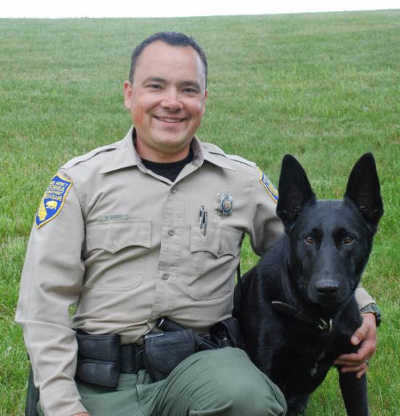
The California Department of Fish and Wildlife (CDFW) has announced the selection of Warden Chris Stoots as its 2015 Wildlife Officer of the Year.
Stoots' dedication to his job and the tenacity with which he relentlessly pursues poachers are widely respected by officers with many more years of experience and by his supervisors within the Law Enforcement Division, as well as within the community where he works.
“As good as he is at catching poachers, Stoots finds time to promote ethical enjoyment of California's fish and wildlife resources in both a consumptive and non-consumptive manner,” said CDFW Law Enforcement Chief David Bess. “Stoots has done dozens of community presentations and enjoys interacting with outdoors enthusiasts at hunting and fishing trade shows. His enthusiasm for his job is evident no matter what he's doing.”
A warden since 2008, Stoots has been based out of Colusa County.
In recent years, he has developed a reputation for turning small and unlikely pieces of information into what most officers would consider to be a once-in-a-career case.
In 2014, Stoots was the lead investigator in a large-scale, multi-suspect, multi-county commercial poaching case involving habitual offenders.
The case culminated with the service of search warrants at seven locations and followup at an additional five.
Stoots committed several months to the extensive investigation, including coordinating a three-day jury trial with eight officers' testimonies.
His persistence and collaboration with the district attorney resulted in an unprecedented number of felony and misdemeanor convictions, including night hunting, spotlighting, trespassing, hunting in closed seasons, take without proper tags, exceeding bag limits, prohibited species, illegal snaring, shooting from vehicles, shooting near dwellings, commercial sales of sport taken wildlife, theft of diesel fuel, marijuana cultivation and felons in possession of firearms.
Based on the gravity and magnitude of the violations, the suspects' criminal histories, and the thorough investigation and testimony by Stoots, the suspects received prison and jail sentences of up to seven years, and forfeiture of their ATV and trailer, 25 firearms and all other hunting equipment, and several hundred pounds of wild game meat.
Stoots uses a variety of surveillance tools, including night vision, to combat stealthy poachers. He regularly uses the CDFW wildlife forensics laboratory to process even the smallest evidence samples and connect them to crimes committed against wildlife.
In addition to his remarkable investigative work, Stoots has brought great credit to CDFW over the course of his career by still making time to take on additional assignments.
He spent three months as one of CDFW's representatives for the California Department of Justice Campaign Against Marijuana Planting, and he serves as a firearms instructor, a field training officer, a canine handler and a member of the Critical Incident Stress Management team.
He is often recognized in public, as he appeared as one of the primary officers in the National Geographic television series “Wild Justice.”
- Details
- Written by: Editor
KELSEYVILLE, Calif. – The Konocti Junior Tennis Summer Program begins Wednesday, June 17.
The program runs through Friday, July 31, at the Gard Street tennis courts in Kelseyville.
The league meets every Wednesday, Thursday and Friday from 10:30 to 11:30 a.m.
Racquets are provided if needed. Players should bring a water bottle.
For further information call 707-279-9652.
- Details
- Written by: Editor
The California Department of Fish and Wildlife (CDFW) is updating its Game Take Hunter Survey.
To assist with this effort, CDFW has selected Responsive Management, a company specializing in natural resource-related public surveys, to conduct a survey of resident small game and upland game bird hunters.
Between 1948 and 2010, CDFW conducted mail-based surveys of California hunters to estimate the harvest of many hunted species, ranging from big game such as bears and deer to small game such as upland game birds, squirrels and rabbits.
The harvest of big game species is now estimated through CDFW's Automated License Data System (ALDS).
Additionally, the harvest of all migratory birds, including waterfowl and upland migratory birds such as doves, is estimated through the federal Harvest Information Program (HIP).
These programs now provide more consistent information about those species than did the previous mail survey.
There remains a number of resident small game and other hunted species for which harvest can only be tracked through harvest surveys of the type planned.
These animals are hunted under a general hunting license only or with a validation for upland game birds (formerly a stamp) and are the focus of this survey.
This survey will use ALDS databases to identify hunters who purchased general hunting licenses and upland game bird validations. A random sample will be surveyed.
Telephone surveys will be used because the response rate is higher, which improves the statistical reliability of the survey results. The survey will also help CDFW design future harvest reporting through ALDS to be most cost effective for the hunting public.
Responsive Management will be contacting randomly selected hunters through the end of June. Survey participants will be asked about their hunting efforts associated with upland game birds and small game mammals, as well as coyotes and other huntable species. Results will be used to help CDFW use better information to guide game management programs.
Participation is voluntary. However, CDFW encourages selected hunters to participate to increase the reliability of the information and help ensure that management decisions are based on accurate harvest estimates.
Direct any questions about the Game Take Hunter Survey to Levi Souza, CDFW Wildlife Branch, Upland Game Program, at 916-445-3709.