 How to resolve AdBlock issue?
Recreation
- Details
- Written by: Carrie Wilson
What information can be collected from banded birds?
Question: While hunting ducks a few months ago at my hunt club, my son shot a double banded wood duck. It had the normal metal band on one leg and on the other leg it had a pink plastic band with the number 9 on it.
The club next to us raises wood ducks and we were wondering if it may have come from there?
How can I best describe to my kids why some ducks are banded? (Mike O.)
Answer: Bird banding is one of the most useful tools in the modern study of wild birds.
Banding birds with uniquely numbered leg rings is meant to reference where and when each bird is banded, its age, sex, and any other information the bander thinks crucial to report to scientists.
Information from bands subsequently found and reported provides data on the range, distribution and migration habits, their relative numbers, annual production, life span, and causes of death of countless species of birds.
Having this information increases scientists’ ability to understand bird habitat and behavior and assists them in their management and conservation efforts (source: USFWS Web site).
As far as the bands you found, it depends on what kind of metal band the bird had. If the band was issued from the USFWS, then you can go to their website www.pwrc.usgs.gov/bbl and easily find out where it came from.
If it is not a USFWS issued band, that likely means an organization may be providing nesting habitat via wood duck nest boxes, and then banding them as part of a federally-permitted study.
Between the two bands, hopefully you can track some information down.
Animal cruelty
Question: My daughter and I were going to the store on Saturday when we noticed a possum that had just crossed the road and was near the gutter on the other side of the road. The car in front of us veered to the other side of the road and ran over the possum on purpose!
I have been told that possums are a protected animal. Who do I contact to report this?
I was shocked and very angry that someone would do this on purpose! I have pictures of the car, the license plate and of the possum.
I would appreciate any help in this matter. There is no excuse for this kind of cruelty. (Kathi V., Orange County)
Answer: Although opossums are not native to California, they are classified as nongame animals pursuant to Fish and Game Code section 4150, and they may not be taken in the manner you have described (California Code of Regulations Title 14, section 472).
However, these kinds of violations can be difficult to prove and prosecute because the drivers will likely claim it was unintentional and that they were distracted and swerving because of other issues inside the car such as a coffee spill, dropped cell phone, etc.
The driver might also claim he was attempting to avoid the animal but the animal got confused and ran back in the direction the car was veering, which does happen sometimes.
Despite these possible scenarios however, what you described could be investigated as an illegal method of take. Hopefully, this was something you will not come across again.
But if you do, you can call the 24-hour CalTIP hotline at (888) 334-2258 or report by text message via “tip411 (numerically, 847411).
What are the rules for mounting trail cameras?
Question: What are the rules or requirements regarding putting a trail camera in a public park?
We're trying to find a friend's lost dog and have gotten tips that she's in a local public park.
No one can ever find her during the day though so we want to put up a trail camera at night to try to confirm if she is there.
If it makes any difference, one of the parks where we think she might be is next to an elementary school.
I just want to know if it's legal, and if so, if there's anything special that needs to be done to put up the trail camera. (Kevin H.)
Answer: This is not under the jurisdiction of the California Department of Fish and Wildlife (CDFW).
This decision will need to be made by the manager or the agency that manages the park as to whether they have any policies that permit or disallow this practice.
Fishing access to the California Aqueduct?
Question: I see many videos on YouTube regarding fishing along the California Aqueduct.
As a main water supply line for California, I would think most areas would restrict access.
Is there any information I can look up to find where the access areas are? I think most areas on the videos are in Southern California.
I am looking for access to the California aqueduct around Central California. (Daniel S.)
Answer: There are many fishing access points along the aqueduct, and many have signs posted as well.
To find some of these places, please check out our online fishing guide at www.wildlife.ca.gov/fishing/guide or our mobile fishing guide at www.dfg.ca.gov/mobile .
Carrie Wilson is a marine environmental scientist with the California Department of Fish and Wildlife. While she cannot personally answer everyone’s questions, she will select a few to answer each week in this column. Please contact her at
- Details
- Written by: Editor
California's second annual Invasive Species Action Week will run from Saturday, June 6 through Sunday, June 14.
Sponsored by the California Department of Fish and Wildlife (CDFW), Invasive Species Action Week is a statewide event that provides the public with opportunities to learn about non-native plants and animals that wreak havoc on our environment and the beneficial native species that live here.
Federal and state agencies and numerous organizations across the state have teamed up to host more than 30 Action Week events this year.
Upcoming public volunteer opportunities range from ragwort removal at Prosper Ridge in Humboldt County, to surveying for aquatic invasives in the Lake Tahoe Basin, to trapping crayfish in Los Angeles' Medea Creek.
A complete county-by-county schedule of events can be downloaded at www.wildlife.ca.gov/CISAW .
Citizens can also contribute to a healthy environment by taking small, everyday actions – like selecting native plants for landscaping, being responsible pet (aquaria) owners and reporting invasive species they encounter.
One of the newest opportunities to monitor for invasive species during and beyond the Action Week is through California Nerodia Watch, the CDFW's burgeoning citizen-science monitoring project for invasive (and restricted) Nerodia watersnakes.
Currently, Nerodia watersnake populations are established in Roseville, Folsom and Harbor City, with several sightings reported in the Sacramento-San Joaquin Delta. Nerodia are notorious predators of fish and amphibians, and if their range expands, they will pose a serious threat to nearby endangered giant garter snakes and threatened steelhead and Chinook salmon.
With the public's help, CDFW biologists hope to monitor and prevent the spread of existing populations.
The public is encouraged to learn more about Nerodia watersnakes ( see the CDFW invasive species profiles at www.wildlife.ca.gov/conservation/invasives/species ) and report observations through the iNaturalist project Web page ( www.inaturalist.org/projects/california-nerodia-watch ) or by downloading the iNaturalist smartphone app.
For questions or more information about the Action Week or California Nerodia Watch, please contact
- Details
- Written by: Tami Cramer
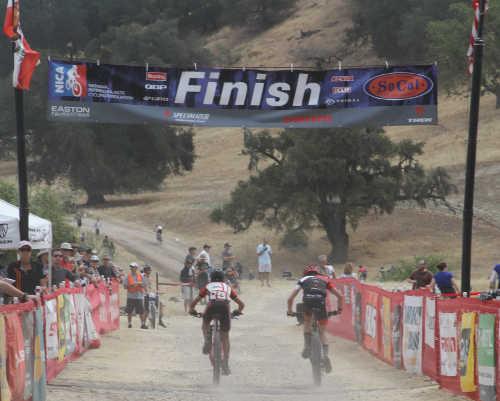
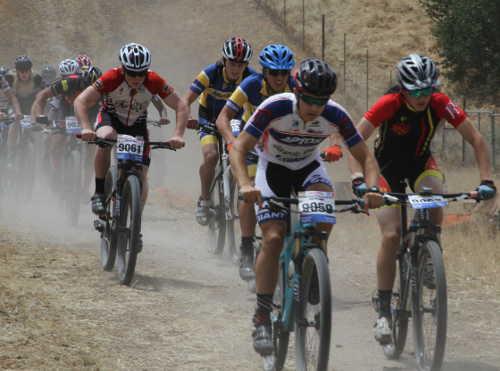
LOS OLIVOS, Calif. – On Sunday, May 17, the largest high school mountain bike race is history took place in Los Olivos.
The SoCal Cycling League hosted 785 riders from throughout California at the Dirt Club, a private mountain bike facility/property in the Santa Ynez Valley.
Located not far from Michael Jackson’s Neverland Ranch, the area is dotted with vineyards and horse ranches among its rolling oak grasslands.
As with Neverland, the site was somewhat “out of this world”; the venue became a huge RV park as hundreds camped, hot air balloons floated by, a marching band played music and hundreds of children on bikes networked with others from all over California.
Riders converged onto the 6-mile course that climbed approximately 800 feet each lap; completing two to four laps (12 to 24 miles) depending on their category.
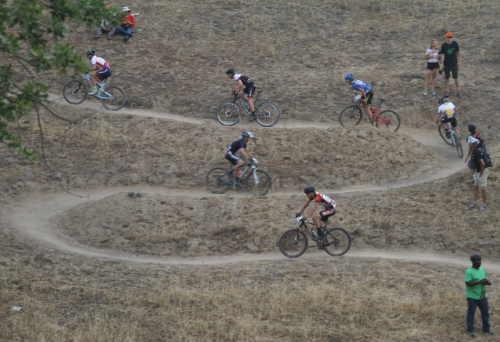
With a huge climb right near the start of the lap, the remainder of the course was fairly smooth and rolly with lots of switchbacks.
Technicality was largely due to the large amount of climbing. This is where all the training and fitness will be tested.
With six riders representing Lake County, Clear Lake High School junior Mark Jeffrey Morton came into state ranked third overall in Junior Varsity Division 2 in the NorCal North Conference.
Summing up the race, Morton stated, “It was a fun, but challenging race. It had the most and steepest climbing of any of the other races. Another reason it was difficult – many more riders. I was happy to be able to squeeze out a sixth place.”
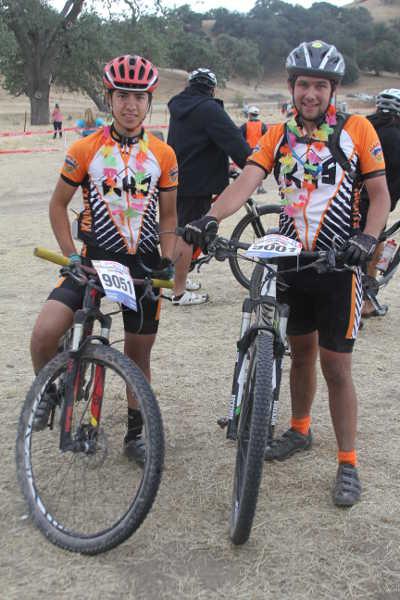
The largest field of the day, Junior Varsity Division 2 had 94 riders compete. Among the other JV competitors, Jadon Lindsey, Kelseyville High, placed 22nd; Gabe Wind, Clear Lake High, 40th; and Craig Andre, Kelseyville High, 73rd.
Unfortunately Craig suffered from a mechanical problem in his very last high school race.
“In his final lap, Craig’s rear brake lever broke,” said Coach Tami Cramer. “Since braking is shared between the front and rear brakes when riding; when it broke it all went to the front. This resulted in Craig wiping out in a turn. Once back on the bike, he rode considerably slower since he only had the front brake, but finished.”
When asked to compare freshman versus senior year, Craig stated, “Freshman year I was determined to just get through the year. I didn’t expect to and was hesitant at every obstacle. This year, I not only try to get through; but I lost most of the fear and hesitation I experienced. I’ve gained confidence in my abilities, not to mention new strength and skill.”
The other two riders to compete included CLHS sophomore Solano Dominguez and KHS sophomore girl Kia Kohler.
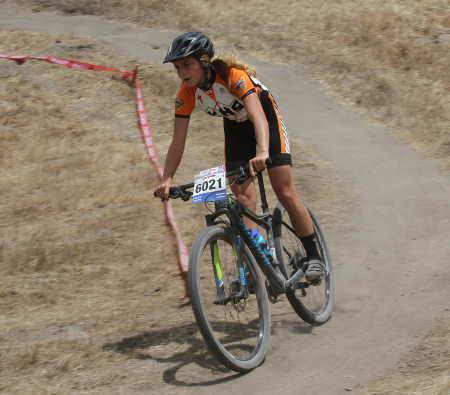
Battling back and core issues this year, Solano felt considerably better in this race finishing 10th out of 57 riders.
Kia, who hadn’t been able to get in as much training the 3 weeks between race No. 5 and state, felt pretty happy to walk away with 23rd out of 39 competitors.
“We had a great season,” said Coach Jeff Cramer. “State marks the official end to the season, but most of the riders will continue throughout the year. All Kelseyville and Clear Lake High School students reading this; go ride your bike and we hope to see you on our interest rides in the fall.”
A big shout out to our 2015 Sponsors: Main Street Bicycles, City Fitness, Wasson Memorial Hospital, Conser Land Surveying, Maherajah Water Skis and Longboards, Mountain High Coffee and Books, Disney’s Boat Rentals, Edward Jones Investing, and a big thank you for continued support from Clear Lake High Sports Foundation and Kelseyville High School Boosters.
Follow Lake County High School Mountain Bike Teams on Facebook.
- Details
- Written by: Carrie Wilson
Late 8 a.m. start time for abalone unfair
Question: Just a note (complaint) … the start time of 8 a.m. for abalone is very, very unfair. The two lowest tides of the year are in May and June, and you just eliminated them.
Rock pickers are put into a shorter collection time and can make even more hurried decisions to take an under-size ab off a rock.
You are punishing all rock pickers and putting them in danger by forcing them to dive for abs when they are not good divers (thus, in danger of drowning).
The 8 a.m. rule does not adversely affect the divers at all. You already closed off way over half the state of California. There is no way that abalone hunters can wipe out the abalone population.
I go rock picking for abalone with six others and we all share these thoughts. (Fred M., San Francisco).
Answer: The California Department of Fish and Wildlife (CDFW) made recommendations to the Fish and Game Commission to reduce the take of abalone because recent scuba surveys had shown lower numbers of abalone at popular abalone sites, particularly in Sonoma County.
According to CDFW Marine Environmental Scientist Jerry Kashiwada, the current Abalone Recovery and Management Plan (ARMP) recommends a 25 percent reduction in the take of abalone when the density (number of abalone in a standard area) reaches the low levels seen in the most recent surveys.
Density in the Fort Ross area was so low it reached an ARMP “trigger” for closure to allow the abalone population to recover.
The commission had a choice between the 8 a.m. start time, reduction of daily limit to two abalone, reduction of the limit on the abalone card, reduction of the season (more closed months), reduction of take for Sonoma and Marin counties or some combination those proposed changes.
The 8 a.m. start time was initially proposed by CDFW wildlife officers who had been seeing large numbers of rock pickers at all low tides and believed that segment of the fishery was unsustainable.
The officers observed rock pickers were taking more time to find legal limits, were less likely to get a limit and were removing and returning more short abalone, many of which were unlikely to survive the handling.
The later start time also helps officers by eliminating predawn fishing hours when the light is too dim to observe violations.
The effect of the new start time was estimated using data from returned abalone report cards, but the actual effect is unknown since it depended on whether many people would shift to later hours.
Data from abalone cards returned this year will provide a clearer picture of the effects of the regulation changes.
The timing of low tides is variable from year to year and while the 8:00 a.m. start reduces the number of low tides available, there usually are some days with suitable tides.
The lower numbers of abalone being taken by rock pickers may make it easier to find abalone at higher tide levels than in the past.
The activities of sport fishermen might not be sufficient to cause extinction of abalone species but they can reduce abalone populations to the point that the abalone are spaced so far apart that their chances of reproducing are very low.
At low abalone population levels, many people might stop participating in the fishery because it is too difficult to find abalone.
Reducing abalone populations to low levels also makes them more vulnerable to events like the 2011 die-off that affected abalone in much of Sonoma County.
CDFW is currently in the process of developing a Red Abalone Fishery Management Plan and revising sections of the ARMP.
For more information, please visit the CDFW Invertebrate Management Project Web site at www.dfg.ca.gov/marine/redabalonefmp/ .
Can a non-hunter carry an unloaded shotgun when with other hunters?
Question: While hunting on a game bird club, can a non-licensed, non-hunter carry an unloaded shotgun while walking with other hunters? (Anonymous)
Answer: While it may not technically violate the law for you to carry an unloaded shotgun without a license, by doing this with others who have ammunition and are taking game, it will likely generate many questions by the wildlife officer contacting you in the field.
Whether or not you have a hunting license is not an element of “take.”
You may argue you are not taking game, but the officer has sufficient evidence to prove you are.
Do you really want to put yourself through the hassle of going to court?
Leave the firearm behind if you want to go with your buddies while they are taking game.
Carrie Wilson is a marine environmental scientist with the California Department of Fish and Wildlife. While she cannot personally answer everyone’s questions, she will select a few to answer each week in this column. Please contact her at