 How to resolve AdBlock issue?
Recreation
- Details
- Written by: Editor
NORTH COAST, Calif. – A Senate Joint Resolution authored by Sen. Mike McGuire protecting the Smith River watershed received overwhelming support, winning approval from the State Senate, and sending the resolution to the State Assembly for its final vote.
Mike McGuire advocated for Smith River protection on the Senate floor April 9, urging his fellow senators to help him ensure the state's premiere wild and scenic river would be protected from the devastating effects of a proposed strip-mining operation along the North Fork of the Smith River in southern Oregon, just over the California border.
“Any future mining activities will unnecessarily put the people and wildlife that rely on the Smith River at risk and would create irreversible impacts to the entire watershed,” Senator McGuire said.
SJR 3 – the Smith River Watershed Protection measure – urges the president of the United States and Congress to permanently safeguard the currently unprotected North Fork of the Smith River watershed in Oregon from any mining activities.
Co-authoring the resolution are Senators Mark Leno and Fran Pavley, along with Assemblymembers Jim Wood, Marc Levine, Bill Dodd, Mark Stone and Das Williams.
Recently, the Panama-based Red Flat Nickel Corp. submitted a plan to drill up to 59 test mine shafts on 3,980 acres, which could allow for one of the largest nickel, cobalt and chromium mines in the Western United States.
Any mining would have irreversible negative impacts to water supplies, the North Coast’s economy and the environment in California’s portion of the Smith River Watershed.
“Mining of any kind in the Smith River Watershed is simply unacceptable. I will work tirelessly to protect our river, which is one of the premier salmon fisheries in the lower 48 states and the source of drinking water for tens of thousands of residents in Del Norte County, including Crescent City,” said McGuire.
The Smith River is the primary source of drinking water for the majority of Del Norte County’s 28,000 residents, and is a crucial waterway for the endangered Coho salmon and other important fish runs. The Smith also offers a multitude of recreational activities that are a primary driver of the Del Norte economy.
Support for the resolution is broad and includes the United States Department of the Interior, California State Parks, the Crescent City Council, Del Norte Board of Supervisors, the Smith River and Elk Valley Rancherias, Trout Unlimited and many more.
- Details
- Written by: Editor
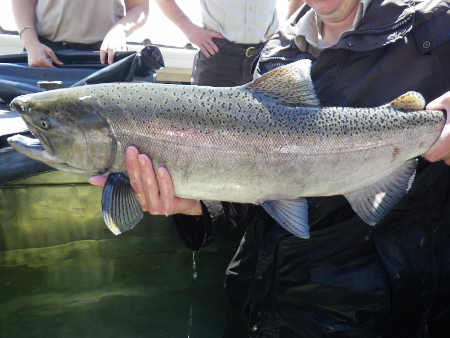
Recommendations by the California Department of Fish and Wildlife (CDFW) to provide dual areas of protection to Sacramento River winter-run Chinook salmon were approved by the state Fish and Game Commission on Friday.
An emergency regulation closing 5.5 miles of spawning habitat above the city of Redding on the Upper Sacramento River will go into effect on or about April 27.
Enhanced protective measures were also included in the ocean sport and commercial fisheries regulations for the 2015 season.
“We are taking proactive measures on two fronts to protect these endangered fish both in the ocean and on their natal spawning habitat,” said CDFW Chief of Fisheries Stafford Lehr. “The fishing communities have stepped forward to support these measures and work towards long-term sustainability of the resource. None of us wanted to be in this situation, but heading into a fourth year of extreme drought calls for extreme measures.”
The emergency regulation closes all fishing on the 5.5 mile stretch of the Sacramento River from the Highway 44 Bridge where it crosses the Sacramento River upstream to Keswick Dam.
The area is currently closed to salmon fishing but was open to trout fishing. The closure will protect critical spawning habitat and eliminate any incidental stress or hooking mortality of winter-run salmon by anglers.
The commission also adopted ocean sport fishing regulations, which will mirror federal regulations approved earlier this week.
CDFW, in consultation with representatives of California's sport and commercial salmon fishing industries, recommended additional strategic protective measures for winter-run Chinook salmon to the Pacific Fishery Management Council (PFMC).
Following a two-month evaluation process, the PFMC recommended federal regulations that provide for sport and commercial seasons off California designed to target more abundant stocks, including Sacramento River fall-run Chinook salmon, while minimizing contact with winter-run Chinook.
“The CDFW proposal to reduce the allowable ocean harvest rate on winter-run salmon and change the timing and location of ocean fisheries south of San Francisco was accepted by the PFMC after in-depth analysis, review and discussion,” said Marci Yaremko, CDFW's representative to the PFMC. “The Commission concurred with these recommendations, realizing their conservation benefit to all winter-run.”
It is highly unusual for a state to propose even stricter guidelines on a listed species than required by the federal Endangered Species Act.
However, CDFW scientists believe the additional protection provided in the emergency river closure and additional ocean fishing restrictions will help a significant segment of the winter-run population to avoid losses.
- Details
- Written by: Editor
LAKE COUNTY, Calif. – The Redbud Audubon Society April field trip will be to the Mendocino Botanical Gardens.
Participants are asked to meet Saturday, April 18, at the Botanical Gardens at 18220 Highway 1, Ft. Bragg at 9 a.m.
Leader Pat Harmon reports that the gardens present several habitats with a variety of birds to see.
Seabirds, such as the scoters, to hummingbirds, warblers, thrushes, and a variety of other songbirds will be seen and heard.
There is a fee to enter the gardens: $10 senior, $14 general; but if 12 or more people attend, the rate is reduced to $7.50 per person.
You are encouraged to bring a lunch to enjoy at the gardens, as the café is not yet open for the season.
Redbud Audubon will not officially arrange carpooling as some folks attending this outing plan on spending the night. However, individuals are encouraged to make their own carpooling arrangements.
- Details
- Written by: Editor
The California Department of Fish and Wildlife (CDFW) will sponsor a youth art contest to promote awareness of plant and animal invaders that threaten our state’s native species, as part of the 2015 California Invasive Species Action Week (CISAW), June 6-14.
Now in its second year, the CISAW aims to promote public participation in the fight against invasive species and their impacts on our natural resources.
CDFW partners with federal agencies, state departments, and numerous local organizations and volunteer groups to host and promote public participation in locally organized events held across the state.
The 2015 schedule of events will include invasive species removal efforts, native habitat restoration projects, youth educational activities, citizen science monitoring efforts and the second annual youth art contest, with the theme “Don’t be a vector! Be a protector!”
The contest encourages youths to learn about invasive species vectors, which are the physical means by which invasive species are moved from one place to another.
Youths are asked to think of a situation in which invasive species could be spread, identify the vector that can move it and illustrate what they can do to prevent the spread and protect California’s resources.
Please visit the Action Week Web page ( www.wildlife.ca.gov/cisaw ) to learn about vectors and for contest details and entry forms.
All types of media are accepted, including drawings, paintings, animations, comic strips, videos and public service announcements.
The contest is open to youths in grades 2-12. Entries must include a completed entry form and be received by May 27.
The contest is sponsored by the California Foundation for Agriculture in the Classroom.
For more information on Action Week, including hosting an event, how to get involved, or the youth art contest, please contact CDFW Environmental Scientist Valerie Cook Fletcher at 916-654-4267 or at