 How to resolve AdBlock issue?
Regional
- Details
- Written by: YUROK TRIBE
The projects will serve Native people living in both rural and urban areas in Northern California.
“This is one of the first times that an urban-rural support network is being created for Native peoples,” said Joseph James, chairman of the Yurok Tribe. “Too often, tribes and urban Indian organizations are pitted against each other for limited funding. This partnership shows what is possible when we put the needs of all native people first and foremost, and focus on providing holistic services on and off-tribal lands.”
With support from Gov. Gavin Newsom and Friendship House, the Yurok Tribe received $15 million from the California Department of Health Care Services to construct a residential treatment center on the Yurok Reservation in Northern California.
The center is part of Yurok Tribe’s $100 million dollar Regional Wellness Plan for the region, and will provide outpatient and medication assisted treatment services to serve tribal citizens from seven different tribes and native peoples throughout the region.
Friendship House, a leader in treatment and recovery programs for native peoples since 1963, will provide technical assistance to the tribe in operating the facility.
The Yurok Tribe and Friendship House will also develop two housing projects for native people in San Francisco — a 65-unit sober-living transitional housing facility and an 85-unit affordable housing facility for first-time Native homeowners.
“Other successful models of treatment and housing have proven what we know to be true,” said Gabriel Pimentel, executive director of Friendship House. “Safe, affordable housing is key to long-term sobriety and well-being.”
The treatment center and housing projects are part of a larger Friendship House-led environmental and racial justice campaign called “The Village SF Initiative” to reclaim and rebuild community for urban Indians.
Both Yurok Tribe and Friendship House are focused on Indigenous-led solutions for native peoples. Friendship House has seen high rates of success with its treatment programs, with more than 80% of its graduates maintaining sobriety six months or more after completing the program.
“The health, violence, poverty and housing disparities that exist today in native communities can be traced directly to federal and state policies including genocide, boarding schools and federal relocation,” said Abby Abinanti, chief judge of the Yurok Tribe. “But it is up to native people, leaders, and organizations to develop solutions. We must not wait for the solutions we know that work. And what we know is that native communities are safest when we create and build our own solutions.”
- Details
- Written by: CALTRANS

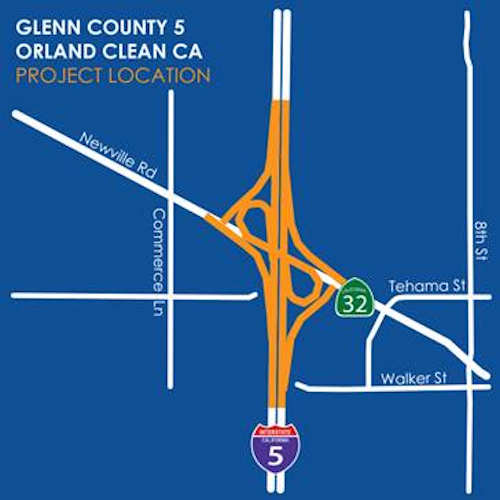
ORLAND, Calif. — Caltrans recently began construction on a unique city gateway project that will bring new buzz to the city of Orland, known as the “Queen Bee Capital of North America.”
The centerpiece of the $2.7 million project at the interchange of Interstate 5 and State Route 32 will be two bee sculptures created by Orland artist Jake Midgley that will stand about 16 feet high at opposite sides of the interchange and will be complemented by unique honeycomb-like paving.
The project is made possible through Gov. Gavin Newsom’s Clean California initiative, a sweeping, $1.2 billion, multiyear clean-up effort led by Caltrans to remove trash, create thousands of jobs and join with communities throughout the state to reclaim, transform and beautify public spaces.
“Public art and public transportation are a natural, powerful pairing, one that Orland’s new queen-bee themed city gateway will wonderfully demonstrate for many years to come,” said Caltrans Director Tony Tavares.
This project — the second of six Clean California projects to begin construction in Caltrans District 3, which includes Glenn County — also will upgrade the interchange where 2,500 vehicles travel each day. Increased safety measures will include additional paving and new landscaping with inert material such as rock, gravel, and recycled glass.
The contract was awarded to Vanguard Construction of Livermore.
Many Clean California projects throughout the state will include public art and other design aesthetics. Among its many positive attributes, art in public spaces has been shown to benefit communities by reducing illegal dumping and graffiti.
“The city of Orland is pleased and proud to partner with Caltrans in beautifying the freeway interchange at exit 619 in Orland,” said Orland City Manager Peter R. Carr. “The unique, locally hand-crafted honeybee sculptures and honeycomb-stamped concrete will announce to motorists that they have arrived in the Queen Bee Capital of North America, will become an enduring asset of local esteem, and will instill public pride in the state’s highway system. Leveraging the talents of a local welder-artist and state contractors, this project benefits the community and the traveling public with an improved freeway interchange experience.”
Caltrans District 3 Director Amarjeet S. Benipal said the feedback Caltrans received from the city during the planning stages for the project, and from the public during the community meeting held in January, were extremely valuable.
“Caltrans fully appreciates the effort the City of Orland made to gather public input for this project,” he said. “This engagement provided us with important information to improve the safety and aesthetics of this gateway to the City of Orland. The two locally designed bee sculptures and honeycomb paving included in the project will make clear the city’s unique identity as the Queen Bee Capital of North America.”
This project is among 126 Clean California beautification projects worth $312 million designed to help energize communities and create connectivity along the state highway system.
There are an additional 105 projects statewide funded by nearly $300 million in Clean California local grants to remove litter and transform public spaces in underserved communities. Collectively, these projects are expected to generate 7,200 jobs.
The new state budget includes $100 million to fund another round of Clean California local grant projects.
Since launching Clean California in July 2021, Caltrans has removed more than 1.1 million cubic yards of litter from state highways — the equivalent of nearly 19,000 tons or enough to fill 344 Olympic-size swimming pools — and hired more than 800 new team members as part of Clean California, including 420 maintenance workers who collect litter and remove graffiti. For more information, visit www.CleanCA.com.
- Details
- Written by: LAKE COUNTY NEWS REPORTS
This time, the hate crime involves a mural dedicated to Missing and Murdered Indigenous Women located at 945 W 2nd St.
The artist reported an unidentified individual drew swastikas and obscene language on the mural and attempted to light the bottom on fire.
One of the artists who created that mural, Shane Grammer, also created a mural in Upper Lake depicting Vanessa Niko in honor of Missing and Murdered Indigenous Women, as Lake County News has reported.
“At this time, it is unknown if this incident is related to the hate crime also being investigated at the Congregation Beth Israel synagogue,” the Chico Police Department said.
On Wednesday afternoon, police officers responded to the synagogue, where they found someone had drawn swastikas on a sign in front of the synagogue and then set the sign on fire.
The department said both the synagogue and mural cases have been forwarded to its detective bureau for further investigation.
“The Chico Police Department takes these incidents seriously and will investigate them thoroughly. Hate crimes impact not only individuals but our community,” the agency said in a Thursday statement.
The Chico Police Department is asking for the public’s assistance. Anyone with information is asked to call the police department at 530-897-4911, reference case number 22-006874.
- Details
- Written by: CHICO POLICE DEPARTMENT
At 4:15 p.m. Wednesday, the Chico Police Dispatch Center received a call regarding a vandalism incident at the Congregation Beth Israel synagogue, located on the 1300 block of Hemlock Street.
Officers arrived on scene and discovered that an unidentified individual burned a sign in front of the synagogue and drew swastikas on the sign. The officers collected evidence and began an investigation.
Police said the vandalism is being treated as a hate crime.
“These incidents are serious acts against members of our community and will be investigated thoroughly,” the agency said.
The Chico Police Department is asking for assistance from any community members who may have information regarding this incident.
Anyone with information is asked to call the police department at 530-897-4900.