 How to resolve AdBlock issue?
Regional
- Details
- Written by: California Department of Fish and Wildlife
Better known as a “red tide” since it has turned much of the Bay a reddish-brown color, the HAB was first detected in Alameda in late July and has grown to become the largest in the Bay’s recorded history.
Already, the HAB has been responsible for the deaths of thousands of fish, including large sturgeon, sharks, striped bass, bat rays and anchovy.
While this type of HAB is not considered a health threat to humans, it is recommended that people avoid swimming until further notice. The cause of the HAB is still not known.
“It’s very upsetting to see the scale of harm to aquatic life and we know how disturbing this has been for the public,” said Eileen White, executive officer of the San Francisco Regional Water Board. “We are doing everything possible to monitor the situation, work with other agencies and search for solutions.”
At Lake Merritt, which is connected to San Francisco Bay, reports suggest as many as 10,000 fish died in late August.
On Aug. 29, San Francisco Bay Regional Water Board staff conducted a field investigation at Lake Merritt, where very low dissolved oxygen levels were measured in the water.
Water samples were collected for identification of algal species and toxins. Updates to this sampling event will be posted on the HAB web map.
CDFW will be conducting both boat and shore-based surveys next week at various locations around San Pablo and Suisun bays.
The goals of these surveys will be to determine the geographic extent of the fish kill, any expansion into new areas, the species affected and the numbers of dead fish on select target species such as white and green sturgeon.
CDFW is also tracking reports from partners and community scientists to determine where fish mortalities are occurring.
Due to the likelihood of increased fish mortalities through the weekend, CDFW is encouraging people who may be recreating on the nearby shorelines in affected areas to report sightings of dead fish through the iNaturalist smartphone app.
The water boards have worked with various agencies, including the City of Oakland, Alameda County, San Mateo County and East Bay Regional Park District to post caution advisory signs near affected waters (e.g., Lake Merritt, the Oakland Estuary, Coyote Point, and Crown Beach) to inform the public to avoid contact with the discolored water caused by the red tide.
For questions specifically related to fish mortalities from this HAB, please contact Jordan Traverso at CDFW at 916-212-7352.
For more information about HABs, please visit Cabs/slifornia Harmful Algal Blooms Portal.
- Details
- Written by: GOVERNOR’S OFFICE
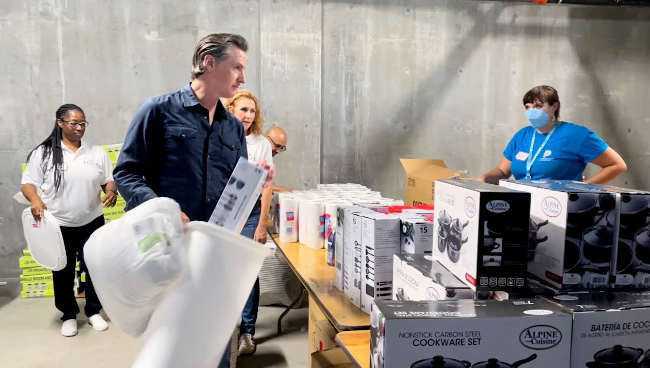
Alongside state and local leaders at a new Homekey project in Los Angeles preparing to welcome tenants, Gov. Gavin Newsom on Wednesday announced the award of $694 million for 35 projects that will create more than 2,500 new units in 19 communities throughout the state.
In total, including Wednesday’s announcement, California’s nation-leading Homekey program has funded more than 200 projects statewide — creating more than 12,500 permanent and interim homes for people exiting homelessness.
“With 12,500 new homes funded in just two years, Homekey is changing lives across the state,” said Newsom. “Homekey’s groundbreaking success is a model for the nation, showing that we can make real progress on ending homelessness in months, not years. In partnership with cities and counties like Los Angeles, we’ll continue to safely house Californians in need faster and more cost-effectively than ever.”
The governor celebrated Homekey’s recent two-year anniversary at a volunteer workday for a Los Angeles Homekey project, where he assisted in assembling welcome kits as part of the site’s move-in preparations. Including today’s awards, the Los Angeles region has to date received $948 million for 62 Homekey projects that will create 4,034 units of housing.
The governor was joined by Los Angeles Mayor Eric Garcetti, Rep. Karen Bass (D-CA), Business, Consumer Services and Housing Agency (BCSH) Secretary Lourdes Castro Ramírez and Department of Housing and Community Development Director Gustavo Velasquez.
“Homekey is more than just another tool in our toolbox in the work to end homelessness – it’s an opportunity for thousands to start anew, and an injection of pride and dignity that can keep Angelenos off the street for good,” said Mayor Eric Garcetti. “Thanks to this latest infusion of funds, hundreds of people experiencing homelessness today will be offered the stability of a permanent home, the safety of a door with a lock, and the services they need to get back on their feet.”
Homekey has become a national model for how to quickly deploy emergency funds to meet the diverse needs of rural, suburban, urban and tribal communities working to expand homeless housing.
Building on the program’s success, the state budget signed by the governor this year invests an additional $150 million, bringing total Homekey funding to $3.75 billion.
“Homekey has been one of our most effective and catalytic affordable housing supply solutions,” said BCSH Secretary Lourdes Castro Ramírez. “Thanks to Gov. Newsom’s vision, in 24 months, we designed a hotels-to-housing national model, mobilized technical assistance and marshaled historic housing resources. The state brought together housing providers, social service organizations, residents and local leaders to create over 12,500 places that people exiting homelessness can call home. This is an incredible example of good government responding with compassion, speed and transformative solutions.”
Newsom on Wednesday also announced $47 million in housing grants to create more residential care options for seniors and adults with disabilities, including people at risk of or experiencing homelessness.
These grants are the first to be awarded through the new Community Care Expansion — Capital Expansions Grants Program administered by the California Department of Social Services to help address historic gaps in the state’s behavioral health and long-term care continuum.
The governor’s multibillion-dollar homeless housing investments will provide more than 55,000 new housing units and treatment slots in the coming years.
Building on last year’s historic $12 billion investment to help get the most vulnerable people off the streets, the state budget this year invests an additional $3 billion in behavioral health housing, homeless emergency aid, and encampment rehousing strategies, creating a total $15 billion package.
“In just two years, Homekey has facilitated the creation of 12,500 interim and permanent homes for our most at-risk Californians. In this program, HCD continues implementing systemic changes to address both the urgent need to shelter people and to progress toward our Statewide Housing Plan goal for more affordable housing for lower-income and unhoused residents who are disproportionately people of color,” said HCD Director Gustavo Velasquez. “State and local collaboration has been key throughout these two years, and we must continue to use Homekey as a model to accelerate production and affirmatively further fair housing.”
The latest Homekey awards include the following projects:
• City of Fontana: $3.1 million for 14 interim units.
• City of Fresno: Four awards totaling $57.9 million for 283 units.
• City of Los Angeles: Ten awards totaling $277.3 million for a total of 960 units.
• County of Los Angeles: Two awards totaling $24.6 million for a total of 78 units.
• City of Long Beach: Two awards totaling $30.6 million for 110 interim units.
• City of Newark: $38.1 million for 124 permanent units and one manager unit.
• City of Oakland: $5.6 million for 24 interim units and 10 interim youth units.
• City of Palo Alto: $26.6 million for 108 interim units.
• County of Riverside/Palm Springs: $19.1 million for 70 interim units and 10 interim youth units.
• County of San Diego: $11.8 million for 40 permanent units and one manager unit.
• San Francisco: Two awards totaling $73.4 million for a total of 221 units.
• City of San Jose: $51.6 million for 204 interim units.
• County of San Luis Obispo: $568,000 for 3 interim housing youth units.
• City of Santa Rosa: Two awards totaling $24.7 million for 91 units.
• Sonoma County: $6.3 million for 21 permanent units and one manager unit.
• City of Stockton: $4.1 million for 14 permanent units and one manager unit.
• City of Thousand Oaks: $26.7 million for 77 permanent units and one manager unit.
• County of Ventura: $5.9 million for 27 interim youth units.
• City of West Hollywood: $6 million for 20 interim units and one manager unit.
- Details
- Written by: CALIFORNIA HIGHWAY PATROL
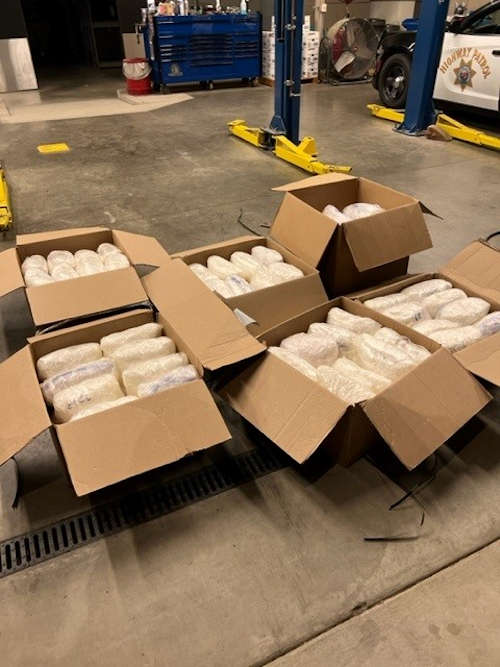
FRESNO, Calif. – In one of the largest drug seizures by a California Highway Patrol Central Division canine team, a CHP canine officer seized 500 pounds of crystal methamphetamine and arrested two suspects on several drug charges in Bakersfield last week.
The bust came on the heels of two other major drug seizures on the same day earlier this month by Central Division canine officers, whose seven teams since the beginning of the year have seized 1,384 pounds of illegal drugs, including cocaine, heroin, methamphetamine, marijuana, and fentanyl, during their traffic enforcement duties.
Officers have also arrested 97 suspects on various drug charges and confiscated 17 weapons and nearly $1.3 million in cash.
At 9:45 p.m. Tuesday, a CHP officer stopped a 2017 Land Rover for a vehicle code violation on northbound State Route 99, north of 7th Standard Road in Bakersfield.
After noticing indicators of criminal activity, the officer deployed his canine, which alerted to the odor of narcotics.
During a search of the vehicle, the officer found crystal methamphetamine in several cardboard boxes in the cargo area and arrested two male suspects from Fresno who were booked into Kern County Jail on charges of possessing a controlled substance for sale and selling or transporting methamphetamine.
The case has been sent to the Kern County Narcotics Task Force.
“Illegal narcotics have a devastating effect on our communities,” said CHP Central Division Chief Ceto Ortiz. “I would like to thank our Central Division Canine Unit for its continued commitment and dedication to removing dangerous narcotics from our roadways.”
Tuesday’s arrests follow two traffic stops by Central Division canine officers on the same day recently that resulted in the combined seizure of 150 pounds of drugs — 92 pounds of cocaine and 66 pounds of methamphetamine.
On Aug. 11, at approximately 1:35 p.m., a canine officer from the CHP’s Central Division stopped a 2017 Nissan Rogue on Interstate 5 at Nees Avenue in Fresno County for a vehicle code violation.
During the contact, the officer noted several indicators of criminal activity and obtained consent to search the vehicle. During the search, the officer discovered 92 pounds of cocaine hidden within the vehicle.
Agents with the High Impact Investigations Team (HIIT) responded to the scene and assumed the investigation.
The driver, Umar Ovalle, 35, of King County, Washington, was subsequently booked into the Fresno County Jail on charges of possession of cocaine for sale, transportation of cocaine across noncontiguous counties, and possession of a compartment used to transport narcotics.
Later that day, at approximately 3:15 p.m., a second CHP Central Division canine officer stopped a Nissan Frontier along State Route 99 north of Avenue 24 in Tulare County for a vehicle code violation.
During the contact, the officer noticed signs of criminal activity and deployed the canine to search the exterior of the pickup.
The canine alerted to the odor of narcotics and a subsequent search resulted in the recovery of approximately 66 pounds of methamphetamine on the rear seat.
The driver, Miguel Oropeza, 32, of Kern County was taken into custody without incident and booked into the Kern County Jail on charges of possession of methamphetamine for sale and transportation of methamphetamine across noncontiguous counties.
“I am extremely proud of the work of our canine teams throughout the state, who are working tirelessly to identify drug traffickers and remove illegal weapons and drugs from our communities,” said CHP Commissioner Amanda Ray. “Our efforts to arrest those using our freeways for dangerous illegal activity will continue.”
- Details
- Written by: CALIFORNIA HIGHWAY PATROL
As such, motorcycle-involved crashes in California continue to be a major concern for the California Highway Patrol.
In an effort to reduce the number of motorcycle incidents or crashes resulting from unsafe speed, following too closely, unsafe lane changes, improper turning, and other violations by both motorcyclists and other drivers, the CHP Humboldt Area will deploy additional officers throughout the 2022 Labor Day weekend.
To assist the CHP in this traffic safety effort, the Office of Traffic Safety, through the National Highway Traffic Safety Administration, has awarded a grant titled “Get Educated and Ride Safe III.”
With the grant-funding, the Humboldt Area will continue to deploy additional enforcement efforts through Sept. 30, 2022.
If you have any questions or need additional information, please contact the Humboldt Area office at 707-822-5981.