 How to resolve AdBlock issue?
Veterans
- Details
- Written by: Editor
Interested applicants can apply to work in any of Thompson’s offices, including in Napa, Santa Rosa, Vallejo and Washington, DC.
“As a combat Vietnam veteran, serving our veterans and finding ways to incorporate their expertise into my work is one of my top priorities,” said Thompson. “So I am honored to have the opportunity to add one of our nation’s veterans to my staff and include their knowledge into our work to serve our district. All eligible veterans are encouraged to apply and take advantage of this great chance to continue in public service.”
The duties of the position could include, but is not limited to working as a constituent services representative helping local constituents resolve issues with federal agencies, attending local events and meetings on behalf of your Member of Congress, and performing legislative work.
The Wounded Warrior Fellowship Program was established by the House of Representatives to provide employment opportunities for wounded or disabled veterans within member offices.
The program is limited to veterans who meet all of the following requirements:
– Honorably discharged and released from active duty within the last five years;
– Terminal pay grades at or below E-5 or O-3; and
– Twenty percent or greater service connected disabilities (waived if you have a Purple Heart).
Please note that veterans who are in receipt of a 20-year or Temporary Early Retirement Authorization retirement are not eligible for the program.
Interested veterans should go to https://www.usajobs.gov/ and search “Wounded Warrior Fellowship Program” for more information and how to apply.
- Details
- Written by: Department of Veterans Affairs
These two opportunities will allow eligible veterans to receive a review of a decision on a claim much faster than the current appeals process.
“VA is committed to transforming the appeals process,” said VA Acting Secretary Robert Wilkie. “This is evidenced by the success of Rapid Appeals Modernization Program which has seen over 12,000 veterans opt-in. In addition, the Board of Veterans’ Appeals has issued approximately 46,000 decisions this fiscal year — nearly 23,000 more decisions than last year at this time. We are on pace to reach a historical fiscal goal of 81,000 decisions.”
First, VA will expand the Rapid Appeals Modernization Program, or RAMP, by removing the requirement that veterans first receive an invitation from VA in order to elect participation in the program.
RAMP, which was initially launched in November 2017 as an invitation only program, allows eligible veterans with a disability compensation appeal early access to the Higher-Level Review and Supplemental Claim Lanes outlined in the Appeals Modernization Act.
By removing the invitation requirement, veterans will have the opportunity to benefit from the new, more efficient decision review process, versus continuing to wait in the legacy appeal process. As of March 31, RAMP reviews were completed in an average of 52 days.
Second, in May, the Board of Veterans’ Appeals will launch its Early Applicability of Appeals Modernization, or BEAAM, pilot project.
Under this project, the board will partner with the National Organization of Veterans’ Advocates, Paralyzed Veterans of America and the California Department of Veterans Affairs to identify 50 Veterans who are dissatisfied with a recent decision on their benefits claim.
These veterans will participate in a study that allows them the option of appealing directly to the board or seeking a review in RAMP. In this study, the board will collect preliminary data about veteran choices and experiences.
In October, the board will begin deciding appeals from RAMP decisions using the features of the Appeals Modernization Act, specifically its new, separate Direct, Evidence and Hearing dockets.
The expansion of RAMP, combined with the BEAAM, will allow VA to collect valuable data about implementation of the Appeals Modernization Act.
- Details
- Written by: Department of Veterans Affairs
VA’s Vocational Rehabilitation and Employment (VR&E) entered into an agreement with the SBA Office of Veterans Business Development in early December to provide self-employment guidance, assistance and on-the-job training to disabled Veterans.
“Our partnership with the Small Business Administration brings together the best of public and private business resources to help disabled veterans start their business on a firm footing,” said VA Acting Secretary Robert Wilkie. “This program is available to veterans who want to transition to self-employment and want the guidance and mentorship provided by SBA partners to increase their success.”
To qualify for the program, Veterans must meet three conditions: a service-connected disability, an employment handicap and acceptance into the VR&E program.
SBA partners include Service Corps of Retired Executives, Small Business Development Centers, Veterans Business Outreach Centers, Women’s Business Centers and U.S. Export Assistance Centers.
The VA-SBA memorandum of agreement formalizes a working relationship that has been in place for many years. Hundreds of disabled veterans have worked with SBA partners to establish and build their businesses.
In some cases, training opportunities are available for veterans to work with existing businesses and gain valuable business skills through the Non-Paid Work Experience program. This program is similar to an internship, and participants receive a monthly VR&E housing allowance.
VR&E assists veterans with service-connected disabilities to find and maintain suitable employment in meaningful careers.
For veterans with service-connected disabilities that are so severe that they cannot immediately consider work, VR&E provides services to improve their ability to live as independently as possible.
VR&E employs nearly 1,000 professional vocational rehabilitation counselors and delivers services through a network of nearly 350 office locations.
For more information on the VR&E programs go to https://www.benefits.va.gov/vocrehab/ .
- Details
- Written by: Department of Veterans Affairs
The new funding can be used where needed for repairs, renovation or new construction, and is part of an omnibus bill that represents the largest allocation to the more than 50-year-old State Veterans Home Construction Grant Program; funding for the program has averaged $94 million over the last five years.
The State Veterans Home Construction Grant Program provides up to 65 percent of the cost to build and renovate facilities.
“This program has been operating with a backlog of applications for construction projects,” said VA Acting Secretary Robert Wilkie. “This new allocation will let us fund projects on our priority list, many of which have been waiting for years. We thank Congress for its commitment and support of veterans across the country.”
Plans for the new funding include at least 52 projects including bed replacement projects in Massachusetts, Michigan and Wisconsin; life safety projects in Ohio, Oklahoma and Texas; new construction projects in Arizona, Hawaii, Illinois, Montana, Nevada, North Carolina, South Carolina, Tennessee and Virginia; and general renovation projects in Alabama, Connecticut, Delaware, Florida, Georgia, Iowa, Massachusetts, Michigan, Missouri, North Carolina, North Dakota, New Hampshire, New Jersey, New York, Ohio, Oklahoma, Pennsylvania, Vermont and Wisconsin.
“As the largest appropriation in the more-than 50-year history of this program, it demonstrates just how strongly President Donald Trump cares for and is keeping his promises to our nation’s veterans,” Wilkie said.
- Details
- Written by: Department of Veterans Affairs
The new VA briefing is designed to be more collaborative and stimulating, helping service members make informed decisions about their health care, employment, housing and other benefits.
“Each year, thousands of military members leave the service and settle in communities around the nation, with the goals of establishing comfortable homes, attaining quality education for themselves and their families, and finding rewarding employment opportunities,” said Acting VA Secretary Robert M. Wilkie. “Coming from the Department of Defense, I understand the importance of this great program, and I believe these changes will strengthen it further and provide real-life relevance to those who have given a portion of their lives to serving our nation.”
Because no two transitions are the same, the updates deliver elements relevant to service members based on where they are in their career and life.
The redesign will encourage whole-health support for service members and their family members, to include relevant information about Veterans Service Organizations, or VSOs, and allow time to identify local VSO representatives.
The updates, released this month, incorporated suggestions made by veterans, VSOs and post-9/11 veterans groups, including taking a more holistic view of a service member’s new life, as well as the psychosocial aspects of the transition to civilian life.
“In fiscal year 2017, VA provided more than 63,000 events to educate more than 500,000 transitioning service members and family members,” said Margarita Devlin, executive director of the VA Benefits Assistance Service. “VA consistently receives high evaluations from service members who attend these benefits briefings, and we have taken the next step by incorporating recommendations by other stakeholders to make the program even better.”
VA will now work to fully integrate TAP objectives into the military lifecycle, and as an added benefit, will begin implementing a post-transition veteran survey.
To view VA’s updated curriculum, visit https://www.benefits.va.gov/TAP/.
- Details
- Written by: Department of Veterans Affairs
The move is designed to address lingering deficiencies in its health-care system once and for all.
Every two years, GAO calls attention to agencies and program areas that are high risk as a result of vulnerabilities and in need of transformation.
VA is currently in the midst of a department-wide modernization that will build capacity for long-term management of GAO High-Risk List activities and strengthen VA’s foundational business practices.
“We thank GAO for its review and for highlighting practices that VA needs to improve,” said VA Acting Secretary Robert Wilkie. “Under President Trump, we are serious about doing business differently to improve Veterans’ care and we are holding ourselves accountable to the nation’s Veterans and to American taxpayers who entrust them to our care.”
GAO identified five specific risk areas when it added VA health care to the federal government’s list of 32 high-risk agencies and programs in 2015: ambiguous policies and inconsistent processes, inadequate oversight and accountability, information technology challenges, inadequate training for VA staff, and unclear resource needs and allocation priorities.
VA recently delivered a comprehensive action plan to GAO that includes these crucial steps the agency has taken to address these risk areas for VA health care, along with a number of others to improve business operations:
– Reducing ambiguity and red tape. Eliminated outdated policy documents. VA has already purged more than 235 expired directives and 85 percent of all outdated manuals.
– Eliminating bureaucracy and streamlining decision making. VA has reduced central office staff positions by 10 percent and consolidated its policy and operations functions in mental health, primary care, and geriatrics to improve support to field activities and Veteran-facing services. These restructuring actions allow VA to become more efficient by pushing decision rights to the lowest appropriate level.
– Strengthening internal oversight and accountability. The Veterans Health Administration established the Office of Integrity to consolidate its compliance, ethics, and oversight programs under a single executive, and moved swiftly to establish an internal audit function and associated governance committee that provides the Under Secretary for Health with an independent and objective way to assess operations.
– Modernizing information technology support. VA’s Electronic Health Record (EHR) Modernization program will enable seamless care and full interoperability with the Department of Defense’s EHR modernization solution, and enhance the ability to exchange Veteran health data with community health partners.
– Clarifying resource needs and priorities. VA established a centralized manpower management office to integrate staffing processes, and transformed its financial management methods to improve resource planning and allocation.
In addition to addressing the GAO high-risk areas, VA officials said the agency continually responds to GAO recommendations on VA operations throughout each year. At any given time, there are 80 to 100 open recommendations about VA health care.
Overall, VA has succeeded in closing approximately 377 recommendations since 2009, and is committed to closing as quickly as possible all 22 recommendations that GAO has identified as high priority.
VA expects the next GAO report to be released in early 2019.
- Details
- Written by: CalVet
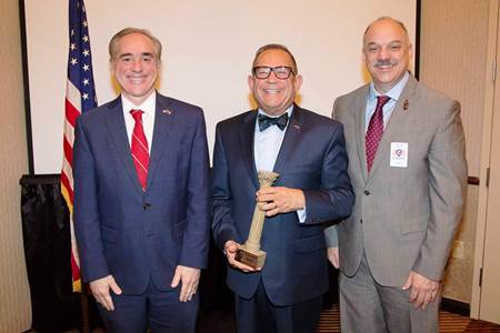
WASHINGTON, D.C. – The California Department of Veterans Affairs (CalVet) was awarded the Pillars of Excellence for Innovative State Programs for its Disabled Veteran Business Enterprise (DVBE) Program earlier this month week by the U.S. Department of Veterans Affairs (VA) and the National Association of State Directors of Veterans Affairs (NASDVA) during the organization’s annual conference in Washington, D.C.
As the state advocate for DVBEs, CalVet Secretary Dr. Vito Imbasciani accepted the award from VA Secretary Dr. David Shulkin and National Association of State Directors of Veterans Affairs President and Director of the Alaska Office of Veterans Affairs Verdie Bowen.
California’s DVBE program was created to ensure at least 3 percent of all state contracting dollars are awarded to DVBEs. That 3 percent means millions of dollars annually go directly to veteran-owned businesses, enabling them to create jobs and expand their businesses.
The program seeks to level the playing field, enabling DVBEs to compete more fairly and effectively for a portion of the state’s contracting dollars.
“I am proud to note that the state of California has met or exceeded that 3 percent goal for each of the past five years,” Dr. Imbasciani said. “In fact, as a single agency, CalVet nearly quadrupled that goal this past year by spending 11.82 percent of our contracting budget doing business with the veterans we serve.”
The program, administered by California’s Department of General Services in close consultation with CalVet, has been tremendously successful.
In the 2015-2016 fiscal year, the DVBE program exceeded the 3 percent goal by awarding 4.3 percent of contracts to veteran-owned small businesses. That is $439 million dollars of contracts awarded to our nation’s heroes.
“Veteran-owned small businesses and disabled-veteran business enterprises are essential to the good health of our economy and are a principal source of new jobs in California,” Imbasciani said. “Our team at CalVet, including our Deputy Secretary for Veterans Services, Keith Boylan, our Assistant Deputy Secretary Michael Magee, our program manager for DVBE outreach Jamie Jones, as well as her staff, have gone to great lengths to ensure that California veterans get a shot at doing business with the state.”
- Details
- Written by: Department of Veterans Affairs
An external group will review these recommendations and provide VA with guiding principles for future canine research to assure benefits to veterans.
“We understand that this is a sensitive issue,” said VA Secretary David Shulkin, “We look forward to a time when research involving canines is no longer necessary to advance the health of our veterans and are taking action to hasten that day, but until then, the agency has a duty to do everything in its power to develop new treatments to preserve and restore our veterans’ health.”
Animal research at VA is strictly controlled and monitored with accountability mechanisms in place that comply with the same regulations and standards that university programs, state, private and military organizations use.
In the past 20 years, VA use of canines in research has been reduced significantly and continues to be reduced, as much as possible.
It is important to note that of thousands of VA research projects, fewer than 15 currently involve canines.
VA has always required medical relevance and justification for canine use, and in late 2017, VA instituted a policy that no new canine research would begin without approval of both, the chief research and development officer and the VA secretary.
As a result, new canine studies have not been initiated, and two new studies were required to use alternative models instead of canines.
VA is now reviewing existing studies using canines to determine whether the use of canines in these studies should be phased out in advance of their original end dates.
In addition, when canines are the only viable models, VA is proactively contacting the principal investigators leading these studies, requesting they develop plans to establish alternative models.
VA intends to fund development of canine alternatives, which will reduce the need for canine research within VA.
- Details
- Written by: Editor
The event, which coincides with National Vietnam War Veterans Day, will begin at noon in the Vietnam Veterans Memorial in Capitol Park, located at 15th Street at Capitol Avenue behind the Rose Garden in Sacramento.
All Vietnam veterans are invited to attend and receive a commemorative lapel pin in honor of their service to our nation. Pins will be distributed on a first-come, first-served basis.
The public is welcome to attend.
Nearly three and a half million Americans served in the United States military during the Vietnam War and related conflicts in Southeast Asia between 1959 and 1975. More than 58,000 U.S. service members died during the Vietnam War, including 5,656 Californians.
The U.S. Vietnam War Commemoration began on Memorial Day in 2012 and will conclude on Veterans Day in 2025.
The period of Nov. 1, 1955, to May 15, 1975, is being used to recognize the service and sacrifice of those who served on active duty in the U.S. Armed Forces.
Nov. 1, 1955, was selected to coincide with the official designation of Military Assistance Advisory Group-Vietnam and May 15, 1975, marks the end of the battle precipitated by the seizure of the SS Mayaguez.
U.S. involvement in Vietnam started slowly with an initial deployment of advisors in the early 1950s, grew incrementally through the early 1960s and expanded with the deployment of full combat units in July 1965.
The last U.S. personnel were evacuated from Vietnam in April 1975.
For more information, visit http://www.vietnamwar50th.com.