How to resolve AdBlock issue?
Refresh this page
How to resolve AdBlock issue?
Refresh this page
Lake County News,California
  • Home
    • Registration Form
  • News
    • Education
    • Veterans
    • Community
      • Obituaries
      • Letters
      • Commentary
    • Police Logs
    • Business
    • Recreation
    • Health
    • Religion
    • Legals
    • Arts & Life
    • Regional
  • Calendar
  • Contact us
    • FAQs
    • Phones, E-Mail
    • Subscribe
  • Advertise Here
  • Login
How to resolve AdBlock issue?
Refresh this page

News

Middletown man identified as fatality in Sunday crash; driver arrested

Details
Written by: Elizabeth Larson
Published: 22 July 2025

LAKE COUNTY, Calif. — The California Highway Patrol said Tuesday that a south county wreck on Sunday evening claimed the life of a Middletown man, with the driver arrested on suspicion of driving under the influence and vehicular manslaughter.

The CHP’s Clear Lake Area office identified Samrat Kakkari, 45, as the person who died in the solo-vehicle crash.

The driver, Steven Craig Wilhite Jr., 44, of Calistoga, was arrested after the crash, authorities said.

The Tuesday report said that at approximately 6:58 p.m. Sunday, CHP Clear Lake personnel received a call of a traffic crash involving a solo vehicle rollover on Big Canyon Road, north of Harbin Springs Road, near Middletown.

When the officers arrived, they determined that the vehicle, a pickup, overturned several times, ejecting a passenger and causing fatal injuries, the CHP said.

Radio reports on Sunday night indicated that Kakkari was trapped under the bed of the pickup, which was on its side, blocking Big Canyon Road, as Lake County News has reported.

The Lake County Sheriff’s Office and South Lake County Fire also responded to the scene to assist with medical aid, the CHP said.

The CHP said the preliminary investigation determined that Wilhite was driving his Dodge Ram pickup while under the influence of a controlled substance while Kakkari was riding in the front right passenger seat of Wilhite’s truck.

Wilhite, the report said, “was driving at unsafe speeds on a dirt/gravel roadway causing him to lose control of his vehicle, which overturned and ejected Kakkari.”

The CHP said South Lake County firefighters worked to save his life but Kakkari died of his injuries at the scene.

Neither Wilhite nor Kakkari were wearing their seatbelts at the time of the crash, the CHP said.

Wilhite was arrested and treated for his injuries before being booked at the Lake County Jail for vehicular manslaughter while intoxicated and felony DUI, the CHP reported.

Lake County Jail records showed that Wilhite remained in custody on Tuesday afternoon, with bail set at $1,030,000.

Email Elizabeth Larson at This email address is being protected from spambots. You need JavaScript enabled to view it.. Follow her on Twitter, @ERLarson, and on Bluesky, @erlarson.bsky.social. Find Lake County News on the following platforms: Facebook, @LakeCoNews; X, @LakeCoNews; Threads, @lakeconews, and on Bluesky, @lakeconews.bsky.social. 

Lake County Planning Commission to consider new environmental impact report for Guenoc Valley resort

Details
Written by: Elizabeth Larson
Published: 22 July 2025

LAKEPORT, Calif. — This week the Guenoc Valley Mixed Use Planned Development Project will make its return to the Lake County Planning Commission, which will consider whether or not to approve the project’s new environmental documents and recommend possible zoning changes to the Board of Supervisors.

The meeting will begin at 9 a.m. Thursday, July 24, in the board chambers on the first floor of the Lake County Courthouse, 255 N. Forbes St., Lakeport.

The agenda is here.

To participate in real-time, join the Zoom meeting by clicking this link. 

The webinar ID is 994 1760 2765, the pass code is 155982. 

Access the meeting via one tap mobile at +16699006833,,99417602765#,,,,*155982# or dial in at 669-900-6833 or 1-669-444-9171.

The meeting also can be viewed on the county’s website or Facebook page.

The Planning Commission’s main item of business at the Thursday meeting is a public hearing to consider certifying a new final environmental impact report, or EIR, for the project, as well as make recommendations to the Board of Supervisors about changes to the Lake County General Plan, the Middletown Area Plan and the Lake County Zoning Ordinance.

The project will be built on a portion of what’s known in the planning documents as the “Guenoc Valley Site,” which consists of 82 existing parcels covering approximately 16,000 acres located in southeastern Lake County near Middletown.

The property has been owned since 2016 by Chinese developer Yiming Xu and his firm, Lotusland Investment Holdings of San Francisco. Lotusland also is the project’s applicant.

While Lotusland’s holdings also include Langtry Farms — once owned by famed English actress Lillie Langtry — county planning documents state that the Guenoc Valley Site does not include the approximately 360 acres which contains the Langtry winery and the Lillie Langtry estate home.

The project’s first EIR was certified in 2020. In June of that year, the Lake County Planning Commission voted to approve forwarding the ultra-luxury resort plan to the Board of Supervisors, which approved it the following month.

In the form approved by the board, the project, which also has been known as Maha Guenoc Valley, included a first phase covering a 1,415-acre footprint that was slated to include 385 residential villas in five subdivisions; five boutique hotels with 127 hotel units and 141 resort residential cottages; 20 campsites; up to 100 workforce housing co-housing units; resort amenities such as an outdoor entertainment area, spa and wellness amenities, sports fields, equestrian areas, a new golf course and practice facility, camping area and commercial and retail facilities; agricultural production and support facilities; essential accessory facilities, including back of house facilities; 50 temporary workforce hotel units; emergency response and fire center, float plane dock, helipads; and supporting infrastructure, according to planning documents.

In September 2020, the Center for Biological Diversity and the California Native Plant Society sued the county over the project, with the California Attorney General’s Office intervening in support of their suit.

That led to a 2021 trial in Lake County Superior Court before Judge J. David Markham who, in a January 2022 decision, found that the county’s EIR on the project was insufficient due to its conclusions that community fire evacuation routes were “less than significant.”

Markham ordered the county to rescind the project approvals because the EIR omitted disclosure and analysis of the project’s impacts on wildfire evacuation and public safety.

While Markham’s ruling resulted in a new EIR needing to be created, late last year, the California First District Appellate Court also ruled in the matter, taking action to additionally order a new EIR. Its ruling went further than Markham’s because the appellate court determined that the county failed to assess how the project would worsen existing wildfire risks.

Staff’s report to the Planning Commission explains that, at full buildout, throughout multiple phases, the resort project would allow for the development of up to 400 hotel rooms, 450 resort residential units, 1,400 residential estates, and 500 workforce co-housing units within the zoning district. 

The project’s phase one includes the phased subdivision to allow up to 385 residential villas, 141 resort residential units, 147 hotel units, accessory resort and commercial uses; a subdivision and rezoning of an off-site parcel to accommodate 21 single family residences with optional accessory dwelling units, 29 duplex units in 15 structures, and a community clubhouse and associated infrastructure; a proposed water supply well on an off-site parcel and pipeline located adjacent to and within Butts Canyon Road, along with intersection and electrical transmission line improvements.

Project modifications, as outlined in the staff report, include the following:

• Relocating 25 residential building sites that the 2020 project would have located on a hilltop near the proposed Equestrian Center and 39 residential building sites that the 2020 project would have located within the northeastern portion of the project site to move them further from the wildland/urban interface.
• A new proposed emergency route called the Grange Road Connector will connect the Guenoc Valley Site with the county-maintained Grange Road to the north. 
• Reconfiguring the roadway plan so that there are no dead-end, non-looped road segments that exceed one mile in length.
• Improving an area of approximately 10 feet on each side of roadways with hardscape, to the extent topography permits.
• Removal of the camping area in the northern portion of the property.
• Funding and staffing commitments for the onsite emergency response center.
• Various renewable energy commitments and greenhouse gas reduction measures that will not change the development footprint.

Email Elizabeth Larson at This email address is being protected from spambots. You need JavaScript enabled to view it.. Follow her on Twitter, @ERLarson, and on Bluesky, @erlarson.bsky.social. Find Lake County News on the following platforms: Facebook, @LakeCoNews; X, @LakeCoNews; Threads, @lakeconews, and on Bluesky, @lakeconews.bsky.social. 

NCO Community Emergency Response Team and Lake County Public Health launch mutual aid partnership

Details
Written by: LAKE COUNTY NEWS REPORTS
Published: 22 July 2025
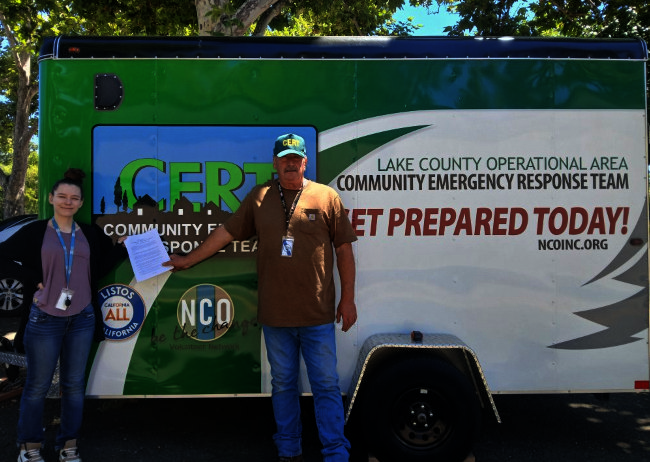
North Coast Opportunities’ Community Emergency Response Team, or CERT, Dennis Burke and Amanda Samson stand in front of the CERT Equipment Trailer. Photo courtesy of North Coast Opportunities.


LAKE COUNTY, Calif. — North Coast Opportunities’ Community Emergency Response Team, or CERT, in Lake County has entered into a formal mutual aid memorandum of understanding with the Lake County Public Health Department, effective July 1.

This new collaboration creates a reciprocal partnership: NCO CERT Instructors will provide disaster preparedness and emergency response training to Lake County Public Health Public Health staff, while Public Health will offer training to CERT volunteers to support vaccine clinics and public health emergency response, including future pandemics.

The partnership is already in action — NCO CERT Instructors Dennis Burke (Project Coordinator III) and Lead Volunteer Duell Parks recently conducted training for Public Health staff on fire suppression and fire extinguisher use. 

Public Health-led training for CERT volunteers is set to begin soon and will include topics such as handling toxic and hazardous materials during emergencies.

Lake County Public Health is also investing $15,000 to support several CERT programs. This funding will expand outreach through:

• Preparedness Program Awareness for Seniors, or PPAS, offering disaster readiness resources, go-bags and smoke detectors to vulnerable seniors;
• A brand-new TEEN CERT Program launching in a local high school — Lake and Mendocino Counties’ first;
• Continued disaster pet preparedness outreach;
• Completion of ham radio installations in Lake County CERT disaster trailers, including solar power systems.

NCO said this milestone was made possible through the dedication of Public Health staff and NCO’s Dennis Burke, Amanda Samson (Project Coordinator I) and Program Manager Yvett Reeve, who championed the project through months of planning and coordination.

“This partnership strengthens our ability to serve Lake County through coordinated response and proactive preparedness,” said Reeve.

North Coast Opportunities Inc. is a nonprofit community action agency serving Lake and Mendocino counties, with additional programs in Humboldt, Sonoma, Del Norte, Napa and Solano counties.

PBS and NPR are generally unbiased, independent of government propaganda and provide key benefits to US democracy

Details
Written by: Stephanie A. (Sam) Martin, Boise State University
Published: 22 July 2025

Congress’ cuts to public broadcasting will diminish the range and volume of the free press and the independent reporting it provides. MicroStockHub-iStock/Getty Images Plus

Champions of the almost entirely party-line vote in the U.S. Senate to erase US$1.1 billion in already approved funds for the Corporation for Public Broadcasting called their action a refusal to subsidize liberal media.

“Public broadcasting has long been overtaken by partisan activists,” said U.S. Sen. Ted Cruz of Texas, insisting there is no need for government to fund what he regards as biased media. “If you want to watch the left-wing propaganda, turn on MSNBC,” Cruz said.

Accusing the media of liberal bias has been a consistent conservative complaint since the civil rights era, when white Southerners insisted news outlets were slanting their stories against segregation. During his presidential campaign in 1964, U.S. Sen. Barry Goldwater of Arizona complained that the media was against him, an accusation that has been repeated by every Republican presidential candidate since.

But those charges of bias rarely survive empirical scrutiny.

As chair of a public policy institute devoted to strengthening deliberative democracy, I have written two books about the media and the presidency, and another about media ethics. My research traces how news institutions shape civic life and why healthy democracies rely on journalism that is independent of both market pressure and partisan talking points.

That independence in the United States – enshrined in the press freedom clause of the First Amendment – gives journalists the ability to hold government accountable, expose abuses of power and thereby support democracy.

A gray-haired man with a beard and wearing a blue jacket and tie, talks in a large room.
GOP Sen. Ted Cruz speaks to reporters as Senate Republicans vote on President Donald Trump’s request to cancel about $9 billion in foreign aid and public broadcasting spending on July 16, 2025. AP Photo/J. Scott Applewhite

Trusting independence

Ad Fontes Media, a self-described “public benefit company” whose mission is to rate media for credibility and bias, have placed the reporting of “PBS NewsHour” under 10 points left of the ideological center. They label it as both “reliable” and based in “analysis/fact.” “Fox and Friends,” by contrast, the popular morning show on Fox News, is nearly 20 points to the right. The scale starts at zero and runs 42 points to the left to measure progressive bias and 42 points to the right to measure conservative bias. Ratings are provided by three-person panels comprising left-, right- and center-leaning reviewers.

A 2020 peer-reviewed study in Science Advances that tracked more than 6,000 political reporters likewise found “no evidence of liberal media bias” in the stories they chose to cover, even though most journalists are more left-leaning than the rest of the population.

A similar 2016 study published in Public Opinion Quarterly said that media are more similar than dissimilar and, excepting political scandals, “major news organizations present topics in a largely nonpartisan manner, casting neither Democrats nor Republicans in a particularly favorable or unfavorable light.”

Surveys show public media’s audiences do not see it as biased. A national poll of likely voters released July 14, 2025, found that 53% of respondents trust public media to report news “fully, accurately and fairly,” while only 35% extend that trust to “the media in general.” A majority also opposed eliminating federal support.

Contrast these numbers with attitudes about public broadcasters such as MTVA in Hungary or the TVP in Poland, where the state controls most content. Protests in Budapest October 2024 drew thousands demanding an end to “propaganda.” Oxford’s Reuters Institute for the Study of Journalism reports that TVP is the least trusted news outlet in the country.

While critics sometimes conflate American public broadcasting with state-run outlets, the structures are very different.

Safeguards for editorial freedom

In state-run media systems, a government agency hires editors, dictates coverage and provides full funding from the treasury. Public officials determine – or make up – what is newsworthy. Individual media operations survive only so long as the party in power is happy.

Public broadcasting in the U.S. works in almost exactly the opposite way: The Corporation for Public Broadcasting is a private nonprofit with a statutory “firewall” that forbids political interference.

More than 70% of the Corporation for Public Broadcasting’s federal appropriation for 2025 of US$1.1 billion flows through to roughly 1,500 independently governed local stations, most of which are NPR or PBS affiliates but some of which are unaffiliated community broadcasters. CPB headquarters retains only about 5% of that federal funding.

Stations survive by combining this modest federal grant money with listener donations, underwriting and foundation support. That creates a diversified revenue mix that further safeguards their editorial freedom.

And while stations share content, each also has latitude when it comes to programming and news coverage, especially at the local level.

As a public-private partnership, individual communities mostly own the public broadcasting system and its affiliate stations. Congress allocates funds, while community nonprofits, university boards, state authorities or other local license holders actually own and run the stations. Individual monthly donors are often called “members” and sometimes have voting rights in station-governance matters. Membership contributions make up the largest share of revenue for most stations, providing another safeguard for editorial independence.
Two people inside a radio studio, sitting at a long table-desk combination.
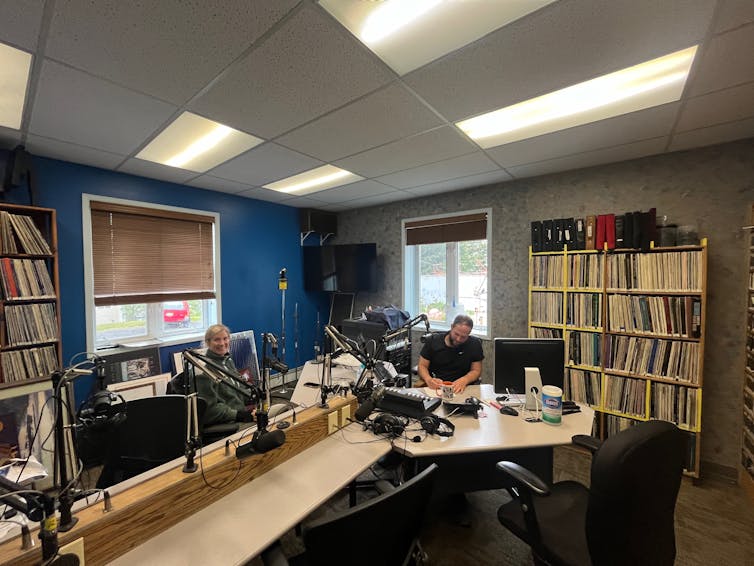
A host and guest in July 2024 sit inside a recording studio at KMXT, the public radio station on Kodiak Island in Alaska. Nathaniel Herz/Northern Journal

Broadly shared civic commons

And then there are public media’s critical benefits to democracy itself.

A 2021 report from the European Broadcasting Union links public broadcasting with higher voter turnout, better factual knowledge and lower susceptibility to extremist rhetoric.

Experts warn that even small cuts will exacerbate an already pernicious problem with political disinformation in the U.S., as citizens lose access to free information that fosters media literacy and encourages trust across demographics.

In many ways, public media remains the last broadly shared civic commons. It is both commercial-free and independently edited.

Another study, by the University of Pennsylvania’s Annenberg School in 2022, affirmed that “countries with independent and well-funded public broadcasting systems also consistently have stronger democracies.”

The study highlighted how public media works to bridge divides and foster understanding across polarized groups. Unlike commercial media, where the profit motive often creates incentives to emphasize conflict and sensationalism, public media generally seeks to provide balanced perspectives that encourage dialogue and mutual respect. Reports are often longer and more in-depth than those by other news outlets.

Such attention to nuance provides a critical counterweight to the fragmented, often hyperpartisan news bubbles that pervade cable news and social media. And this skillful, more balanced treatment helps to ameliorate political polarization and misinformation.

In all, public media’s unique structure and mission make democracy healthier in the U.S. and across the world. Public media prioritizes education and civic enlightenment. It gives citizens important tools for navigating complex issues to make informed decisions – whether those decisions are about whom to vote for or about public policy itself. Maintaining and strengthening public broadcasting preserves media diversity and advances important principles of self-government.

Congress’ cuts to public broadcasting will diminish the range and volume of the free press and the independent reporting it provides. Ronald Reagan once described a free press as vital for the United States to succeed in its “noble experiment in self-government.” From that perspective, more independent reporting – not less – will prove the best remedy for any worry about partisan spin.The Conversation

Stephanie A. (Sam) Martin, Frank and Bethine Church Endowed Chair of Public Affairs, Boise State University

This article is republished from The Conversation under a Creative Commons license. Read the original article.

  1. Legislators oppose Trump administration’s attempt to undermine church-state separation
  2. Solo vehicle crash results in fatality Sunday evening
  3. Supervisors to discuss economic development plans, air quality fee hike and CEO-style government
  • 282
  • 283
  • 284
  • 285
  • 286
  • 287
  • 288
  • 289
  • 290
  • 291
How to resolve AdBlock issue?
Refresh this page