How to resolve AdBlock issue?
Refresh this page
How to resolve AdBlock issue?
Refresh this page
Lake County News,California
  • Home
    • Registration Form
  • News
    • Education
    • Veterans
    • Community
      • Obituaries
      • Letters
      • Commentary
    • Police Logs
    • Business
    • Recreation
    • Health
    • Religion
    • Legals
    • Arts & Life
    • Regional
  • Calendar
  • Contact us
    • FAQs
    • Phones, E-Mail
    • Subscribe
  • Advertise Here
  • Login
How to resolve AdBlock issue?
Refresh this page

News

New supervisors sworn in; board elects new chair and vice chair

Details
Written by: LINGZI CHEN
Published: 08 January 2025
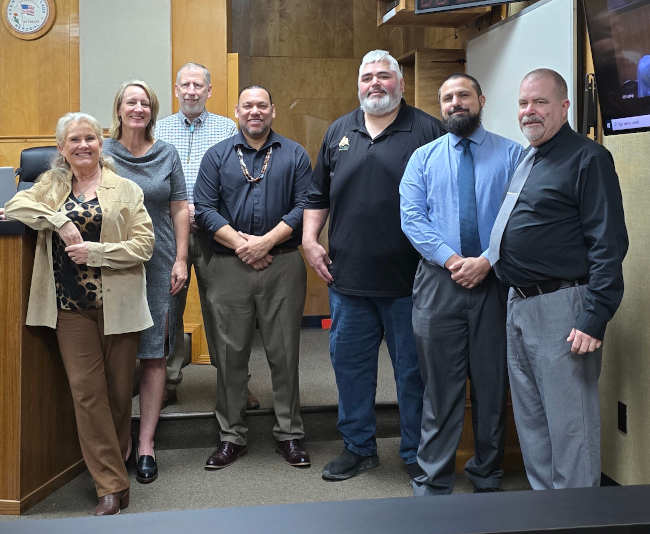
From left, new District 1 Supervisor Helen Owen, District 5 Supervisor Jessica Pyska, outgoing District 4 Supervisor Michael Green, District 3 Supervisor and Board Chair EJ Crandell, outgoing District 1 Supervisor Moke Simon, District 2 Supervisor Bruno Sabatier and new District 4 Supervisor Brad Rasmussen during the Board of Supervisors meeting on Tuesday, Jan. 7, 2025. Photo by Lingzi Chen/Lake County News.

LAKE COUNTY, Calif. — At the Board of Supervisors’ first meeting of 2025 on Tuesday, newly elected and re-elected supervisors were sworn into office and they elected the board’s new chair and vice chair.

District 1 Supervisor Helen Owen, a longtime Middletown rancher, and District 4 Supervisor Brad Rasmussen, Lakeport’s retired police chief, officially took office as the county’s newest supervisors. They succeed outgoing supervisors Mike Simon and Michael Green, respectively.

District 5 Supervisor Jessica Pyska, who won reelection in March, is starting her second term.

Supervisor Eddie Crandell was elected as the chair and Supervisor Rasmussen as the vice chair.

In the meeting, outgoing supervisors made their final remarks.

“Just want to thank everybody who supported me throughout my two terms,” said Simon, who expressed special thanks to the county administration and employees for their hard work.

Supervisor Green said being a supervisor does not only mean to represent the constituency and workforce, but also “the municipal corporation that is the county itself,” where “hundreds of millions of dollars flow through the County of Lake to provide services.”

“I do want to thank county administrative staff and all the department heads for their support, patience and understanding during my brief yet rewarding term,” Green said. He was appointed by the Governer’s Office as District 4 supervisor at the end of 2022 to succeed Tina Scott.

Lake County Registrar of Voters Maria Valadez administered the oath of office individually for all candidates who were to start a new term of service for the county, including the three supervisors and the new Sheriff-Coroner Lucas Bingham, who won his election unopposed in March.

‘Double election’ of the board chair and vice chair

The process of electing a new chair and vice chair generated some confusion.

After taking the oath, new supervisors Owen and Rasmussen were asked to take a seat at the table right below the dais, while Green and Simon stayed in their seats.

“Stay right there,” said Green to Owen and Rasmussen. “We’re going to do an election, and then we’re going to get you up here.”

“And this, ladies and gentlemen, is how we do a peaceful, orderly transition of power,” Green added, and the audience in the chamber applauded with light laughter.

Green, who was stepping down from his role, went on to take nominations for the chair and vice chair for the new board.

Pyska nominated Crandell — who was the vice chair in 2024 — as the chair, which was the only nomination for the position. Green moved on to have the vote by the sitting board that included the two outgoing supervisors.

It turned out that the seven “supervisors,” incoming and outgoing, all said “aye” in favor of having Crandell as the new chair.

Owen then nominated Rasmussen as vice chair. Pyska immediately raised a question.

“According to our board policy, you have to have one year to be vice chair or chair,” Pyska said. “It’s in our board policy.”

“I don’t believe it’s a hard shall-not,” said Supervisor Bruno Sabatier.

While the board policy does not have a written prerequisite for the vice chair position, it does have one for the chair.

County Counsel Lloyd Guintivano said in the meeting that he found the rule from the Board of Supervisors’ policy manual which states “a member shall not be elected to serve as chair unless he or she has been a member of the board for the preceding calendar year.”

Guintivano noted in the situation where the chair is not available, “whoever’s sitting as a chair must be a member of the board for the preceding calendar year.”

“In reading that language, it appears that your board may consider other nominations for the vice chair in light of that clause,” Guintivano added.

“I would say, that particular clause, the most strict application? Yes,” said Green. “But if we want it to be that strict in that application, we should have added the term ‘vice chair’ to that same clause.”

He added, “As the sitting chair, that’s my outgoing act — I don’t think the strict application is necessary at this point. And most importantly, we don’t have any other nominations.”

During the discussion, a member of the public called in on Zoom saying that she wanted to nominate another candidate. It was stopped by Green, who said that the public would not be entitled to make nominations. While the woman did not identify herself, Lake County News staff believe it was Julia Bono of Middletown.

The board went on to have the vote and all voted in favor of having Rasmussen as the vice chair.

After a brief recess, Green and Simon left the dais and Owen and Rasmussen moved up to take their seats.

The new board then voted again to select the chair and vice chair, with the same results, with unanimous approval.

While both rounds of votes generated the same outcome, Assistant Clerk to the Board of Supervisors Johanna DeLong said only the votes of the five supervisors of the new board would count.

“They were all sitting there saying aye, but I think the only ones that count are technically the new board,” she said when Lake County News called to verify the voting action details. “There were only five seats; we don’t have seven supervisors.”

The new Board of Supervisors now includes Helen Owen for District 1, Bruno Sabatier for District 2, Eddie Crandell for District 3, Brad Rasmussen for District 4 and Jessica Pyska for District 5, with Crandell serving as the new chair and Rasmussen the vice chair for 2025.

Email staff reporter Lingzi Chen at This email address is being protected from spambots. You need JavaScript enabled to view it..


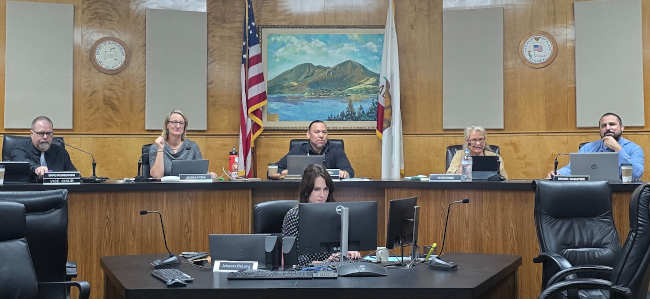
The new Lake County Board of Supervisors gets down to business in its first meeting of the year on Tuesday, Jan. 7, 2025. Photo by Lingzi Chen/Lake County News.

New District 1 supervisor opens applications for Lake County Planning Commission

Details
Written by: Elizabeth Larson
Published: 08 January 2025
LAKE COUNTY, Calif. — New Supervisor Helen Owen is accepting applications for the District 1 representative on the Lake County Planning Commission.

Owen, who was elected Nov. 5, took her seat on the Board of Supervisors during its first meeting of the year on Tuesday.

Owen said she is taking applications for the position from interested individuals as part of following through on her promise to represent all the people of the district fairly.

Applications must be submitted by Jan. 21 to This email address is being protected from spambots. You need JavaScript enabled to view it..

Owen said she has created a panel with a representative from all areas in the district to review the applications. Additionally, the panel will include retired District 5 Supervisor Rob Brown.

The top candidates will be called for a formal interview with the panel. Owen will have the final decision on who is recommended for the position.

The selection will be made and the candidate will be notified and it will be confirmed that they are willing to serve as the District 1 planning commissioner, Owen said.

Owen said she plans to place her planning commissioner recommendation for the board’s approval on the Feb. 4 agenda.

Email Elizabeth Larson at This email address is being protected from spambots. You need JavaScript enabled to view it.. Follow her on Twitter, @ERLarson, and on Bluesky, @erlarson.bsky.social. Find Lake County News on the following platforms: Facebook, @LakeCoNews; X, @LakeCoNews; Threads, @lakeconews, and on Bluesky, @lakeconews.bsky.social.

Dr. Erica Pan appointed next California Department of Public Health director and state Public Health officer

Details
Written by: LAKE COUNTY NEWS REPORTS
Published: 08 January 2025
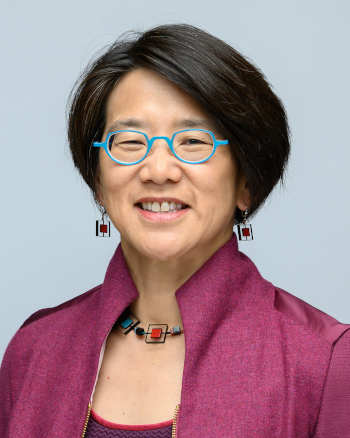
Dr. Erica Pan. Courtesy photo.

Dr. Erica Pan will become the next Director and state Public Health officer of the California Department of Public Health, or CDPH, on Feb. 1.

She will work collaboratively with partners to help to implement Gov. Gavin Newsom’s public health policy goals to support healthy individuals, families and communities.

Dr. Pan will replace Dr. Tomás Aragón, who recently announced his upcoming retirement.

Dr. Aragón has served as CDPH director and state Public Health officer since Jan. 4, 2021. He retires on Jan. 31.

Dr. Aragón has served California as a public health leader for more than 20 years. As CDPH director, he has helped transform public health policies and systems with an emphasis on equity, antiracism, healing and health for all. Before joining CDPH, he was the health officer for the city and county of San Francisco.

“I am confident Erica will take CDPH to the next level with her deep understanding of public health, strong servant leadership, compassion and work ethic,” said Dr. Aragón. “She brings to this role a unique combination of skills, along with a demonstrated commitment to equity, that will help her deliver results for the people of California."

Dr. Pan joined CDPH in July 2020 as the deputy director for the Center for Infectious Diseases and state epidemiologist. During that time, she helped lead the state through the COVID-19 pandemic, multiple infectious disease outbreaks, Ebola planning and the current bird flu situation.

In all, Dr. Pan has more than 20 years of public health leadership experience. Before joining CDPH, she served as the Alameda County Health Officer. In fact, she held various roles at the Alameda County Public Health Department since 2011, including director of the Division of Communicable Disease Control and Prevention, and deputy health officer.

“It is an incredible honor to serve California in this role at a critical time when we need to empower and engage the public to have confidence in the science and evidence that has saved lives and promotes a healthy California for all,” said Dr. Pan. “Dr. Aragón has been an inspiration and mentor to me from early on in my public health career and he is a respected public health leader who has led CDPH to ‘become the best at getting better.’ I aim to build on his legacy, and I’m committed to a smooth transition for the Department.”

Dr. Pan is also a clinical professor in the Department of Pediatrics, Division of Pediatric Infectious Diseases at the University of California, San Francisco. She maintained her clinical work at San Francisco General Hospital and at UCSF Benioff Children's Hospitals in San Francisco and Oakland in Infectious Diseases until 2019.

Will AI revolutionize drug development? Researchers explain why it depends on how it’s used

Details
Written by: Duxin Sun, University of Michigan and Christian Macedonia, University of Michigan
Published: 08 January 2025


A high drug failure rate is more than just a pattern recognition problem. Thom Leach/Science Photo Library via Getty Images

The potential of using artificial intelligence in drug discovery and development has sparked both excitement and skepticism among scientists, investors and the general public.

“Artificial intelligence is taking over drug development,” claim some companies and researchers. Over the past few years, interest in using AI to design drugs and optimize clinical trials has driven a surge in research and investment. AI-driven platforms like AlphaFold, which won the 2024 Nobel Prize for its ability to predict the structure of proteins and design new ones, showcase AI’s potential to accelerate drug development.

AI in drug discovery is “nonsense,” warn some industry veterans. They urge that “AI’s potential to accelerate drug discovery needs a reality check,” as AI-generated drugs have yet to demonstrate an ability to address the 90% failure rate of new drugs in clinical trials. Unlike the success of AI in image analysis, its effect on drug development remains unclear.

Pharmacist searching through drawer of drug packages
Behind every drug in your pharmacy are many, many more that failed. nortonrsx/iStock via Getty Images Plus

We have been following the use of AI in drug development in our work as a pharmaceutical scientist in both academia and the pharmaceutical industry and as a former program manager in the Defense Advanced Research Projects Agency, or DARPA. We argue that AI in drug development is not yet a game-changer, nor is it complete nonsense. AI is not a black box that can turn any idea into gold. Rather, we see it as a tool that, when used wisely and competently, could help address the root causes of drug failure and streamline the process.

Most work using AI in drug development intends to reduce the time and money it takes to bring one drug to market – currently 10 to 15 years and US$1 billion to $2 billion. But can AI truly revolutionize drug development and improve success rates?

AI in drug development

Researchers have applied AI and machine learning to every stage of the drug development process. This includes identifying targets in the body, screening potential candidates, designing drug molecules, predicting toxicity and selecting patients who might respond best to the drugs in clinical trials, among others.

Between 2010 and 2022, 20 AI-focused startups discovered 158 drug candidates, 15 of which advanced to clinical trials. Some of these drug candidates were able to complete preclinical testing in the lab and enter human trials in just 30 months, compared with the typical 3 to 6 years. This accomplishment demonstrates AI’s potential to accelerate drug development.

Drug development is a long and costly process.

On the other hand, while AI platforms may rapidly identify compounds that work on cells in a Petri dish or in animal models, the success of these candidates in clinical trials – where the majority of drug failures occur – remains highly uncertain.

Unlike other fields that have large, high-quality datasets available to train AI models, such as image analysis and language processing, the AI in drug development is constrained by small, low-quality datasets. It is difficult to generate drug-related datasets on cells, animals or humans for millions to billions of compounds. While AlphaFold is a breakthrough in predicting protein structures, how precise it can be for drug design remains uncertain. Minor changes to a drug’s structure can greatly affect its activity in the body and thus how effective it is in treating disease.

Survivorship bias

Like AI, past innovations in drug development like computer-aided drug design, the Human Genome Project and high-throughput screening have improved individual steps of the process in the past 40 years, yet drug failure rates haven’t improved.

Most AI researchers can tackle specific tasks in the drug development process when provided with high-quality data and particular questions to answer. But they are often unfamiliar with the full scope of drug development, reducing challenges into pattern recognition problems and refinement of individual steps of the process. Meanwhile, many scientists with expertise in drug development lack training in AI and machine learning. These communication barriers can hinder scientists from moving beyond the mechanics of current development processes and identifying the root causes of drug failures.

Current approaches to drug development, including those using AI, may have fallen into a survivorship bias trap, overly focusing on less critical aspects of the process while overlooking major problems that contribute most to failure. This is analogous to repairing damage to the wings of aircraft returning from the battle fields in World War II while neglecting the fatal vulnerabilities in engines or cockpits of the planes that never made it back. Researchers often overly focus on how to improve a drug’s individual properties rather than the root causes of failure.

Diagram of airplane with clusters of red dots on the wing tips, tail and cockpit areas
While returning planes might survive hits to the wings, those with damage to the engines or cockpits are less likely to make it back. Martin Grandjean, McGeddon, US Air Force/Wikimedia Commons, CC BY-SA

The current drug development process operates like an assembly line, relying on a checkbox approach with extensive testing at each step of the process. While AI may be able to reduce the time and cost of the lab-based preclinical stages of this assembly line, it is unlikely to boost success rates in the more costly clinical stages that involve testing in people. The persistent 90% failure rate of drugs in clinical trials, despite 40 years of process improvements, underscores this limitation.

Addressing root causes

Drug failures in clinical trials are not solely due to how these studies are designed; selecting the wrong drug candidates to test in clinical trials is also a major factor. New AI-guided strategies could help address both of these challenges.

Currently, three interdependent factors drive most drug failures: dosage, safety and efficacy. Some drugs fail because they’re too toxic, or unsafe. Other drugs fail because they’re deemed ineffective, often because the dose can’t be increased any further without causing harm.

We and our colleagues propose a machine learning system to help select drug candidates by predicting dosage, safety and efficacy based on five previously overlooked features of drugs. Specifically, researchers could use AI models to determine how specifically and potently the drug binds to known and unknown targets, the level of these targets in the body, how concentrated the drug becomes in healthy and diseased tissues, and the drug’s structural properties.

These features of AI-generated drugs could be tested in what we call phase 0+ trials, using ultra-low doses in patients with severe and mild disease. This could help researchers identify optimal drugs while reducing the costs of the current “test-and-see” approach to clinical trials.

While AI alone might not revolutionize drug development, it can help address the root causes of why drugs fail and streamline the lengthy process to approval.The Conversation

Duxin Sun, Associate Dean for Research, Charles Walgreen Jr. Professor of Pharmacy and Pharmaceutical Sciences, University of Michigan and Christian Macedonia, Adjunct Professor in Pharmaceutical Sciences, University of Michigan

This article is republished from The Conversation under a Creative Commons license. Read the original article.

  1. Yuba Community College District Board to consider approving new faculty contract
  2. Woodland Community College’s Lake County Campus plans Super Saturday and Culinary Round Up
  3. Forecast calls for gusty winds in parts of Lake County
  • 487
  • 488
  • 489
  • 490
  • 491
  • 492
  • 493
  • 494
  • 495
  • 496
How to resolve AdBlock issue?
Refresh this page