 How to resolve AdBlock issue?
News
- Details
- Written by: LAKE COUNTY NEWS REPORTS
“As we launch this new service year with the nation’s largest service corps, we reaffirm that service to others is the highest form of civic duty. These paid opportunities embody the best of California’s values — a commitment to each other, mutual understanding, and the belief that when we lift others, we all rise together,” Newsom said.
California leads the way in national service
In 2025, California Service Corps programs will be over 10,000 members strong and will help communities by:
• Tutoring and mentoring K-12 students.
• Supporting communities experiencing and recovering from disasters.
• Combating food insecurity and connecting vulnerable people to resources and services.
• Taking climate action — planting trees, preventing wildfires, and installing solar panels.
California Service Corps programs include:
• #CaliforniansForAll College Corps.
• Youth Service Corps.
• California Climate Action Corps.
• AmeriCorps California.
“Service members have stepped up to bridge divides and help their communities by serving in the California Service Corps,” said California Chief Service Officer Josh Fryday. “These members are the state’s future leaders, and we need their energy and enthusiasm to address our greatest challenges.”
California Service Corps members gain skills and experience while effecting positive change in their communities. Members receive living stipends, and many can receive up to $10,000 toward higher education after completing their service to be used for college, trade school or to pay back student loans.
To learn more about applying to the California Climate Action Corps, Youth Service Corps and AmeriCorps California, visit www.CAServiceCorps.com.
- Details
- Written by: LAKE COUNTY NEWS REPORTS
The free, two-hour Start Smart class helps newly licensed teens navigate the risks of driving while highlighting the essential role of guardian involvement in traffic safety.
Led by an experienced CHP public information officer, the class covers topics such as crash prevention, safe driving habits, consequences of risky behavior, guardian responsibilities, and legal liabilities.
The program requires a guardian’s participation because it recognizes their influence on teen driving habits.
Through Start Smart, guardians learn how to support their teens, enforce safe driving practices, and understand the laws affecting young drivers.
“The Start Smart program allows us to take proactive steps in protecting our youngest drivers by equipping them and their parents or guardians with the knowledge and tools needed to navigate the road safely,” said CHP Commissioner Duryee. “Educating new drivers on responsible habits today will help prevent tragedies tomorrow, and we’re proud to be able to offer a program that prioritizes the safety and well-being of our communities.”
To register to attend an upcoming Start Smart class, contact your local CHP office. More information about Start Smart and California’s provisional driver licensing law is available on the free CHP Start Smart App.
Available for download in the Apple app store or Google Play, this app provides users with access to the Department of Motor Vehicles’ California Driver’s Handbook and a trip logger to track driving time as teens prepare to obtain their driver's license.
Additional information about the Start Smart program and the mobile app can be found on the CHP’s website.
Funding for this program was provided by a grant from the California Office of Traffic Safety through the National Highway Traffic Safety Administration.
- Details
- Written by: LINGZI CHEN

The vibrant orange of the pumpkin patch pops against the backdrop of tall, green corn stalks, with whimsical pink pig rides flying across the scene — colors that capture the essence of fall and fun.
For eight years, That Ranch has come alive every weekend from mid-September to late October.
It features a nonprofit pumpkin patch, where proceeds go to the National FFA Organization chapter at Kelseyville High, known as the Kelseyville FFA, and a for-profit corn maze paired with family-friendly activities celebrating agricultural traditions and community bonds.
Throughout the week, the ranch also hosts various events, from mocktail parties to art sessions, spooky Halloween nights to relaxed family outings.
The name That Ranch is a play on owner Tanya Hat’s name, combining the “T” from Tanya with her last name.
When asked how many pumpkins were grown each year, Hat laughed.
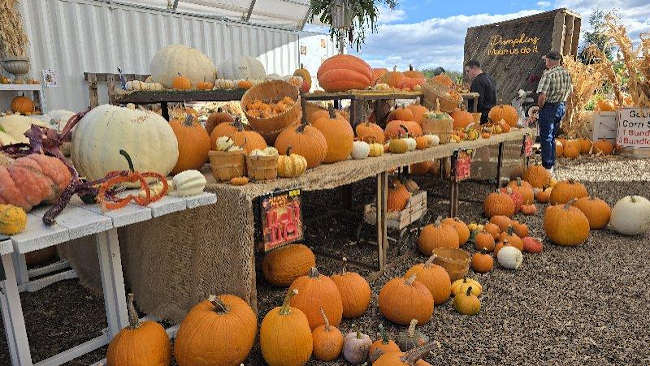
“I really have never measured the amount. I just keep growing!” she told Lake County News, standing beside her pumpkins on a sunny Tuesday morning in October.
Later, Hat’s husband, Michael Hat said over the phone that he estimated it to be about 30,000 pumpkins last year grown from the 14 acres of land; and it’s a little less than that this year.
Tanya Hat admitted she's not one for numbers — her passion lies in creating and visualizing.
That Ranch grows more than100 varieties of pumpkins, she said. The entrance is decorated with pumpkins in all sizes and colors — yellow, orange, blue and white, evoking the magical atmosphere of a fairytale garden.
On one of the benches, mini pumpkins were placed on a large chess board as the chess pieces and would draw children to play as if it were a real game.
“The design, the detail here blows me away,” said Marilyn Holdenried, a longtime Kelseyville resident who, along with husband Myron, grows winegrapes and pears. She was admiring how Hat curated and rearranged pumpkins and other elements every night.
For Hat, That Ranch is more than just six weeks in the fall. Along with her small team of two full-time staff, Hat starts preparing the fields as early as April — laying drip lines and planning the layout. Planting begins in summer, and within 90 to 120 days, 30,000 pumpkins and towering corn stalks emerge.
“It’s really magic within a short period of time, yeah?” Hat said. “So within literally four months, this appears.”
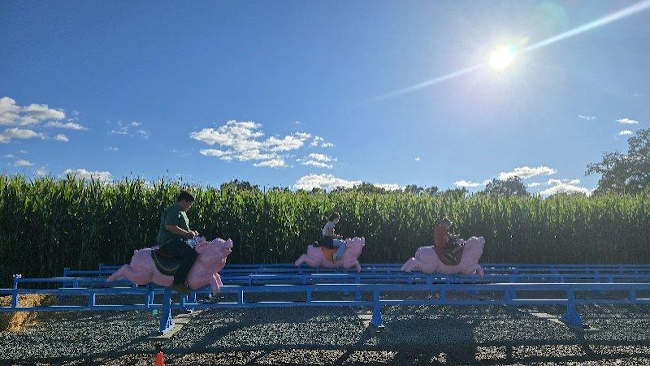
High schoolers, pumpkins and the corn maze
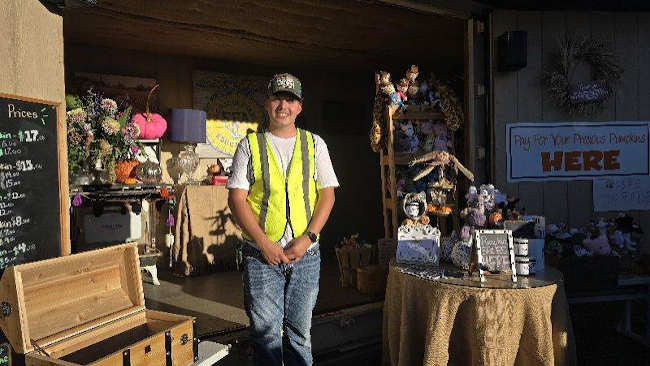
The pumpkin sales station is managed by students from Kelseyville High School as part of their Supervised Agriculture Education program.
This year, 70 students applied and 32 were selected to work. They take morning and afternoon shifts on weekends, interacting with visitors, managing booths, and overseeing ranch activities.
At the end of every season, Tanya Hat writes a check to Kelseyville FFA, reflecting the pumpkin sales.
“First year we did it, I think it was like $2,000, then $4,000, then $6,000,” Hat said, recalling the growth in sales over the years
In 2022, sales reached $30,000, and in 2023, they hit $40,000 — all of which went to Kelseyville FFA, said Hat.
“Pumpkin sales have sent our students all over California, along with trips to Washington DC and soon the National FFA Convention at the end of the month,” said a message posted on Kelseyville FFA’s Facebook page on Sep. 25.
“It’s huge,” Hat said of the partnership between That Ranch and the school through the school FFA advisor Donelle McCallister. “I couldn’t do what I do without Donnell and her kids.”

For the students, this opportunity gives them real-world experience in interacting with the community and handling business.
“We’re growing up in a few years; we’re going to be out in the world,” said Jose Mejia, a sophomore at Kelseyville High who worked as the pumpkin cashier last Sunday. “But this is like a little, tiny baby step, dipping our toes into those waters.”
Besides all the fun and joy, Hat did not forget to set up a voter registration booth on site embraced by pumpkins with voter registration forms and other information brochures.
“We have to encourage people to get registered to vote, to go vote and believe in the process of voting.”
This year the corn maze was carved out in an election-themed design — an elephant and a donkey representing the two political parties, with “WE THE PEOPLE” at the top and “LAKE COUNTY 2024” the bottom
The message is: “We, the people, vote,” Hat said.
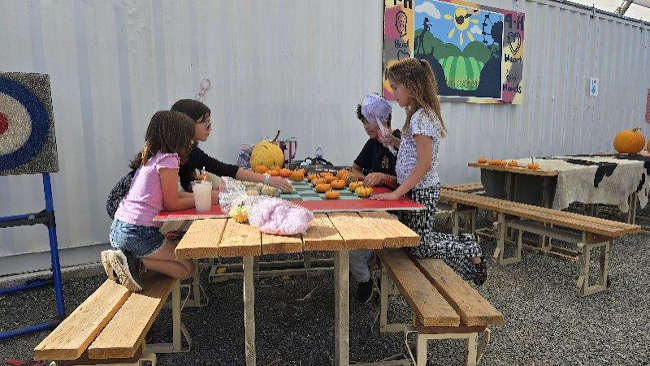
What if you get lost in the maze?
“We’ll find you next Thursday,” Hat said with a grin.
After a drizzly Saturday, the land where pumpkins and corn grow was still a bit muddy. But under clear skies and warm sunshine the next day on Oct. 14, families and friends gathered as children played and explored the curated wonderland.
Pumpkins were picked and loaded into wheelbarrows by visitors while high schoolers stayed busy, working as cashiers or making popcorn and hotdogs.
Sunflowers stood tall, guarding the trails around the corn maze. In the pizza garden, tomatoes and peppers quietly thrived under the care of the students. Sprinklers worked diligently, watering the soil and occasionally giving passersby an unexpected shower. Children dashed into the sea of bubbles blown from the foam daddy machine.
As Hat put it, “It’s just a playground of fun.”
Email Lingzi Chen at

- Details
- Written by: Elizabeth Larson
The board will meet beginning at 9 a.m. Tuesday, Oct. 22, in the board chambers on the first floor of the Lake County Courthouse, 255 N. Forbes St., Lakeport.
The meeting can be watched live on Channel 8, online at https://countyoflake.legistar.com/Calendar.aspx and on the county’s Facebook page. Accompanying board documents, the agenda and archived board meeting videos also are available at that link.
To participate in real-time, join the Zoom meeting by clicking this link.
The meeting ID is 865 3354 4962, pass code 726865. The meeting also can be accessed via one tap mobile at +16694449171,,86533544962#,,,,*726865#. The meeting can also be accessed via phone at 669 900 6833.
In an untimed item, the board will consider a proposed letter to Charles M. Schulz Sonoma County Airport, or STS, encouraging development of approach and departure procedures to mitigate noise impacts by aircraft on the Cobb Mountain communities.
The report to the board from Supervisor Jessica Pyska says the airport “is in the process of updating their Runway Approach Protection Plan. This Approach Feasibility Study is a 5-year project to address noise concerns, receive input from the community surrounding the airport, and to ‘be a good neighbor.’”
Psyka also notes, “The communities of Cobb Mountain and Middletown are impacted by the increasing air traffic approaching and departing runway 14 at STS. As STS develops its Fly Quiet Program through this feasibility study, it is timely and important that the County of Lake take the opportunity to suggest mitigations that will benefit our residents from noise impacts.”
In other business, at 9:15 a.m., the board is scheduled to hold a public hearing, continued from Aug. 13, to consider an appeal of the Planning Commission’s approval of a major use permit for Highland Farms, a large cannabis grow next to Highland Springs Recreation Area outside of Lakeport.
However, Community Development Department staff has requested a continuance to analyze additional documents submitted on the project.
Also on Tuesday, at 11 a.m. the board will consider the proposed Lake County Hospital Improvement District.
The full agenda follows.
CONSENT AGENDA
5.1: Adopt proclamation recognizing the month of October 2024 as Filipino American History Month.
5.2: Adopt resolution approving Agreement No. 24-0510-000-SG with California Department of Food and Agriculture for compliance with the High Risk Pest Exclusion Program for the period July 1, 2024, through June 30, 2025, for $10,612.90.
5.3: Approve Amendment No. 1 to the CalMHSA Participation Agreement for the Remote Supervision Program in the amount of $100,000 for Fiscal Years 2023-2025 and authorize the board chair to sign.
5.4: Adopt Resolution of the Lake County Board of Supervisors of the County of Lake Authorizing Application to and Participation in the Behavioral Health Continuum Infrastructure Program ("BHCIP").
5.5: Approve agreement between county of Lake and Star View Children and Family Services Inc. for youth community treatment services and specialty mental health services in the amount of $150,000 for fiscal year 2024-25 and authorize the board chair to sign.
5.6: Approve Amendment No. 1 to the agreement between county of Lake and Community Behavioral Health for substance use disorder medication assisted treatment services with no change to the contract max for fiscal year 2024-2025 and authorize the board chair to sign.
5.7: Approve Amendment No. 4 to the agreement between county of Lake and Community Behavioral Health for specialty mental health services with no change to the contract max for fiscal years 2023-24, 2024-25, and 2025-26 and authorize the board chair to sign.
5.8: Approve Board of Supervisors meeting minutes Sept. 24, Oct. 1 and Oct. 8, 2024.
5.9: (a) Waive the formal bidding process, pursuant to Lake County Code Section 2-38.4, Cooperative Purchases, and (b) authorize the IT director to issue a purchase order to Dell Marketing L.P. for Microsoft 365 G3 ‘Step up’ licenses in the amount of $26,470.
5.10: (a) Approve Purchase of one (1) 2024 Ford F-150 Police Responder Crew Cab 4x4 Vehicle from Napa Ford Lincoln in the amount not to exceed $63,000 from the Sheriff/Pursuit Replacement Budget Unit 2217, Object Code 62.72 and (b) authorize the sheriff/coroner or his designee to sign the purchase order.
5.11: (a) Waive the formal bidding process, pursuant to Lake County Code Section 38.2, as it is not in the public interest due to the unique nature of goods or services; (b) Approve purchase of a Flygt Replacement Pump; (c) and Authorize the Department Head to issue a purchase order to Xylem not to exceed the amount of $194,400.
TIMED ITEMS
6.2, 9:03 a.m.: Pet of the Week.
6.3, 9:05 a.m.: Presentation of Proclamation Recognizing October 2024 as Filipino Heritage Month in Lake County.
6.4, 9:15 a.m.: Public hearing, continued from Aug. 13, consideration of appeal (AB 24-02) of Planning Commission’s approval of Major Use Permit (UP 20-96), Highland Farms, Appellants: Tom Lajcik, Margaux Kambara and Associates; Location: 7408, 7522, 7527, 7634, & 7746 Highland Springs Road and 7257 & 7357 Amber Ridge Road, Lakeport (APNs 007-006-27, 34, 35, 40, 41, and 007-057-01, 02).
6.5, 9:45 a.m.: Consideration of annual report of the Maternal, Child, and Adolescent Health Advisory Board.
6.6, 10 a.m.: Consideration of proposed two-year plan to complete the Wildfire Benefit Assessment Zone Pilot Project.
6.7, 11 a.m.: Consideration of the proposed Lake County Hospital Improvement District (LCHID).
6.8, 11:15 a.m.: Consideration of “County of Lake, Department of Public Works, FY 2024-2025 Work Plan” Presentation.
UNTIMED ITEMS
7.2: Consideration of proposed letter to Charles M. Schulz Sonoma County Airport encouraging development of approach and departure procedures to mitigate noise impacts by aircraft on the Cobb Mountain communities.
7.3: Consideration of upcoming courthouse facility projects.
7.4: Consideration and discussion of an agreement with AMPM Consulting LLC for departmental and countywide capital improvement planning services, for an amount not to exceed $157,950 and authorize the chair to sign.
7.5: Consideration of an Update to the CAL-Card Program Policies and Procedures Manual.
7.6: Sitting as the Air Quality Management District Board of Directors, consideration of a resolution authorizing hiring incentives and differential add pay for the Lake County Air Quality Management District staff in response to critical hiring and staffing issues in Lake County’s Air Quality Management District.
7.7: Consideration of agreement between county of Lake and Hardeep Singh, MD to perform substance use disorder treatment medical director responsibilities on behalf of Lake County Behavioral Health Services in the amount of $1,819,640 for fiscal year 2024-2025.
7.8: Consideration of Amendment No. 2 to the agreement between county of Lake and Sutter Center for psychiatry for acute inpatient psychiatric hospital services and professional services associated with acute inpatient psychiatric hospitalizations in the amount of $300,000 for fiscal year 2023-2024.
7.9: Consideration of the following Advisory Board Appointments: Emergency Medical Care Committee, First Five Lake County, Spring Valley CSA #2.
7.10: Consideration of updated hiring incentive policy.
7.11: Consideration of Resolution Amending Resolution No. 2024-100 Establishing Position Allocations for Fiscal Year 2024-25, Budget Unit No. 8799 Air Quality Management District
7.12: Sitting as the Lake County Sanitation District, Board of Directors, consideration of agreement between the county of Lake on behalf of Lake County Sanitation District (LACOSAN), and Jacobs Engineering Group Inc. for LACOSAN Full Circle Effluent Pipeline Project Update to the 2004 Preliminary Design Report for an amount not to exceed $320,611 and authorize the chair to sign.
7.13 Consideration of (a) Waiving the formal bidding process, pursuant to Lake County Code Section 38.2, as it is not in the public interest due to the unique nature of goods or services; (b) Purchase of a 900 Eco 12-yard Truck Mounted Combination Sewer Cleaner; (c) and authorizing the Department Head to issue a Purchase Order to U-Rock not to exceed the amount of $653,040.
7.14: Sitting as the Lake County Watershed Protection District, Board of Directors, adopt resolution to approve the memorandum of understanding between Lake County Watershed Protection District, Habematolel Pomo of Upper Lake, and Robinson Rancheria to execute the USEPA 2024-2027 Environmental Information Exchange Network Grant.
7.15: ADDENDUM, consideration of patch payment on a Public Guardian conservatee “BB” from general funds in an amount not to exceed $30,000 at $5,000 per month, continued from October 8, 2024, Board of Supervisors agenda, item 7.6.
CLOSED SESSION
8.1: Public employee discipline/dismissal/release.
8.2: Conference with legal counsel: Existing Litigation pursuant to Gov. Code sec. 54956.9 (d)(1) – FERC Project No. 77, Potter Valley Hydroelectric Project.
8.3, 3 p.m.: Public Employee Appointment Pursuant to Gov. Code Section 54957(b) (1): Appointment of Animal Control director.
Email Elizabeth Larson at