How to resolve AdBlock issue?
Refresh this page
How to resolve AdBlock issue?

Refresh this page
Lake County News,California
  • Home
    • Registration Form
  • News
    • Education
    • Veterans
    • Community
      • Obituaries
      • Letters
      • Commentary
    • Police Logs
    • Business
    • Recreation
    • Health
    • Religion
    • Legals
    • Arts & Life
    • Regional
  • Calendar
  • Contact us
    • FAQs
    • Phones, E-Mail
    • Subscribe
  • Advertise Here
  • Login
How to resolve AdBlock issue?

Refresh this page

News

Comet appears over Lake County

Details
Written by: LAKE COUNTY NEWS REPORTS
Published: 14 October 2024
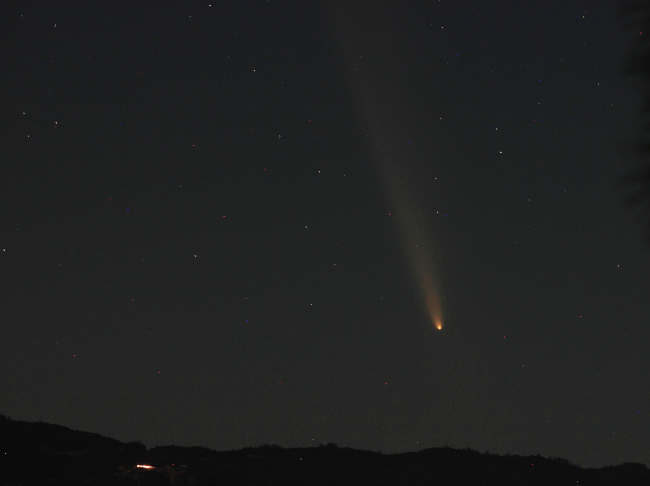
Comet C/2023 A3 (Tsuchinshan-ATLAS) captured by Bill Haddon on Sunday, Oct. 13, 2024.

LAKE COUNTY, Calif. — An ancient comet discovered last year is becoming visible in Lake County’s skies.

Comet C/2023 A3 (Tsuchinshan-ATLAS) will be visible in the west just after sunset, with the best times to observe from Oct. 14 to 24.

On Sunday, Bill Haddon, president of the Friends of the Taylor Observatory, captured this picture of the comet over the Hopland Grade at around 7:45 p.m.

The photo was taken at ISO 400, f3.4 using a Rokinon 135mm lens mounted on a Canon t2i and just using a tripod, no tracking, Haddon said.

Lakeport City Council to discuss ballot measure, body cameras and crosswalks

Details
Written by: Elizabeth Larson
Published: 14 October 2024
LAKEPORT, Calif. – The Lakeport City Council this week will consider support for a new ballot measure, new body cameras for police and a resolution related to crosswalks.

The council will meet Tuesday, Oct. 15, at 5:30 p.m. for a special closed session meeting to discuss labor negotiations with the unrepresented management group before its regular meeting begins at 6 p.m. in the council chambers at Lakeport City Hall, 225 Park St.

The agenda can be found here.

If you cannot attend in person, and would like to speak on an agenda item, you can access the Zoom meeting remotely at this link or join by phone by calling toll-free 669-900-9128 or 346-248-7799.

The webinar ID is 973 6820 1787, access code is 477973; the audio pin will be shown after joining the webinar. Those phoning in without using the web link will be in “listen mode” only and will not be able to participate or comment.

Comments can be submitted by email to This email address is being protected from spambots. You need JavaScript enabled to view it.. To give the city clerk adequate time to print out comments for consideration at the meeting, please submit written comments before 3:30 p.m. on Tuesday, Oct. 15.

At the start of the meeting, the council will present a proclamation designating October 2024 as Domestic Violence Awareness Month in Lakeport.

The council will then go on to hold a public hearing on the 2024 Community Development
Block Grant Notice of Funding Availability. As part of the hearing, the council will consider adopting the resolution authorizing the city manager to apply for CDBG funding.

Also on the Tuesday agenda, Police Chief Dale Stoebe will take two requests to the council.

The first will be for body camera upgrades. Stoebe is requesting authorization for the city manager to enter into a five-year agreement with Motorola Solutions Inc., for audio-video capture and storage services at a cost of $99,892.37 over five years, with the first-year cost of $29,728.37.

Stoebe also will ask for the council to adopt a resolution in support of Proposition 36, The Homelessness, Drug Addiction, and Theft Reduction Act of 2024.

The November ballot measure is meant to make some changes to 2014’s Proposition 47, including increasing the sentences for property crimes based on the amount stolen, mandating treatment for certain felony drug offenses and increasing penalties for trafficking deadly drugs.

“Proposition 36 is NOT about going back to an era of mass incarceration,” Stoebe wrote in his report to the council. “This is about creating a new era of mass treatment for the underlying conditions fueling so many thefts and driving so many people into homelessness.”

Also on Tuesday, Public Works Director Ron Ladd will ask the council to adopt a resolution designating marked crosswalks at various locations throughout the city.

“The City of Lakeport has been reviewing its pedestrian safety infrastructure, specifically focusing on crosswalks. This review was prompted by several upcoming paving projects that include restriping efforts. As part of these paving projects, a number of crosswalks will be repainted to improve visibility and safety,” Ladd wrote in his report to the council.

Ladd said a comprehensive inventory was conducted to assess the condition of existing crosswalks, identify new areas requiring pedestrian crossings and categorize the crosswalks by type. He said the resolution includes the addition of new crosswalks and updates to existing ones.

He said 113 crosswalks have been identified across the city, providing improved pedestrian safety in high-traffic areas and school zones.

On the consent agenda — items considered noncontroversial and usually accepted as a slate on one vote — are ordinances; minutes of the City Council’s regular meeting on Sept. 17 and the special meeting on Sept. 26; warrants; approval of the continuation of the proclamation declaring a local state of emergency due to severe weather conditions including heavy rain, and extreme wind; approval of application 2024-035, with staff recommendations, for the 2024 Trick or Treat Main Street event; approval of application 2024-036, with staff recommendations, for the 2024 Halloween Parade; adoption of the resolution accepting construction of South Main Street Sidewalk Project, by T&T Paving Inc., dba Valley Paving and authorize the filing of the notice of completion; receipt and filing of the quarterly reports from Quarter 4 of FY 23-24 and Quarter 1 of FY 24-25; adoption of the side letter to amend Article 6 of the current Lakeport Police Officers Association memorandum of understanding add provisions for assignments to SWAT duties.

Email Elizabeth Larson at This email address is being protected from spambots. You need JavaScript enabled to view it.. Follow her on Twitter, @ERLarson, or Lake County News, @LakeCoNews.

Purrfect Pals: Many waiting kittens

Details
Written by: Elizabeth Larson
Published: 14 October 2024
LAKE COUNTY, Calif. — Lake County Animal Care and Control has numerous kittens waiting to be adopted.

The cats at the shelter that are shown on this page have been cleared for adoption.

Call Lake County Animal Care and Control at 707-263-0278 or visit the shelter online for information on visiting or adopting.

The shelter is located at 4949 Helbush in Lakeport.

Email Elizabeth Larson at This email address is being protected from spambots. You need JavaScript enabled to view it.. Follow her on Twitter, @ERLarson, or Lake County News, @LakeCoNews.


A#70e(Pink collar)'s preview photo
A#70e(Pink collar)

A#70f(red collar)'s preview photo
A#70f(red collar)

A#70a(Green collar)'s preview photo
A#70a(Green collar)

A#70b (yellow collar)'s preview photo
A#70b (yellow collar)

A#70c's preview photo
A#70c

A#70d's preview photo
A#70d


A#12a's preview photo
A#12a

A#106b's preview photo
A#106b

A#12b(BlueCollar)'s preview photo
A#12b(BlueCollar)

A#106a's preview photo
A#106a

A#106c's preview photo
A#106c

A#120's preview photo
A#120


A#52b's preview photo
A#52b


C#134's preview photo
C#134


Atmospheric rivers are shifting poleward, reshaping global weather patterns

Details
Written by: Zhe Li, University Corporation for Atmospheric Research
Published: 14 October 2024


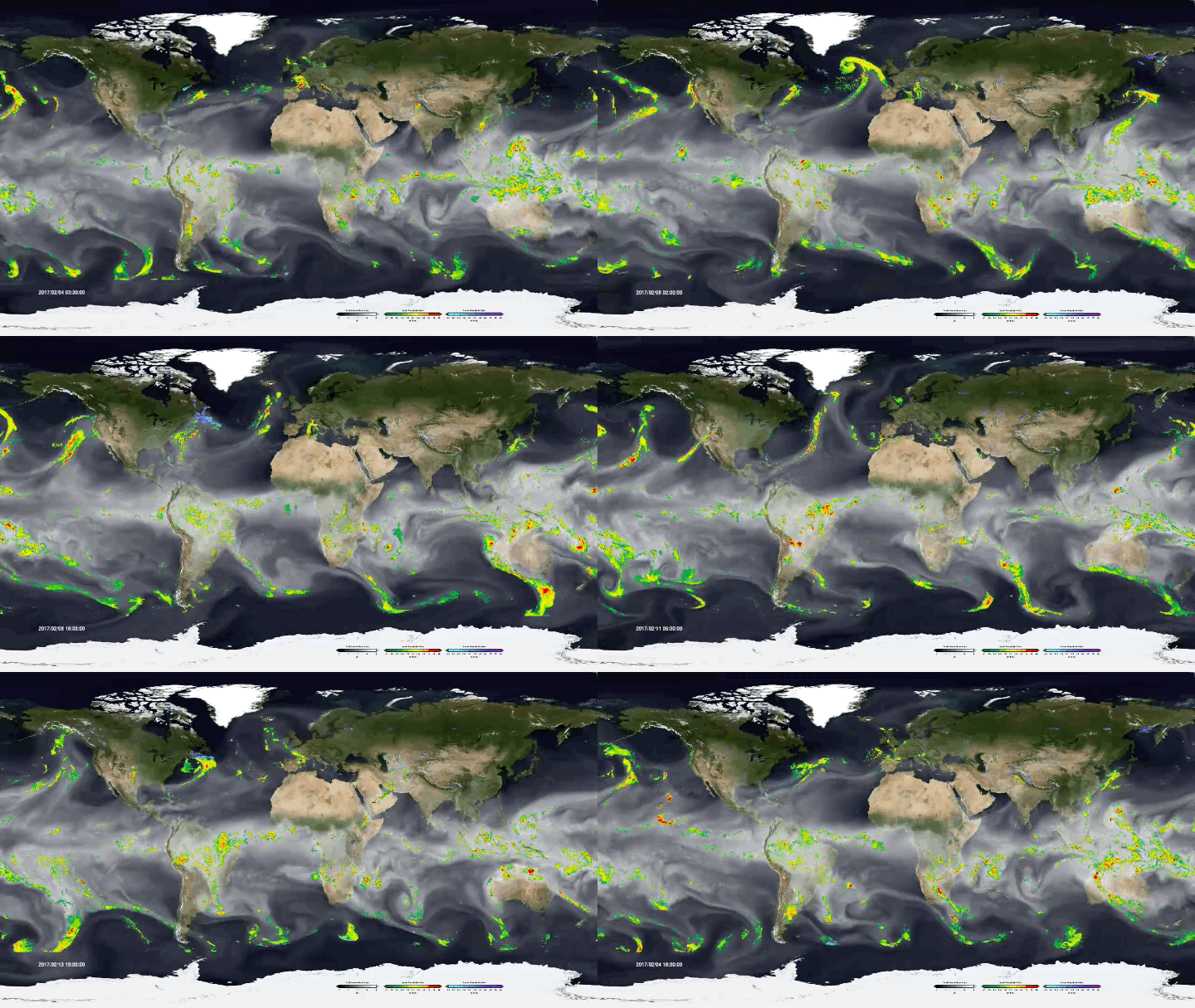
Atmospheric rivers are long filaments of moisture that curve poleward. Several are visible in this satellite image. Bin Guan, NASA/JPL-Caltech and UCLA

Atmospheric rivers – those long, narrow bands of water vapor in the sky that bring heavy rain and storms to the U.S. West Coast and many other regions – are shifting toward higher latitudes, and that’s changing weather patterns around the world.

The shift is worsening droughts in some regions, intensifying flooding in others, and putting water resources that many communities rely on at risk. When atmospheric rivers reach far northward into the Arctic, they can also melt sea ice, affecting the global climate.

In a new study published in Science Advances, University of California, Santa Barbara, climate scientist Qinghua Ding and I show that atmospheric rivers have shifted about 6 to 10 degrees toward the two poles over the past four decades.

Atmospheric rivers on the move

Atmospheric rivers aren’t just a U.S West Coast thing. They form in many parts of the world and provide over half of the mean annual runoff in these regions, including the U.S. Southeast coasts and West Coast, Southeast Asia, New Zealand, northern Spain, Portugal, the United Kingdom and south-central Chile.

California relies on atmospheric rivers for up to 50% of its yearly rainfall. A series of winter atmospheric rivers there can bring enough rain and snow to end a drought, as parts of the region saw in 2023.

Atmospheric rivers occur all over the world, as this animation of global satellite data from February 2017 shows. NASA/Goddard Space Flight Center Scientific Visualization Studio

While atmospheric rivers share a similar origin – moisture supply from the tropics – atmospheric instability of the jet stream allows them to curve poleward in different ways. No two atmospheric rivers are exactly alike.

What particularly interests climate scientists, including us, is the collective behavior of atmospheric rivers. Atmospheric rivers are commonly seen in the extratropics, a region between the latitudes of 30 and 50 degrees in both hemispheres that includes most of the continental U.S., southern Australia and Chile.

Our study shows that atmospheric rivers have been shifting poleward over the past four decades. In both hemispheres, activity has increased along 50 degrees north and 50 degrees south, while it has decreased along 30 degrees north and 30 degrees south since 1979. In North America, that means more atmospheric rivers drenching British Columbia and Alaska.

A global chain reaction

One main reason for this shift is changes in sea surface temperatures in the eastern tropical Pacific. Since 2000, waters in the eastern tropical Pacific have had a cooling tendency, which affects atmospheric circulation worldwide. This cooling, often associated with La Niña conditions, pushes atmospheric rivers toward the poles.

The poleward movement of atmospheric rivers can be explained as a chain of interconnected processes.

During La Niña conditions, when sea surface temperatures cool in the eastern tropical Pacific, the Walker circulation – giant loops of air that affect precipitation as they rise and fall over different parts of the tropics – strengthens over the western Pacific. This stronger circulation causes the tropical rainfall belt to expand. The expanded tropical rainfall, combined with changes in atmospheric eddy patterns, results in high-pressure anomalies and wind patterns that steer atmospheric rivers farther poleward.

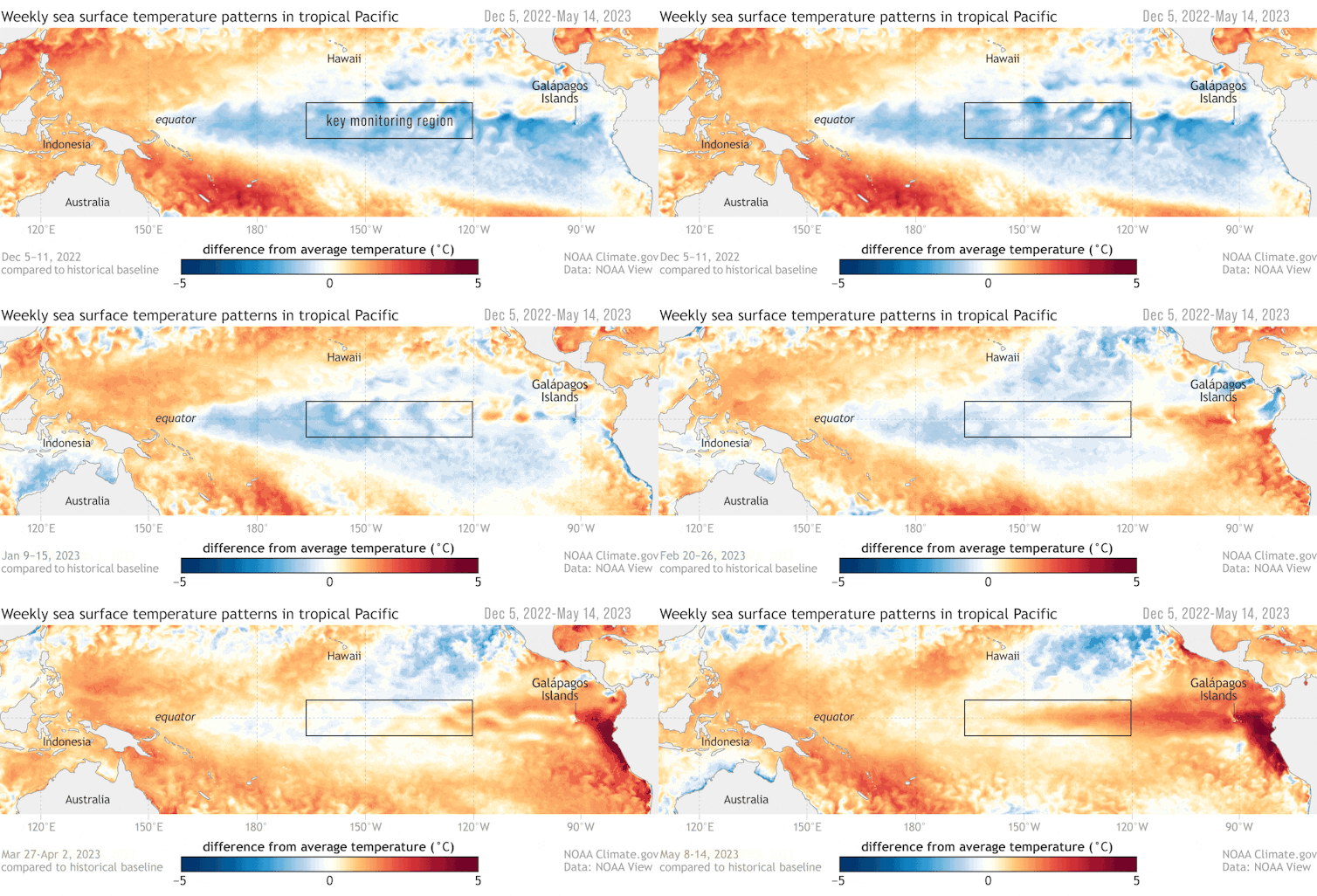
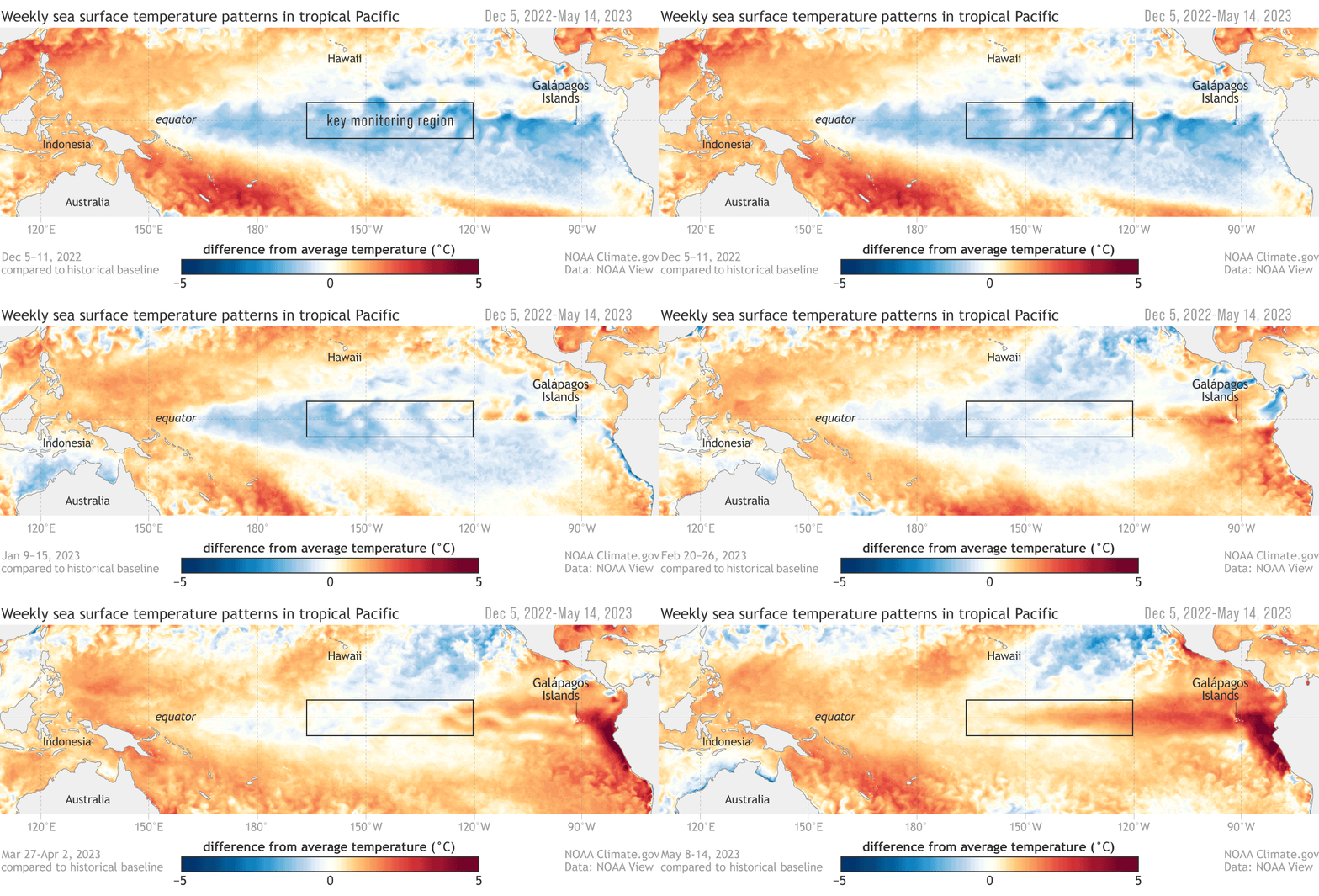
An animation of satellite data shows sea surface temperatures changing over months along the equator in the eastern Pacific Ocean. When they're warmer than normal, that indicates El Niño forming. Cooler than normal indicates La Nina.
La Niña, with cooler water in the eastern Pacific, fades, and El Niño, with warmer water, starts to form in the tropical Pacific Ocean in 2023. NOAA Climate.gov

Conversely, during El Niño conditions, with warmer sea surface temperatures, the mechanism operates in the opposite direction, shifting atmospheric rivers so they don’t travel as far from the equator.

The shifts raise important questions about how climate models predict future changes in atmospheric rivers. Current models might underestimate natural variability, such as changes in the tropical Pacific, which can significantly affect atmospheric rivers. Understanding this connection can help forecasters make better predictions about future rainfall patterns and water availability.

Why does this poleward shift matter?

A shift in atmospheric rivers can have big effects on local climates.

In the subtropics, where atmospheric rivers are becoming less common, the result could be longer droughts and less water. Many areas, such as California and southern Brazil, depend on atmospheric rivers for rainfall to fill reservoirs and support farming. Without this moisture, these areas could face more water shortages, putting stress on communities, farms and ecosystems.

In higher latitudes, atmospheric rivers moving poleward could lead to more extreme rainfall, flooding and landslides in places such as the U.S. Pacific Northwest, Europe, and even in polar regions.

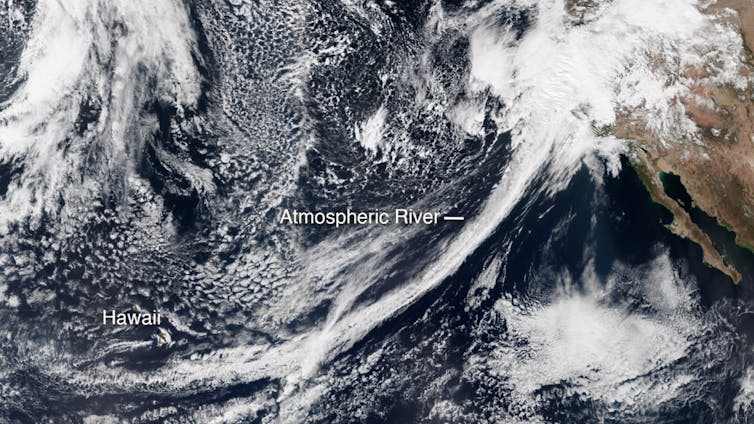
A long narrow band of moisture sweeps up toward California, crossing hundreds of miles of Pacific Ocean.
A satellite image on Feb. 20, 2017, shows an atmospheric river stretching from Hawaii to California, where it brought drenching rain. NASA/Earth Observatory/Jesse Allen

In the Arctic, more atmospheric rivers could speed up sea ice melting, adding to global warming and affecting animals that rely on the ice. An earlier study I was involved in found that the trend in summertime atmospheric river activity may contribute 36% of the increasing trend in summer moisture over the entire Arctic since 1979.

What it means for the future

So far, the shifts we have seen still mainly reflect changes due to natural processes, but human-induced global warming also plays a role. Global warming is expected to increase the overall frequency and intensity of atmospheric rivers because a warmer atmosphere can hold more moisture.

How that might change as the planet continues to warm is less clear. Predicting future changes remains uncertain due largely to the difficulty in predicting the natural swings between El Niño and La Niña, which play an important role in atmospheric river shifts.

As the world gets warmer, atmospheric rivers – and the critical rains they bring – will keep changing course. We need to understand and adapt to these changes so communities can keep thriving in a changing climate.The Conversation

Zhe Li, Postdoctoral Researcher in Earth System Science, University Corporation for Atmospheric Research

This article is republished from The Conversation under a Creative Commons license. Read the original article.

  1. Tuleyome Tales: Western black widows — a spooky story revisited
  2. More low-cost spay/neuter clinics coming to Lake County in 2025
  3. Helping Paws: Many great dogs
  • 579
  • 580
  • 581
  • 582
  • 583
  • 584
  • 585
  • 586
  • 587
  • 588
How to resolve AdBlock issue?

Refresh this page