How to resolve AdBlock issue?
Refresh this page
How to resolve AdBlock issue?
Refresh this page
Lake County News,California
  • Home
    • Registration Form
  • News
    • Education
    • Veterans
    • Community
      • Obituaries
      • Letters
      • Commentary
    • Police Logs
    • Business
    • Recreation
    • Health
    • Religion
    • Legals
    • Arts & Life
    • Regional
  • Calendar
  • Contact us
    • FAQs
    • Phones, E-Mail
    • Subscribe
  • Advertise Here
  • Login
How to resolve AdBlock issue?
Refresh this page

News

National Weather Service issues red flag warning for Lake County; public safety power shutoff set to move forward

Details
Written by: Elizabeth Larson
Published: 17 October 2024
LAKE COUNTY, Calif. — With forecasters having issued a red flag warning for Lake County and other parts of Northern California due to an incoming wind event, Pacific Gas and Electric is continuing to plan for a public safety power shutoff that will impact thousands of its customers across the region starting Thursday night.

A red flag warning means that critical fire weather conditions — which the National Weather Service describes as a combination of strong winds, low relative humidity, warm temperatures and critically dry fuels that can contribute to extreme fire behavior — are either occurring now, or will shortly.

The red flag warning will be in effect from 11 p.m. Thursday to 5 p.m. Saturday in response to strong northeast winds with isolated gusts of up to 50 miles per hour, according to the forecast.

Forecasters also have predicted very low humidity of down to about 10 percent during the day on Friday and Saturday, and poor recoveries of 30 to 40 percent Thursday night and 20 to 30 percent Friday night.

PG&E’s shutoff, meanwhile, is expected to begin between 3 and 6 p.m. on Thursday and is anticipated to involve 168 Lake County customers, who are among 28,000 customers in 30 Northern California counties.

Also included in the shutoff as currently planned are 10 customers in Mendocino County, 649 in Napa and 707 in Sonoma, PG&E reported.

In Lake County, the shutoff is focused mostly around Hidden Valley Lake, some areas near MIddletown and Cobb, and areas east of Clearlake Oaks, particularly Spring Valley, according to the shutoff map.

PG&E is setting up two community resource centers for impacted residents.

The first will be at Live Oaks Senior Center, 12502 Foothill Blvd. in Clearlake Oaks. The second will be at Hidden Valley Lake Association, 19305 Donkey Hill Road.

Both will be open from noon to 10 p.m. Thursday. Available resources will include ADA-accessible restrooms and washing stations; blankets, snacks and water; device charging; small medical device charging; seating; and wi-fi.

Updates are available at https://pgealerts.alerts.pge.com/psps-updates/.

Email Elizabeth Larson at This email address is being protected from spambots. You need JavaScript enabled to view it.. Follow her on Twitter, @ERLarson, or Lake County News, @LakeCoNews.

CHP secures grant to boost motorcycle safety and awareness across California

Details
Written by: LAKE COUNTY NEWS REPORTS
Published: 17 October 2024
The California Highway Patrol is launching Get Educated and Ride Safe VII, or GEARS VII, a yearlong program that focuses on education and enforcement strategies to reduce motorcycle-related crashes and fatalities.

The $700,000 federal grant will help the CHP boost motorcycle safety and awareness across California.

Provisional data from the federal fiscal year 2022-23 highlights the urgent need for such measures, with more than 7,000 motorcycle-involved crashes, resulting in 336 fatalities and more than 6,300 injuries within CHP jurisdiction.

“This grant will significantly enhance the CHP’s motorcycle safety and awareness programs by allowing us to continue educating both motorcyclists and drivers on safe practices,” said CHP Commissioner Sean Duryee. “It’s a vital reminder that whether you’re driving a car or riding a motorcycle, everyone shares the responsibility for keeping our roads safe.”

Throughout the grant period, CHP is ramping up motorcycle safety activities in regions with high crash rates and will participate in statewide and national traffic safety public awareness campaigns.

These efforts will promote the use of U.S. Department of Transportation-compliant helmets and emphasize the importance of sharing the road with motorcyclists.

Additionally, the CHP will increase enforcement in areas with motorcycle-involved crashes caused by speed, improper turns, and driving under the influence of alcohol and/or drugs.

Funding for this program is provided by a grant from the California Office of Traffic Safety through the National Highway Traffic Safety Administration.

Is childproofing the internet constitutional? A tech law expert draws out the issues

Details
Written by: Meg Leta Jones, Georgetown University
Published: 17 October 2024


The U.S. Supreme Court and Congress are wrestling with how to protect kids online. Meg Leta Jones, CC BY-ND

Mounting pressure to regulate children’s use of technology in the United States raises the question: Is childproofing the internet constitutional?

In response to significant political pressure stemming from alarming revelations about youth experience with digital technologies, a wave of state laws have recently passed across the U.S. They address a variety of online harms affecting children, ranging from exposure to pornography and risky content to manipulative design and social media access.

Most of the newly passed state laws have already been challenged, and those challenges are working their way up through the appeals process of the court system. In the 2024-25 term, the U.S. Supreme Court will review the constitutionality of a Texas law that obligates porn sites to block underage users in the case Free Speech Coalition v. Paxton.

The controversy found its way to the highest court after a federal district court determined that the law violated the First Amendment but the 5th U.S. Circuit Court of Appeals overturned the lower court decision. The 5th Circuit ruling compared the new law with those banning the sale of pornography magazines to minors in the 1960s, which were ruled constitutional.

While the court considers the Texas law, the U.S. House will be considering the Kids Online Safety Act, known as KOSA, and the Children and Teens Online Privacy Protection Act, referred to as COPPA 2.0, because it updates the 1998 Children’s Online Privacy Protection Act, COPPA. KOSA addresses addictive design features and parental controls, and COPPA limits data collection and use. Senate leaders merged the two into KOSPA, which passed 91-3.

Age-gating

All these laws demand that platforms treat children differently from adults, and so require platforms to know who is a child and who is an adult. This practice is referred to as age-gating and includes a few methods.

The old COPPA 1.0 added restrictions, responsibilities and liability for sites directed at kids or sites that had knowledge a user was under 13. Most sites avoid the law’s restrictions and requirements by simply including language in their terms of service forbidding those under 13 from creating an account. Others, like Facebook, eventually went further, asking the user to input their age or date of birth. Kids long ago learned to circumvent the virtually meaningless barrier.

The new wave of laws requires more, using one of two age-gating options: inference and verification. To infer age, the platforms make a good guess by using data generated by the user, either through biometric scans of the face or voice or analysis of the data troves the platforms already collect for targeted advertising. Age verification involves relying on evidence already vetted by another institution such as a government ID or credit card.

While the inference method provokes significant privacy concerns, age-gating advocates argue that age verification at the operating system or browser level is effective and doesn’t burden users or put their privacy at risk.

The last time the constitutionality of age-gating the internet came before the Supreme Court, the law did not survive. In 1997, the Supreme Court in Reno v. ACLU invalidated provisions of the Communications Decency Act enacted to protect children from exposure to explicit material online because they lacked the precision required to narrowly target unprotected speech. Congress made some adjustments and tried again with the Children’s Online Protection Act, not to be confused with COPPA, which ultimately failed as well but under a highly fractured court.

Comic panel 5 old pink iMac image with Reno v. ACLU 1997 on the screen
Meg Leta Jones

3 questions

While the constitutional analysis, the technology and the associated research are fairly complex, the outcome depends on answers to three main questions.

To limit sharing or accessing content, the government needs to have a good reason. So, the first question to ask is whether the harms to kids are really that bad and whether the challenged law mitigates the harms. Laws sometimes fail this test.

Like in 2011, when the Supreme Court scuttled California’s attempt to prohibit the sale of violent video games to minors, Utah’s efforts to limit children’s access to social media recently stalled after the government could not convince the district court that a compelling link exists between youth mental health problems and social media.

The second question is whether restrictions and obligations related to children place burdens on speakers and seekers who have legitimate rights to share and access information freely. While the 5th Circuit maneuvered around this question by relying on the constitutionality of laws that require showing an ID to access offline pornography, other courts have gotten technical. For instance, Arkansas’s Social Media Safety Act did not survive because the court determined adults would be deterred from creating accounts if it involved producing an ID or biometric scans.

This question may come down to not only the technical reality or potential of age-gating but also user experience research.

The third question is whether alternatives, namely parental controls, work better and leave adult access unhindered. Although some parents and policymakers insist parental controls have not worked to protect children, lower courts considering the new wave of age-gating have found that parental controls remain superior options for addressing online harms to children, just like the Supreme Court did two decades ago.

Nobody knows how the Supreme Court will answer these three questions this time around. So much has changed. The court has changed, the technology has changed, the research has changed, childhood has changed. If age-gating laws are upheld as constitutional, more big changes are likely to follow.The Conversation

Meg Leta Jones, Associate Professor of Technology Law & Policy, Georgetown University

This article is republished from The Conversation under a Creative Commons license. Read the original article.
Lucerne Harbor Park dredging project gets final approval

Details
Written by: Elizabeth Larson
Published: 16 October 2024
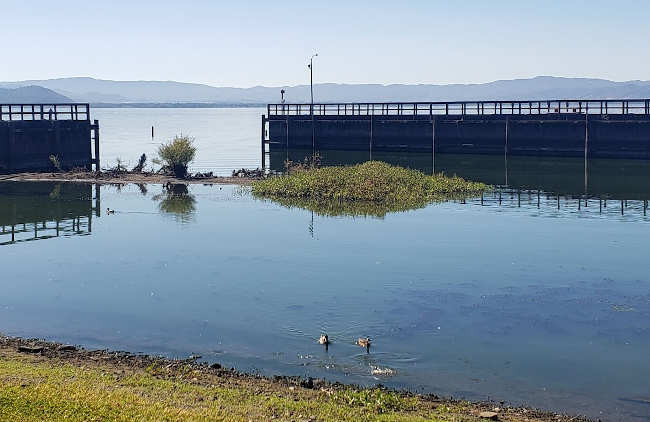
The harbor at Lucerne Harbor Park in Lucerne, California. Photo by Elizabeth Larson/Lake County News.


LUCERNE, Calif. — After several years of winding its way through a government regulatory process, the Lucerne Harbor Park dredging project has received final approval.

At its Oct. 1 meeting, the Board of Supervisors voted unanimously to award a $211,700 contract to Marz Engineering of Ukiah, one of two firms to submit bids for the project.

Public Services Director Lars Ewing said the bids from Marz Engineering and Steelhead Constructors JV of Redding, which bid $1,097,777, were opened on Aug. 28.

Ewing noted the “significant discrepancy” between the two bids, explaining that his staff communicated with Marz Engineering to ensure that they had factored in prevailing wage and labor law compliance.

A labor organization contacted the county to ask about the bid’s adherence to prevailing wage, Ewing said, adding he had communicated directly with Marz about that concern.

The company included with their bid submittal the mandatory prevailing wage and related labor requirements certification document, which Ewing said established the company’s acknowledgment that it had to pay prevailing wage and conform to other labor laws.

Ewing said the project is fully funded through Budget Unit 1781, Special Projects. Money from the sale of the Lucerne Hotel was set aside to cover the project.

Board members acknowledged the project was a long time in coming and they are looking forward to seeing it take place.

Supervisor Michael Green, who said he was excited to see the project move forward, noted there was a tribal monitoring agreement with Robinson Rancheria which complicated the process. He asked Ewing if it was a model for other dredging projects.

Ewing said if it was used as a model, it would be for lessons learned and what not to do for a project.

The project originally was put out with a request for review with a proposed categorical exemption to the California Environmental Quality Act, or CEQA, Ewing said.

It’s not abnormal to have tribal monitoring and archaeological monitoring above and beyond that, which is what there is in the case of this project, said Ewing.

“By and large this is not an overly complex project. It was the process, I would suggest that on this, that we can learn from. But I would stop short of saying that it’s a model. Every project is somewhat unique,” he said.

“This is going to be great for Lucerne. It’s great to get boats in the harbor and interacting with the shore, and I just look forward to seeing this project moving forward very much,” said Green.

The project has been in the works for five years. Northshore Supervisor EJ Crandell, whose tribe has the monitoring agreement, tried to explain the delays, beginning with the project starting in 2019, then the COVID-19 pandemic beginning the following year. In 2021, the categorical exemption occurred.

He said there was monitoring and they found “a situation” that slowed the process, an apparent reference to the discovery of an archaeological site. There also was changeover in Community Development Department heads, he said, thanking Ewing for being steadfast.

Board Chair Bruno Sabatier said he doesn’t usually get excited in agenda review, but that was the case when he saw the harbor dredging project being brought forward for the meeting.

“This is exciting. Anybody who’s passed by, especially during the drought, could see the amount of buildup that’s occurred within Lucerne Harbor. This is going to be great. It has been a long time coming. Hiccups happen unfortunately and some of them are out of our control,” said Sabatier.

He said he was happy they found the pathway to get to that point, and he said he hoped that whatever initial study review they’ve done can be used for Lucerne Harbor in the future, as he knows it’s going to happen again in that area.

Ewing said he can communicate with Water Resources and the two cities on the maintenance dredging side of things.

He said it was the first time the harbor was being dredged since its construction. “So there is a pathway through permitting agencies if it’s truly maintenance dredging, if you continually perform this.”

That’s something to consider as opposed to a one-time, standalone project that has different requirements, Ewing said.

Sabatier said the project has potential for economic impact, adding it will be helpful for the Northshore.

Green said the Blue Ribbon Committee for the Rehabilitation of Clear Lake had given a shout out to the Lucerne Harbor dredging project.

He said the committee pointed out that among other benefits of the project, it will take out an estimated two tons of phosphorus and about 0.4 tons of nitrogen by dredging out sediment. That’s roughly equivalent to 2% of the annual input of phosphorus of Clear Lake.

“It may sound like just a little bit, but part of what we know about water quality in Clear Lake is there is a lot of phosphorus present in those deposited sediments,” Green said.

While it’s probably not the best way to scrape the entire lake of phosphorus, there is a tangible benefit called out by the committee, Green said.

Crandell moved to approve the project, which Supervisor Jessica Pyska seconded and the board approved 5-0.

Project needed for several years

The need for the project has been evident for several years, as an island of sediment has built up within the harbor, making a portion of it impassable.

In January 2019 the Lucerne Area Town Hall passed a resolution asking the county to spend a small portion of the $2.5 million sales price from the Lucerne Hotel to dredge the harbor.

Then-County Administrative Officer Carol Huchingson pushed back on the proposal, which the Board of Supervisors ultimately approved in the 2019-20 budget with $250,000 set aside for the project. The project’s estimated price tag later rose to $350,000.

The project ended up being held over for several years.

In November 2020, Public Services had to close the boat launch at the park as a result of the sediment buildup, coupled with the low water level. County officials at that time had estimated the dredging project would be finished by the end of 2021.

At its June 11 meeting, the supervisors approved the plans and specifications for the project as part of the consent agenda.

As followup to the Oct. 1 meeting, Lake County News asked Ewing about the history of the harbor and its construction.

“The record drawings I have show construction/dredging of the launching facility in 1965, followed by a 1977 site improvement project that included construction of the parking lot, restroom, floating docks, landscaping, and other site improvements (but no dredging),” Ewing said in an email.

Asked about when the project could begin, Ewing said, “I anticipate this project will start no later than the end of October. The work window is between Oct. 15 and Dec. 31, to protect the Clear Lake hitch.”

Ewing said that while the project is not an overly complicated one, “it certainly has had more than its fair share of obstacles.”

Email Elizabeth Larson at This email address is being protected from spambots. You need JavaScript enabled to view it.. Follow her on Twitter, @ERLarson, or Lake County News, @LakeCoNews.
  1. Public safety power shutoff possible for parts of Lake County beginning Thursday
  2. Lake County Economic Development Corp. launches ‘Eat Drink Shop Local’ campaign to support local businesses
  3. CHP receives Native-Tribal Traffic Education Program grant to strengthen community partnerships
  • 576
  • 577
  • 578
  • 579
  • 580
  • 581
  • 582
  • 583
  • 584
  • 585
How to resolve AdBlock issue?
Refresh this page