 How to resolve AdBlock issue?
News
- Details
- Written by: Lake County News reports
On Sunday, the California Emergency Management Agency (Cal EMA) announced that eight state, city and county-level emergency managers are currently being deployed to the East Coast to assist in the ongoing recovery process of Hurricane Sandy.
This is the latest in ongoing resource coordination efforts under way at the State Operations Center (SOC) inside Cal EMA’s Headquarters in Mather, Calif.
“Often the hardest part of a disaster isn’t the initial impact, but taking care of the critical needs of survivors left in its wake,” said Cal EMA Secretary Mark Ghilarducci. “That’s why it’s so important that we do our part by offering assistance and send experts from throughout California who are highly-skilled in emergency management and coordination. Our hearts go out to those still struggling to recover.”
The eight personnel tasked for deployment today are coming from the City of Los Angeles, City and County of San Francisco and Cal EMA’s Coastal Region.
The deployed staff is headed for Westchester County Department of Emergency Services in Hawthorne, New York, just 30 miles north of New York City.
Sunday’s deployment of specifically skilled personnel was coordinated by Cal EMA through the Emergency Management Assistance Compact, or EMAC, a national agreement among all 50 states and U.S. territories.
The EMAC allows for emergency resources to be made available in a neighbor-helping-neighbor system before, during and after a major disaster.
EMAC is used in conjunction with federal disaster assistance and other regional mutual aid agreements.
“Right now, we’re currently very focused on these recovery operations and requests coming from the east coast,” said Tina Curry, director of the activated State Operations Center. “These emergency managers are going to give a big boost to the local staff there and assist them any way they can.”
Since before Hurricane Sandy made landfall on U.S. soil, Cal EMA has been working with emergency managers throughout California, California Utilities Emergency Association, California Highway Patrol, California Department of Transportation, California Department of Public Health, California Emergency Services Authority, California Department of Social Services and America Red Cross to provide assistance and stand ready to meet the needs of the affected states.
Other deployments include:
- California National Guard deployed the 129th Rescue Wing including two C-130 large aircraft, two HH-60 Pave Hawk helicopters and a total of 83 personnel trained in medical aid, search and rescue and other emergency response activities.
- According to the California Utilities Emergency Association, more than 630 utility responders have been deployed and 55 more responders are in staging areas around California ready to respond. They sent specialized equipment including massive generators, lowboys, and utility trucks to assist in restoring power to those still without power.
- 15 California fire service personnel have been deployed to Herndon, VA as part of Urban Search and Rescue Incident Support Teams. These personnel are being tasked to several different areas along the northeast.
- The California Emergency Management Agency has assembled special emergency coordination personnel working in the State Operations Center and formed a special transportation task force to help expedite the travel of utility trucks and personnel across state lines.
For more information visit www.calema.ca.gov/Pages/default.aspx .
- Details
- Written by: Lake County News Reports
LAKE COUNTY, Calif. – For the second time in recent months, a conservation group has filed a petition that would protect a Lake County native species.
The first petition seeks both state and federal protection under the Endangered Species Act for a fish, the Clear Lake hitch. Now a mammal is in the spotlight.
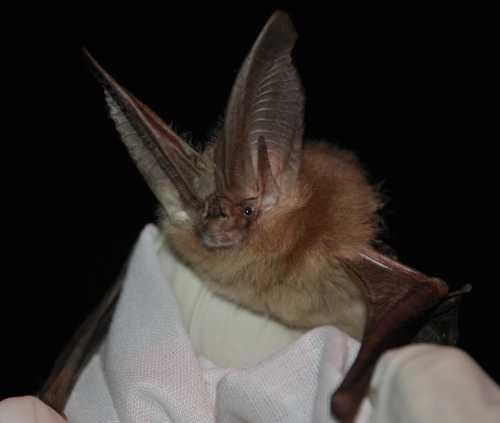
On Oct. 18, the nonprofit Center for Biological Diversity filed a petition with the California Fish and Game Commission, calling for threatened or endangered listing for the Townsend’s big-eared bat throughout its statewide range.
That range includes Lake County, but all throughout the West the Townsend’s bat – a species with long, rabbit-like ears – is disappearing.
In California, despite its wide range, surveys show “serious declines in the number of colonies, colony size, and availability of suitable roosting habitat,” said Noah Greenwald, endangered species director at the Center for Biological Diversity and the author of the 80-page petition, which draws on surveys and studies by bat biologists Elizabeth D. Pierson and William E. Rainey, and others.
As old mines are cleaned up or reopened throughout the Coast Ranges, the need for better protections has increased, bat advocates say.
Townsend’s bat preferred roosting sites are mines and caves, where they are easily disturbed by human activities.
Bats also are threatened by the release of toxics from mines where they roost and forage. According to the US Geological Survey, mercury accumulation in the tissues of wildlife is linked with “neurological and behavioral abnormalities, low reproductive success, and direct toxicity.”
Yet cleaning up the mines presents another threat. According to one study by Pierson, public lands policy manuals don’t often recognize mines as habitat. “Some of the most pressing conservation issues facing bats today arise from their propensity to roost in mines.”
A USGS investigation of the Helen, Chicago and Research mines concluded that “release of mercury from the mine sites has increased its concentration in invertebrates and fish.”
Higher concentrations of dangerous methylmercury were found in invertebrates from the upper sites on Dry Creek. “Mammals and birds could consume water from the drainages, or eat the sediments, invertebrates, and vertebrates in the area,” the study said.
Other threats are habitat loss, pesticide poisoning and the westward expansion of white-nose syndrome, a fungal disease that has wiped out millions of bats on the East Coast.
Bats provide vital ecological services, experts say, consuming mosquitoes and agricultural pests.
Townsend’s bats feed heavily on Noctuidae moths, which are pests that can harm crops.
Greenwald thinks that the state has been too slow to act.
In 1986, California Fish and Game designated the Townsend’s bat a “species of special concern.” According to the department’s Web site, “Species of concern receive no legal protection.”
The goal of the designation is to halt their decline “by calling attention to their plight” and to address the problem “early enough to secure their long term viability,” according to Greenwald.
In 1987, the department hired UC Davis researchers Pierson and Rainey to conduct a survey of the state’s Townsend’s bat populations.
Their report, finalized in 1998, offered fresh evidence of the bat’s dire situation.
The four-year survey found steep population declines over the past 40 years. Overall, the number of animals had dropped 55 percent and the size of colonies had plummeted as well.
Of the 37 known colonies, which held about 4,250 adult females, only three had protected roost sites.
There were significant losses at Lake County’s four important hibernating sites, which included Bartlett Mountain. Historic records showed that the largest number of individuals in Lake County had been 55. Pierson and Rainey’s survey found only 17.
The primary cause of its decline: “human disturbance of roosting sites,” the survey found.
In 2011, a Fish and Game status review of the 25 bat species in California found that Townsend’s bat has the greatest need for conservation.
A brew of factors was cited: disturbance at caves and mines, loss of habitat to mining, logging and urban development, white-nose syndrome and others.
Still, no new protections were put in place, Greenwald’s petition noted.
The California Department of Fish and Game developed a draft conservation plan for bats, with Townsend’s the greatest concern, but never finalized it.
Without state protection, there is no assurance the bats won’t be disturbed during the cleanup of old mines on public lands.
In his petition Greenwald mentioned the “extraordinary measures” experts recommend when doing roost surveys. Everything from the noise of rustling fabric to using the right lighting must be considered.
The Bureau of Land Management considers Townsend’s bat a “sensitive species.” That means, where the bat lives on Bureau land, “the use of all methods and procedures necessary” to improve their condition and habitats.
But the bats often evade detection without careful surveys, according to reports by Pierson.
Townsend’s bat has been documented at old mine sites near Middletown. The Helen, Chicago and Research mercury mines are slated for cleanup – and the Bureau has evidence of the bats’ presence on at least one site.
A 2008 BLM resource report for the Helen Mine found five sensitive species “are present in the vicinity of the Helen Mine,” including Townsend’s bat. The Bureau did not recommend mitigation measures to protect them during cleanup.
Bureau Supervisor Gary Sharpe said the Townsend’s bat was “documented north of the Helen Mine, at the Chicago Mine on BLM land, rather than on the Helen Mine site proper.”
He added, “There is one partially collapsed adit at the Helen Mine site that did not appear to be suitable for the bats nor was it identified as a location occupied by the bats.”
Since the partially collapsed adit – a mine entrance – “did not appear to be a public hazard, it was not disturbed during the mine remediation activities,” Sharpe said.
He assumes the bats do roost in the mine tunnels at the Chicago Mine. “The one I believe they have been identified as occupying is dangerous to the public,” he said.
“I don’t have the designs done for the Chicago Mine site cleanup, but can assure you that the bats will be taken into account and their habitat protected,” Sharpe said.
The petition will next undergo a 90-day review period by the U.S. Fish and Wildlife Service and the California Fish and Game Commission.
If the bat becomes a candidate species, another evaluation will follow: a one-year review of the Townsend’s bat status.
Sheila Pell is a correspondent for Lake County News. She lives in Hidden Valley Lake, Calif.
- Details
- Written by: Lake County News Reports
Chestnuts are famously associated with the Christmas season because of the 1946 classic, “The Christmas Song,” with its affectionate reference to chestnuts roasting on an open fire.
This line, forever memorialized by Nat King Cole’s velvet vocals and Bing Crosby’s croon, are a common response when the word chestnut is uttered.
It happened to me recently. I told my brother-in-law I was seeking chestnuts at local stores, and he suggested I look for them on an open fire.
Despite this association, chestnuts are a fall crop, typically coming into season in the weeks prior to Thanksgiving.
They’re a starchy nut, containing twice as much as potatoes, and are used as a substitute for this tuber in Europe, Asia, and Africa.
As the song suggests, they’re fantastic straight from the oven or fire, but they may also be used in a variety of ways in cuisine, both savory and sweet.
It’s possible the chestnut is one of the first foods consumed by man, as they’ve been part of our diet since prehistoric times.
Unlike most nuts, they’re low in fat and high in carbohydrates. They’re also high in fiber. They rank low on the glycemic index, which means they don’t cause a spike in blood sugar as many other foods high in carbohydrates do.
They have a high vitamin C content (so much so they’re said to help prevent the common cold) and contain a plethora of other nutrients, such as manganese, potassium, copper, phosphorus, magnesium, and iron. They’re cholesterol free and low in sodium.
As to cuisine, they’re a popular addition to stuffing recipes for fowl – particularly this time of year – and are an accompaniment in various forms for meats such as lamb, pork, duck and lobster.
They’re added to or used as the main ingredient for soups, stuffed into ravioli, made into puree, combined with potatoes and rice (Upper Lake farmer Haji Warf tells me Koreans enjoy adding them to the latter), used as a stuffing for squashes, and paired with such things as mushrooms and leeks.
On the sweet side, many desserts can be made with chestnuts, including mousse, fillings for cream puffs, ice cream, truffles, tortes, candy, and cakes. Chestnuts and chocolate are often combined in desserts.
If roasting chestnuts isn’t your thing, chestnuts are abundant in jars this time of year, and canned chestnut puree (either sweetened for confections or pure for savory foods) may be found in holiday displays at markets. One popular brand is imported from France.
Chestnuts can be ground into flour and used for baking, a practice which has been popular in Italy for centuries. When combined with other types of flour, chestnut flour may be used to make such things as breads, scones, cakes, and muffins.
Because chestnuts are gluten-free, combining chestnut flour with flours made with other gluten-free foods, such as sorghum or rice, is a boon for those with Celiac disease or sensitivity to wheat.
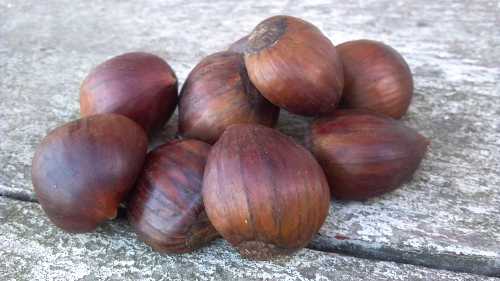
Visually chestnuts are quite lovely. Mahogany-colored shells look as though they’ve been lacquered, giving their wood grain-like patterns a subtle sheen. They make a pleasant clicking sound, almost like castanets, when tossed together.
While on the tree, the nuts grow encased in a spiny outer covering that sheds when the nuts drop to the ground. There are usually three nuts within each of these spiny casings.
Chestnut trees are in the same family as beeches and oaks. There are four main species, commonly known as European, Chinese, Japanese, and American chestnuts. Those in the U.S. are mainly of European stock (which was introduced there from Sardis in Asia Minor) because a deadly and unfortunate blight destroyed most of the American chestnut trees in the early part of the last century. The blight “hitchhiked” on chestnut trees imported from Asia, which carried the fungus but were immune to its effects.
Efforts are currently being made to restore the American chestnut, which once grew prolifically throughout the United States and Canada. Sadly, the blight of the last century took most of these native trees, other than a few stands in the Pacific Northwest and California.
The Zeni family of Yorkville in Mendocino County has been harvesting and selling chestnuts since their grandfather purchased a ranch there in 1918. I went to high school with the current ranch owners, and John, the eldest brother, tells me that the height of harvest was in the 1970s when more than 14,000 pounds of chestnuts were sold.
The blight struck their trees shortly after that and they lost 75 percent of them. Even so, they still harvest enough chestnuts to hold an annual festival at the ranch. In John’s words, “people come and pick their own chestnuts, enjoy a vast potluck lunch and fire roasted chestnuts, drink homemade wine and fresh pressed apple juice, and discuss the varied agricultural bounty that people bring and display.”
The festival, the 30th this year, is being celebrated this weekend in conjunction with the Mendocino County Permaculture Society. Yesterday featured a potluck lunch and chestnut picking; today includes a chestnut roast and mini farmers’ market.
To get directions or to inquire about chestnuts (they charge a little for people to gather their own), contact Linda Zeni at 707-884-4208, John Zeni at 707-291-6805 or Raymond Zeni at 707-895-2309.
Closer to home, the Dorn Family of Kelseyville (who own Dorn Vineyards and Loasa Farms) harvests chestnuts from two beautiful trees on their property. They have a farm stand and contact information can be found on their colorful blog: http://dornvineyards.blogspot.com/ .
Another local site for chestnuts is the Livermore Ranch, situated on the slopes of Mt. St. Helena near the Lake-Napa county line.
Ranch founder, Bob Livermore, an avid agricultural student at U.C. Davis in the 1940s, started planting chestnut trees throughout the Mt. St. Helena region in about 1980.
Bob’s gone now (he died in 1996), but ranch manager, Pete McGee, tells me that the now-mature trees “produce great amounts of food for deer and other wildlife … however, the ranch has yet to conquer any niche market for selling chestnuts.”
If you’d like to find out more about Livermore Ranch or talk to McGee about chestnuts, he invites you to contact him at
In Sonoma County, chestnut purveyors Jim and Dave of Sonoma Coast Organic Produce are well known at the Santa Rosa farmers’ market, which they attend only when chestnuts are in season. According to co-owner Jim McCrumb, the chestnut trees on the farm they purchased 30 years ago are more than 100 years old.
Interestingly, they learned this because they counted the rings on the stump left from a tree which the former owner had cut down to make a coffee table. To find out more about Jim and Dave’s chestnuts, they may be contacted at 707-847-3454.
If you’re interested in mail order chestnuts, you may enjoy the website of this Sonoma County chestnut ranch: http://www.chestnutranch.com/Green_Valley_Chestnut_Ranch/Home.html . Located in Sebastopol, the Green Valley Chestnut Ranch will ship fresh chestnuts to your door. You’ll have to wait, however, as they’re sold out for the 2012 season.
The ranch’s Web site is still worth perusing, as they have some interesting recipes and varied information on chestnuts, such as storage. (Basically, they should be stored in your fridge or freezer because of their high moisture content.)
I played around with roasting chestnuts, as well as experimenting with another method for removing from their shells: boiling in water.
Before employing either method, it’s important that the chestnuts be scored with a sharp knife to make an “X” on their top. This enables the skin to open up for peeling after cooking, and, more importantly, it prevents explosion of chestnuts in the oven due to steam build-up. (Based on others’ experiences, this is a real possibility.)
I roasted the chestnuts in a 425 degree Fahrenheit oven for about 30 minutes, and boiled another batch on the stove for about as long. They’re ready when the skins pop open at the crosshatch marks.
Each of these methods yields a somewhat different outcome. The boiled chestnuts were a bit more difficult to peel (the skin didn’t seem to want to let go of the flesh), and in terms of texture, they were moister. The roasted chestnuts had a slightly different flavor profile. I enjoyed both.
I was told by a student in one of my past culinary classes that some of her Portuguese relatives boil chestnuts in port wine. I haven’t yet tried this, but I would imagine the rich sweetness of port wine marries well with the creaminess of chestnuts.
For those who wish to roast chestnuts on an open fire (as the song indicates), I recommend this site for detailed instructions: http://www.essortment.com/all/chestnutsroasti_ranw.htm .
For this week’s recipe, I offer an updated version of a medieval recipe for chestnut soup, courtesy of this site which offers recipes for a medieval Christmas dinner: http://www.bellaonline.com/articles/art54386.asp .
The chestnuts should be roasted (or boiled) so they may be peeled before using in the recipe. The author recommends pureeing the soup in a blender; however, I highly recommend using an immersion blender if you have one, which eliminates the need to transfer hot soup from the pot to the blender.
Bon appétit! Enjoy!
Chestnut soup
3 tablespoons butter
2 onions, thinly sliced
2 carrots, diced
1 cinnamon stick
2 pounds chestnuts, peeled
6 cups chicken or vegetable stock
1/8 teaspoon mace
1/8 teaspoon nutmeg
Salt & pepper to taste
1 cup heavy cream
Melt butter and add onion, carrot, and cinnamon stick.
Cover and cook until vegetables are browned, stirring occasionally to prevent burning.
Remove cinnamon stick.
Blend in chestnuts and stock. Cook until chestnuts are tender, 15-20 minutes.
Puree in blender. Return puree to pot.
Add seasonings and whisk in the cream.
Once cream is added, keep warm but do not boil.
Esther’s note: If using a blender to puree hot ingredients, be sure to hold the lid on tight with a kitchen towel. Otherwise, the heat can cause the lid to blow off and cause injury.
Esther Oertel, a freelance writer, cooking teacher, and speaker, is passionate about local produce and all foods in the vegetable kingdom. She welcomes your questions and comments and may be reached at
- Details
- Written by: Elizabeth Larson
LAKEPORT, Calif. – There’s a new variety of dogs available for adoption at Lake County Animal Care and Control this week, ranging from the very little to the very big.
Among the little ones are a litter of springer spaniel mix puppies, with this week’s largest dog being a big mastiff mix weighing more than 150 pounds.
Thanks to Lake County Animal Care and Control’s new veterinary clinic, many of the animals offered for adoption already are spayed or neutered and ready to go home with their new families.
Dogs that are adopted from Lake County Animal Care and Control are either neutered or spayed, microchipped and, if old enough, given a rabies shot and county license before being released to their new owner. License fees do not apply to residents of the cities of Lakeport or Clearlake.
If you're looking for a new companion, visit the shelter. There are many great pets hoping you'll choose them.
The following dogs at the Lake County Animal Care and Control shelter have been cleared for adoption (additional dogs on the animal control Web site not listed are still “on hold”).

Male springer spaniel mix puppy
This cute little male springer spaniel mix puppy is 8 weeks old.
He has a brown coat, floppy ears and blue eyes, weighs 4.6 pounds, and already is neutered and ready to go to a new home.
He is in kennel No. 3a, ID No. 34687.

Male springer spaniel mix puppy
This little springer spaniel mix pup, like his littermates in kennel No. 3, is 8 weeks old.
He has a brown and white coat, floppy ears and blue eyes, weighs 5.4 pounds and has been altered.
Find him in kennel No. 3b, ID No. 34688.

Male springer spaniel mix puppy
Another of the springer spaniel mix litter, this male pup is 8 weeks old.
He weighs 5.2 pounds, has a brown and white coat, blue eyes and floppy ears, and he has been neutered.
He’s in kennel No. 3c, ID No. 34689.

Male springer spaniel mix puppy
The littlest of the springer spaniel mix litter, this little puppy is 8 weeks old.
He weighs 4.4 pounds, has a brown coat, floppy ears and blue eyes, and has been neutered.
Find him in kennel No. 3d, ID No. 34690.

English Mastiff mix
This big fellow has the distinction of being the biggest dog available for adoption at the shelter this week.
He is a 6 year old English Mastiff mix.
He weighs a whopping 151 pounds, has floppy ears and brown eyes, and a short fawn coat. The big guy has been neutered.
Find him in kennel No. 5, ID No. 34771.

‘Brody’
“Brody” is an older gentleman who has fallen on hard times.
The 7-year-old boxer mix was left by his owner at the shelter, and is hoping someone with a big heart will come along and give him a place to live out his senior years.
He has big brown eyes and floppy ears, a short brown brindle coat and a docked tail.
He already has been neutered and weighs nearly 90 pounds.
Find Brody in kennel No. 8, ID No. 34726.

Male husky mix
This 4 and a half year old male husky mix would like a new home, preferably not one with livestock.
He has gold eyes and erect ears, a short red and tan coat. He has been altered and weighs 56 pounds.
He's in kennel No. 10, ID No. 32738.

Female pit bull terrier mix
This female pit bull terrier mix is 4 months old.
She has a short brown coat and has not been altered.
She’s in kennel No. 19b, ID No. 34754.
Female shepherd mix
This female shepherd mix is 1 year old.
She has brown eyes and floppy years, and a short black and brown coat. Shelter staff did not report if she had been spayed.
Find her in kennel No. 20, ID No. 34623.

Female cattle dog mix
This female cattle dog mix is 1 year old.
She has a short brown coat, floppy ears and brown eyes, and weighs 39 pounds. She has been spayed.
Shelter staff said she is a jumper (she can top a 6-foot fence) and loves tennis balls.
She’s in kennel No. 24, ID No. 34758.

Female pit bull terrier mix
This female pit bull terrier mix is 14 weeks old.
She has a short black coat and floppy ears. Shelter staff did not report if she had been altered.
Find her in kennel No. 27, ID No. 34761.

Female pit bull terrier mix
This female pit bull terrier mix is 4 months old.
She has a short black coat, has floppy ears and has not yet been spayed.
She’s in kennel No. 29, ID No. 34753.
Please note: Dogs listed at the shelter's Web page that are said to be “on hold” are not yet cleared for adoption.
To fill out an adoption application online visit http://www.co.lake.ca.us/Government/Directory/Animal_Care_And_Control/Adopt/Dog___Cat_Adoption_Application.htm .
Lake County Animal Care and Control is located at 4949 Helbush in Lakeport, next to the Hill Road Correctional Facility.
Office hours are Monday through Friday, 8 a.m. to 5 p.m., and 1 p.m. to 3 p.m., Saturday. The shelter is open from 10:30 a.m. to 4:30 p.m. Monday through Friday and on Saturday from 1 p.m. to 3 p.m.
Visit the shelter online at http://www.co.lake.ca.us/Government/Directory/Animal_Care_And_Control.htm .
For more information call Lake County Animal Care and Control at 707-263-0278.
Email Elizabeth Larson at