 How to resolve AdBlock issue?
News
- Details
- Written by: Lake County News reports
LAKE COUNTY, Calif. – The annual Lake County Burn Ban for 2012 will be lifted on Monday, Nov. 5.
The lifting of the burn ban coincides with Cal Fire declaring an end to fire hazard season.
Lake County’s joint fire and Air Quality Management District’s open burning program has incorporated both fire safety and air quality management since 1987, and has greatly contributed to our community’s superior fire safety and air quality.
Burn permits are required for all burning in the Lake County Air Basin. Contact your local fire protection agency for a burn permit or the Lake County Air Quality Management District, 707-263-7000, to obtain a smoke management plan.
A smoke management plan is required for all burns over 20 acres in size, multi-day burns, standing vegetation burns, and whole tree or vine removals over an acre.
A fee is required for all burn permits, payable at the time the permit is issued. Burn permits (agricultural and residential) and smoke management plans are $23, while land development/lot clearing burn permits are $70.
Only clean dry vegetation that was grown on the property may be burned. Residential burn permits require a one-acre or larger lot, a burn location that is located at least 100 feet from all neighbors, and a burn location at least 30 feet from any structure.
Lot clearing burns require special permits available at your local fire agency. Burn only the amount of material that can be completely consumed during the allowed burning hours. Read your burn permit carefully and follow all the conditions.
Each day of the burning season is designated as a “no burn day,” a “limited burn day” or an “extended burn day.”
On “no burn days” all open burning is prohibited, unless an economic exemption has been given for a specific burn. Contact the Lake County Air Quality Management District for details.
On all permissive burn days, burning is generally allowed from 9 a.m. to 3 p.m. only.
Extended burn days allow burning during daylight hours for certain agricultural burn permit holders with specific approval for extended hours. Read your permit for allowed hours of burning.
You can determine the daily burn day status by calling the phone numbers found on your burn permit.
Consider using the vegetative waste pickup provided with your waste collection services or composting as an alternative to burning leaves.
Improper leaf burning can produce excessive smoke creating a health hazard and potentially a public nuisance. Contact your local fire safe council for chipping information.
For South County go to www.southlakefiresafecouncil.org or your local fire station. For all other areas of the county, call 707-279-2968.
The law requires that an able-bodied adult supervise all fires. Burning even a small amount of illegal material can result in toxic ash and smoke that contain cancer-causing substances and contribute to other health problems.
Burning prohibited materials can also result in significant fines. Some people have smoke allergies and/or respiratory problems and their health is degraded by even small amounts of smoke.
Please be considerate of your neighbors. A permit does not allow you to create health problems for others and you can be liable for health care costs, fines and other costs resulting from your burning.
Lake County Air Quality Management thanks the community for its cooperation this burn season.
- Details
- Written by: Lake County News reports
This animation above tracks several gamma rays through space and time, from their emission in the jet of a distant blazar to their arrival in Fermi's Large Area Telescope (LAT). During their journey, the number of randomly moving ultraviolet and optical photons (blue) increases as more and more stars are born in the universe. Eventually, one of the gamma rays encounters a photon of starlight and the gamma ray transforms into an electron and a positron. The remaining gamma-ray photons arrive at Fermi, interact with tungsten plates in the LAT, and produce the electrons and positrons whose paths through the detector allows astronomers to backtrack the gamma rays to their source. Credit: NASA's Goddard Space Flight Center/Cruz deWilde.
Astronomers using data from NASA’s Fermi Gamma-ray Space Telescope have made the most accurate measurement of starlight in the universe and used it to establish the total amount of light from all of the stars that have ever shone, accomplishing a primary mission goal.
“The optical and ultraviolet light from stars continues to travel throughout the universe even after the stars cease to shine, and this creates a fossil radiation field we can explore using gamma rays from distant sources,” said lead scientist Marco Ajello, a postdoctoral researcher at the Kavli Institute for Particle Astrophysics and Cosmology at Stanford University in California and the Space Sciences Laboratory at the University of California at Berkeley.
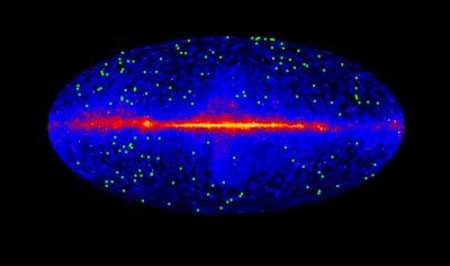
Gamma rays are the most energetic form of light. Since Fermi’s launch in 2008, its Large Area Telescope (LAT) observes the entire sky in high-energy gamma rays every three hours, creating the most detailed map of the universe ever known at these energies.
The total sum of starlight in the cosmos is known to astronomers as the extragalactic background light (EBL).
To gamma rays, the EBL functions as a kind of cosmic fog. Ajello and his team investigated the EBL by studying gamma rays from 150 blazars, or galaxies powered by black holes, that were strongly detected at energies greater than 3 billion electron volts (GeV), or more than a billion times the energy of visible light.
“With more than a thousand detected so far, blazars are the most common sources detected by Fermi, but gamma rays at these energies are few and far between, which is why it took four years of data to make this analysis,” said team member Justin Finke, an astrophysicist at the Naval Research Laboratory in Washington.
As matter falls toward a galaxy’s supermassive black hole, some of it is accelerated outward at almost the speed of light in jets pointed in opposite directions. When one of the jets happens to be aimed in the direction of Earth, the galaxy appears especially bright and is classified as a blazar.
Gamma rays produced in blazar jets travel across billions of light-years to Earth. During their journey, the gamma rays pass through an increasing fog of visible and ultraviolet light emitted by stars that formed throughout the history of the universe.
Occasionally, a gamma ray collides with starlight and transforms into a pair of particles – an electron and its antimatter counterpart, a positron. Once this occurs, the gamma ray light is lost. In effect, the process dampens the gamma ray signal in much the same way as fog dims a distant lighthouse.
From studies of nearby blazars, scientists have determined how many gamma rays should be emitted at different energies. More distant blazars show fewer gamma rays at higher energies – especially above 25 GeV – thanks to absorption by the cosmic fog.
The farthest blazars are missing most of their higher-energy gamma rays.
The researchers then determined the average gamma-ray attenuation across three distance ranges between 9.6 billion years ago and today.
From this measurement, the scientists were able to estimate the fog’s thickness. To account for the observations, the average stellar density in the cosmos is about 1.4 stars per 100 billion cubic light-years, which means the average distance between stars in the universe is about 4,150 light-years.
A paper describing the findings was published Thursday on Science Express.
“The Fermi result opens up the exciting possibility of constraining the earliest period of cosmic star formation, thus setting the stage for NASA’s James Webb Space Telescope,” said Volker Bromm, an astronomer at the University of Texas, Austin, who commented on the findings. “In simple terms, Fermi is providing us with a shadow image of the first stars, whereas Webb will directly detect them.”
Measuring the extragalactic background light was one of the primary mission goals for Fermi.
“We’re very excited about the prospect of extending this measurement even farther,” said Julie McEnery, the mission’s project scientist at NASA’s Goddard Space Flight Center in Greenbelt, Md.
Goddard manages the Fermi astrophysics and particle physics research partnership. Fermi was developed in collaboration with the U.S. Department of Energy with contributions from academic institutions and partners in France, Germany, Italy, Japan, Sweden and the United States.
- Details
- Written by: Elizabeth Larson
THIS STORY HAS BEEN UPDATED BASED ON NEW INFORMATION FROM THE CHP; THE ARRESTEE WAS MALE, NOT FEMALE, AS ORIGINALLY REPORTED.
NORTH COAST, Calif. – A Friday night crash closed a portion of Highway 20 east of the Lake and Colusa County line and resulted in one person being flown to a hospital.
The crash, involving a van and an SUV, occurred shortly after 8 p.m. on Highway 20 near the Mitchell Flat area, several miles east of the Lake and Colusa County line, according to radio reports.
The highway was completely shut down until just after 9:30 p.m. as Cal Fire and Colusa County officials responded, according to the California Highway Patrol.
There were five victims of the crash – four adults and a child – scanner reports indicated. All of them were out of the vehicles by the time firefighters arrived.
A Northshore Fire medic unit responded on a mutual aid request, but was canceled before arriving at the scene, according to radio traffic.
The Cal Star 4 air ambulance landed nearby to transport one person. The helicopter lifted off for Enloe Hospital in Chico just after 9 p.m., reports from the scene stated.
It was not immediately clear if any of the other subjects involved were injured.
The CHP reports indicated a Colusa County Sheriff’s deputy responded to Enloe Hospital to detain a male subject involved with the crash after finding drugs in a diaper bag.
Additional details on the crash were not available Friday night.
Email Elizabeth Larson at
- Details
- Written by: Lake County News reports
LAKE COUNTY, Calif. – With the recent rains and cooler temperatures, Cal Fire’s Sonoma-Lake-Napa Unit will transition out of fire season effective Monday, Nov. 5, at 8 a.m.
The onset of cooler, wetter weather allows Cal Fire to reduce staffing through release of seasonal employees, the closure of select facilities, and release of local fixed wing aircraft.
However, Cal Fire is prepared to increase staffing and provide statewide response if weather or fire activity dictate.
The requirement for Cal Fire burn permits also expires with the end of fire season. Property owners interested in conducting control burns should check with their local fire agency and air pollution district to ensure they meet all fire and air pollution permit requirements, prior to burning.
The Sonoma-Lake-Napa Unit responded to over 536 wildland fires within the six counties during the peak season.
Although the unit had four wildland fire incidents which exceeded 1,000 acres, the vast majority of wildland fires were less than 10 acres, due to aggressive initial attack by Cal Fire and local fire agencies.
Residents who create and maintain 100 feet of defensible space around their homes had a major role in keeping these fires small, reducing the threat to life and property.
Cal Fire is a full service fire department and will continue to provide response to local emergencies such as fires, traffic collisions, medical calls, and haz mat incidents through local agreements; as well as statewide or regional emergencies such as floods or earthquakes
The Sonoma-Lake-Napa Unit responsibility area includes six counties: Sonoma, Lake, Napa, Yolo, Solano and Colusa.