 How to resolve AdBlock issue?
News
- Details
- Written by: Lake County News reports
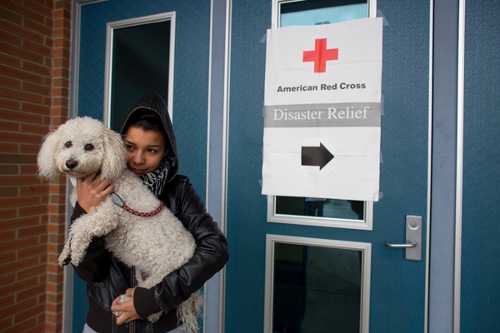
LAKEPORT, Calif. – St. John’s Episcopal Church in Lakeport has signed a shelter agreement with the American Red Cross Sonoma, Mendocino and Lake Counties.
The agreement makes possible the use of St. John’s Carey Hall as a temporary refuge for local disaster victims during Red Cross disaster relief activities.
“We welcome creative use of our sacred buildings and gardens to benefit our neighbors and community,” said St. John’s Parish Priest Fr. Leo M. Joseph, O.S.F.
“We’re pleased to partner with American Red Cross which, we know, provides shelter, food, emotional assistance and basic health care during disasters,” Joseph added.
St. John’s is the presence and ministry of The Episcopal Church in Lake County since 1877. The church building was recognized as a county point of historical interest by California Historical Resources Commission in 1989.
The American Red Cross provides services to individuals, families, and communities when disaster strikes.
Red Cross disaster relief efforts in Lake County are made possible by the generous people of Lake County.
More information about the local Red Cross, including how to volunteer, donate, and prepare for emergencies, is available at www.arcsm.org .
The church is located at 1190 N. Forbes St. For further information, call Fr. Leo Joseph at 707-349-6563 or visit St. John’s Web site, www.saintjohnslakeport.org .
- Details
- Written by: Elizabeth Larson
LAKEPORT, Calif. – The California Secretary of State said Friday that California’s voter registration has reached a record level.
Secretary of State Debra Bowen’s final tally was based on registrations her office received through its new online system as well as reports from the Lake County’s Registrar of Voters Office and other county elections offices throughout the state.
Bowen’s office said 18,245,970 Californians, or 76.7 percent of those eligible, are registered to vote in Tuesday’s presidential election.
While the percentage of eligible Californians who are registered has remained relatively steady for more than a decade, the raw number of registrants is a record high in the state, Bowen reported. California’s voting population has increased by 941,879 people since this time four years ago.
Bowen’s office said the previous record high for California was 17,334,275 registrants, set in February 2009.
The last day to register was Oct. 22.
Lake County Registrar of Voters Diane Fridley said her office delivered the final voter registration numbers for the Nov. 6 election to Bowen earlier this week.
The final numbers Fridley provided to Lake County News showed that approximately 34,938 people are registered to vote in this month’s presidential election. Bowen’s tally on Lake County comes up two votes short, at 34,936. Fridley said they received two additional ballots and are updating the state.
The final number Fridley reported is down slightly from the 35,154 voters who were reported by Fridley’s office as registered for the November 2008 presidential election.
Of the 2012 presidential election’s registered voters in Lake County, 16,068, or 45.9 percent, are registered to vote at polling places, and 18,647, or 53.3 percent, cast their ballots as absentees, or vote by mail, according to Fridley.
Bowen reported that this year’s voter registration figures did not beat the dramatic registration surge in the 2008 presidential election season.
While voter registration always increases significantly in the final weeks before a presidential election, registration activity in September and October 2012 was less robust than in the 2008 election cycle, according to Bowen’s report.
In the final 45 days before California’s voter registration deadline four years ago, nearly 1.2 million people registered to vote; this year 986,290 people registered to vote in that 45-day timeframe, she said. A large number of new voters used the Secretary of State’s new online registration system.
“Seeing a record number of Californians registered to vote is wonderful, but there are still too many eligible people skipping the electoral process altogether,” said Secretary of State Debra Bowen, California’s chief elections officer. “Registering to vote is easier now than it was four years ago, yet fewer people actually registered in this final 45-day window than did in 2008. This makes it clear that it’s not just a question of making voter registration easier; it’s really about what inspires people to care about their democracy and be part of the decision-making process.”
Based on Bowen’s report, the Democratic Party has the largest number of registered voters in California, 7,966,422, or 43.6 percent, followed by Republicans, 5,356,608, 29.3 percent; no party preference (known prior to 2011 as “decline-to-state”), 3,820,545, 21 percent; American Independent, 477,129, 2.6 percent; miscellaneous, 336,196, 1.8 percent; Green, 115,034, 0.6 percent; Libertarian, 108,736, 0.6 percent; Peace and Freedom, 61,987, 0.34 percent; American Elect, 3,313, 2.6 percent.
Lake County’s registration picture looked similar to that of the state.
Voters registered as Democratic total 14,279, or 41 percent; Republican, 9,662, 28 percent; no party preference, 8,625, 25 percent; American Independent, 1,398, 4 percent; Green, 471, 1.35 percent; Libertarian, 271, 0.78 percent; Peace and Freedom, 157, 0.45 percent; other, 71, 0.20 percent; Americans Elect, 2, 0.01 percent.
Polls will be open on Tuesday, Nov. 6, from 7 a.m. to 8 p.m. All ballots, including vote-by-mail ballots, must be received by county elections officials by 8 p.m. on Election Day.
“Registering is just the first step. Now it’s time for the next two important steps: getting informed and voting by Election Day,” Bowen added.
The highest voter turnout for a presidential election in California was 88.4 percent in 1964, she reported.
The complete report on registered voters, which includes voter registration data for a variety of political subdivisions, is at www.sos.ca.gov/elections/ror/ror-pages/15day-general-12 .
Email Elizabeth Larson at
- Details
- Written by: Dennis Fordham
California’s “putative spouse doctrine” treats a so-called “putative spouse” like a surviving spouse with legal standing to sue for wrongful death of a deceased spouse and to claim a surviving spouse’s inheritance rights.
A putative spouse is someone who is found by a court to have genuinely believed that he or she was legitimately married although the marriage was invalid, void or voidable due to some legal defect affecting the union (for example bigamy).
Now, surviving domestic partners in a defective partnership may similarly argue that the “Putative Spouse Doctrine” applies to them, although that is not uniformly agreed throughout California.
The doctrine is all about fairness to innocent parties. It allows a court to find a union where otherwise strictly applying the law would result in an injustice. It requires the persons claiming to be married to have held a good faith belief in the invalid, void or voidable marriage.
Courts have examined numerous factors when deciding whether or not a person in good faith believed they were married.
Factors include the person’s level of education, cultural background and lifestyle. It is a facts and circumstances case by case analysis.
California judicial case law, however, is divided over whether the belief needs to be objectively reasonable or merely subjectively held.
Does a putative spouse’s erroneous belief that he or she was married need to be reasonable given the circumstances? Or is an alleged state of mind, no matter how implausible, sufficient?
California’s Supreme Court will decide this legal issue in the pending case of Ceja v. Rudolph & Sletten Inc., on appeal.
A putative spouse (or partner) has the same rights as a surviving spouse if the other spouse (or partner) is deceased.
In particular, if the deceased putative spouse died with assets not transferrable under a valid will or trust then the surviving putative spouse is entitled to receive all those assets that were acquired during the union which otherwise would have been the couple’s community property assets if their union had been valid (so-called “quasi marital property”). He or she is also entitled to either one-half or one-third of the decedent’s separate property assets.
Recently California’s Superior Court in Burnham v. Public Employees’ Retirement System [(2012) 208 CA4th 1576] ruled against a surviving domestic partner where the couple’s declaration of domestic partnership was signed only hours prior to one partner’s death, and then filed the California Secretary two days later.
The court found the partnership invalid because the declaration had to be filed while the partners were both alive for the union to be finalized.
The court held that the putative spouse doctrine inapplicable because it only applied to protect a putative spouse’s expectancy in the future assets that the couple acquired while living together like a married couple.
Given that the couple’s declaration was signed only hours prior to one partner’s death the doctrine was inapplicable.
Nonetheless, the court’s decision does not explain why the putative spouse doctrine was inapplicable insofar as the surviving partner should have been awarded the rights of an “omitted spouse” (that is a spouse who was married but not included in any will either because no will was executed or the decedent’s will was executed prior to the marriage).
As a putative spouse, the surviving partner would been entitled to one-third of the deceased partner’s retirement plan.
The putative spouse doctrine obviously is not an estate planning tool. It is a fall-back position that from time to time protects a surviving “spouse” or “partner” who thought he or she was in a legally recognized union.
Otherwise, the only recourse of the aggrieved surviving “spouse” or “partner” is to sue as a creditor of the decedent’s estate regarding any contractual obligations that were created by cohabiting but unmarried persons.
Dennis A. Fordham, attorney (LL.M. tax studies), is a State Bar Certified Specialist in Estate Planning, Probate and Trust Law. His office is at 55 First St., Lakeport, California. Dennis can be reached by e-mail at
- Details
- Written by: Dr. Tony Phillips

New results from NASA’s Mars rover Curiosity show that the mineralogy of Martian soil is similar to weathered basaltic soils of volcanic origin in Hawaii.
The minerals were identified in the first sample of Martian soil ingested recently by the rover. Curiosity used its Chemistry and Mineralogy (CheMin) instrument to analyze the sample.
“Our team is elated with these first results from our instrument,” said David Blake of NASA Ames Research Center in Moffett Field, Calif., who is the principal investigator for CheMin. “They heighten our anticipation for future CheMin analyses in the months and miles ahead for Curiosity.”
Innovations from Ames led to an X-ray diffraction instrument compact enough to fit inside the rover. Mars exploration wasn’t the only benefit, however.
CheMin uses X-ray diffraction, the standard practice for geologists on Earth using much larger laboratory instruments. This method provides more accurate identifications of minerals than any method previously used on Mars. X-ray diffraction reads minerals’ internal structure by recording how their crystals distinctively interact with X-rays.
The innovations have also led to applications on Earth such as compact and portable X-ray diffraction equipment for oil and gas exploration, analysis of archaeological objects and screening of counterfeit pharmaceuticals, among other uses.
The identification of minerals in rocks and soil is crucial for Curiosity’s mission to assess past environmental conditions in Gale Crater. Each mineral records the conditions under which it formed.
The specific sample for CheMin’s first analysis was soil Curiosity scooped up at a patch of dust and sand that the team named Rocknest.
The sample was processed through a sieve to exclude particles larger than 0.006 inch, roughly the width of a human hair.
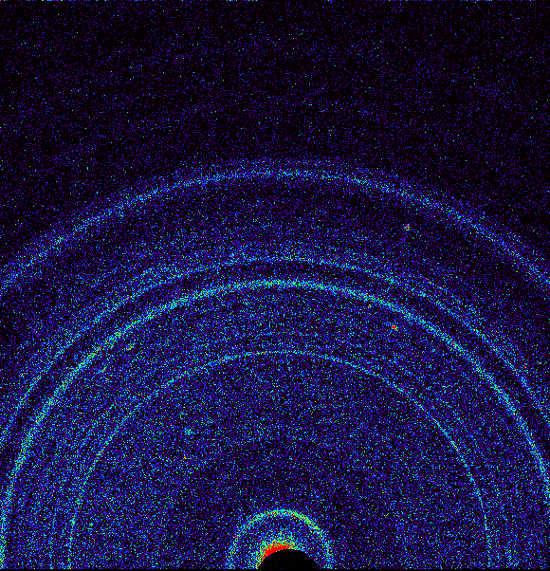
The sample has at least two components: dust distributed globally in dust storms and fine sand originating more locally.
Unlike conglomerate rocks Curiosity investigated a few weeks ago, which are several billion years old and indicative of flowing water, the soil material CheMin has analyzed is more representative of modern processes on Mars.
“Much of Mars is covered with dust, and we had an incomplete understanding of its mineralogy,” said David Bish, CheMin co-investigator with Indiana University in Bloomington. “We now know it is mineralogically similar to basaltic material, with significant amounts of feldspar, pyroxene and olivine, which was not unexpected. Roughly half the soil is non-crystalline material, such as volcanic glass or products from weathering of the glass. “
Bish said, “So far, the materials Curiosity has analyzed are consistent with our initial ideas of the deposits in Gale Crater recording a transition through time from a wet to dry environment. The ancient rocks, such as the conglomerates, suggest flowing water, while the minerals in the younger soil are consistent with limited interaction with water.”
During the two-year prime mission of the Mars Science Laboratory Project, researchers are using Curiosity’s 10 instruments to investigate whether areas in Gale Crater ever offered environmental conditions favorable for microbial life.
For more information about Curiosity and its mission, visit: http://www.nasa.gov/msl and http://mars.jpl.nasa.gov/msl .
You can follow the mission on Facebook and Twitter at: http://www.facebook.com/marscuriosity and http://www.twitter.com/marscuriosity .
Dr. Tony Phillips works for the National Aeronautics and Space Administration.