 How to resolve AdBlock issue?
News
The state of California has awarded almost $20 million in grants to 18 Native American tribes in California to support their efforts addressing the Missing and Murdered Indigenous People, or MMIP, crisis.
The California Board of State and Community Corrections, or BSCC, approved a second round of awards under the MMIP Grant Program, established in the 2022 budget to provide competitive grants to California tribal nations.
The grant cycle is from Aug. 1, 2024, to June 1, 2028.
Lake County tribes including Robinson Rancheria and Scotts Valley are among the grantees.
Grants focus on work such as developing culturally-based prevention strategies, strengthening responses to human trafficking, providing culturally appropriate support services to affected families and their communities, and improving cooperation and communication on jurisdictional issues between state, local, federal, and tribal law enforcement agencies.
“Too many Native people, many of them women and girls, are missing with no answer. Behind each Missing and Murdered Indigenous Person case is a family and community grieving a loved one. These grants will support tribal governments in helping those families find peace — and in stemming this tragic epidemic,” said Gov. Gavin Newsom.
The MMIP crisis is a worldwide issue, recognized in the United States, Canada, Australia and New Zealand.
In the United States alone, 84% of Native women and 82% of Native men will experience violence in their lifetimes.
MMIP cases are seven times less likely to be solved than any other group, and Native women are victims of murder at rates more than ten times the national average.
California has worked closely with tribes across the state to develop strategies to support tribal work and investigations to solve and prevent these cases.
The work funded by these grants includes the following projects.
Cahuilla Band of Indians (in collaboration with the Santa Rosa Band of Cahuilla Indians, Los Coyotes Band of Cahuilla and Cupeno Indians): $999,998
The Cahuilla Consortium Victim Advocacy Program plans to build a "Hub" website that would warehouse awareness, prevention, and direct service information for all tribes in California, focused by region — Northern, Central and Southern. The information would be arranged and accessible to key audiences, tribal members, tribal service providers, tribal leadership, non-tribal service providers, both tribal and non-tribal law enforcement agencies. Additionally, the CCVAP will provide direct emergency services to those victimized by crimes that connect to the MMIP epidemic, with support provided to vulnerable Native survivors, their families and communities.
Dry Creek Rancheria Band of Pomo Indians: $1,000,000
The Dry Creek Rancheria Band of Pomo Indians will implement two initiatives. 1) Protecting the Sacred, through which the tribe will a) Educate schools, law enforcement, tribal systems on the signs of human trafficking, exploitation, and abuse; b) Convene an Indigenous Regional MMIP Coalition; c) Conduct a culturally based outreach and awareness campaign; and d) Promote coordination between Emergency Responders (police, firefighters, EMT, child welfare, health systems) to address human trafficking, exploitation, and violence towards indigenous people. 2) Healing Our Communities, through which the tribe will provide: a) Behavioral health and crisis interventions; b) Community healing activities; c) Traditional healing services; and d) Culturally centered interventions.
Greenville Rancheria: $982,870
Greenville Rancheria will take a preventative and proactive approach to ensuring youth, family and individuals' well-being in our communities along the Northern California I-5 corridor and in rural remote areas through: 1) Prevention, awareness, education, and events for tribal communities we serve; 2) Developing and producing digital mapping, and story maps with the collaboration of experts, to locate clusters of areas where our MMIP persons were last seen or were found; and 3) Assisting victim families with the most immediate needs of private investigator funds, counseling or as a liaison between law enforcement, courts processes and seeking help from culturally sensitive and familiar outreach.
Hoopa Valley Tribe: $1,000,000
With the support of BSCC funding, the Hoopa Tribal Education Association will strengthen internal capacity to disrupt systems of violence in the Hoopa community by promoting cultural engagement opportunities, trauma-informed practices, and by supporting access to education. The proposed project will hire a full-time cultural coordinator, support trauma-informed practices by providing opportunities for community training and wellness and support equal access to education for youth. By building protective factors through culture, education, and furthering ourselves as a trauma-informed community we hope to reduce the individual risk factors that perpetuate violence.
Ione Band of Miwok Indians (in collaboration with Wilton Rancheria): $1,999,675
Find My Relations Project is dedicated to addressing the critical issue of organizing a dedicated task force exclusively dedicated to finding missing and murdered indigenous people. With a mission rooted in compassion and justice, we aim to bring closure to affected families, find those who are lost, and significantly raise awareness about this pressing issue. Our multifaceted approach includes establishing a specialized and highly trained Native tactical task force, launching comprehensive awareness and education campaigns, and providing direct support to families and communities in need.
Jamul Indian Village of California (in collaboration with the Manzanita Band, San Pasqual Band, and Sycuan Band of the Kumeyaay): $1,999,625
Our proposal focuses on combating human trafficking in San Diego Indigenous communities through awareness, training, and law enforcement collaboration. It includes initiatives such as hosting a Summit, expanding the Acorns to Oaks program for young Indigenous girls, and launching public service announcements and billboard campaigns. Training programs will be enhanced with virtual reality components, and a tribal officer will be assigned to the San Diego Human Trafficking Task Force to promote coordination between tribal police and their non-tribal counterparts. This comprehensive approach aims to create a safer community and combat human trafficking effectively.
Karuk Tribe: $1,000,000
The Karuk Tribe requires a specialist to create and execute a Tribal Community Response Plan for MMIP cases, which outlines the roles, protocols, and resources for handling incidents and is tested and updated regularly. The specialist will also raise awareness, protect youth and vulnerable groups, and directly support victims and families.
Pala Band of Mission Indians: $1,000,000
The Pala Band of Mission Indians (PBMI), a Federally Recognized Tribe, submits this MMIP grant proposal to enhance efforts to provide awareness and preventative measures with the MMIP crisis affecting our tribal communities. PBMI intends to implement systemic change providing culturally based prevention strategies, strengthening responses to human trafficking, improving cooperation and communication on jurisdictional issues between state, local, federal and tribal law enforcement. PBMI intends to collaborate collectively with other Tribes in their efforts to bring awareness for all California’s MMIP regardless of geographical area.
Pechanga Band of Indians: $980,035
This program is a multi-disciplinary approach to enhance the Pechanga Tribal Rangers (PTR) and Pechanga Child and Family Services (PCFS) departments’ capacity to effectively respond to runaway juvenile and missing persons incidents and strengthen juvenile runaways and potential victims of human trafficking. Further, it will educate and engage our tribal community to work together to protect our vulnerable and at-risk members. PTR will hire a trained law enforcement investigator/MMIP and Human Trafficking Coordinator. PCFS will hire a Master’s level Social Worker with a comprehensive background in Commercial Sexual Exploitation.
Picayune Rancheria of the Chukchansi Indians: $967,845
The Picayune Rancheria is dedicated to addressing the issue of domestic violence in our community. Our Tribe recognizes that domestic violence cases are high and resources available in our area are limited to address these cases. To address this urgent need, we intend to use the MMIP grant to establish a program that will provide essential MMIP services to our community. Our program will offer a range of services, including crisis intervention, counseling, legal assistance, and case management. With the support of the MMIP grant, we will be able to provide the necessary resources and support to help victims find safety, healing, and justice.
Pinoleville Pomo Nation (in collaboration with the Robinson Rancheria, Kashia Band of Pomo Indians, and Redwood Valley Rancheria): $1,999,661
The proposed collaborative project is designed to increase awareness on MMIP issues to 500 people in Tribal and non-Tribal communities; provide mental health services, community healing and wrap-around services focusing on at-risk youth (30 per year) and promoting jurisdictional cooperation in Lake, Mendocino and Sonoma County. The project collaborates with Potter Valley Tribe and Redwood Valley Rancheria and partners with Ukiah Unified School District, Mendocino College, Consolidated Tribal Health Project and New Life Clinic. The project will implement three major goals to address critical challenges faced by the Native American youth
in response to MMIP.
Pit River Tribe: $1,000,000
The Pit River Tribe will develop MMIP projects led by the Tribal Victim Witness department. The MMIP project will include culturally based support and resources for family members that have had their loved one go missing. The project will develop and provide training such as search and rescue teams, a formal process in feather alert activation, and coordination with law enforcement. With an emphasis on culturally based practices that address the intersections of the MMIP crisis within the four county regions of the ancestral boundary area of Pit River, of which extends 3.5 million acres. This includes the Shasta, Modoc, Lassen and Siskiyou Counties.
Round River Indian Tribe: $750,571
The Round River Indian Tribe will build a MMIP system of response that is based on the Tribe's unique needs as a rural and remote community. The tribe will utilize a multistrategy approach that includes prevention, intervention, and response. The intent of the proposed project is to respond to urgent needs to prevent factors that contribute to MMIP. The Tribe will hire two full-time staff to develop the MMIP Prevention and Intervention/Response Program components.
San Pasqual Band of Missions Indians: $926,136
The proposed project is designed to help the San Pasqual community to develop and implement evidence and culturally informed prevention and outreach strategies and strengthen responses to issues related to MMIP. Culturally based prevention strategies include activities that help to restore youth and adult connections to traditional knowledge, language learning, and cultural awareness aim to improve cultural identities, wellness and self-esteem. Community engagement workshops and advocacy/awareness campaigns aim to improve knowledge and understanding to prevent victimization, reduce violent crime and improve community involvement in safety concerns.
Santa Rosa Rancheria Tachi Yokut Tribe: $981,173
The Santa Rosa Rancheria Tachi Yokut Tribe will use BSCC funding to establish a comprehensive program to address a critical gap in MMIP awareness, prevention, support, and healing to human trafficking victims, survivors, and families on the Tribal reservation. The Tribal Public Safety and Social Service Departments will train staff on how to recognize warning signs of human trafficking and learn to engage, assist, and provide services for human trafficking. The Tribe and both departments shall offer enhanced trainings and programs in several categories of MMIP.
Scotts Valley Band of Pomo Indians: $498,690
The Scotts Valley Band of Pomo Indians will create a MMIP awareness and protection program that utilizes wrap-around program service concepts in a culturally informed manner. Services will include prevention, intervention and protection for Tribal members that are the most vulnerable and at risk of MMIP.
Torres Martinez Desert Cahuilla Indians: $500,000
The Torres Martinez Desert Cahuilla Indians’ initiative to establish a tiny homes village for the unhoused, along with a new grant database, aligns with the MMIP Grant Program, addressing homelessness and promoting cultural resilience. The village provides a culturally sensitive and safe living environment for the tribe's most vulnerable members, while the grants database enhances coordination and secures future funding. These efforts contribute to addressing MMIP by fostering community support and aiding at-risk or homeless tribal members. If awarded, 70 percent of funds will support services for the village, with 30 percent allocated to implement a sophisticated cloud based tribal grants database.
Wilton Rancheria: $991,323
Wilton Rancheria will use BSCC funding over the 46-month grant period to establish culturally appropriate trainings to local law enforcement agencies, uphold the current MOU with Sacramento County Sheriff’s Office, create our Tribal Law Enforcement code, and initiate the process of developing a Tribal Law Enforcement Department. The gap Wilton Rancheria intends to address consists of strengthening the public trust with local tribal communities with policing agencies, and to prevent MMIP and human trafficking in Sacramento County.
The California Board of State and Community Corrections, or BSCC, approved a second round of awards under the MMIP Grant Program, established in the 2022 budget to provide competitive grants to California tribal nations.
The grant cycle is from Aug. 1, 2024, to June 1, 2028.
Lake County tribes including Robinson Rancheria and Scotts Valley are among the grantees.
Grants focus on work such as developing culturally-based prevention strategies, strengthening responses to human trafficking, providing culturally appropriate support services to affected families and their communities, and improving cooperation and communication on jurisdictional issues between state, local, federal, and tribal law enforcement agencies.
“Too many Native people, many of them women and girls, are missing with no answer. Behind each Missing and Murdered Indigenous Person case is a family and community grieving a loved one. These grants will support tribal governments in helping those families find peace — and in stemming this tragic epidemic,” said Gov. Gavin Newsom.
The MMIP crisis is a worldwide issue, recognized in the United States, Canada, Australia and New Zealand.
In the United States alone, 84% of Native women and 82% of Native men will experience violence in their lifetimes.
MMIP cases are seven times less likely to be solved than any other group, and Native women are victims of murder at rates more than ten times the national average.
California has worked closely with tribes across the state to develop strategies to support tribal work and investigations to solve and prevent these cases.
The work funded by these grants includes the following projects.
Cahuilla Band of Indians (in collaboration with the Santa Rosa Band of Cahuilla Indians, Los Coyotes Band of Cahuilla and Cupeno Indians): $999,998
The Cahuilla Consortium Victim Advocacy Program plans to build a "Hub" website that would warehouse awareness, prevention, and direct service information for all tribes in California, focused by region — Northern, Central and Southern. The information would be arranged and accessible to key audiences, tribal members, tribal service providers, tribal leadership, non-tribal service providers, both tribal and non-tribal law enforcement agencies. Additionally, the CCVAP will provide direct emergency services to those victimized by crimes that connect to the MMIP epidemic, with support provided to vulnerable Native survivors, their families and communities.
Dry Creek Rancheria Band of Pomo Indians: $1,000,000
The Dry Creek Rancheria Band of Pomo Indians will implement two initiatives. 1) Protecting the Sacred, through which the tribe will a) Educate schools, law enforcement, tribal systems on the signs of human trafficking, exploitation, and abuse; b) Convene an Indigenous Regional MMIP Coalition; c) Conduct a culturally based outreach and awareness campaign; and d) Promote coordination between Emergency Responders (police, firefighters, EMT, child welfare, health systems) to address human trafficking, exploitation, and violence towards indigenous people. 2) Healing Our Communities, through which the tribe will provide: a) Behavioral health and crisis interventions; b) Community healing activities; c) Traditional healing services; and d) Culturally centered interventions.
Greenville Rancheria: $982,870
Greenville Rancheria will take a preventative and proactive approach to ensuring youth, family and individuals' well-being in our communities along the Northern California I-5 corridor and in rural remote areas through: 1) Prevention, awareness, education, and events for tribal communities we serve; 2) Developing and producing digital mapping, and story maps with the collaboration of experts, to locate clusters of areas where our MMIP persons were last seen or were found; and 3) Assisting victim families with the most immediate needs of private investigator funds, counseling or as a liaison between law enforcement, courts processes and seeking help from culturally sensitive and familiar outreach.
Hoopa Valley Tribe: $1,000,000
With the support of BSCC funding, the Hoopa Tribal Education Association will strengthen internal capacity to disrupt systems of violence in the Hoopa community by promoting cultural engagement opportunities, trauma-informed practices, and by supporting access to education. The proposed project will hire a full-time cultural coordinator, support trauma-informed practices by providing opportunities for community training and wellness and support equal access to education for youth. By building protective factors through culture, education, and furthering ourselves as a trauma-informed community we hope to reduce the individual risk factors that perpetuate violence.
Ione Band of Miwok Indians (in collaboration with Wilton Rancheria): $1,999,675
Find My Relations Project is dedicated to addressing the critical issue of organizing a dedicated task force exclusively dedicated to finding missing and murdered indigenous people. With a mission rooted in compassion and justice, we aim to bring closure to affected families, find those who are lost, and significantly raise awareness about this pressing issue. Our multifaceted approach includes establishing a specialized and highly trained Native tactical task force, launching comprehensive awareness and education campaigns, and providing direct support to families and communities in need.
Jamul Indian Village of California (in collaboration with the Manzanita Band, San Pasqual Band, and Sycuan Band of the Kumeyaay): $1,999,625
Our proposal focuses on combating human trafficking in San Diego Indigenous communities through awareness, training, and law enforcement collaboration. It includes initiatives such as hosting a Summit, expanding the Acorns to Oaks program for young Indigenous girls, and launching public service announcements and billboard campaigns. Training programs will be enhanced with virtual reality components, and a tribal officer will be assigned to the San Diego Human Trafficking Task Force to promote coordination between tribal police and their non-tribal counterparts. This comprehensive approach aims to create a safer community and combat human trafficking effectively.
Karuk Tribe: $1,000,000
The Karuk Tribe requires a specialist to create and execute a Tribal Community Response Plan for MMIP cases, which outlines the roles, protocols, and resources for handling incidents and is tested and updated regularly. The specialist will also raise awareness, protect youth and vulnerable groups, and directly support victims and families.
Pala Band of Mission Indians: $1,000,000
The Pala Band of Mission Indians (PBMI), a Federally Recognized Tribe, submits this MMIP grant proposal to enhance efforts to provide awareness and preventative measures with the MMIP crisis affecting our tribal communities. PBMI intends to implement systemic change providing culturally based prevention strategies, strengthening responses to human trafficking, improving cooperation and communication on jurisdictional issues between state, local, federal and tribal law enforcement. PBMI intends to collaborate collectively with other Tribes in their efforts to bring awareness for all California’s MMIP regardless of geographical area.
Pechanga Band of Indians: $980,035
This program is a multi-disciplinary approach to enhance the Pechanga Tribal Rangers (PTR) and Pechanga Child and Family Services (PCFS) departments’ capacity to effectively respond to runaway juvenile and missing persons incidents and strengthen juvenile runaways and potential victims of human trafficking. Further, it will educate and engage our tribal community to work together to protect our vulnerable and at-risk members. PTR will hire a trained law enforcement investigator/MMIP and Human Trafficking Coordinator. PCFS will hire a Master’s level Social Worker with a comprehensive background in Commercial Sexual Exploitation.
Picayune Rancheria of the Chukchansi Indians: $967,845
The Picayune Rancheria is dedicated to addressing the issue of domestic violence in our community. Our Tribe recognizes that domestic violence cases are high and resources available in our area are limited to address these cases. To address this urgent need, we intend to use the MMIP grant to establish a program that will provide essential MMIP services to our community. Our program will offer a range of services, including crisis intervention, counseling, legal assistance, and case management. With the support of the MMIP grant, we will be able to provide the necessary resources and support to help victims find safety, healing, and justice.
Pinoleville Pomo Nation (in collaboration with the Robinson Rancheria, Kashia Band of Pomo Indians, and Redwood Valley Rancheria): $1,999,661
The proposed collaborative project is designed to increase awareness on MMIP issues to 500 people in Tribal and non-Tribal communities; provide mental health services, community healing and wrap-around services focusing on at-risk youth (30 per year) and promoting jurisdictional cooperation in Lake, Mendocino and Sonoma County. The project collaborates with Potter Valley Tribe and Redwood Valley Rancheria and partners with Ukiah Unified School District, Mendocino College, Consolidated Tribal Health Project and New Life Clinic. The project will implement three major goals to address critical challenges faced by the Native American youth
in response to MMIP.
Pit River Tribe: $1,000,000
The Pit River Tribe will develop MMIP projects led by the Tribal Victim Witness department. The MMIP project will include culturally based support and resources for family members that have had their loved one go missing. The project will develop and provide training such as search and rescue teams, a formal process in feather alert activation, and coordination with law enforcement. With an emphasis on culturally based practices that address the intersections of the MMIP crisis within the four county regions of the ancestral boundary area of Pit River, of which extends 3.5 million acres. This includes the Shasta, Modoc, Lassen and Siskiyou Counties.
Round River Indian Tribe: $750,571
The Round River Indian Tribe will build a MMIP system of response that is based on the Tribe's unique needs as a rural and remote community. The tribe will utilize a multistrategy approach that includes prevention, intervention, and response. The intent of the proposed project is to respond to urgent needs to prevent factors that contribute to MMIP. The Tribe will hire two full-time staff to develop the MMIP Prevention and Intervention/Response Program components.
San Pasqual Band of Missions Indians: $926,136
The proposed project is designed to help the San Pasqual community to develop and implement evidence and culturally informed prevention and outreach strategies and strengthen responses to issues related to MMIP. Culturally based prevention strategies include activities that help to restore youth and adult connections to traditional knowledge, language learning, and cultural awareness aim to improve cultural identities, wellness and self-esteem. Community engagement workshops and advocacy/awareness campaigns aim to improve knowledge and understanding to prevent victimization, reduce violent crime and improve community involvement in safety concerns.
Santa Rosa Rancheria Tachi Yokut Tribe: $981,173
The Santa Rosa Rancheria Tachi Yokut Tribe will use BSCC funding to establish a comprehensive program to address a critical gap in MMIP awareness, prevention, support, and healing to human trafficking victims, survivors, and families on the Tribal reservation. The Tribal Public Safety and Social Service Departments will train staff on how to recognize warning signs of human trafficking and learn to engage, assist, and provide services for human trafficking. The Tribe and both departments shall offer enhanced trainings and programs in several categories of MMIP.
Scotts Valley Band of Pomo Indians: $498,690
The Scotts Valley Band of Pomo Indians will create a MMIP awareness and protection program that utilizes wrap-around program service concepts in a culturally informed manner. Services will include prevention, intervention and protection for Tribal members that are the most vulnerable and at risk of MMIP.
Torres Martinez Desert Cahuilla Indians: $500,000
The Torres Martinez Desert Cahuilla Indians’ initiative to establish a tiny homes village for the unhoused, along with a new grant database, aligns with the MMIP Grant Program, addressing homelessness and promoting cultural resilience. The village provides a culturally sensitive and safe living environment for the tribe's most vulnerable members, while the grants database enhances coordination and secures future funding. These efforts contribute to addressing MMIP by fostering community support and aiding at-risk or homeless tribal members. If awarded, 70 percent of funds will support services for the village, with 30 percent allocated to implement a sophisticated cloud based tribal grants database.
Wilton Rancheria: $991,323
Wilton Rancheria will use BSCC funding over the 46-month grant period to establish culturally appropriate trainings to local law enforcement agencies, uphold the current MOU with Sacramento County Sheriff’s Office, create our Tribal Law Enforcement code, and initiate the process of developing a Tribal Law Enforcement Department. The gap Wilton Rancheria intends to address consists of strengthening the public trust with local tribal communities with policing agencies, and to prevent MMIP and human trafficking in Sacramento County.
- Details
- Written by: Lake County News reports

The Bureau of Land Management is approving seven herbicide active ingredients to control noxious weeds and invasive species on public lands.
The decision will be published in Friday’s Federal Register, and BLM field and district offices can now begin considering the use of these tools in efforts to control and eradicate noxious weeds and invasive plant species on the public lands they manage.
“One of BLM's highest priorities is to promote ecosystem health, and one of the greatest obstacles to achieving this goal is the rapid expansion of noxious and invasive weeds. Invasive annual grasses like cheatgrass and Ventenata accelerate wildfire risk and outcompete the native plants essential to maintaining healthy lands and waters. They are one of the greatest threats to important wildlife habitat for sage-grouse and mule deer,” said Sharif Branham, BLM assistant director for resources and planning. “BLM applies an integrated approach to vegetation management that includes science-informed and appropriate use of herbicides to manage weeds across public lands.”
The seven approved herbicides are Aminocyclopyrachlor, Clethodim, Fluazifop-P-butyl, Flumioxazin, Imazamox, Indaziflam and Oryzalin.
These herbicides have been approved by the U.S Environmental Protection Agency for treatment of weeds in rangelands and forests by all state and federal agencies subject to location-specific laws or regulations.
The BLM adopted assessments by the U.S. Department of Agriculture Forest Service completed Human Health and Ecological Risk Assessments considering their use on public lands.
BLM manages 245 million acres of public lands primarily in the western United States, including Alaska.
Approximately one third of these lands, or 79 million acres, are impacted by noxious and invasive weeds such as cheatgrass, leafy spurge, and aquatic weeds like giant salvinia. If not eradicated or controlled, these plants will continue to jeopardize the health of public lands, waters and wildlife — including mule deer and Greater sage-grouse where cheatgrass and related natural fire regime changes pose a substantial threat to habitat —in addition to constraining many other uses.
Invasive plant communities can become immune to herbicide active ingredients over time, so BLM and partners often use new active ingredients to overcome such resistance.
Several ingredients developed and registered during the past several years provide more effective and efficient management.
These approved herbicides are now available for use on public lands after BLM field offices complete local National Environmental Policy Act analyses and authorizations.
For more information, please visit the BLM National NEPA Register.
- Details
- Written by: LAKE COUNTY NEWS REPORTS
LAKE COUNTY, Calif. — A man died Wednesday when his vehicle went off Bottle Rock Road and hit a tree.
The crash occurred at approximately 1:44 p.m. Wednesday, the California Highway Patrol’s Clear Lake Area office reported.
The CHP did not release the name of the crash victim in its Wednesday night report pending the identification of next of kin.
CHP officers responded to a report of a solo vehicle crash on Bottle Rock Road, north of Spring Hill Road, involving a 2006 white Toyota Scion.
A preliminary investigation indicated the adult male driver was driving the Toyota northbound at a high rate-of-speed, the CHP said.
For reasons pending further investigation, the CHP said the driver lost control of the Toyota.
The Toyota traveled out of control in a northeasterly direction and traveled off of the east roadway edge, the CHP said.
The CHP said the Toyota traveled down a descending embankment, overturned, and struck a tree east of the roadway.
The driver and sole occupant of the Toyota was found ejected from the vehicle.
As a result of the crash, the driver sustained fatal injuries and was pronounced deceased at the scene by Cal Fire, the CHP said.
The driver was not wearing his safety belt during the crash and neither alcohol nor drug use is suspected to be a factor in this wreck, according to the CHP report.
Lake County Sheriff’s Office and Five Star Towing were summoned to the scene and assisted CHP.
Bottle Rock Road, at this location, was reduced to one-way traffic control, the CHP said.
The crash is being investigated by CHP Officer K. Brown.
The crash occurred at approximately 1:44 p.m. Wednesday, the California Highway Patrol’s Clear Lake Area office reported.
The CHP did not release the name of the crash victim in its Wednesday night report pending the identification of next of kin.
CHP officers responded to a report of a solo vehicle crash on Bottle Rock Road, north of Spring Hill Road, involving a 2006 white Toyota Scion.
A preliminary investigation indicated the adult male driver was driving the Toyota northbound at a high rate-of-speed, the CHP said.
For reasons pending further investigation, the CHP said the driver lost control of the Toyota.
The Toyota traveled out of control in a northeasterly direction and traveled off of the east roadway edge, the CHP said.
The CHP said the Toyota traveled down a descending embankment, overturned, and struck a tree east of the roadway.
The driver and sole occupant of the Toyota was found ejected from the vehicle.
As a result of the crash, the driver sustained fatal injuries and was pronounced deceased at the scene by Cal Fire, the CHP said.
The driver was not wearing his safety belt during the crash and neither alcohol nor drug use is suspected to be a factor in this wreck, according to the CHP report.
Lake County Sheriff’s Office and Five Star Towing were summoned to the scene and assisted CHP.
Bottle Rock Road, at this location, was reduced to one-way traffic control, the CHP said.
The crash is being investigated by CHP Officer K. Brown.
- Details
- Written by: Lake County News reports

California’s peak wildfire season is here, and state officials said it’s significantly more active than the last five years.
So far this year there have been more than 3,500 wildfires across California, with 207,415 acres burned and 128 structures damaged or destroyed.
That’s compared to just 10,080 acres at this time last year — and the five-year average of 38,593 acres burned.
The state continues to expand its aerial firefighting force, which is the largest in the world. California also continues to leverage new technologies to support its firefighting capabilities.
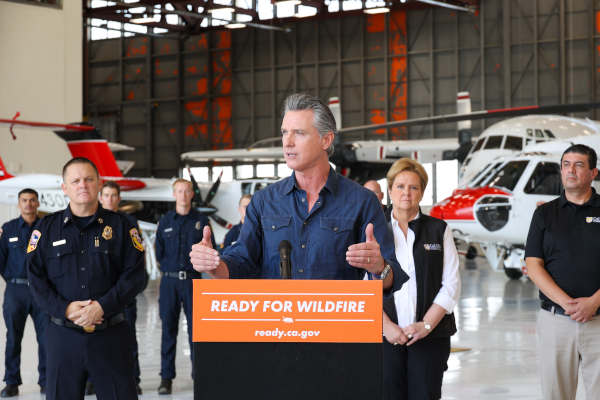
Gov. Gavin Newsom joined state fire and emergency officials in Sacramento at Cal Fire McClellan Air Tanker Base on Wednesday to provide an update on California’s wildfire response and readiness.
“The last couple years brought welcome relief for California as we saw historically low levels of wildfire. This season is shaping up to be very active, bringing the threat of dangerous wildfire to many parts of our state. California is ready with the world’s largest aerial firefighting fleet and new technology that helps us fight fire smarter — and we’re already seeing our investments pay off,” said Newsom.
The recently signed 2024 budget agreement maintains $2.6 billion through 2028 to protect Californians from wildfires and improve forest health.
This is in addition to $200 million per year for healthy forest and fire prevention programs, including prescribed fire and other fuel reduction projects.
The administration is implementing shorter workweeks for state firefighters and aims to bring on more than 2,400 additional firefighters over five years to augment staffing levels.
Californians can visit ready.ca.gov for resources and safety tips on wildfire, heat and other natural disasters.
Below is a recap of the ways California is keeping communities safe from wildfire.
New aircraft, night-flying capabilities, and expanded drone deployment
• Expansion of helitack bases: Five additional helitack bases are operational, after personnel completed. training, bringing the total to eight bases equipped for night operations. Night-flying aircraft have been activated in response to many wildfires this year.
• Contracted aircraft add to Cal Fire’s permanent fleet of over 60 aircraft. Twenty additional helicopters and four airplanes, including five night-flying capable helicopters.
• Drone deployment: Cal Fire currently operates 159 unmanned aerial systems, representing a doubling in Cal Fire’s use of UAS for aerial ignition, support of prescribed burns, and wildfire containment.
• Ongoing transfer and outfitting of seven C-130 aircraft from the federal government.
Harnessing recent innovations
• Fire Integrated Real-Time Intelligence System, or FIRIS, to map wildfire information in real-time.
• Tecnosylva Wildfire Projection Tool to predict wildfire spread.
• Partnership with Department of Defense, using satellites to map wildfires.
• LiDAR Investments to make detailed, 3-D maps of more than 30 million acres of topography and vegetation in high-risk areas.
• Wildfire Threat Intelligence Center, or WFTIC, serving as California’s integrated hub for wildfire and weather intelligence.
Giving every Californian access to real-time wildfire intelligence
• A new and improved fire.ca.gov website gets information to Californians in real-time. Cal Fire’s redesigned website now provides more essential information, faster — including total emergency response, wildfires, acres burned, fatalities and structure damage. Integration of ALERTCalifornia Cameras for anyone to view, and real-time aircraft tracking. Comprehensive incident map of fires over 10 acres, in real-time.

- Details
- Written by: Lake County News reports