How to resolve AdBlock issue?
Refresh this page
How to resolve AdBlock issue?
Refresh this page
Lake County News,California
  • Home
    • Registration Form
  • News
    • Community
      • Obituaries
      • Letters
      • Commentary
    • Education
    • Veterans
    • Police Logs
    • Business
    • Recreation
    • Health
    • Religion
    • Legals
    • Arts & Life
    • Regional
  • Calendar
  • Contact us
    • FAQs
    • Phones, E-Mail
    • Subscribe
  • Advertise Here
  • Login
How to resolve AdBlock issue?
Refresh this page
How to resolve AdBlock issue?
Refresh this page

News

Arrest made in connection to Saturday’s Pocket fire

NORTH COAST, Calif. — Cal Fire’s law enforcement officers have made an arrest in connection to the 11-acre Pocket fire, which began Saturday north of Geyserville in Sonoma County.

The adult subject from Cloverdale was arrested and booked into the Sonoma County Jail in Santa Rosa on one felony charge and three misdemeanor charges.

The felony charge was for unlawfully causing a fire of a structure or forest land and the three misdemeanors were on violations of Health and Safety Code section 13001 as well as
California Public Resource Codes sections 4431 and 4421, which speak to negligent actions involving machinery and flammable materials leading to fires.

Cal Fire said the cause of the Pocket fire was determined to be the result of using a riding lawn mower in cured annual grasses that were 4 feet tall. The riding lawn mower used is designed for wet, green lawns, not for dry weeds or grass. The medal blades on riding lawn mowers can spark fires when hitting rocks.

Asides from lawn mowers, other equipment use that can spark a wildfire include weed-eaters, chainsaws, grinders, welders, tractors and trimmers. Defensible space work is critical to help create a perimeter around your home to protect it from a wildfire, but only when done under the right weather conditions.

Cal Fire urges the public to avoid any activities that may ignite a wildfire. Given the combination of extreme heat, elevated fire conditions and an abundant, cured grass and shrub crop across most of California, Cal Fire will have maximum enforcement on human-caused wildfires.

This is the second arrest made over the past week by Cal Fire Sonoma-Lake-Napa Unit Law Enforcement Officers in connection to the cause of a wildland fire.

The first arrest was of an adult male on July 3 in connection to the cause of the Adams Fire, which was started by weed-eating in dried grasses.

The Pocket fire started at 11:19 a.m. Saturday near Pocket Ranch Road and Ridge Oaks Road. Cal Fire’s initial attack strategy is to keep 95 percent of all fires at 10 acres or less. By the time Air Attack had arrived overhead it had already exceeded that size, but a coordinated air and ground attack was able to quickly contain the fire once resources were at scene.

Along with Cal Fire, additional responding agencies included the Northern Sonoma County Fire Protection District, the Healdsburg Fire Department and the Cloverdale Fire District.

No structures were damaged or destroyed in the fire and no injuries were reported.

Saturday’s fire burned in the same footprint as the 2017 Pocket fFire, which was a part of the Central LNU Complex. That fire started on Oct. 9, 2017 and consumed 17,357 acres.

To learn more about preparing for the threat of wildfire, visit https://readyforwildfire.org/.
Details
Written by: Lake County News reports
Published: 08 July 2024

Lakeport Planning Commission to discuss short-term rentals, sidewalk vending

LAKE COUNTY, Calif. — The Lakeport Planning Commission this week will discuss two items relating to economic development — short-term rentals and sidewalk vending.

The commission will meet at 5:30 p.m. Wednesday, July 10, in the council chambers at Lakeport City Hall, 225 Park St.

The agenda is available here.

To speak on an agenda item, access the meeting remotely here; the meeting ID is 814 1135 4347, pass code is 847985.

To join by phone, dial 1-669-444-9171; for one tap mobile, 16694449171,,81411354347#,,,,*847985#.

Comments can be submitted by email to This email address is being protected from spambots. You need JavaScript enabled to view it.. To give the city clerk adequate time to print out comments for consideration at the meeting, please submit written comments before 4:30 p.m. on Wednesday, July 10.

On the agenda is a discussion regarding short-term rentals.

The commission is being requested to review and discuss zoning code policy that would establish a ministerial review process for short-term rentals.

Also on Wednesday, the commission will hold a requested review and discussion of zoning code policy related to sidewalk vending.

Email Elizabeth Larson at This email address is being protected from spambots. You need JavaScript enabled to view it.. Follow her on Twitter, @ERLarson, or Lake County News, @LakeCoNews.
Details
Written by: Elizabeth Larson
Published: 08 July 2024

Lake County Office of Education celebrates over 40 graduates from alternative education programs

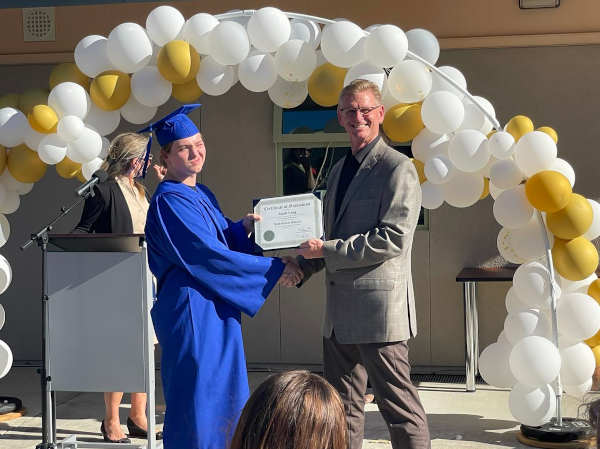
Lake County Superintendent of Schools Brock Falkenberg hands Hance Community School Graduate Jacob Long his diploma during the graduation ceremony. Lake County Office of Education.

LAKEPORT, Calif. — The Lake County Office of Education announced the graduation of over 40 Lake County students from its alternative education programs during the 2023-24 school year.

These include two students from the Hance Community School, 38 students from the Lake County Adult School and two students from Clearlake Creativity School.

These institutions provide flexible and comprehensive educational opportunities to students across the county, empowering them to achieve their academic goals.

“Our alternative education programs are designed to meet the diverse needs of our students, providing them with the support and resources necessary to succeed,” said Lake County Superintendent of Schools Brock Falkenberg. “These graduates have demonstrated incredible grit, resilience and dedication. We are immensely proud of their accomplishments.”

The Lake County Adult School, which opened in September 2023 at the Lake County Campus of Woodland Community College, offers a free, in-person high school diploma completion program for adults aged 18 and up.

With a Western Association of Schools and Colleges, or WASC, accreditation graduation requirement, the program ensures a well-rounded educational experience.

The school has already seen tremendous success, with several students graduating and many more actively working towards their diplomas.

Hance Community School and Clearlake Creativity School have also played pivotal roles in supporting students through innovative and personalized educational approaches.

These schools cater to the unique needs of their students, offering a dynamic and adaptable learning environment that fosters growth and achievement.

With over 40 graduates stepping forward to receive their diplomas, they embody the spirit of resilience and the power of education. Their achievements are a testament to the unwavering commitment of our educators and the supportive community that surrounds them.

The Lake County Office of Education remains dedicated to providing accessible and transformative educational opportunities for all. For more information, visit https://www.lakecoe.org/.

The graduation ceremony of the Lake County Adult School. Photo courtesy of the Lake County Office of Education.
Details
Written by: Lake County News reports
Published: 07 July 2024

To insure or self-insure? The question homeowners must answer amid impact of climate change


No matter where you live, there’s a good chance the weather’s getting wilder. In just the past few weeks, tornadoes have wreaked havoc on Midwest and Southern states, and large swaths of southern Florida were flooded. Globally, 2023 was the hottest year on record.

In addition to harming life and property, weather-related catastrophes have caused the cost of homeowners insurance to spike. Premiums have risen at rates well above general inflation.

In places such as Florida that are particularly exposed to natural disasters, homeowners insurance isn’t just expensive – it’s increasingly becoming difficult to find. That has caused some homeowners to go without it entirely.

More than 6 million American homeowners don’t have homeowners insurance, according to a recent analysis from the Consumer Federation of America. That’s about one out of every 14 homeowners in the country. Collectively, they have at least US$1.6 trillion in unprotected market value. That’s a lot of risk.

As a math professor and an expert in actuarial science, which deals in assessing risks, I’ve watched the mounting homeowners insurance crisis closely.

If catastrophic weather events continue to escalate, so-called “self-insurance” – buying no insurance and paying for any losses yourself – might be the only viable option for homeowners living in disaster-prone areas.

Why risk is getting more expensive

In general, the price of risk, as reflected by an insurance premium, is a function of the risk’s potential frequency and its severity. Potential frequency means the likelihood of a loss occurring, and severity means the financial cost associated with the loss.

So, increases in the frequency or severity of risks result in higher homeowners insurance premiums. The biggest catastrophic risks affecting homeowners insurance include hurricanes, tornadoes, floods, wildfires and winter storms.

Given climate change, it’s likely that many of these catastrophes will become stronger and more common, leading to higher insurance costs. In fact, this is already happening – although how much insurance companies are pricing in the cost of climate change, and whether it’s enough, is uncertain.

If you do opt to buy homeowners insurance, as more than 92% of American homeowners do, you should comparison shop for the best price and coverage. You can do this independently or through an agent or broker.

They may not differ much in their premium prices, however, given the emerging risks. And some insurers may be unwilling to write new policies, depending on where you live. For example, State Farm and Allstate have paused their writing of new homeowners insurance policies in some disaster-prone markets in California.

Choosing to self-insure

Instead of buying homeowners insurance, you may choose to self-insure. Finance experts consider self-insurance to be a legitimate risk management strategy. But that’s only if you choose it with full knowledge of the risk exposure and financial consequences.

Self-insurance is a common component of large organizations’ overall risk strategy. For example, as many as 33% of privately employed workers nationwide are insured by employer-sponsored, self-insured group health plans. For many organizations, self-insurance is also common for workers’ compensation insurance.

For those homeowners wealthy enough to absorb a major uninsured loss, it makes sense to consider self-insurance.

Of course, there are some caveats.

First, homeowners need to be realistic about their ability to respond to a significant uninsured loss. Having a thorough knowledge of your personal financial situation – or access to a qualified financial planner – is critical.

Second, self-insurance is likely to be viable only for homeowners who own their homes outright. If there is a mortgage on the property, purchase of an insurance policy is typically required to protect the lender.

A flood-swollen canal is menacingly visible behind a row of hurricane-battered houses.
Florida homes after 2022’s Hurricane Ian, which caused more than $60 billion in privately insured losses in the Sunshine State alone. Thomas O'Neill/NurPhoto via Getty Images

And finally, it’s important to remember that homeowners insurance is a “multi-peril” policy, which includes liability coverage for accidents. While the size of a property loss might be limited to the value of that property, liability risk is potentially unlimited.

Without homeowners insurance, potential liability exposure should be addressed in some other way – for example, through risk-control efforts such as warning signs or limiting guests on the property, or through some type of stand-alone personal liability insurance policy.

How long will the insurance crunch last?

Most insurers try to maintain stable rates and premiums. But historically, most property-liability insurance has followed a multiyear underwriting cycle. This cycle, from the standpoint of the insurer, goes from a high-premium/low-loss ratio to a low-premium/high-loss ratio, and back again.

This stems from several factors, including price competition within the insurance industry and uncertainty associated with future losses. The result is that when it comes to homeowners insurance, affordability and availability problems are often just temporary. Ultimately, supply and demand adjust, with a new market equilibrium arising as a natural part of the cycle.

Whether this will be the case for current issues in homeowners insurance depends on a number of challenges facing homeowners. There’s some reason for pessimism: Mortgage rates have recently hit their highest levels in over 20 years, and in the meantime, prices in many areas have skyrocketed.

Meanwhile, in 2023, the National Association of Realtors Housing Affordability Index reached its lowest level in almost 40 years. And the future impact of climate change on homeowners insurance losses remains uncertain at best.

Amid all this uncertainty, one thing is clear: Being, or aspiring to be, a homeowner is a real challenge these days.The Conversation

Rick Gorvett, Professor, Mathematics and Economics, Bryant University

This article is republished from The Conversation under a Creative Commons license. Read the original article.

Details
Written by: Rick Gorvett, Bryant University
Published: 07 July 2024
  1. Helping Paws: More new shepherds and labs
  2. Space News: To guard against cyberattacks in space, researchers ask ‘what if?’
  3. Police chief reports on Lakeport’s July 4 celebration

Subcategories

Community

  • 616
  • 617
  • 618
  • 619
  • 620
  • 621
  • 622
  • 623
  • 624
  • 625
How to resolve AdBlock issue?
Refresh this page