How to resolve AdBlock issue?
Refresh this page
How to resolve AdBlock issue?
Refresh this page
Lake County News,California
  • Home
    • Registration Form
  • News
    • Community
      • Obituaries
      • Letters
      • Commentary
    • Education
    • Veterans
    • Police Logs
    • Business
    • Recreation
    • Health
    • Religion
    • Legals
    • Arts & Life
    • Regional
  • Calendar
  • Contact us
    • FAQs
    • Phones, E-Mail
    • Subscribe
  • Advertise Here
  • Login
How to resolve AdBlock issue?
Refresh this page
How to resolve AdBlock issue?
Refresh this page

News

Summertime can be germy: A microbiologist explains how to avoid getting sick at the barbecue, in the pool or on the trail


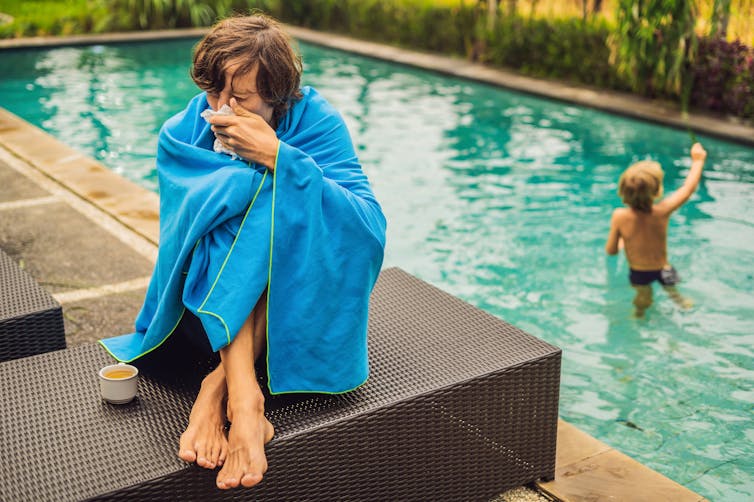
Taking precautions against outdoor pathogens can keep you from getting sidelined over the summer. galitskaya/iStock via Getty Images Plus

As flowers bloom and temperatures climb, many are eager to get back outside. But while the Sun may be shining, there is a dark side that can make the great outdoors not so great.

Gangs of germs are lurking in the woods, in the soil, in the water and in your food, ready to rain on your summer parade.

I’m a professor of microbiology at the Indiana University School of Medicine, where I study and teach about infectious disease. Here are some things to keep in mind to help you and your loved ones stay free of illness while enjoying summer activities.

Germs in the backyard

There’s nothing like the smell of a good barbecue and fresh goodies from your own garden. To make sure people leave your party with only good memories, be aware of germs commonly linked to food poisoning, which can result in diarrhea, cramps, nausea, vomiting and fever.

Meats, including fish and poultry, often house harmful bacteria such as Salmonella, E. coli or Listeria. Raw meat can contaminate anything it touches, so be sure to wash your hands and disinfect surfaces and utensils. To avoid cross contamination, do not keep uncooked meat near prepared foods. Meat products must be cooked to proper temperatures to ensure harmful germs are destroyed before consuming.

Person washing a cutting board in the kitchen sink
Washing cooking utensils that touch raw meat can reduce cross contamination. Catherine Falls Commercial/Moment via Getty Images

In addition to bacteria, a parasite called Toxoplasma gondii can cause acute food poisoning. Toxoplasma parasites are shed as microscopic oocysts in the feces of infected cats. Oocysts persist in the environment for a year or more, and other animals, including people, can inadvertently ingest them.

Upon infection, Toxoplasma forms tissue cysts in the flesh of food animals – another reason to cook your meats thoroughly. Pregnant people need to take special care in avoiding Toxoplasma, since the parasite can cross the placenta and cause miscarriage or birth defects.

To avoid getting toxoplasmosis from oocysts, people should wear gloves while gardening, wash fruits and vegetables, and make sure the sandbox is free of cat poop and covered when not in use.

Germs in the water

Recreational water facilities, such as pools, water parks and fountains, are a great way to beat the summer heat. The smell of chlorine is a good sign that the water is being treated to kill many types of germs.

Unfortunately, some germs can remain infectious in chlorine for several minutes or days, which is plenty of time to spread from one person to another. These include viruses such as norovirus, bacteria such as E. coli, and parasites such as Cryptosporidium and Giardia.

Accidental ingestion of these germs can cause stomach problems, including diarrhea, which can become serious if it leads to dehydration. To avoid becoming infected, swim in well-maintained facilities and avoid swallowing the water. To avoid infecting others, stay out of public water for at least a week if you have diarrhea.

Hand holding pH and chlorine test kit above a swimming pool
While a well-chlorinated pool can kill most germs, some may still lurk in the water. Antonio Hugo Photo/Moment via Getty Images

Bacteria in the water that get trapped in the ear can lead to a painful infection known as swimmer’s ear, which can be prevented by wearing earplugs in the water.

Ponds, rivers and lakes can also be home to these diarrhea-causing germs. Warm fresh water may also contain Naegleria fowleri, the so-called “brain-eating amoeba.” While extremely rare, inhaling water containing Naegleria fowleri is almost always fatal. Wearing nose plugs can help prevent infection.

If you’re going to reach for the beach, be sure to reach for waterproof bandages if you have an open wound, piercing or tattoo. Global warming has produced a rise in so-called “flesh-eating bacteria” that cause a dangerous condition called necrotizing fasciitis. These infections can be very difficult to treat and may result in surgical removal of affected tissue or limbs.

Shellfish such as oysters, clams and mussels filter ocean water as they eat, causing germs to get trapped inside their bodies. Consuming raw shellfish can lead to serious food poisoning due to infection with bacteria or Toxoplasma oocysts.

Germs on the trail

While hiking or camping, you may come across water that looks clean enough to drink, but don’t be tempted.

Be sure to boil or properly filter water you drink to avoid bacteria such as E. coli and parasites such as Giardia and Cryptosporidium. These intestinal pathogens will produce cramps, nausea and diarrhea – especially unpleasant symptoms when you don’t have access to indoor plumbing.

After a very mild winter, you can expect a lot of ticks and mosquitoes in the summer, both of which are carriers of serious diseases. As they feed on blood, ticks can inject bacteria that cause Lyme disease or Rocky Mountain spotted fever. They can also transmit a parasite that causes babesiosis. Symptoms of illness following a tick bite should be promptly evaluated by a physician.

Person applying bug spray on arm of child outdoors
Insect repellent can help protect you from diseases transmitted through bug bites. SeventyFour/iStock via Getty Images Plus

Mosquitoes can carry numerous viruses that are injected into the bloodstream while they take a blood meal. Common mosquito-borne viruses in the U.S. include West Nile virus, eastern equine encephalitis and Zika. In most cases, these viruses produce flu-like symptoms that typically resolve on their own. Infection with Zika virus during pregnancy, however, can lead to birth defects, and West Nile virus can cause acute fever and neurological effects in some people.

To avoid tick and mosquito bites, wear insect repellent and keep your skin covered whenever possible. Wear light colors so the insects are more visible to you. Ticks like shade and high grass, so mow your lawn down to about 2 inches in height. Be sure to inspect your body and scalp for ticks after being outside.

It is important to pay attention to local news reporting outbreaks of infectious agents in your area or travel destination. With these precautions in mind, you’re sure to have a terrific time, uninterrupted by the germs of summer.The Conversation

Bill Sullivan, Professor of Pharmacology and Toxicology, Indiana University

This article is republished from The Conversation under a Creative Commons license. Read the original article.

Details
Written by: Bill Sullivan, Indiana University
Published: 06 July 2024

Californians affected by wildfire smoke should take steps to protect their health

With wildfire smoke and reduced air quality affecting many California communities, the California Department of Public Health, or CDPH, is urging Californians to take steps to protect themselves from air pollutants.

Wildfire smoke can affect anyone’s health, but some people are at higher risk, including pregnant people, children, older adults, first responders, and people with chronic conditions like asthma, COPD, diabetes, kidney disease or heart disease.

“All Californians should be aware of the risks of wildfire smoke and ash inhalation and take steps to avoid breathing in pollutants, including reducing outdoor activity and staying indoors when possible," said Dr. Tomás J. Aragón, CDPH director and state public health officer. "Wildfire smoke can make anyone sick, but it’s particularly unhealthy for vulnerable individuals, including children, people who are pregnant, and those with chronic health conditions."

How Californians can protect their health

To avoid possible health problems due to wildfire smoke and poor air quality, CDPH recommends taking the following steps:

• Stay informed. Check the air quality and sign up for updates. Californians can check their local air quality index (AQI) at AirNow.
• Stay indoors. If the air quality is bad, stay inside as much as possible and close all windows, doors and vents.
• Adjust your A/C. Change the settings on your A/C unit to re-circulate or close outdoor air intakes to avoid drawing in smoky outdoor air. Running an air purifier can also help.
• Wear a mask. If you must go outside, wear a well-fitting N95 mask. This is especially important for those who must work outdoors for long periods, in areas with heavy smoke.

Wildfire smoke contains fine particles which are respiratory irritants, and when inhaled deeply, can affect the lungs and the heart. Exposure to high concentrations of fine particles can cause persistent cough, runny nose, phlegm, wheezing, and difficulty breathing. Smoke from wildfires can also cause eye irritation, reduced lung function and bronchitis.

Those with asthma or another lung disease should keep at least a seven-day supply of medication on hand and call a health care provider if nearby wildfires worsen breathing issues.

In case of evacuation

Wildfires can also lead to emergency evacuations and it's important to follow the direction of local officials when evacuations are ordered.

Current evacuation information can often be found through monitoring local news outlets as well as official social media channels of emergency responders such as a sheriff's office, police department and fire department.

Knowing the “Ps of Preparedness” can help you react quickly if a wildfire threatens your area:

• People (help children, older adults and people with disabilities). 
• Pets.    
• Papers (important documents).    
• Phones.    
• Prescriptions (and glasses). 
• Pictures. 
• PCs (computers) (for the information stored). 
• Plastic (credit cards and cash). 

For more information on how you can protect yourself during extreme heat, visit Heat Ready California.

Additional resources and information can also be found at CDPH’s Extreme Heat site and the California Office of Emergency Services.
Details
Written by: Lake County News reports
Published: 06 July 2024

Space News: What’s up for July 2024


What's up for July? The Moon gets the band back together, find planet Uranus with some help from Mars, and the star clusters that feel the Scorpion's sting.

All month in July, as in June, the planetary action is in the a.m. sky. Find Saturn rising around midnight, and climbing high into the south by sunrise. Mars rises a couple of hours later, with Jupiter trailing behind it, and shifting higher in the sky each day.

On July 2 and 3 before sunrise, the crescent Moon will join Jupiter and Mars in the east. Looking for them before the sky starts to brighten, you'll also find the Pleiades star cluster above Jupiter, as well as bright stars Capella and Aldebaran. As the Moon swings around the planet in its orbit, this same group gets back together at the end of the month, but as a much tighter gathering of Jupiter, Mars, and the Moon with the bright stars of the constellation Taurus.

Then on the evening of July 7 and 8, those with an unobstructed view of the western horizon can spot Mercury shining brightly, low in the sky with a slim crescent Moon. Look for them starting 30 to 45 minutes after the Sun sets. Observers in the Southern Hemisphere will find Mercury a good bit higher in the northwest sky all month after sunset.

On July 13, for the first few hours after dark, look to the southwest to find the first quarter Moon snuggled up with bright bluish-white star Spica. For much of the lower 48 United States and most of Mexico, the Moon will appear to pass in front of Spica – an event called an occultation.

Next, over three days in mid-July, grab your binoculars and have a look at Mars in the early morning before the sky starts to brighten, and you'll find the distant planet Uranus quite close by. Uranus is not too difficult to see with binoculars or a small telescope anytime it's reasonably high above the horizon at night, but you really need to know where to look for it, or use an auto-guided telescope. But occasionally the Moon or one of the brighter planets will pass close to Uranus in the sky, making for a great opportunity to find it with ease.

The winding form of constellation Scorpius, adorned with the bright red star Antares, is a feature of the night sky around the world this time of year. And at the tip of the scorpion's tail are two well-known star clusters that are well placed for viewing at this time of year.

M7, aka Ptolemy's Cluster, and M6, the Butterfly Cluster, are both located about 5 degrees east of the bright stars that mark the "stinger" end of the scorpion's tail. They reach their highest point in the sky around 10 or 11 pm local time.

To find M7, imagine a line toward the east through the "stinger stars," Lesath and Shaula, and it will lead you straight to the star cluster. M6 is just a couple of degrees above M7. Both are "open star clusters," meaning they're loose groupings of stars that formed together, in the same region of space, and they're only loosely bound together by gravity, so they'll eventually go their separate ways.

M7 is just visible to the unaided eye under dark skies as a hazy patch just left of the tip of the scorpion's tail. But it's best seen with binoculars or a telescope with a wide field of view. Its stars are located at a distance of about 1000 light years from us, and they formed about 200 million years ago. The cluster was discovered by Greek-Roman astronomer Ptolemy in the year 130, hence its other name.

M6 is about half the apparent size of M7, and contains fewer stars. It's also a bit farther away from us, at around 1600 light years. It's estimated to be about half as old as M7, at an age of around 100 million years. It was discovered by Italian astronomer and contemporary of Galileo, Giovanni Battista Hodierna, in 1654. These two clusters are easy to observe in July, and their location in Scorpius makes them pretty straightforward to locate on a clear night.

So there's no reason to fear this scorpion's sting. Instead, let it guide you to two distant star clusters, and see for yourself two little families of stars in the process of spreading out into the Milky Way.

Preston Dyches works for NASA's Jet Propulsion Laboratory.
Details
Written by: PRESTON DYCHES
Published: 06 July 2024

Wheatland man arrested in connection to Adams fire

LAKE COUNTY, Calif. — Cal Fire said it has arrested a Wheatland man for actions that sparked a fire in Lower Lake this week.

Cal Fire’s law enforcement officers arrested the adult male in connection to the cause of the 16-acre Adams Fire Wednesday afternoon off of Main Street in Lower Lake.

The cause of the Adams Fire was determined to be the result of weed-eating in dry grass, Cal Fire said.

Cal Fire said the man, whose name was not released, was arrested and released with a notice to appear in court on three misdemeanor charges for violations of state Health and Safety Code and California Public Resource Codes.

The Adams Fire started at 3:09 p.m. on July 3 near the 16200 block of Main Street in Lower Lake. It quickly spread in the 100-plus degree conditions in grass-oak woodland and multiple structures were threatened.

The Lake County Sheriff’s Office initiated evacuation orders for Zone LOW-E169 south of Main Street and evacuation warnings for zones LOW-E170 and LOW-E176. All evacuation orders and warnings have since been lifted.

Cal Fire credited “an aggressive attack by air and ground resources” that led to crews quickly containing the fire.

As of Friday, the Adams fire, still held to 16 acres, was reported to be 90% contained. No residential structures were damaged or destroyed in the fire.

The Cal Fire Sonoma-Lake-Napa Unit, Lake County Fire Protection District and Lake County Sheriff’s Office were in unified command on the incident.

Given the combination of extreme heat, elevated fire conditions and an abundant, cured grass and shrub crop across most of California, Cal Fire said it will institute maximum enforcement on human-caused wildfires.

Lawn mowers, weed-eaters, chainsaws, grinders, welders, tractors and trimmers can all spark a wildland fire, Cal Fire said.

Defensible space work is critical to help create a perimeter around your home to protect it from a wildfire, but only when done under the right weather conditions. Cal Fire officials urge the public to avoid any activities that may ignite a wildfire.

State code sections cited in the arrest

Cal Fire made the Adams fire arrest based on three state code violations. Those sections are as follows.

Health and Safety Code section 13001

Every person is guilty of a misdemeanor who, through careless or negligent action, throws or places any lighted cigarette, cigar, ashes, or other flaming or glowing substance, or any substance or thing which may cause a fire, in any place where it may directly or indirectly start a fire, or who uses or operates a welding torch, tar pot or any other device which may cause a fire, who does not clear the inflammable material surrounding the operation or take such other reasonable precautions necessary to insure against the starting and spreading of fire.”

California Public Resource Codes section 4431

During any time of the year when burning permits are required in an area pursuant to this article, no person shall use or operate or cause to be operated in the area any portable saw, auger, drill, tamper, or other portable tool powered by a gasoline-fueled internal combustion engine on or near any forest-covered land, brush-covered land, or grass-covered land, within 25 feet of any flammable material, without providing and maintaining at the immediate locations of use or operation of the saw or tool, for firefighting purposes one serviceable round point shovel, with an overall length of not less than 46 inches, or one serviceable fire extinguisher. The Director of Forestry and Fire Protection shall by administrative regulation specify the type and size of fire extinguisher necessary to provide at least minimum assurance of controlling fire caused by use of portable power tools under various climatic and fuel conditions.

The required fire tools shall at no time be farther from the point of operation of the power saw or tool than 25 feet with unrestricted access for the operator from the point of operation.

California Public Resource Codes section 4435

If any fire originates from the operation or use of any engine, machine, barbecue, incinerator, railroad rolling stock, chimney, or any other device which may kindle a fire, the occurrence of the fire is prima facie evidence of negligence in the maintenance, operation, or use of such engine, machine, barbecue, incinerator, railroad rolling stock, chimney, or other device. If such fire escapes from the place where it originated and it can be determined which person's negligence caused such fire, such person is guilty of a misdemeanor.

To learn more about preparing for the threat of wildfire, visit https://readyforwildfire.org/.
Details
Written by: Lake County News reports
Published: 05 July 2024
  1. Red flag and excessive heat warnings extended through the weekend
  2. Anderson Marsh State Historic Park’s ‘Senior Days’ programs conclude July 13
  3. Clearlake Animal Control: ‘Layla,’ ‘Cutie Pie’ and ‘Pablo’

Subcategories

Community

  • 618
  • 619
  • 620
  • 621
  • 622
  • 623
  • 624
  • 625
  • 626
  • 627
How to resolve AdBlock issue?
Refresh this page