How to resolve AdBlock issue?
Refresh this page
How to resolve AdBlock issue?
Refresh this page
Lake County News,California
  • Home
    • Registration Form
  • News
    • Community
      • Obituaries
      • Letters
      • Commentary
    • Education
    • Veterans
    • Police Logs
    • Business
    • Recreation
    • Health
    • Religion
    • Legals
    • Arts & Life
    • Regional
  • Calendar
  • Contact us
    • FAQs
    • Phones, E-Mail
    • Subscribe
  • Advertise Here
  • Login
How to resolve AdBlock issue?
Refresh this page
How to resolve AdBlock issue?
Refresh this page

News

Program aims to help Lake County residents impacted by 2018 wildfires purchase homes

LAKE COUNTY, Calif. — Applications are now open for a new program to help Lake County households impacted by the 2018 wildland fires purchase homes outside of high fire areas.

The Golden State Finance Authority has launched the ReCoverCA Homebuyer Assistance Program.

It’s funded by a $28 million grant from the California Department of Housing and Community Development that’s designed to help low- and moderate-income residents — homeowners or renters — of the most impacted and distressed California counties to relocate outside of high fire hazard severity zones.

It was created with a goal centered on increasing the level of homeownership among impacted disaster survivors and contributing to the affordability and sustainability of communities across the state.

Low-to-moderate income homeowners and renters whose primary residence was located in high or very high fire hazard severity zones in Lake County in 2018 will qualify for the program.

Qualifying households will receive assistance in the form of a forgivable loan, up to $350,000, to cover the funding gap between the first mortgage loan amount and the purchase price of a home.

Lake County qualified due to the 2018 Mendocino Complex — consisting of the Ranch and River fires — which at one point led to much of Lake County’s population being evacuated. The complex burned 459,123 acres before it was fully contained, and it remains the third-largest wildland fire in California history.

In addition to Lake County, qualifying disaster areas in 2018 were Butte, Los Angeles and Shasta counties.

Another group of counties qualified for the grant as disaster areas for 2020: Butte, Fresno, Los Angeles, Napa, Santa Cruz, Shasta, Siskiyou, Solano and Sonoma.

“It is difficult for many families that lost their homes to wildfire to simply rebuild in the same location due to construction costs, fire insurance requirements, and other factors. In fact, many families had to relocate temporarily, even obtaining new jobs in a different location,” said Craig Ferguson, Deputy Director of GSFA. “ReCoverCA homebuyer assistance will be a big boost to help them start again with long-term housing and less fire risk going forward. We are excited to be a part of such a positive recovery effort.”

Carolyn Sunseri, a spokesperson for the program, said to qualify for the program, families don’t have to have lost their homes, sustained damage or even been evacuated. Rather, they have to have been “impacted” by living or renting in a high or very high fire severity zone.

The program’s guidelines also require income qualification and that they purchase a home that is not in a high fire area.

In Lake County, such areas are limited, Sunseri acknowledged.

Cal Fire’s fire severity map shows that areas in and around downtown Kelseyville, parts of the Northshore including portions of Clearlake Oaks, Lucerne and Nice, Upper Lake and and Blue Lakes, and portions of Lakeport and Clearlake are not in the high fire area.

Sunseri said those who successfully apply can purchase a home in any part of the state that’s not in a fire hazard severity zone.

She explained that applicants need to work with an approved lender. A list of such lenders is found on the ReCover website.

Once they are in contact with a lender, the lender goes through a process to make sure they are qualified in eligibility requirements. “They qualify them for a mortgage loan based on their current financial situation,” and what they can afford in a monthly payment, Sunseri said.

However, the assistance is beyond and on top of that, in order to help them purchase a home that’s either larger or in a different location, she said.

Once the determination is made for the loan size, then the home buyer loan kicks in on top of that amount, Sunseri explained.

The lender has to make the determination of how much of the $350,000 they will qualify for, which she said will give them a range of homes to consider for purchase.

She said the $350,000 maximum is reduced in a few cases, including due to the sale price of the home or if the applicant has a duplication of benefits, such as receiving some kind of financial assistance specifically for housing that they’ve not used up and which the state would want to be put toward their home purchase.

The total amount of assistance also will be reduced based on liquid assets. Sunseri said if a household has more than $100,000 in liquid assets, then the portion that’s over $100,000 would reduce the $350,000 piece.

However, she said, most people are going to qualify for the full $350,000 in assistance.

“It is designed to fill the gap between what they can afford in a monthly mortgage payment and what a home payment would really be for them as a family,” and to get them out of the high fire zone and into a comfortable situation, she said.

For low- and moderate-income families, “it can have a huge impact,” and avoid putting them in a monthly payment they can’t afford, Sunseri explained.

The program won’t expire for two or three years, although Sunseri is confident the $28 million will be expended by then.

That amount will cover 80 forgivable loans of $350,000. In the program’s first week, it had five applications across all counties, Sunseri said.

“I personally see the state renewing the funding for this,” Sunseri said, explaining that it’s believed the program will make an impact.

Sunseri said she plans to start hosting outreach events such as town halls in Lake County beginning in July. There also will be on-demand educational workshops online.

Complete program policies, eligibility requirements, interest rates, APRs, and loan applications are available through a network of ReCoverCA approved lenders, published on the Golden State Finance Authority website, www.gsfahome.org.

Email Elizabeth Larson at This email address is being protected from spambots. You need JavaScript enabled to view it.. Follow her on Twitter, @ERLarson, or Lake County News, @LakeCoNews.
Details
Written by: Elizabeth Larson
Published: 25 June 2024

Potential thunderstorms forecast for Tuesday

LAKE COUNTY, Calif. — The National Weather Service is forecasting the potential for rain and thunderstorms on Tuesday and cooler temperatures mid-week.

The forecast said a plume of subtropical moisture is expected to arrive early Tuesday, and may trigger some gusty showers or an isolated dry thunderstorm in Lake County, along with cooler temperatures.

The long term forecast said the jet stream “continues to remain unusually active for the season.”

Due to that activity, temperatures are expected to rise again toward the end of the week.

The jet stream also will impact westerly winds in Lake County, which are expected to see gusts of up to 30 miles per hour.

Temperatures on Tuesday are forecast to be in the mid 90s during the day and the high 50s at night.

On Wednesday and Thursday, conditions will roll back into the 80s during daytime hours and low 50s at night before moving back into the 90s over the weekend and into next week.

Email Elizabeth Larson at This email address is being protected from spambots. You need JavaScript enabled to view it.. Follow her on Twitter, @ERLarson, or Lake County News, @LakeCoNews.
Details
Written by: Elizabeth Larson
Published: 25 June 2024

Legislation seeks to make Office of Wildfire Technology Research and Development permanent

Legislation advanced on Monday from Sen. Bill Dodd, D-Napa, that would continue the significant wildfire safety innovation coming from the state’s Office of Wildfire Technology Research and Development by lifting an upcoming sunset date on the office and making it a permanent fixture under Cal Fire.

“Through the extension of this office, California can continue to work smarter to address the increasing wildfire threat,” Sen. Dodd said. “We must continue to be leaders on wildfire innovation, whether it be through novel use of artificial intelligence for early smoke detection or any other means. By remaining on the vanguard, this office can continue to develop ways to keep our state safe.”

In response to catastrophic wildfires over the past five years, Sen. Dodd in 2021 wrote Senate Bill 109, creating the Office of Wildfire Technology Research and Development to study emerging technology in wildfire safety.

The office has since been producing noteworthy results, including an AI-related tool in conjunction with University of San Diego called Alert California that helps detect smoke in California forests.

However, under the original bill, the Office of Wildfire Technology Research and Development would close after 2029.

Sen. Dodd’s new bill, SB 74, repeals the sunset date, making the office permanent under Cal Fire. With SB 74’s approval, the Office of Wildfire Technology Research and Development can continue to be a central organizing hub for the state’s identification of emerging wildfire technology.

Under provisions of the bill, the office will be governed by a board, which is required to submit an annual report of findings and recommendations to the Legislature and governor.

The bill was approved by the Assembly Emergency Management committee and heads next to Assembly Appropriations.

Dodd represents California’s Third Senate District, which includes all or portions of Napa, Solano, Sonoma, Yolo, Sacramento, and Contra Costa counties.
Details
Written by: Lake County News reports
Published: 25 June 2024

Traffic engineers build roads that invite crashes because they rely on outdated research and faulty data


A car fails to yield as a family attempts to cross a road in Long Beach, Calif. Brittany Murray/MediaNews Group/Long Beach Press-Telegram via Getty Images

Back in 1998, “The Simpsons” joked about the Canyonero, an SUV so big that they were obviously kidding. At that time, it was preposterous to think anyone would drive something that was “12 yards long, two lanes wide, 65 tons of American Pride.”

In 2024, that joke isn’t far from reality.

And our reality is one where more pedestrians and bicyclists are getting killed on U.S. streets than at any time in the past 45 years – over 1,000 bicyclists and 7,500 pedestrians in 2022 alone.

Vehicle size is a big part of this problem. A recent paper by urban economist Justin Tyndall found that increasing the front-end height of a vehicle by roughly 4 inches (10 centimeters) increases the chance of a pedestrian fatality by 22%. The risk increases by 31% for female pedestrians or those over 65 years, and by 81% for children.

It’s hard to argue with physics, so there is a certain logic in blaming cars for rising traffic deaths. In fact, if a bicyclist is hit by a pickup truck instead of a car, Tyndall suggests that they are 291% more likely to die.

Yet automakers have long asserted that if everyone simply followed the rules of the road, nobody would die. Vehicle size is irrelevant to that assertion.

My discipline, traffic engineering, acts similarly. We underestimate our role in perpetuating bad outcomes, as well as the role that better engineering can play in designing safer communities and streets.
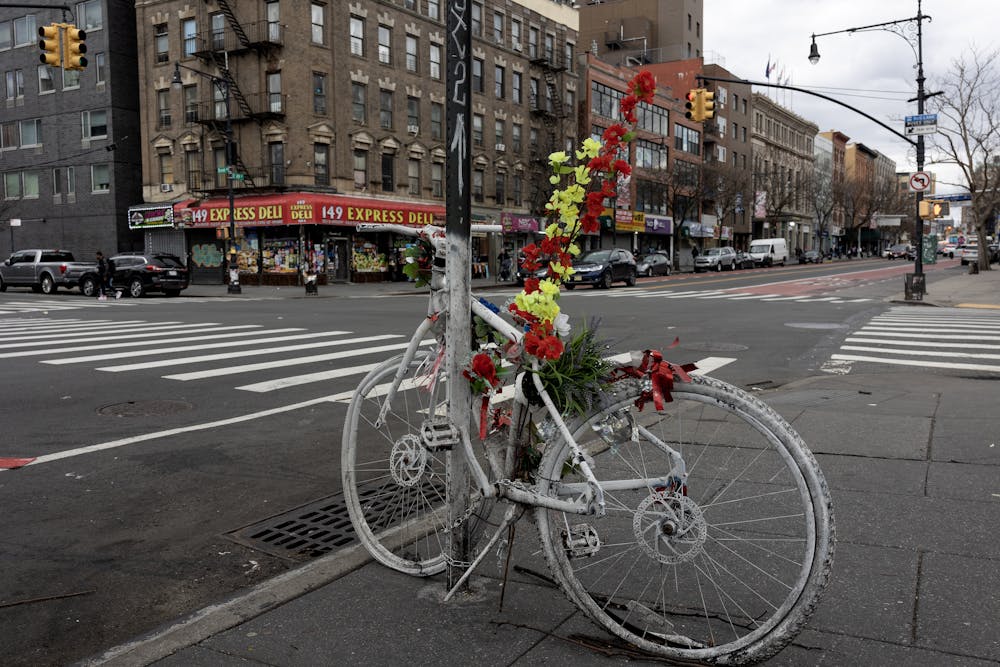
A bicycle, painted white and decorated with flowers, attached to a street pole at an urban intersection.
One of three memorial ‘ghost bikes’ on a single block in the Bronx, New York, April 6, 2024, memorializing delivery workers killed in traffic accidents. Andrew Lichtenstein/Corbis via Getty Images

Millions of road deaths

How bad are the bad outcomes? The U.S. has been tracking car-related road deaths since 1899. As a country, we hit the threshold of 1 million cumulative deaths in 1953, 2 million in 1975 and 3 million in 1998. While the past several years of data have not yet been released, I estimate that the U.S. topped 4 million total road deaths sometime in the spring of 2024.

How many of those are pedestrians and bicyclists? Analysts didn’t do a great job of separating out the pedestrian and cyclist deaths in the early years, but based on later trends, my estimate is that some 930,000 pedestrians and bicyclists have been killed by automobiles in the U.S.

How many of those deaths do we blame on big cars or bad streets? The answer is, very few.

As I show in my new book, “Killed by a Traffic Engineer: Shattering the Delusion that Science Underlies our Transportation System,” the National Highway Traffic Safety Administration calls road user error the “critical reason” behind 94% of crashes, injuries and deaths.

Crash data backs that up.

Police investigate crashes and inevitably look to see which road users, including drivers, pedestrians and cyclists, are most at fault. It’s easy to do because in almost any crash, road user error appears to be the obvious problem.

This approach helps insurance companies figure out who needs to pay. It also helps automakers and traffic engineers rationalize away all these deaths. Everyone – except the families and friends of these 4 million victims – goes to sleep at night feeling good that bad-behaving road users just need more education or better enforcement.

But road user error only scratches the surface of the problem.


Who creates dangerous streets?

When traffic engineers build an overly wide street that looks more like a freeway, and a speeding driver in a Canyonero crashes, subsequent crash data blames the driver for speeding.

When traffic engineers provide lousy crosswalks separated by long distances, and someone jaywalks and gets hit by that speeding Canyonero driver, one or both of these road users will be blamed in the official crash report.

And when automakers build gargantuan vehicles that can easily go double the speed limit and fill them with distracting touchscreens, crash data will still blame the road users for almost anything bad that happens.

These are the sorts of systemic conditions that lead to many so-called road user errors. Look just below the surface, though, and it becomes clear that many human errors represent the typical, rational behaviors of typical, rational road users given the transportation system and vehicle options we put in front of them.

Look more deeply, and you can start to see how our underlying crash data gives everyone a pass but the road users themselves. Everyone wants a data-driven approach to road safety, but today’s standard view of crash data lets automakers, insurance companies and policymakers who shape vehicle safety standards off the hook for embiggening these ever-larger cars and light-duty trucks.

It also absolves traffic engineers, planners and policymakers of blame for creating a transportation system where for most Americans, the only rational choice for getting around is a car.

Transportation engineer Wesley Marshall explains why he believes traffic engineers systematically fail to design safer streets.

Understanding road behavior

Automakers want to sell cars and make money. And if bigger SUVs seem safer to potential customers, while also being much more profitable, it’s easy to see how interactions between road users and car companies – making seemingly rational decisions – have devolved into an SUV arms race.

Even though these same vehicles are less safe for pedestrians, bicyclists and those in opposing vehicles, the current data-driven approach to road safety misses that part of the story.

This can’t all be fixed at once. But by pursuing business as usual, automakers and traffic engineers will continue wasting money on victim-blaming campaigns or billboards placed high over a road telling drivers to pay attention to the road.

A better starting point would be remaking the U.S.’s allegedly data-driven approach to road safety by reinventing our understanding of the crash data that informs it all.

The key is starting to ask why. Why did these road users act as they did? Why didn’t they follow the rules that were laid out for them? Bad road user behavior shouldn’t be excused, but a bit of digging below the surface of crash data unearths a completely different story.

Figuring out which road user is most at fault may be useful for law enforcement and insurance companies, but it doesn’t give transportation engineers, planners, policymakers or automakers much insight into what they can do better. Even worse, it has kept them from realizing that they might be doing anything wrong.The Conversation

Wesley Marshall, Professor of Civil Engineering, University of Colorado Denver

This article is republished from The Conversation under a Creative Commons license. Read the original article.

“Can you name the truck with four-wheel drive, smells like a steak, and seats 35?”
Details
Written by: Wesley Marshall, University of Colorado Denver
Published: 25 June 2024
  1. Fire in Lakeport prompts evacuations
  2. Museums of Lake County Oral History Program gives new dimension to community’s past
  3. Containment rises on Point, Sites fires

Subcategories

Community

  • 630
  • 631
  • 632
  • 633
  • 634
  • 635
  • 636
  • 637
  • 638
  • 639
How to resolve AdBlock issue?
Refresh this page
