 How to resolve AdBlock issue?
News
- Details
- Written by: Lake County News reports
SACRAMENTO, Calif. – California Community Colleges Chancellor Jack Scott announced Tuesday that he will retire as the head of the nation’s largest system of higher education on Sept. 1, capping a distinguished 58-year career in higher education and public service.
In a statement sent to community colleges statewide, Scott said, “I have greatly enjoyed my work since becoming chancellor on January 1, 2009. It is true that it has been a tough time for community colleges because of the financial difficulties of the state of California. But I have been received warmly in Sacramento and on college campuses by trustees, faculty, staff, administrators, and students. I have proudly represented our colleges before the Legislature, the governor, and many other audiences.”
Chancellor Scott, a fierce advocate for increased investment in higher education, has provided leadership that streamlined the transfer process from community colleges to the California State University with the new Associate Degree for Transfer program.
He also was a driving force in helping to craft the recommendations of the California Community Colleges Board of Governors Student Success Task Force, which will lead to more students transferring to four-year institutions and earning certificates and degrees on time.
“The Board of Governors wishes to express its gratitude to Chancellor Scott for his extraordinary leadership of our system,” said Board President Scott Himelstein. “Chancellor Scott’s passion and commitment to community colleges will be evident in the success of our colleges for generations to come. The board will begin immediately the process of selecting a chancellor who can build on the success of Dr. Scott.”
Scott also oversaw innovations in career technical education programs, including those in nursing education, allied health, clean energy technology, and environmental sustainability at the system’s 112 colleges.
And, as community college campuses increasingly welcomed military veterans returning from overseas conflicts, Scott worked with the California Department of Veterans Affairs to strengthen services for veterans to help ease the transition from military to civilian and student life.
“Jack has been an invaluable partner and friend to the California State University,” said system Chancellor Charles B. Reed. “He has been a tireless advocate for higher education and a champion for students. His leadership in areas granting CSU the authority to offer doctorates of education, as well as establishing the Associate Degree for Transfer were historical milestones for the CSU and for our students.”
Before becoming the California Community Colleges Chancellor, Scott served in the California Legislature for 12 years as a State Senator (2000-2008) and Assemblymember (1996-2000) representing Pasadena, Glendale, Burbank, a portion of the city of Los Angeles and other surrounding cities and communities. He served as chair of the Senate Committee on Education.
Among the 146 bills authored by Scott that became law, Senate Bill 361 was a landmark community college financing measure signed by then Gov. Arnold Schwarzenegger in 2006. Also in 2006, Scott led the charge in passing Senate Bill 1309 that helped address the state’s nursing shortage. Scott also worked closely with Gov. Schwarzenegger in 2005 to pass Senate Bill 70, a measure that strengthens career technical education programs between K-12, community colleges and the business sector.
"Jack has been a great champion of community colleges, both in the Legislature and as chancellor. During a time of extreme state budget cuts, Jack provided stability and vision. He never lost sight of the importance of career technical education, especially in the clean energy and healthcare fields, in keeping our economy strong,” former Gov. Arnold Schwarzenegger said. “I supported his appointment by the Board of Governors because he was always passionate about community colleges and a great leader for students."
Before Scott was elected to the state Legislature, he was President of Pasadena City College (1987-95) and Cypress College (1978-87). He also served as Distinguished Professor of Higher Education at Pepperdine University (1995-2000).
“During his long public career, Chancellor Scott has proven to be an unwavering champion of public education in California. As steward of the vital California Community Colleges, he has demonstrated a deep commitment to California’s Master Plan for Higher Education, fully dedicated to the idea that, by working together, California’s higher education segments have given this state a model for the world to follow,” University of California President Mark G. Yudof said. “He also has been a courageous and reliable ally in the ongoing struggle to reverse the chronic disinvestment by the state in public higher education. I wish him and Lacreta all the best in retirement."
Scott holds a Bachelor’s degree from Abilene Christian University, a Master of Divinity degree from Yale University, and a Ph.D. degree in History from Claremont Graduate University. He also holds an honorary doctorate from Pepperdine University and is Chancellor Emeritus of Pasadena City College. He was chosen as the Distinguished Graduate from both Abilene Christian College and Claremont Graduate University.
Jack Scott and his wife, Lacreta, will return to their home in the Pasadena-area upon his retirement.
The California Community Colleges is the largest system of higher education in the nation. It is composed of 72 districts and 112 colleges serving 2.6 million students per year.
Follow Lake County News on Twitter at http://twitter.com/LakeCoNews, on Tumblr at www.lakeconews.tumblr.com , on Google+, on Facebook at www.facebook.com/pages/Lake-County-News/143156775604?ref=mf and on YouTube at www.youtube.com/user/LakeCoNews .
- Details
- Written by: Lake County News reports
LAKE COUNTY, Calif. – As part of AmeriCorps Week, the Lake County Office of Education’s AmeriCorps program and community partners will hold the third annual All AmeriCorps Food Drive on Saturday, March 10.
The drive will take place from 9 a.m. to 3 p.m. at Safeway on 11th Street in Lakeport and Grocery Outlet, located on Main Street in Lakeport and Olympic Drive in Clearlake.
The group reported that all donations stay in Lake County and will be donated to North Coast Opportunities for distribution to Lake County’s food cupboards.
Over the past 11 years, the Lake County Office of Education’s AmeriCorps program has collected and donated more than 46,000 pounds of food to our local food cupboards.
Though it sounds like a large amount, the local AmeriCorps reported that it's a small part of what is needed to keep the county's children, families and community fed throughout the year.
Requested food items include canned fruits and vegetables; canned or dry soup mixes; boxed dinners like Hamburger Helper; canned meats and stews; spaghetti and other pastas; canned cooking sauces, including spaghetti and pasta sauces; pork and beans; packaged dry goods, such as rice, stuffing, boxed potatoes and baking mixes; breakfast foods, including cereal, oatmeal, pancake mix and syrup; and juice or fruit drinks on cans or plastic containers.
The group asks that no foods in glass jars or bottles be donated.
For more information about the food drive or the work of the local AmeriCorps, visit www.lakecountyamericorps.org or call 707-263-8796.
Follow Lake County News on Twitter at http://twitter.com/LakeCoNews, on Tumblr at www.lakeconews.tumblr.com , on Google+, on Facebook at www.facebook.com/pages/Lake-County-News/143156775604?ref=mf and on YouTube at www.youtube.com/user/LakeCoNews .
- Details
- Written by: Elizabeth Larson
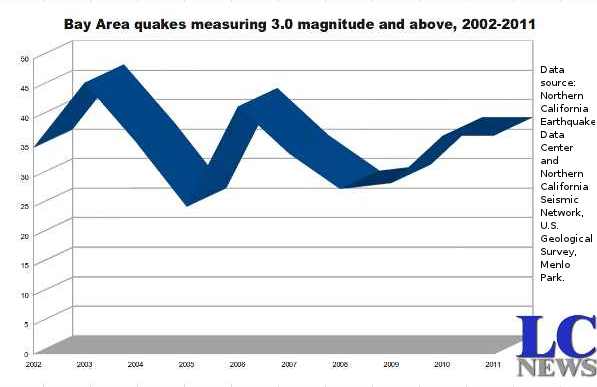
Two moderate-sized earthquakes hit within seconds of each other in the Bay Area early Monday morning, with thousands of people around the state reporting that they felt the second, larger temblor.
The United States Geological Survey said the quakes, measuring 3.5 and 4.0, took place just after 5:30 a.m. Monday.
The first, at approximately 5:33:12 a.m., was centered one mile north of El Cerrito, one mile south southeast of East Richmond Heights and four miles north northwest of Berkeley, at a depth of 5.2 miles, the U.S. Geological Survey reported.
The survey reported receiving only two shake reports on that quake.
Eight seconds later, the 4.0-magnitude quake hit. U.S. Geological Survey records showed that second temblor was centered in a slightly different spot, one mile north northwest of El Cerrito, one miles south southeast of East Richmond Heights and four miles north northwest of Berkeley, at a depth of 5.3 miles.
By Monday evening more than 14,500 people in nearly 300 California zip codes reported feeling that quake, according to survey shake report records.
Two smaller aftershocks centered one miles southeast of East Richmond Heights, followed, one measuring magnitude 1.9 at 6:03 p.m. and the second measuring 1.1 at 6.29 p.m., the survey reported.
E-mail Elizabeth Larson at
- Details
- Written by: Lake County News reports
The California Office of Traffic Safety (OTS) on Monday announced deaths due to handheld cell phone use by drivers have dropped since California enacted a ban on handheld cell phone use while driving in July 2008.
The analysis, conducted by the Safe Transportation Research and Education Center (SafeTREC) at the University of California, Berkeley, showed that, when looking at state crash records two years before and two years after the handheld ban went into effect, overall traffic deaths declined 22 percent while handheld cell phone driver deaths went down 47 percent.
Similar results were shown for hands-free cell phone use as well as injuries in both categories.
“These results suggest that the law banning handheld cell phone use while driving had a positive impact on reducing traffic fatalities and injuries,” said Dr. David Ragland, director of SafeTREC.
Contributing to the decline in cell phone deaths and injuries is an overall drop in cell phone usage while driving.
A Statewide Intercept Opinion Survey commissioned with federal funds by OTS last summer showed 40 percent of California drivers reported they talk less (handheld and hands free) since enactment of the handheld cell phone ban.
In February 2010, the Insurance Institute for Highway Safety (IIHS) reported similar results from their telephone survey which found that 44 percent of drivers in states with bans reported they don't use phones (handheld or hands-free) when driving, compared with 30 percent in states without such laws.
Further, IIHS observational research found that bans on handheld phoning while driving can have big and long-term effects in curbing handheld cell phone use.
“While we are thrilled to see that the handheld ban in California has worked to reduce distracted driving crashes and overall cell phone use, there are still far too many drivers talking and texting while driving,” said Christopher J. Murphy, director for the California Office of Traffic Safety. “A good step for parents is to never call or text your kids if you think they might be driving.”
Cell phone usage while driving is top of the mind with California drivers, which they see as carrying a significant traffic safety threat.
The same OTS statewide opinion survey reported that 62 percent of respondents stated that texting and talking are the biggest safety concerns on California roadways and 84 percent claimed cell phone conversations or texting while driving constitute the most serious distractions while driving.
Another clue to the reduction in crashes might be found in new information from the Department of Motor Vehicles that shows, statewide in 2011, there were 460,487 handheld cell phone convictions – up 22 percent from 361,260 convictions in 2010 and 52 percent from 301,833 in 2009.
The cost of a ticket for a first offense is at least $159, and $279 for subsequent offenses.
“Highly visible and publicized enforcement, along with the cooperation of the motoring public to reduce distractions behind the wheel, has played a significant role in the reduction in collisions,” said California Highway Patrol (CHP) Commissioner Joe Farrow. “In addition, there are many educational programs developed by the CHP, our allied agencies, as well as nonprofit organizations such as Impact Teen Drivers that have made sustained efforts in reducing distracted driving.’’
In April 2011, the Office of Traffic Safety using federal funds conducted the nation’s first statewide cell phone observational survey that showed nine percent of drivers were talking or texting while driving, representing hundreds of thousands of drivers at any given time.
Research has shown that drivers who use handheld devices are four times as likely to get into crashes serious enough to injure themselves.
The distracted driving section of the California Strategic Highway Safety Plan (SHSP) has developed the state’s “It’s Not Worth It!” public awareness campaign that employs TV, radio commercials, billboards, Internet, social media and other outreach.
In addition, millions of Californians see the “Hand-held Cell Ticket – $159 – It’s Not Worth It” message on more than 625 permanent changeable message signs for several days throughout the year.
The SHSP’s distracted driving section is currently formulating plans to increase the data and research available to more accurately understand and combat the problem.
Follow Lake County News on Twitter at http://twitter.com/LakeCoNews, on Tumblr at www.lakeconews.tumblr.com , on Google+, on Facebook at www.facebook.com/pages/Lake-County-News/143156775604?ref=mf and on YouTube at www.youtube.com/user/LakeCoNews .