 How to resolve AdBlock issue?
News
- Details
- Written by: Lake County News Reports
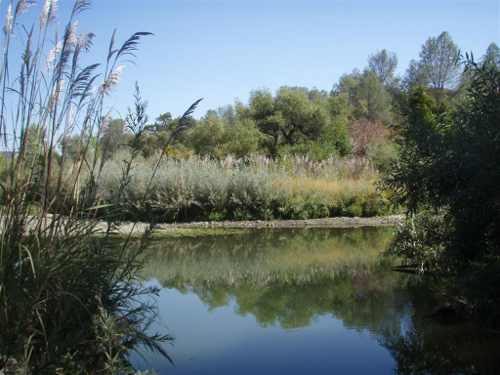
LAKE COUNTY, Calif. – A remarkable partnership project recently made great strides in eradicating a potentially devastating infestation of Ravenna grass (Saccharum ravennae) from some 70 miles of Cache Creek in Lake and Yolo counties.
This invasive weed, which was deliberately introduced to California as an ornamental and has been described as “pampas grass on steroids,” could profoundly degrade riparian areas throughout the region if not controlled, and control is particularly difficult because so many of the plants are found in steep, inaccessible terrain deep in the Cache Creek Wilderness.
The control project was sponsored by the tri-county Cache Creek Watershed Forum stakeholder group, with primary management responsibility shared by the East Lake and Yolo County Resource Conservation Districts and Bureau of Land Management.
One of the first things the group did was ask Tuleyome President Andrew Fulks for help, since he had conducted a very successful tamarisk eradication project in this remote area several years before.
Using kayaks, Tuleyome volunteers pinpointed hundreds of clumps of Ravenna grass with GPS equipment, many perched too high on the canyon walls to be reached from the creek level.
The scope of the infestation was far worse than anyone had imagined, and plainly too extensive to tackle with volunteers alone.
Working together, the Yolo and Lake County RCDs then obtained funding through an American Recovery and Reinvestment grant, with supplementary money from the Rose Foundation to cover the segments on BLM land.
Under the supervision of Yolo RCD Vegetation Management Specialist Gillies Robertson, work on the section downstream from Cache Canyon proceeded uneventfully, but the upstream portion remained daunting: not only was the terrain remote and rugged, its designation as federal Wilderness precluded the use of any form of motorized transportation.
This meant that work crews faced the prospect of long off-trail hikes in bear country, carrying massive quantities of gear, merely to reach the work site.
In the words of East Lake RCD Watershed Coordinator Greg Dills, “This was one of the most tactically difficult projects we have been involved with to date. There were multiple project partners, some of the most rugged terrain in Northern California, restrictions due to Wilderness designation, multiple landowners (both private and public), and bears.”
The conundrum was solved by Cache Canyon River Trips from Yolo County, which provided two large rubber rafts – rafts that usually carry white water recreationists – to transport equipment, supplies and work crews down the creek from the Clear Lake dam and through 25 miles of project area.
Lake County’s Back Country Horsemen also offered to pack in gear, though it turned out that their assistance wasn’t needed.
Although the job remained difficult, it was no longer impossible; starting in mid-August 2011 an estimated 90 percent of the Ravenna grass on Cache Creek was eradicated, providing a model for protecting the biodiversity of a precious wilderness area while simultaneously guarding the special values that make wilderness unique.
The problem now is to mop up the scattered plants left behind and to exterminate seedlings before another widespread stand can become established.
A little grant money remains for an early treatment in the spring, and both RCDs are looking for additional funding sources to continue the project in the future.
Monitoring will be necessary for several years to insure control, and rafters, kayakers, equestrians and hikers are invited help this effort by surveying for regrowth as they recreate in the area.
Victoria Brandon is a Tuleyome board member. She represents the Sierra Club on the California Invasive Species Advisory Committee. Brandon lives in Lower Lake, Calif.
Follow Lake County News on Twitter at http://twitter.com/LakeCoNews, on Tumblr at www.lakeconews.tumblr.com , on Google+, on Facebook at www.facebook.com/pages/Lake-County-News/143156775604?ref=mf and on YouTube at www.youtube.com/user/LakeCoNews .
- Details
- Written by: Lake County News reports

Astronomers have spotted young stars in the Orion nebula changing right before their eyes, thanks to the European Space Agency's Herschel Space Observatory and NASA's Spitzer Space Telescope.
The colorful specks – developing stars strung across the image – are rapidly heating up and cooling down, speaking to the turbulent, rough-and-tumble process of reaching full stellar adulthood.
The rainbow of colors represents different wavelengths of infrared light captured by both Spitzer and Herschel.
Spitzer is designed to see shorter infrared wavelengths than Herschel. By combining their observations, astronomers get a more complete picture of star formation.
NASA's Jet Propulsion Laboratory in Pasadena, Calif., manages the Spitzer mission for NASA, and also plays an important role in the European Space Agency-led Herschel mission.
In the portion of the Orion nebula pictured, the telescopes' infrared vision reveals a host of embryonic stars hidden in gas and dust clouds. These stars are at the very earliest stages of evolution.
A star forms as a clump of this gas and dust collapses, creating a warm glob of material fed by an encircling disk. In several hundred thousand years, some of the forming stars will accrete enough material to trigger nuclear fusion at their cores, and then blaze into stardom.
Herschel mapped this region of the sky once a week for six weeks in the late winter and spring of 2011.
To monitor for activity in protostars, Herschel's Photodetector Array Camera and Spectrometer probed long infrared wavelengths of light that trace cold dust particles, while Spitzer gauged the warmer dust emitting shorter infrared wavelengths.
In this data, astronomers noticed that several of the young stars varied in their brightness by more than 20 percent over just a few weeks.
As this twinkling comes from cool material emitting infrared light, the material must be far from the hot center of the young star, likely in the outer disk or surrounding gas envelope.
At that distance, it should take years or centuries for material to spiral closer in to the growing starlet, rather than mere weeks.
A couple of scenarios under investigation could account for this short span.
One possibility is that lumpy filaments of gas funnel from the outer to the central regions of the star, temporarily warming the object as the clumps hit its inner disk. Or, it could be that material occasionally piles up at the inner edge of the disk and casts a shadow on the outer disk.
“Herschel's exquisite sensitivity opens up new possibilities for astronomers to study star formation, and we are very excited to have witnessed short-term variability in Orion protostars,” said Nicolas Billot, an astronomer at the Institut de Radioastronomie Millimétrique (IRAM) in Grenada, Spain who is preparing a paper on the findings along with his colleagues. “Follow-up observations with Herschel will help us identify the physical processes responsible for the variability.”
Herschel is a European Space Agency cornerstone mission, with science instruments provided by consortia of European institutes and with important participation by NASA.
NASA's Herschel Project Office is based at JPL. JPL contributed mission-enabling technology for two of Herschel's three science instruments.
The NASA Herschel Science Center, part of the Infrared Processing and Analysis Center at the California Institute of Technology in Pasadena, supports the United States astronomical community. Caltech manages JPL for NASA.
More information is online at http://www.herschel.caltech.edu , http://www.nasa.gov/herschel and http://www.esa.int/SPECIALS/Herschel .
Follow Lake County News on Twitter at http://twitter.com/LakeCoNews, on Tumblr at www.lakeconews.tumblr.com , on Google+, on Facebook at www.facebook.com/pages/Lake-County-News/143156775604?ref=mf and on YouTube at www.youtube.com/user/LakeCoNews .
- Details
- Written by: Lake County News reports
Scientists from the Department of Fish and Game (DFG) and PRBO Conservation Science have completed an innovative study on the effects of climate change on vulnerable birds.
This first-of-its-kind study prioritizes which species are most at risk and will help guide conservation measures in California.
The study was published Friday in the journal PLoS ONE.
“What’s most exciting about the study is that our unique approach is one that other scientists and resource managers can duplicate to help them conserve wildlife in the face of climate change,” said PRBO Ecologist Tom Gardali, the study’s lead author.
“Not only does our study look at which birds will be most at risk given a changed climate, it also evaluates how climate change, piled on top of all the existing threats such as development and invasive
species, will affect birds,” said Gardali. “This gives a more comprehensive picture, and provides the information necessary to help allocate scarce dollars for conservation.”
The study combines existing stressors such as habitat loss and degradation with the vulnerability of California’s bird species to projected climate change impacts to produce a prioritized list of at-risk species for conservation action.
The research shows that nearly 130 species of birds are vulnerable to the predicted effects of climate
change and that 21 of the state’s 29 threatened and endangered bird species (72 percent) will be further impacted by climate change, increasing their risk of extinction.
“Lists of at-risk species like ours are simply a first step. Now conservationists and resource managers need to use the list and other resources to identify how best to spend limited conservation dollars to
benefit birds, other wildlife and human communities,” noted Dr. Nat Seavy, study co-author and PRBO scientist.
The study also found that wetland species are more vulnerable than other groups of birds because they are specialized on habitats that will be threatened by sea level rise and changes in precipitation.
The most vulnerable wetland birds include the California black rail, California and Yuma clapper rails and three species of song sparrow found only in the tidal marshes of San Francisco Bay.
Species that make a living at sea or near-shore waters and that nest on islands or rocky shores are
also highly vulnerable. These species include the Cassin’s auklet, common murre, black oystercatcher and the iconic white and brown pelicans.
“By using this information to prioritize and implement conservation actions now, managers can help to reduce negative impacts of climate change,” said DFG Chief Deputy Director Kevin Hunting. “This
research is yet another example of how the DFG and partners like PRBO are actively addressing climate change, engaging in adaptation planning, and taking important steps towards safeguarding fish, wildlife and habitats across the state for future generations to enjoy.”
The complete list of species and the climate vulnerability scores are
available online through the California Avian Data Center, http://data.prbo.org/apps/bssc/index.php?page=climate-change-vulnerability .
Follow Lake County News on Twitter at http://twitter.com/LakeCoNews, on Tumblr at www.lakeconews.tumblr.com , on Google+, on Facebook at www.facebook.com/pages/Lake-County-News/143156775604?ref=mf and on YouTube at www.youtube.com/user/LakeCoNews .
- Details
- Written by: Elizabeth Larson
KELSEYVILLE, Calif. – The Kelseyville Unified School District has added another measure of protection to its campuses in order to safeguard students, staff and community members.
Portable defibrillators were placed around district’s campuses about a month and a half ago, an effort made possible through a grant, according to Matt Cockerton, principal of Kelseyville High School.
“We started planning some time ago to get these on campus,” said Cockerton.
An event last year raised awareness of the need for such life-saving devices, he said.
“We had a basketball player go into arrest last school year and we almost lost him during a practice session,” said Cockerton.
Although Kelseyville Fire’s main station is just down the street, it happened that day that they were on a call and couldn’t respond in time, he said.
Teachers on campus know cardiopulmonary resuscitation and were able to care for the boy, but Cockerton said the situation was “touch and go.”
Kelseyville Fire helped the district apply for the grant to cover the defibrillators, which cost about $1,000 each, according to Cockerton.
He said Kelseyville High got the lion’s share of the grant to pay for three defibrillators – one at the main building, one at the gym and one at the track and football field.
Each of the other campuses received one of the life-saving decides, he said.
Cockerton said the models the district purchased interact with those used by Kelseyville Fire.
Staff has been trained on the devices, which Cockerton said are very simple to use, with simple instructions that walk users through the steps. He said the defibrillators also must regularly be maintained and tested.
The three new devices are a good start, but Cockerton said they would like to add more to the high school campus if the opportunity arises.
“There will be a day that schools will all have them,” he said.
E-mail Elizabeth Larson at