How to resolve AdBlock issue?
Refresh this page
How to resolve AdBlock issue?
Refresh this page
Lake County News,California
  • Home
    • Registration Form
  • News
    • Community
      • Obituaries
      • Letters
      • Commentary
    • Education
    • Veterans
    • Police Logs
    • Business
    • Recreation
    • Health
    • Religion
    • Legals
    • Arts & Life
    • Regional
  • Calendar
  • Contact us
    • FAQs
    • Phones, E-Mail
    • Subscribe
  • Advertise Here
  • Login
How to resolve AdBlock issue?
Refresh this page
How to resolve AdBlock issue?
Refresh this page

News

The US is losing wetlands at an accelerating rate − here’s how the private sector can help protect these valuable resources


Roads divide what once was a larger wetland into four smaller pools in east-central North Dakota. AP Photo/Charlie Riedel

Wetlands aren’t the most eye-catching ecosystems. They include swamps, bogs, fens and other places where soil is covered by water most of the time. But they perform a huge range of valuable services, from soaking up floodwaters to filtering out pollutants and providing habitat for thousands of species of mammals, fish, reptiles, insects and birds.

In a high-profile 2023 ruling, Sackett v. Environmental Protection Agency, the U.S. Supreme Court greatly limited federal power to protect wetlands. According to one estimate, this ruling stripped federal protection from up to 90 million acres of wetlands across the U.S.

Today, the U.S. is losing wetlands, mainly to development and agriculture, at an accelerating rate. With Congress polarized and gridlocked, new federal wetland protection laws are unlikely to be enacted in the next several years.

Some states have stepped up to fill the gap, but others have instead chosen to roll back their existing protections. This comes despite the fact that even before the Sackett ruling, people across the U.S. strongly favored more protection for wetlands.

The Supreme Court’s 2023 Sackett v. EPA ruling left half of U.S. wetlands without federal protection.

We are environmental law scholars who recently conducted a study, to be published in a forthcoming issue of the Minnesota Law Review, that explores how private environmental governance can protect wetlands. This approach uses private agreements, certifications and other practices such as monitoring and dispute resolution to foster sustainability.

Relying on private action is not a substitute for regulation, but it can act as a stopgap while other legislative and regulatory efforts are developed. And it can complement new laws and regulations once those measures are in place.

Certifications and supply chain leverage

Corporations and nongovernment organizations have a variety of ways to encourage protection of wetlands.

First, certification bodies can develop standards for wetland-friendly goods, much like fair trade labels for products that promote safe working conditions, environmental protection and living wages for producers. Greater use of such standards can allow customers, investors and lenders to vote with their wallets. An example might be a label that identifies products made from ingredients grown on farms that preserve wetlands.

For construction, a gold standard already exists for the environmental certification of buildings: Leadership in Energy and Environmental Design, or LEED, certification. LEED already incorporates some wetland protections, and its requirements can be bolstered to ensure protection of wetlands exposed as a result of the Sackett ruling.


Next, corporate pressure can use supply chain contracting to influence the sectors most likely to fill in wetlands: farming, construction and forestry. Corporations could require suppliers to agree not to damage wetlands exposed by the Sackett decision, in the same way that companies already use contracts to address other environmental issues.

For example, Whole Foods Market requires suppliers to follow a code of conduct that includes minimizing their impacts on the environment, avoiding deforestation and seeking opportunities to conserve water. Similarly, Albertsons, the fourth-largest U.S. grocery store chain, requires suppliers to strive to reduce natural resource destruction and water contamination.

The role of banks and investors

Large institutional investors and lenders can also play a role. Those with sustainability policies can insist that developers seeking funds follow pre-Sackett wetland protections.

Major banks have already shown various degrees of commitment to sustainability. In 2003, 10 leading banks from seven countries adopted the Equator Principles, a set of principles designed to “serve as a common baseline and risk management framework for financial institutions to identify, assess and manage environmental and social risks when financing projects.”

This includes conducting environmental risk assessments of projects applying for financing, adopting measures to minimize and mitigate risks, and as a last resort compensating for unavoidable effects. We believe this list should be expanded to include assessing the risk of wetlands loss in project financing.

Several banks recently backed out of adhering to these principles but pledged generally to continue to follow them. Nongovernment organizations can help protect wetlands by tracking financing for proposed developments in vulnerable areas.

Former industrial salt ponds around San Francisco Bay are being turned back into wetlands in a large-scale, multiyear restoration project with federal, state and private funding. One goal is to protect shoreline communities from flooding.

Reducing flood risks

Insurance companies can also help fill the gap in wetland protection. Because wetlands are valuable buffers against floods, property insurers have a vested interest in reducing wetland losses.

Many California insurance companies facing rising costs due to climate change have stopped issuing new policies there. Similar decisions are occurring in other disaster-prone states such as Louisiana and Florida.

Without access to insurance, businesses will be less likely to invest in these states. Reducing flood risks due to wetland destruction could help reduce risk for insurance companies.

Private insurers could refuse coverage to properties that significantly degrade wetlands no longer protected after Sackett, or they could make coverage contingent on binding commitments not to degrade wetlands. And conservation groups could work with private insurers to develop climate-focused coverage for particularly sensitive wetlands left uncovered after Sackett.

In an example of this approach, The Nature Conservancy, an environmental nonprofit, bought insurance in 2022 to fund restoration of Hawaii’s coral reefs if they are damaged by hurricanes or tropical storms.

Retail customers, employees, community members and nonprofit groups can place economic pressure on companies to incorporate such protections into their operations. This kind of private pressure has already spurred companies to pledge to reduce their greenhouse gas emissions. Until states and Congress pass new laws to prevent wetlands from being destroyed, we see action by businesses and nongovernment organizations as the most promising substitute.The Conversation

Steph Tai, Professor of Law and Associate Dean, Nelson Institute for Environmental Studies, University of Wisconsin-Madison and Michael Vandenbergh, Professor of Law and Co-Director, Energy, Environment and Land Use Program, Vanderbilt University

This article is republished from The Conversation under a Creative Commons license. Read the original article.


Details
Written by: Steph Tai, University of Wisconsin-Madison and Michael Vandenbergh, Vanderbilt University
Published: 16 June 2024

Helping Paws: Bulldogs, shepherds and terriers

LAKE COUNTY, Calif. — Lake County Animal Care and Control has many great dogs waiting to meet you this week.

Dogs available for adoption this week include mixes of Australian cattle dog, Australian terrier, bulldog, Chihuahua, dachshund, French bulldog, German shepherd, hound, Labrador Retriever, mastiff, pit bull terrier, Rottweiler and terrier.

Dogs that are adopted from Lake County Animal Care and Control are either neutered or spayed, microchipped and, if old enough, given a rabies shot and county license before being released to their new owner. License fees do not apply to residents of the cities of Lakeport or Clearlake.

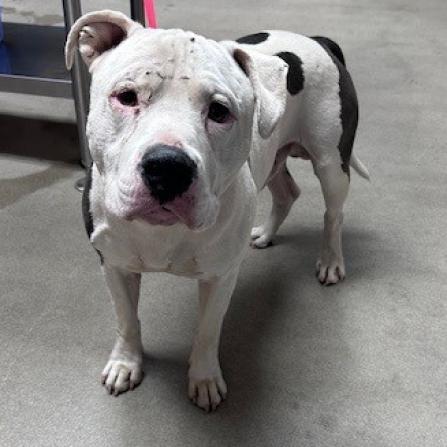
Those dogs and the others shown on this page at the Lake County Animal Care and Control shelter have been cleared for adoption.

Call Lake County Animal Care and Control at 707-263-0278 or visit the shelter online for information on visiting or adopting.

The shelter is located at 4949 Helbush in Lakeport.

Email Elizabeth Larson at This email address is being protected from spambots. You need JavaScript enabled to view it.. Follow her on Twitter, @ERLarson, or Lake County News, @LakeCoNews.

 
Foster#7134(Crusty)'s preview photo
Foster#7134(Crusty)

Kennel#28(Tucker)'s preview photo
Kennel#28(Tucker)

 
Kennel#2's preview photo
Kennel#2


Kennel#3(Jet)'s preview photo
Kennel#3(Jet)

Kennel#24(Rex)'s preview photo
Kennel#24(Rex)

Kennel#9's preview photo
Kennel#9

Kennel#10's preview photo
Kennel#10

Kennel#20(Piper)'s preview photo
Kennel#20(Piper)

 
Kennel#21(Coco)'s preview photo
Kennel#21(Coco)

Kennel#6's preview photo
Kennel#6

Kennel#8's preview photo
Kennel#8

Kennel#29a's preview photo
Kennel#29a

Kennel#32's preview photo
Kennel#32

Kennel#29c's preview photo
Kennel#29c


Kennel#34's preview photo
Kennel#34

Kennel#25's preview photo
Kennel#25

Kennel#30's preview photo
Kennel#30

Kennel#12's preview photo
Kennel#12

 
Kennel#19's preview photo
Kennel#19


Kennel#31(Domino)'s preview photo
Kennel#31(Domino)

Kennel#11's preview photo
Kennel#11

Kennel#15's preview photo
Kennel#15


Details
Written by: Elizabeth Larson
Published: 16 June 2024

Space News: The rush to return humans to the Moon and build lunar bases could threaten opportunities for astronomy


A lunar base on the Moon would include solar panels for power generation, and equipment for keeping astronauts alive on the surface. ESA - P. Carril

The 2020s have already seen many lunar landing attempts, although several of them have crashed or toppled over. With all the excitement surrounding the prospect of humans returning to the Moon, both commercial interests and scientists stand to gain.

The Moon is uniquely suitable for researchers to build telescopes they can’t put on Earth because it doesn’t have as much satellite interference as Earth, nor a magnetic field blocking out radio waves. But only recently have astronomers like me started thinking about potential conflicts between the desire to expand knowledge of the universe on one side and geopolitical rivalries and commercial gain on the other, and how to balance those interests.

As an astronomer and the co-chair of the International Astronomical Union’s working group Astronomy from the Moon, I’m on the hook to investigate this question.

Everyone to the south pole

By 2035 – just 10 or so years away – American and Chinese rockets could be carrying humans to long-term lunar bases.

Both bases are planned for the same small areas near the south pole because of the near-constant solar power available in this region and the rich source of water that scientists believe could be found in the Moon’s darkest regions nearby.

Unlike the Earth, the Moon is not tilted relative to its path around the Sun. As a result, the Sun circles the horizon near the poles, almost never setting on some crater rims. There, the never-setting Sun casts long shadows over nearby craters, hiding their floors from direct sunlight for the past 4 billion years, 90% of the age of the solar system.

These craters are basically pits of eternal darkness. And it’s not just dark down there, it’s also cold: below -418 degrees Fahrenheit (-250 degrees Celsius). It’s so cold that scientists predict that water in the form of ice at the bottom of these craters – likely brought by ancient asteroids colliding with the Moon’s surface – will not melt or evaporate away for a very long time.

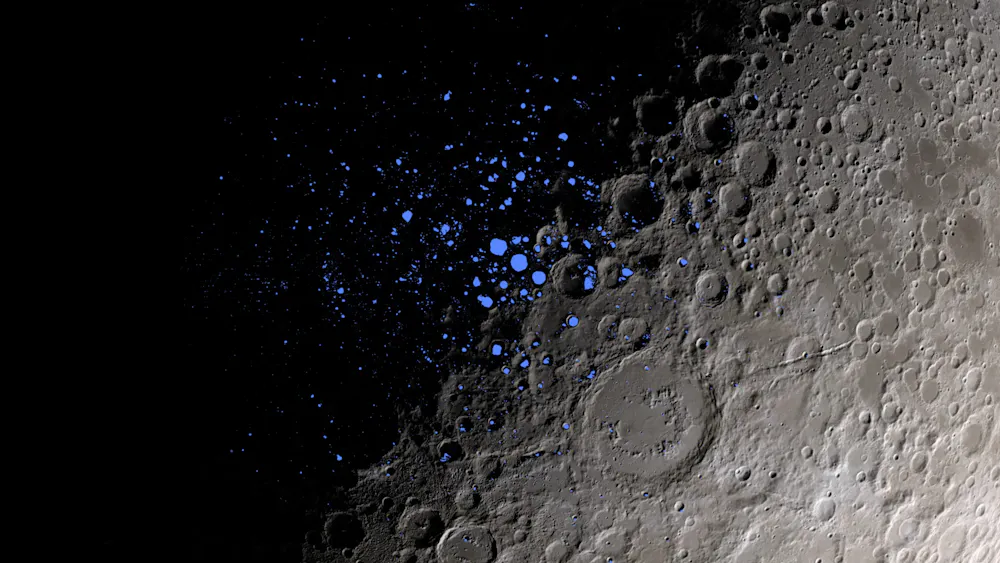
A close-up shot of the Moon's surface, with the left half covered in shadow, and the right half visible, with gray craters. Tiny blue dots in the center indicate PSRs.
Dark craters on the Moon, parts of which are indicated here in blue, never get sunlight. Scientists think some of these permanently shadowed regions could contain water ice. NASA's Goddard Space Flight Center

Surveys from lunar orbit suggest that these craters, called permanently shadowed regions, could hold half a billion tons of water.

The constant sunlight for solar power and proximity to frozen water makes the Moon’s poles attractive for human bases. The bases will also need water to drink, wash up and grow crops to feed hungry astronauts. It is hopelessly expensive to bring long-term water supplies from Earth, so a local watering hole is a big deal.

Telescopes on the Moon

For decades, astronomers had ignored the Moon as a potential site for telescopes because it was simply infeasible to build them there. But human bases open up new opportunities.

The radio-sheltered far side of the Moon, the part we never see from Earth, makes recording very low frequency radio waves accessible. These signals are likely to contain signatures of the universe’s “Dark Ages,” a time before any stars or galaxies formed.

Astronomers could also put gravitational wave detectors at the poles, since these detectors are extraordinarily sensitive, and the Moon’s polar regions don’t have earthquakes to disturb them as they do on Earth.

A lunar gravitational wave detector could let scientists collect data from pairs of black holes orbiting each other very closely right before they merge. Predicting where and when they will merge tells astronomers where and when to look for a flash of light that they would otherwise miss. With those extra clues, scientists could learn how these black holes are born and how they evolve.

The cold at the lunar poles also makes infrared telescopes vastly more sensitive by shifting the telescopes’ black body radiation to longer wavelengths. These telescopes could give astronomers new tools to look for life on Earth-like planets beyond the solar system.

And more ideas keep coming. The first radio antennae are scheduled to land on the far side next year.

Conflicting interests

But the rush to build bases on the Moon could interfere with the very conditions that make the Moon so attractive for research in the first place. Although the Moon’s surface area is greater than Africa’s, human explorers and astronomers want to visit the same few kilometer-sized locations.

But activities that will help sustain a human presence on the Moon, such as mining for water, will create vibrations that could ruin a gravitational wave telescope.

Also, many elements found on the Moon are extremely valuable back on Earth. Liquid hydrogen and oxygen make precious rocket propellant, and helium-3 is a rare substance used to improve quantum computers.

But one of the few places rich in helium-3 on the Moon is found in one of the most likely places to put a far-side, Dark Ages radio telescope.

Finally, there are at least two internet and GPS satellite constellations planned to orbit the Moon a few years from now. Unintentional radio emissions from these satellites could render a Dark Ages telescope useless.

The time is now

But compromise isn’t out of the question. There might be a few alternative spots to place each telescope.

In 2024, the International Astronomical Union put together the working group Astronomy from the Moon to start defining which sites astronomers want to preserve for their work. This entails ranking the sites by their importance for each type of telescope and beginning to talk with a key United Nations committee. These steps may help astronomers, astronauts from multiple countries and private interests share the Moon.The Conversation

Martin Elvis, Senior Astrophysicist, Smithsonian Institution

This article is republished from The Conversation under a Creative Commons license. Read the original article.

Details
Written by: Martin Elvis, Smithsonian Institution
Published: 16 June 2024

Lucerne man charged in Lake County’s first fentanyl homicide case

Joe Nathan Boggs Jr., 27, of Lakeport, California. Lake County Jail photo.


LAKE COUNTY, Calif. — The investigation into the November 2023 death of a Lakeport teenager has led to the first Lake County case in which an individual has been charged with homicide for furnishing fentanyl.

The Lake County Sheriff’s Office said Joe Nathan Boggs Jr., 27, of Lucerne, was arrested early Friday morning for second degree murder for the death of 17-year-old Illeanna Makena Frease.

He also was booked for possession of drugs for sale, transportation of a controlled substance for sale and furnishing a controlled substance to a minor.

Boggs’ bail is set at $1 million. He’s due to be arraigned in Lake County Superior Court on Monday.

Frease died Nov. 10, 2023. She was a member of the Elem Indian Colony.

The sheriff’s office released her name in connection with the case with the permission of her family.

“The Lake County Sheriff’s Office wants to extend its condolences to Illeanna’s family and friends,” Sheriff's spokesperson Lauren Berlinn wrote in her report on the case.

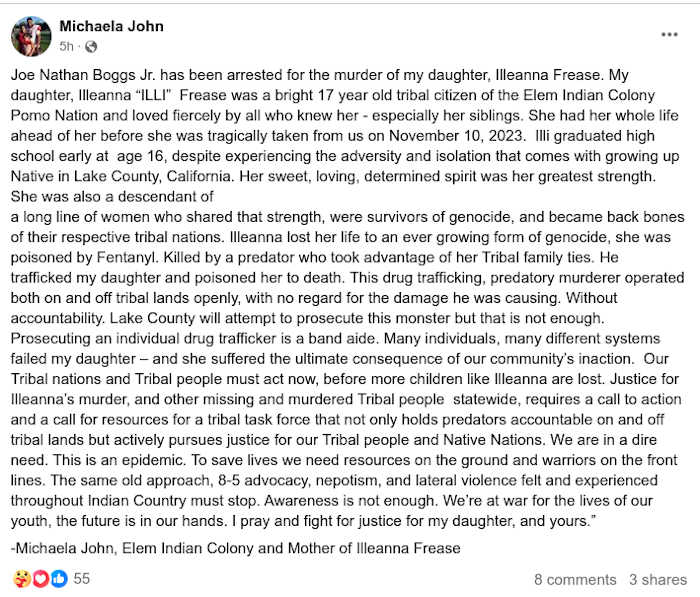
In a Friday afternoon Facebook post, Frease’s mother, Michaela John, remembered her daughter, known as “Illi,” as a bright young woman “loved fiercely by all who knew her — especially her siblings. She had her whole life ahead of her before she was tragically taken from us on November 10, 2023.”

John said her daughter graduated high school early at age 16, “despite experiencing the adversity and isolation that comes with growing up Native in Lake County, California. Her sweet, loving, determined spirit was her greatest strength. She was also a descendant of a long line of women who shared that strength, were survivors of genocide, and became back bones of their respective tribal nations.”

She said of Boggs, who also is Native American, “He trafficked my daughter and poisoned her to death. This drug trafficking, predatory murderer operated both on and off tribal lands openly, with no regard for the damage he was causing. Without accountability.”

The background of the case

Berlinn said the sheriff’s office was dispatched to a coroner’s case at Sutter Lakeside Hospital regarding Frease on the day of her death.

During the initial coroner’s investigation, it was believed Frease died from an overdose, Berlinn said.

Berlinn said an autopsy was conducted, and once toxicology reports were received in February, it was determined that Frease had overdosed from a combination of fentanyl and alcohol.

With the confirmation of the toxicology results, the Sheriff’s Office Major Crimes Unit initiated a criminal investigation to determine who provided the fentanyl to Frease, Berlinn said.

“Throughout the investigation, detectives interviewed witnesses, authored search warrants, and reviewed digital data from cell phones and social media,” Berlinn said in the statement.

Based on the evidence, Berlinn said investigators determined Boggs was responsible for providing the fentanyl to Frease, which ultimately led to her death.

The sheriff’s Major Crimes Unit held a briefing with the Lake County District Attorney’s Office and it was determined Boggs would be prosecuted for Frease’s murder, Berlinn said.

On Thursday, Berlinn said sheriff’s detectives obtained an arrest warrant for Boggs, which led to his arrest the following day.

Lake County Superior Court records show that Boggs has an extensive criminal record stretching back to 2017 that includes felony cases with charges involving drugs, vandalism, assault for a domestic violence case, grand theft and possession of a gun by a convicted felon.

Convictions in 2018 for drugs — which included Boggs and another man being arrested after attempting to sell drugs to an undercover detective — as well as in 2019 for assault, in 2022 for grand theft and 2023 for a felon in possession of a firearm led to state prison terms, according to court records.

Revocation of Boggs’ post release community supervision — which is provided to inmates released from the California Department of Corrections and Rehabilitation — led to county jail sentences in May of 2022 and January of 2023.

Court records also showed that two days before he was arrested in the Frease homicide case, Boggs was arraigned for a misdemeanor drug offense.

Berlinn encouraged anyone who believes they have any information regarding the Frease case to contact the Lake County Sheriff’s Office Major Crimes Unit Tip Line at 707-262-4088 and either Sgt. Jeff Mora or Det. Michael Nakahara will contact them.

Berlinn said that, within the last few years, law enforcement agencies across California and the country have successfully investigated and prosecuted fentanyl homicide cases.

“Illeanna’s case is Lake County’s first arrest for a fentanyl homicide,” Berlinn wrote in her report on the case. “The Lake County Sheriff’s Office will continue to combat the fentanyl crisis in Lake County and hold fentanyl dealers accountable.”

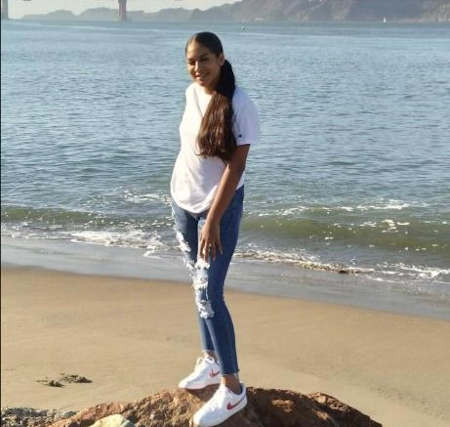
Illeanna Frease. Courtesy photo.

A devastating epidemic

Over the past decade fentanyl has become a national public health crisis, impacting people of all ages, walks of life, and ethnic and cultural backgrounds.

The Drug Enforcement Administration established National Fentanyl Awareness Day in May to raise awareness on “the serious dangers of fentanyl poisoning from fake pills and other illicit drugs.”

Lake County has been hard-hit by the crisis.

Frease’s death in late 2023 came at a time when there were other deaths of young Lake County residents — some of them tribal members like Frease — which prompted local agencies and tribes to issue a December statement that noted that there were “multiple incidents of youth opioid overdose” that had happened in Lake County communities.

“Each is a tragic and stark reminder consumption of drugs, even once, can prove fatal. With the rise of fentanyl, xylazine and similar chemical compounds, events such as these have become far too common. Families, school cohorts and communities are rocked to the core, and we grieve with those most affected,” the statement said.

Officials also took that opportunity to urge parents to speak to their children about drug use.

Among youth and young adults aged 15 to 24, the average annual overdose death rate is 12.6 out of every 100,000, the county reported.

Officials also reported that in 2022, more than 100,000 people died due to overdose in the United States; of those, 79 were Lake County residents.

The California Overdose Surveillance Dashboard showed that in 2022, in California there were 6,473 deaths and 21,316 emergency room visits related to fentanyl overdose.

The dashboard’s report on Lake County showed that black and Native American populations have been hit particularly hard by the opioid-related overdose epidemic, and are the populations with the leading numbers of deaths.

The Northshore communities of Nice and Lucerne have the highest overdose rates, based on the dashboard’s statistics.

The Indian Health Service quoted a Centers for Disease Control report that said that the American Indian and Alaska Native population had the highest drug overdose death rates in both 2020 and 2021, at rates of 42.5 and 56.6 deaths per 100,000 persons. Those numbers include a 33% increase in drug overdose deaths from 2020 through 2021.

“Tribal communities are experiencing an increase in overdoses stemming from polysubstance use. This is primarily caused by unintentional polysubstance use, which is when a person who takes drugs mixed or cut with other substances, like fentanyl, without their knowledge,” the Indian Health Service reported.

In Frease’s case, “Illeanna lost her life to an ever growing form of genocide, she was poisoned by Fentanyl,” her mother said in the Friday Facebook post.

“Lake County will attempt to prosecute this monster but that is not enough,” John wrote. “Prosecuting an individual drug trafficker is a band aide. Many individuals, many different systems failed my daughter – and she suffered the ultimate consequence of our community’s inaction. Our Tribal nations and Tribal people must act now, before more children like Illeanna are lost. Justice for Illeanna’s murder, and other missing and murdered Tribal people statewide, requires a call to action and a call for resources for a tribal task force that not only holds predators accountable on and off tribal lands but actively pursues justice for our Tribal people and Native Nations. We are in a dire need. This is an epidemic. To save lives we need resources on the ground and warriors on the front lines. The same old approach, 8-5 advocacy, nepotism, and lateral violence felt and experienced throughout Indian Country must stop.”

She added, “Awareness is not enough. We’re at war for the lives of our youth, the future is in our hands. I pray and fight for justice for my daughter, and yours.”

If you or someone you know is struggling or in crisis, help is available. Call or text 988 or chat at https://988lifeline.org/.

To learn how to get support for mental health, drug or alcohol issues, visit https://www.lakecountyca.gov/173/Behavioral-Health-Services.

Email Elizabeth Larson at This email address is being protected from spambots. You need JavaScript enabled to view it.. Follow her on Twitter, @ERLarson, or Lake County News, @LakeCoNews.


Details
Written by: Elizabeth Larson
Published: 15 June 2024
  1. Red flag warning set to begin Saturday night
  2. Senate Insurance Working Group established to find legislative pathways to help stabilize market
  3. Governor increases California National Guard deployment to crack down on fentanyl smuggling

Subcategories

Community

  • 640
  • 641
  • 642
  • 643
  • 644
  • 645
  • 646
  • 647
  • 648
  • 649
How to resolve AdBlock issue?
Refresh this page