How to resolve AdBlock issue?
Refresh this page
How to resolve AdBlock issue?
Refresh this page
Lake County News,California
  • Home
    • Registration Form
  • News
    • Community
      • Obituaries
      • Letters
      • Commentary
    • Education
    • Veterans
    • Police Logs
    • Business
    • Recreation
    • Health
    • Religion
    • Legals
    • Arts & Life
    • Regional
  • Calendar
  • Contact us
    • FAQs
    • Phones, E-Mail
    • Subscribe
  • Advertise Here
  • Login
How to resolve AdBlock issue?
Refresh this page
How to resolve AdBlock issue?
Refresh this page

News

Napa man unhurt in aircraft emergency landing

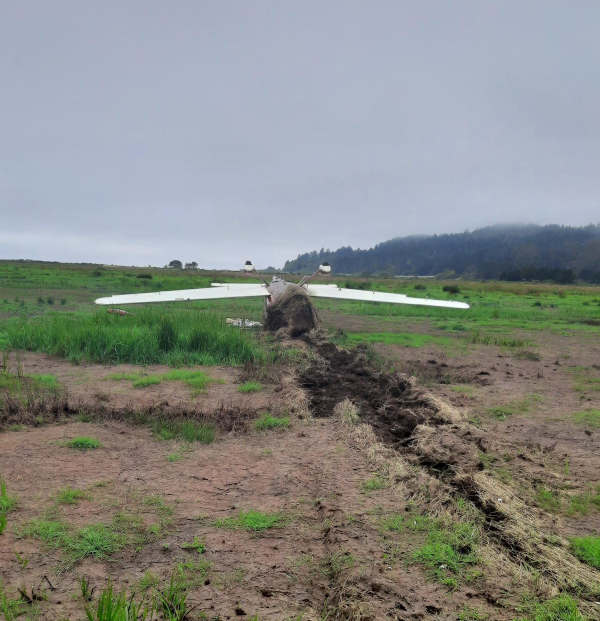
The plane flown by Joseph McCoy of Napa, California, after an emergency landing on Thursday, June 20, 2024. Photo courtesy of the Humboldt County Sheriff’s Office.

NORTH COAST, Calif. — A Napa County man walked away uninjured after having to conduct an emergency landing of his plane on Thursday in Humboldt County.

Joseph McCoy, 67, was the pilot in the crash, according to the Humboldt County Sheriff’s Office.

At 10:35 a.m. Thursday, Humboldt County Sheriff’s deputies were dispatched to the Humboldt Bay National Wildlife Refuge in the Loleta area for a report of a possible small aircraft accident.

Along with the sheriff’s office, California Highway Patrol, California Department of Fish and Wildlife, U.S. Fish and Wildlife Service – Humboldt Bay Refuge, Loleta Volunteer Fire Department and City Ambulance also responded.

Once on scene, responding personnel were able to locate a small, single engine, fixed winged aircraft that had come to rest upside down in a dry marsh area.

McCoy, the pilot and sole occupant of the aircraft, was found to be uninjured, authorities said.

Preliminary information indicates McCoy had just departed the Eureka area when the aircraft lost power, resulting in McCoy making an emergency landing at the refuge.

Upon landing, the soft ground of the marsh appears to have contributed to the aircraft coming to rest in an inverted position. McCoy was able to extricate himself from the aircraft and contact emergency services.

Officials with Humboldt County Environmental Health later responded to assist with evaluating and containing any possible fluid leakage from the aircraft. The National Transportation Safety Board will be conducting an investigation into the potential cause of this incident.

The Humboldt County Sheriff’s Office thanked all allied agencies that responded to assist.

Anyone with information related to this case is encouraged to call the Humboldt County Sheriff’s Office at 707-445-7251.

Joseph McCoy’s plane flipped over during an emergency landing in Humboldt County, California, on Thursday, June 20, 2024. Photo courtesy of the Humboldt County Sheriff’s Office.

Details
Written by: Lake County News reports
Published: 21 June 2024

Firefighting efforts continue around Lake County, Northern California

LAKE COUNTY, Calif. — Firefighters responded to multiple fires in Lake County on Wednesday, as major wildland fires continued to burn elsewhere around the region.

On Wednesday afternoon, one fire after another occurred in Lake County, beginning with a small fire on Wilkinson Road in Kelseyville that was quickly controlled, which was then followed by the beginning of the Scotts fire in the Scotts Valley area, which began shortly after 2 p.m.

Firefighters arriving at the scene were challenged in accessing the fire by an unrated bridge that raised a potential weight issue for fire equipment being the only entry point, besides the creekbed.

In addition to engines and other ground units, Cal Fire air resources were used to fight the fire.

The fire burned a barn as well as vegetation, based on radio reports.

There also was a report of a firefighter that needed to be taken off the line due to difficulty breathing. The firefighter was taken to Sutter Lakeside Hospital for treatment, according to radio reports.

Lakeport Fire units were released by 6 p.m. However, Cal Fire continued to work the fire into the night. By nightfall, the fire was reported to be 38 acres with 15% containment.

As the work on the Scotts fire was underway, a fire in the 6800 block of Hammond Avenue in Nice was reported just before 3 p.m.

With firefighters on the north end of the lake already committed to the Scotts fire, dispatch called for more units to come from the south county.

Firefighters arriving on the scene shortly after 3 p.m. found an estimated half-acre fire. Minutes later, it measured an acre in size and was starting to burn a structure.

By 3:20 p.m., the sheriff’s office had issued an evacuation order for the immediate area, opening an evacuation point at Upper Lake High School’s gymnasium later in the afternoon.

The Hammond Avenue fire was reported to be contained at 6:20 p.m., with two hours of mop up required. It burned a total of 1.2 acres.

The sheriff’s office said that, as of 6:45 p.m., the evacuation warning for zones NIC-E042 and NIC-E047B had been reduced to normal, and the evacuation order for zone NIC-E047A reduced to a warning.

Firefighting efforts continue around the region

Efforts to contain wildland fires in Lake’s neighboring counties continued on Wednesday.

In Sonoma County, the Point fire — burning since Sunday afternoon — remained at 1,207 acres, with containment up to 60%.

One firefighter has been injured, with three structures destroyed and two damaged, Cal Fire reported.

Cal Fire said that 1,011 personnel are assigned, along with 85 engines, 12 water tenders, nine dozers and 32 hand crews.

On the other side of Lake County, the Sites fire continued growing in Colusa County on Wednesday.

The fire, burning since Monday southeast of Stonyford, reached 19,124 by day’s end, with containment at 10%.

The Sites fire is threatening 326 structures, Cal Fire said.

Cal Fire said there are 107 engines, 18 water tenders, seven helicopters, 16 dozers, 18 hand crews and 741 personnel assigned to the incident.

Email Elizabeth Larson at This email address is being protected from spambots. You need JavaScript enabled to view it.. Follow her on Twitter, @ERLarson, or Lake County News, @LakeCoNews.
Details
Written by: Elizabeth Larson
Published: 20 June 2024

Habitat for Humanity accepting Homeownership Program applications

LAKE COUNTY, Calif. — Is renting getting you down? Are you dreaming of owning your own home?

Habitat for Humanity Lake County is actively accepting applications for its Homeownership Program.

The stability and security of homeownership is one of the greatest gifts a family can have. The pride in one’s home and the benefits it offers to the family unit are a boon to the community, helping to make Lake County a better place for all of us, Habitat said.

Habitat for Humanity Lake County said it is here to help make that happen for qualifying, deserving families in our communities.

Applicants must have lived in Lake County for at least one year, be willing to partner with Habitat in the construction of their home, present a positive attitude towards the process and be income-qualified.

If you, or someone you know, are interested and might qualify, please contact the Habitat office at 707-994-1100 for more information or come into the office at 15312 Lakeshore Drive Clearlake to receive a pre-application. For assistance in Spanish dial extension 108.

Details
Written by: Lake County News reports
Published: 20 June 2024

EPA has lowered the screening level for lead in soil – here’s what that could mean for households across the US


A lot of lead from gasoline, house paint and industrial emissions has ended up in soil, and it poses serious health risks. Jamie Grill, Tetra Images via Getty Images

Children can be exposed to lead by swallowing or inhaling soil while they are playing. Young children often put their hands in their mouths and may have dirt on their hands. Kids and pets also can track lead dust from soil indoors. And anyone who eats fruit or vegetables grown in contaminated soil can ingest lead.

Early in 2024, the U.S. Environmental Protection Agency lowered the screening level for lead in residential soils from 400 parts per million – a standard that was more than 30 years old – to 200 parts per million. This more protective lower number reflects current understanding of soil as a significance source of lead exposure for children.

EPA officials said that at homes exposed to lead from multiple sources, the agency will generally use a more conservative 100 parts per million screening level.

This new level is not a cleanup standard; it’s a threshold at which the EPA will make site-specific decisions about how to protect people there. Actions may include providing information about soil lead, recommending ways to reduce exposure, or removing the leaded soil and replacing it with clean soil.

The standard is designed to guide EPA assessments of residential soils around polluted sites under two federal laws. The Superfund law addresses hazardous wastes that were improperly created or disposed of before 1976, while the 1976 Resource Conservation and Recovery Act governs hazardous waste generation and disposal from that year forward. More than 4,000 sites across the nation are currently being cleaned up under those two laws.

I study urban lead poisoning in children from soil and other sources, and I have worked with colleagues to analyze tens of thousands of soil samples collected from typical homes by research scientists and by citizens across the U.S.. This work is ongoing, but our newly published findings show that under the new EPA standard, potentially harmful lead exposure from soil is far more widespread than many people – including public officials – realize. Reducing this risk will be a very long-term effort.

Soil lead levels are a concern in private yards and public parks, and on school playgrounds.

A toxic legacy

Lead exposure has blighted communities across the U.S., particularly lower-income communities of color. Many factors have contributed, including lead in gasoline, water pipes and paint. In addition, redlining and other policies have trapped vulnerable families in substandard housing that often contains lead paint and is located in areas heavily polluted by traffic and industrial sources.

Lead affects many parts of the body, including the brain and central nervous system. Exposure to high levels of lead in childhood can lead to lower educational outcomes and lower earning potential.

Since the federal government started severely limiting the production and use of lead in the 1970s, the share of children in the U.S. who are considered lead-affected, based on current standards, has fallen dramatically. This means that for tens of millions of U.S. children, the risk of being cognitively impaired by lead exposure is greatly reduced. In the 1970s, this figure was near 100%; today it is about 1%, which equates to some 500,000 children.

But many urban children are still exposed to lead at unsafe levels, and soil exposure isn’t addressed by laws that have reduced other lead sources. Lead in soil is the residue of degraded lead-based paint, pollution deposited by cars that burned leaded gasoline for decades, and emissions from factories and industrial facilities.


Lead in soil is a widespread risk

Our national analysis of samples collected from 16 cities found that out of 15,595 household soil samples, 12.3% – one in every eight – exceeded the old federal screening level of 400 parts per million. When the standard is adjusted down to the proposed level of 200 parts per million, 23.7% of households – nearly 1 in 4 – contain a lead hazard.

These samples were typically collected in sets, with one sample near the exterior walls of a home, where highest soil lead values are expected; another from the yard; and a third from near the street, which can also record elevated lead levels.

If our findings are extrapolated across the nation, they indicate that up to roughly 29 million households out of the 123.6 million that were recorded in the 2020 census could be exposed to soil lead hazards and should take steps to mitigate them. Applying the EPA’s aspirational goal of 100 parts per million, our analysis indicates that some 40.2% of households could be affected – equivalent to nearly 50 million households nationwide.

Not all communities in our research have similar risk profiles. In Chicago, for example, 52.8% of household soils that we tested contained more than 200 parts per million of lead. Samples from parts of several medium-sized cities, including Springfield, Massachusetts, and Chattanooga and Memphis, Tennessee, had comparable percentages.

It is difficult to fully assess city-specific soil lead burdens, for several reasons. First, the citizen science dataset that we used in our analysis was collected by private citizens using certain guidelines, not under the strict scientific protocols that the EPA would follow. Second, there is no other systematic, comprehensive measurement of household soil lead values across the U.S. that could be used to assess the accuracy of the community science samples.

Capping soil as a first step

Because so little data on lead soil values exists, it’s not yet possible to determine which particular households have the greatest potential risk. Without that information, the real cost of mitigating this problem is also unknown.

Full remediation, which involves removing contaminated soils and replacing them with clean soils, can cost from US$10,000 to $30,000 per household. Typically, the cost of this type of voluntary cleanup is borne by the homeowner, although some states may have assistance programs.

At this rate, the price tag for mitigating all households nationwide that we project to have soil above the new EPA standard would range from $290 billion to over $1.1 trillion. Household soil remediation involves many steps, including soil testing and monitoring dust levels. If it is done poorly, it can actually scatter lead-contaminated soils and dust beyond the mitigation site.

An industrial facility with a towering smokestack
The Doe Run smelter in Herculaneum, Mo., processed lead from 1892 through 2013. In 2001, the EPA found lead concentrations up to 33,100 parts per million in local yard soils. The smelter closed after the EPA tightened limits on air emissions from lead smelters. Kbh3rd/Wikimedia, CC BY-SA

Given this projected price tag, my colleagues and I do not expect such a program to be proposed any time soon. However, there’s a faster and much cheaper strategy: capping existing soils with clean soil or mulch. This is an imperfect solution, but it solves the immediate lead exposure problem for children living in these settings.

Capping isn’t a permanent answer, since land cover can be disturbed, which would make lead-enriched soils an active risk once again. But even covering a contaminated site with clean soils will permanently dilute the site’s total lead concentration. Nearly all lead deposited from human activities is captured in the upper 10 inches of soils. Adding another 10 inches of clean soil on top would cut the soil lead concentration by half.

It’s a cliche but nonetheless true that the solution for pollution often is dilution. I see this simple strategy as an immediate way for cities to start addressing their new lead challenge.The Conversation

Gabriel Filippelli, Professor of Earth Sciences and Executive Director, Environmental Resilience Institute, Indiana University

This article is republished from The Conversation under a Creative Commons license. Read the original article.

As spring phases into summer across the U.S., kids are spending more time outdoors. Playing outside is healthy in all kinds of ways, but it also poses some risks. One that many families may not be aware of is exposure to lead in soil, which is still a serious problem, mainly in cities.
Details
Written by: Gabriel Filippelli, Indiana University
Published: 20 June 2024
  1. U.S. foreclosure activity increases in May; rate down from last year
  2. Sheriff’s office issues evacuation order for fire in Nice
  3. Sites fire continues rapid growth

Subcategories

Community

  • 635
  • 636
  • 637
  • 638
  • 639
  • 640
  • 641
  • 642
  • 643
  • 644
How to resolve AdBlock issue?
Refresh this page