 How to resolve AdBlock issue?
News
In line with the goals of California’s developing Master Plan for Career Education, Gov. Gavin Newsom and California Community Colleges Chancellor Sonya Christian on Monday announced they submitted a proposal to the U.S. Department of Education to enable students without a high school diploma — or the equivalent — to access Title IV financial aid.
“Regardless of background or credentials, every Californian deserves the opportunity to pursue their dream career and a higher education degree. In partnership with Chancellor Christian, the state is seeking to make community college more accessible and affordable for students without a high school diploma,” said Gov. Newsom.
If the Ability to Benefit, or ATB, proposal is approved, an estimated four million Californians without a high school diploma will have access to federal financial aid to attend college classes — increasing opportunity and access to higher education, training, and jobs across the state.
Students participating in the ATB process will also have support for their education goals, and access to counseling and academic support, including math and writing workshops, tutoring services, accessibility services, and more.
“This initiative has the ability to change lives. It will open college and career opportunities for adult learners seeking to pursue their academic aspirations, regardless of their background or circumstances,” said Chancellor Christian. “By removing barriers to financial support, we’re moving students closer to success. That combined with the tailored supports in this initiative such as, basic needs support, educational and career counseling and tutoring, will allow students realize and unlock their full potential.”
Bigger picture
This proposal is in line with the governor’s Master Plan for Career Education, which will align and simplify the TK-12, university, and workforce systems in California to support greater access to education and jobs for all Californians.
Additionally, California has elevated both the Guided Pathways framework and dual enrollment as strategies to improve student success rates for all students, particularly low-income working adults.
Within the Guided Pathways framework, California community colleges are structuring programs and support services to provide clearer, more defined paths from entry to completion of a credential or degree.
Dual enrollment enables adults seeking a high school diploma or equivalent to concurrently pursue a postsecondary degree or certificate and is a cornerstone strategy for serving adult education learners within the guided pathways framework.
“Regardless of background or credentials, every Californian deserves the opportunity to pursue their dream career and a higher education degree. In partnership with Chancellor Christian, the state is seeking to make community college more accessible and affordable for students without a high school diploma,” said Gov. Newsom.
If the Ability to Benefit, or ATB, proposal is approved, an estimated four million Californians without a high school diploma will have access to federal financial aid to attend college classes — increasing opportunity and access to higher education, training, and jobs across the state.
Students participating in the ATB process will also have support for their education goals, and access to counseling and academic support, including math and writing workshops, tutoring services, accessibility services, and more.
“This initiative has the ability to change lives. It will open college and career opportunities for adult learners seeking to pursue their academic aspirations, regardless of their background or circumstances,” said Chancellor Christian. “By removing barriers to financial support, we’re moving students closer to success. That combined with the tailored supports in this initiative such as, basic needs support, educational and career counseling and tutoring, will allow students realize and unlock their full potential.”
Bigger picture
This proposal is in line with the governor’s Master Plan for Career Education, which will align and simplify the TK-12, university, and workforce systems in California to support greater access to education and jobs for all Californians.
Additionally, California has elevated both the Guided Pathways framework and dual enrollment as strategies to improve student success rates for all students, particularly low-income working adults.
Within the Guided Pathways framework, California community colleges are structuring programs and support services to provide clearer, more defined paths from entry to completion of a credential or degree.
Dual enrollment enables adults seeking a high school diploma or equivalent to concurrently pursue a postsecondary degree or certificate and is a cornerstone strategy for serving adult education learners within the guided pathways framework.
- Details
- Written by: LAKE COUNTY NEWS REPORTS

Study finds that among Medicare enrollees, being healthier, wealthier, white and female may be associated with risk.
Some 13% of older adults are diagnosed with traumatic brain injury, or TBI, according to a study by UC San Francisco and the San Francisco VA Health Care System.
These injuries are typically caused by falls from ground level.
Researchers followed about 9,200 Medicare enrollees, whose average age was 75 at the start of the study, and found that contrary to other studies of younger people, being female, white, healthier and wealthier was associated with higher risk of TBI.
The study was published in JAMA Network Open on May 31.
The researchers, led by first author Erica Kornblith, PhD, of the UCSF Department of Psychiatry and the San Francisco VA Health Care System, tracked TBI Medicare claims of participants enrolled in the Health and Retirement Study, a long-term study of a representative sample of older Americans.
While TBI can be successfully treated, these injuries increase the likelihood of a number of serious conditions, including dementia, Parkinson’s disease and seizures, as well as cardiovascular disease and psychiatric conditions like depression and anxiety.
“The number of people 65 and older with TBI is shockingly high,” said senior author Raquel Gardner, MD, formerly of the UCSF Department of Neurology and the San Francisco VA Health Care System. “We need evidence-based guidelines to inform post-discharge care of this very large Medicare population, and more research on post-TBI dementia prevention and repeat injury prevention.”
The researchers sought to identify the factors that made some patients more vulnerable than others, during a follow-up period of up to 18 years.
Earlier TBI studies have found that males, non-whites and those of lower socio-economic status were more likely to be diagnosed with TBI. But the current study found that females and whites were overrepresented among the 1,148 participants with TBI.
While 58% of the HRS participants were female and 84% were white, among those with TBI, the figures were 64% and 89%. In addition, 31% of those with TBI were in the highest quartile of wealth, while 22% were in the lowest.
Activities of healthier seniors may place them at higher risk
Participants who went on to be diagnosed with TBI were less likely when they enrolled in the study to have lung disease and to have trouble with the activities of daily living, like bathing, walking and getting out of bed. They also were more likely to have normal cognition.
“It’s possible that our findings reflect that adults who are healthier, wealthier and more active are more able or likely to engage in activities that carry risk for TBI,” said Kornblith, who is also affiliated with the UCSF Weill Institute for Neurosciences.
“While most TBIs in older people occur from falls at ground level, if you are in a wheelchair or bedbound, you don’t have as many opportunities for traumatic injuries,” she added. “It’s also possible that participants with cognitive impairment are more limited in their activity and have less opportunity to fall.”
But the findings may mask the true incidence of injury, since the data only reflect cases of TBI in which patients were diagnosed and received care. A 2007 study found that 42% of respondents to an online survey did not seek medical attention after TBI.
“We know that older adults who experience falls, the largest segment of Americans with TBI, as well as lower-resourced adults – including those subjected to racial and ethnic micro-aggressions in a medical setting – are less likely to seek care,” Kornblith said. “It’s possible that our data did not capture the true burden of TBI in this population.”
The study’s findings may raise questions at a time when physical activity is vigorously recommended to reduce or slow the development of dementia.
“The overall evidence still overwhelmingly sides with physical activity being neuroprotective,” said Gardner, who is now at the Sheba Medical Center in Israel. “However, taking measures to optimize safety and mitigate falls is critical. These measures need to change over the life-course as an individual accumulates physical or cognitive disabilities, or both.”
Co-Authors: Kristine Yaffe, MD, of UCSF, the San Francisco VA Health Care System and the Northern California Institute for Research and Education; Grisell Diaz-Ramirez and W. John Boscardin, PhD, of UCSF and the San Francisco VA Health Care System.
Funding: Alzheimer’s Association Research Grant 21-851520 and U.S. Department of Veterans Affairs Career Development Award 1 IK2 RX003073-01A2, grant R35 AG071916 from the National Institute on Aging, grant W81XWH-18-PH/TBIRP-LIMBIC I01CX002096 from VA/Department of Defense and grant R01 NS110944 from the National Institute on Aging.
Suzanne Leigh writes for UC San Francisco.
- Details
- Written by: Suzanne Leigh
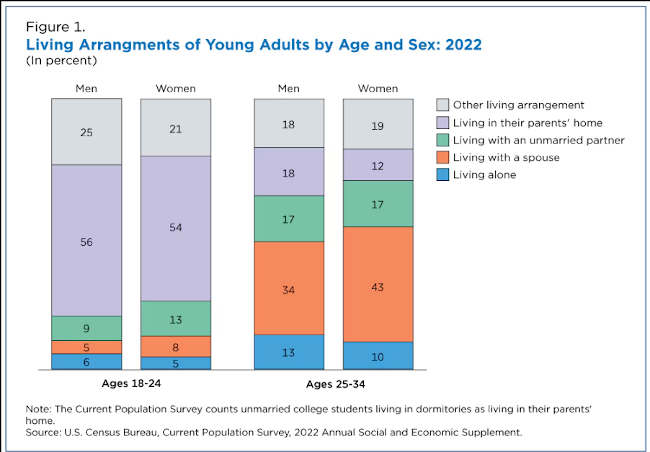
Almost 1 in 10 young adults ages 18-34 and nearly 3 in 10 adults 65 or older lived alone in 2022, according to a new U.S. Census Bureau report.
The report provides a demographic profile of the households and living arrangements of Americans and how they have changed over time by sex and across age groups.
The most common living arrangement among 18- to 24-year-olds in 2022 was living in a parent’s home (Figure 1).
More than half of adult men and women in that age group lived in a parental home. In this survey, young adults living in college dorms are counted as living in their parents’ home.
Among 25- to 34-year-olds, a larger share of women (43%) than men (34%) lived with a spouse and about 17% of young adult men and women in that age group lived with an unmarried partner.
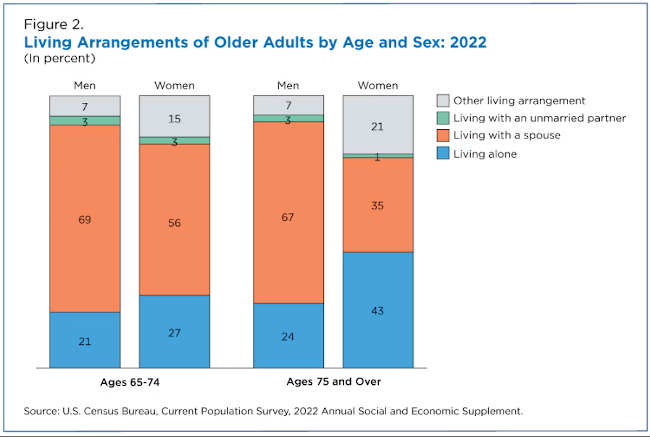
Among older adults, about 27% of women ages 65 to 74 and 43% of those age 75 or older lived alone (Figure 2).
In the age 75 and older group, men (67%) were nearly twice as likely as women (35%) to live with a spouse, a reflection of the longer life expectancy of women.
Living with parents then and now
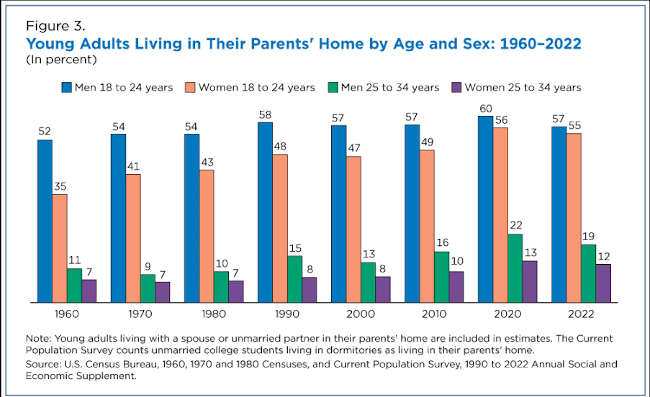
In 1960, 52% of 18- to 24-year-old men were living in their parents’ home, compared to 35% of women in that age range (Figure 3). By 2022, however, those percentages had increased to 57% and 55%, respectively.
The large increase in the share of women living with their parents is at least partially attributable to the increase in women enrolled in college and marrying later.
A lower percentage of men and women ages 25 to 34 lived in their parents’ home although, as was the case with younger adults, the rates grew from 1960 to 2022.
In 1960, just 11% of men and 7% of women in that age group lived with their parents. By 2022, 19% of men and 12% of women were living in their parents’ home.
Other highlights:
• About 47% of U.S. households in 2022 were married-couple households, down from 71% in 1970.
• In 2022, less than two-thirds of all family groups with children under age 18 were maintained by married parents.
• About 74% of mothers and 91% of fathers with a child in the household were also living with their child’s other parent in 2022.
• In 2018, about 17% of children lived in a household that received food stamps, compared to 20% in 2020.
• In 2022, 5% of married parents and 34% of unmarried parents with a child in the household lived in poverty during the previous year.
• From 2019 to 2021, the share of children with no coresident parent(s) in the labor force increased from about 7% to 8%.
Paul Hemez is a survey statistician in the Census Bureau’s Social, Economic, and Housing Statistics Division. Chanell Washington is a statistician/demographer in the Census Bureau’s Population Division.
- Details
- Written by: Paul Hemez and Chanell Washington
LAKEPORT, Calif. – The Lakeport City Council this week will discuss the budget, a department reorganization and the award of an $8 million sewer main project.
The council will meet Tuesday, June 4, at 6 p.m. in the council chambers at Lakeport City Hall, 225 Park St.
The agenda can be found here.
The council chambers will be open to the public for the meeting. Masks are highly encouraged where 6-foot distancing cannot be maintained.
If you cannot attend in person, and would like to speak on an agenda item, you can access the Zoom meeting remotely at this link or join by phone by calling toll-free 669-900-9128 or 346-248-7799.
The webinar ID is 973 6820 1787, access code is 477973; the audio pin will be shown after joining the webinar. Those phoning in without using the web link will be in “listen mode” only and will not be able to participate or comment.
Comments can be submitted by email toThis email address is being protected from spambots. You need JavaScript enabled to view it. . To give the city clerk adequate time to print out comments for consideration at the meeting, please submit written comments before 3:30 p.m. on Tuesday, June 4.
On Tuesday, Assistant City Manager Nick Walker will ask the council to approve updates to the city’s reserve and pension policy.
The council also will conduct a council workshop to review the recommended fiscal year 2024-25 budget.
Administrative Services Director Kelly Buendia will ask the council to consider the Utilities Department reorganization including the removal of the water operations supervisor, wastewater operations supervisor, and maintenance worker III positions and the addition of utilities superintendent, water/wastewater treatment supervisor and utilities underground supervisor positions.
Utilities Director Paul Harris will ask the council to approve the plans, specifications and working details and award a construction contract to Ghilotti Construction Co. Inc. for the 2024 Water & Sewer Main Replacement Project and authorize the city manager to execute the construction
contract for the bid amount of $8,042,049.
On the consent agenda — items considered noncontroversial and usually accepted as a slate on one vote — are ordinances; minutes of the City Council’s regular meeting on May 21; approval of application 2024-024, with staff recommendations, for the Movie Night at
Xabatin event; approval of application 2024-025, with staff recommendations, for Rotary’s Christmas Trees on Main Street.
The council will hold a closed session to discuss a case of existing litigation, City of Lakeport et al. v. Amerisourcebergen Drug Corporation et al.
Email Elizabeth Larson atThis email address is being protected from spambots. You need JavaScript enabled to view it. . Follow her on Twitter, @ERLarson, or Lake County News, @LakeCoNews.
The council will meet Tuesday, June 4, at 6 p.m. in the council chambers at Lakeport City Hall, 225 Park St.
The agenda can be found here.
The council chambers will be open to the public for the meeting. Masks are highly encouraged where 6-foot distancing cannot be maintained.
If you cannot attend in person, and would like to speak on an agenda item, you can access the Zoom meeting remotely at this link or join by phone by calling toll-free 669-900-9128 or 346-248-7799.
The webinar ID is 973 6820 1787, access code is 477973; the audio pin will be shown after joining the webinar. Those phoning in without using the web link will be in “listen mode” only and will not be able to participate or comment.
Comments can be submitted by email to
On Tuesday, Assistant City Manager Nick Walker will ask the council to approve updates to the city’s reserve and pension policy.
The council also will conduct a council workshop to review the recommended fiscal year 2024-25 budget.
Administrative Services Director Kelly Buendia will ask the council to consider the Utilities Department reorganization including the removal of the water operations supervisor, wastewater operations supervisor, and maintenance worker III positions and the addition of utilities superintendent, water/wastewater treatment supervisor and utilities underground supervisor positions.
Utilities Director Paul Harris will ask the council to approve the plans, specifications and working details and award a construction contract to Ghilotti Construction Co. Inc. for the 2024 Water & Sewer Main Replacement Project and authorize the city manager to execute the construction
contract for the bid amount of $8,042,049.
On the consent agenda — items considered noncontroversial and usually accepted as a slate on one vote — are ordinances; minutes of the City Council’s regular meeting on May 21; approval of application 2024-024, with staff recommendations, for the Movie Night at
Xabatin event; approval of application 2024-025, with staff recommendations, for Rotary’s Christmas Trees on Main Street.
The council will hold a closed session to discuss a case of existing litigation, City of Lakeport et al. v. Amerisourcebergen Drug Corporation et al.
Email Elizabeth Larson at
- Details
- Written by: Elizabeth Larson