How to resolve AdBlock issue?
Refresh this page
How to resolve AdBlock issue?
Refresh this page
Lake County News,California
  • Home
    • Registration Form
  • News
    • Community
      • Obituaries
      • Letters
      • Commentary
    • Education
    • Veterans
    • Police Logs
    • Business
    • Recreation
    • Health
    • Religion
    • Legals
    • Arts & Life
    • Regional
  • Calendar
  • Contact us
    • FAQs
    • Phones, E-Mail
    • Subscribe
  • Advertise Here
  • Login
How to resolve AdBlock issue?
Refresh this page
How to resolve AdBlock issue?
Refresh this page

News

Space News: US participation in space has benefits at home and abroad − reaping them all will require collaboration


“Cosmic cliffs” in the Carina nebula, captured by the James Webb Space Telescope. NASA, ESA, CSA, STScI

When people think about what we get from the U.S. space program, it may be along the lines of NASA technology spin-offs such as freeze-dried food and emergency space blankets.

But space activities do much more that benefits life on Earth. Research in space helps scientists study our environment, develop new technologies, create jobs, grow the economy and foster international collaboration.

Of course, with reports of Russia developing an anti-satellite nuclear weapon, members of Congress and the media have focused their attention on space defense and military readiness.

This is critical, but there are still many other benefits to reap from space. Getting the most out of U.S. space involvement will require collaborating across various social, environmental, commercial, governmental, international and technological backgrounds.

As a space policy scholar focused on private-public partnerships, networks and coalitions, I’ve seen that policymakers can get the most out of U.S. space endeavors if they invite a wide array of experts into policy discussions.

Benefits on Earth

NASA satellites play a crucial role in documenting changes in global temperatures, sea-level rise, arctic ice extent and air quality. Satellites have also been collecting data for almost 50 years to monitor water use, crop health and crop production. These long-term observations help researchers track environmental changes across the globe.

Space research provides a wide array of technologies in addition to rockets and Moon landers. Cellphone cameras, CAT scanners, the computer mouse, laptops, wireless headsets and water purification systems are just a few public goods NASA has generated.

These spin-off technologies come from NASA’s partnerships with private firms, which subsequently make scientific discoveries widely available and accessible.

Growing the space economy

Experts predict that the space sector will continue driving the development of nonspace industries. Agriculture, energy, mining, transportation and pharmaceuticals are just some of the sectors that benefit through spin-off technologies and space-based research.

For example, scientists can conduct experiments on the International Space Station using the microgravity of space to study the chemistry of drugs, improve medications and test cancer treatments.

More organizations and individuals than ever share a vested interest in the space sector’s success. Experts anticipate the global space economy – the resources used in space for activities – and research and development will continue to grow to a market of US$1.4 trillion by 2030.

Commercialization policies opened U.S. space activities to the private sector. This has led to partnerships with companies, such as SpaceX, Blue Origin and others, that are growing the space economy.

These companies have increasingly launched rockets and deployed satellites in recent years. This has increased the need for workers, both in manufacturing positions and specialized STEM roles. Additionally, private companies and universities are partnering to develop various technologies, such as landing systems for a U.S. return to the Moon.


Communities that host space industry centers have seen economic and educational benefits. For example, Huntsville, Alabama, home of the Marshall Space Flight Center and the U.S. Space and Rocket Center, has attracted an educated workforce with one of the highest rates of engineers per capita. Almost half of residents over the age of 25 in Huntsville have a bachelor’s degree or higher.

An aerial view of three buildings.
The Marshall Space Flight Center in Huntsville, Ala. NASA

This rate starkly contrasts with the national average, where 37% have at least a bachelor’s degree, and the state’s 27% average. Additionally, Huntsville’s annual median household income is $8,000 higher than the Alabama average.

Since 1982, Huntsville has also hosted over 750,000 students at the U.S. Space and Rocket Center space camp. This camp educates students about science, technology, engineering and leadership to prepare them for a potential future STEM career.

International collaboration

Space also provides an opportunity for the U.S. to collaborate with other countries.

For example, the U.S. works jointly with Italy to observe the impacts of air quality on human health. The James Webb Space Telescope, a result of partnerships between NASA, the European Space Agency and the Canadian Space Agency, allows scientists to peer into previously unobserved parts of the cosmos. International collaboration has also established the Artemis Accords, a set of principles agreed to by 40 countries for peaceful, sustainable and transparent cooperation in space.

Getting the most out of space

Right now, U.S. space policymaking occurs at the federal and international level. And while people outside of the government can act as witnesses during congressional hearings or through advocacy groups, that involvement may not be enough to represent the wide spectrum of viewpoints and interests in space policy.

There are a few ways policymakers can receive input from different stakeholders. These might include inviting more experts from various policy areas to provide recommendations in congressional hearings, collaborating with advocacy coalitions to create sustainable policies, strengthening and expanding private-public partnerships, and setting a space agenda that emphasizes research and development.The Conversation

Cheyenne Black, Graduate Research Assistant in the Institute for Public Policy Research and Analysis, University of Oklahoma

This article is republished from The Conversation under a Creative Commons license. Read the original article.
Details
Written by: Cheyenne Black, University of Oklahoma
Published: 25 May 2024

Vandals do damage and commit theft at Middletown High School; memorial tree destroyed

LAKE COUNTY, Calif. — A group of vandals left behind a trail of damage and committed theft at Middletown High School early Monday morning, with authorities now seeking leads as to the identities of the suspects.

The vandalism and theft took place on the same night as the annual “senior prank,” which the high school said in a Thursday Facebook post has been an “unsanctioned practice and tradition” at the school for many years.

Based on information provided both by the school and the Lake County Sheriff’s Office, the pranksters and the vandals appear to be two distinct groups.

“Seniors, towards the end of their senior year, come together and ‘prank’ the school,” wrote Middletown High School Principal Shane Lee in the Thursday post.

“A prank can be defined as ‘a trick that is intended to be funny but not cause harm or damage,’” Lee wrote. “This year’s efforts had some semblance of ‘prank’ with prank-like results. This year’s ‘prank’ also created harm & damage.”

Lee reported that at 11:30 p.m. Sunday up to 25 individuals entered the school campus.

He said they were familiar with the grounds and presumed to be Middletown High School students, and were on the campus for 30 to 45 minutes.

A second and smaller group of individuals came onto the campus at 4 a.m. Monday, and it was that group that appeared to have been behind the damage and destruction to two trees, Lee said.

One of those trees was planted in memory of a Middletown Unified student, Jeni Hall.

Hall, who suffered from cystic fibrosis, died in November of 1984 at age 12. She would have been a part of the high school’s class of 1990.

The memorial tree for Hall was planted in May of 2018. May is Cystic Fibrosis Month.

“MHS administration has been in contact with the family of this student and is aggressively working to locate and confirm the identity of the vandals and destroyers of the tree(s),” Lee wrote on Facebook.

Lee said the school administration contacted law enforcement. “A Sheriff’s Deputy was on site and documented locations and damages,” Lee wrote.

Lauren Berlinn, spokesperson for the Lake County Sheriff’s Office, confirmed to Lake County News that the vandalism was reported to the agency.

“There was a senior prank earlier in the evening that caused no issue; however, a second group entered the school grounds later in the evening/after midnight and committed theft and vandalism. A deputy went to the school to take a report and talk with staff,” Berlinn said.

Berlinn added, “There are no leads at this time.”

Lee said the high school administration is working with the senior class leadership group, and that replacement trees will be fully funded by the senior class fund. “Monies will be provided to replenish the student fundraising efforts.”

On the district’s end, due to privacy laws, if they identify suspects who are students, Lee said they “cannot disclose specific actions taken towards specific students. Consequences and punitive actions have been implemented.”

Some of the individuals who participated, however, are not believed to have been senior class members, Lee said.

Lee said the high school administration also is working with neighboring businesses to get evidence of possible student activity on their premises the same night.

“MHS administration is continuing to work towards learning more and attempting to discover the identity of the individual(s) who destroyed the trees and removed monies,” Lee wrote.

This wouldn’t be the first time vandalism and damage was reported at the same time as a senior prank.

In 2019, a group was reported to have gone through the campus, spray painting buildings and causing damage, in an incident that was not the planned prank. Those individuals were reportedly caught.

Anyone with information about this week’s theft and vandalism can contact the Lake County Sheriff’s Office’s nonemergency dispatch at 707-263-2690.

The full Facebook post from Middletown High School is published below.


MHS Fact Sheet: "Senior Prank"
MHS “Senior Prank” Incident (5/19/24)

What is the “senior prank” and why does this happen?

The “senior prank” has been an unsanctioned practice and tradition here at MHS for many years. Seniors, towards the end of their senior year, come together and “prank” the school.

What is a “prank” and did this year’s activity fit this definition?

A prank can be defined as “a trick that is intended to be funny but not cause harm or damage”. This year’s efforts had some semblance of “prank” with prank-like results. This year’s “prank” also created harm & damage.

What does MHS/MUSD know about this year’s senior prank as it occurred?

On the evening of 5/19 at approximately 11:30pm, as many as 25 individuals came onto the MHS campus. These individuals were familiar with the grounds and are presumed to be MHS students. The actions took place during the 30-45 minutes. At just after 4:00 am, a smaller group of students entered campus.. It appeared as if this small group was behind damage/destruction to the two trees. One of the trees was planted in memory of an MUSD student. MHS administration has been in contact with the family of this student and is aggressively working to locate and confirm the identity of the vandals and destroyers of the tree(s).

Has local law enforcement been notified of the damages and potential crimes?

Yes. The MHS Administration has established an incident number with law enforcement. A Sheriff’s Deputy was on site and documented locations and damages.

Have arrangements been made to restore trees and monies to the grounds and student group?

Yes. MHS Administration has worked with the MHS Senior Class leadership group. Replacement trees will be fully funded by the Senior Class fund. Monies will be provided to replenish the student fundraising efforts.

Have students been identified and punished for these harmful and damaging actions?

This question does begin to infringe upon student privacy. Due to privacy laws, the district cannot disclose specific actions taken towards specific students. Consequences and punitive actions have been implemented. To provide background information: MHS has 88 seniors. Approximately 25 student-aged individuals showed up for the “Senior Prank” event (some of whom are said to NOT have been seniors). 63 seniors (or more) did not participate in the “Senior Prank” event on 5/19.

What are MHS’ next steps?

MHS administration is working with neighboring businesses to attain any evidence of student activity on their premises during the night / morning of 5/19. MHS administration is continuing to work towards learning more and attempting to discover the identity of the individual(s) who destroyed the trees and removed monies.

-Mr. Lee


Email Elizabeth Larson at This email address is being protected from spambots. You need JavaScript enabled to view it.. Follow her on Twitter, @ERLarson, or Lake County News, @LakeCoNews.
Details
Written by: Elizabeth Larson
Published: 24 May 2024

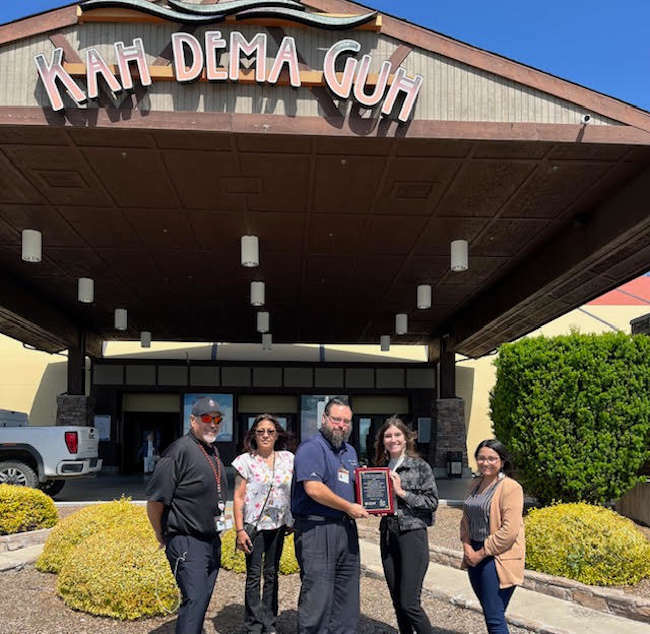
Habematolel Pomo of Upper Lake’s Running Creek Casino honored with California Tribal Community Health Leadership Award

Habematolel Pomo casino staff receive the California Tribal Community Health Leadership Award. Courtesy photo.

UPPER LAKE, Calif. — The Habematolel Pomo of Upper Lake’s Running Creek Casino’s commitment to improving and protecting public health was honored today by the California Clean Air Project with the California Tribal Community Health Leadership Award.

“We are delighted to inform you that the California Tribal Community Health Leadership Award Committee wishes to recognize the Habematolel Pomo of Upper Lake for maintaining a smoke-free environment for patrons and employees. This action demonstrates your commitment to creating a healthier environment for your community,” wrote Regina Gradias, community engagement and outreach coordinator for the California Clean Air Project.

The Running Creek Casino was honored for its smoke-free facilities that launched in the wake of COVID and continue to this day.

The casino received the Tribal Community Health Leadership Award for its work to protect its patrons from the dangers associated with second-hand smoke.

“The Habematolel Pomo of Upper Lake works hard to protect the health of our tribal community and all who visit our tribal enterprises. We are honored to be recognized for our initiatives to protect public health and promote healthy outcomes. We also appreciate the leadership of our casino's general manager, Chris Vieceli, who has guided this enterprise with skillful competence to help ensure our patrons have a great experience,” said Sherry Treppa, chairwoman for the Habematolel Pomo of Upper Lake Tribe.
Details
Written by: LAKE COUNTY NEWS REPORTS
Published: 24 May 2024

Assembly approves measures aimed at reducing disproportionate rates of violence against Native Americans

Three proposals to increase safety in California’s Indian Country and reduce the disparate numbers of Missing and Murdered Indigenous People, or MMIP, are headed to the Senate this week as California works to reduce its fifth-highest in the nation unresolved MMIP case load.

Assemblymember James C. Ramos (D-San Bernardino) authored the bills.

“In 2016 the National Crime Information Center reported 5,712 missing American Indian and Alaska Native women and girls in the U.S., but only 116 of those cases were logged by the National Missing and Unidentified Persons System,” Ramos said. “California is not alone in bearing the trauma of MMIP cases, but we have one of the highest numbers of uninvestigated and unresolved case numbers in the country. Despite state action in recent years to confront the violence and trauma to our families, we know we have much more to do. I am appreciative of the support of my colleagues and the administration in combating the MMIP crisis.”

MMIP legislation now headed to the Senate are:

AB 1863

AB 1863 would require the California Highway Patrol to develop policies and procedures related to the Feather Alert, a notification system similar to the AMBER alert used when Native Americans are missing and in danger.

The Feather Alert took effect in January 2024 after passage of AB 1314 (Ramos, 2022).

AB 1863 would also allow law enforcement agencies or tribal nations to request the alert, updates the definition of danger to a person’s safety, and requires CHP officials to respond to the request for alert activation within 48 hours and provide written notice to the requesting entity if the request is denied.

Ramos said the changes would help ensure an effective and responsive alert system. He added the changes evolved after an informational hearing and discussions with tribes, law enforcement and CHP. It is co-sponsored by Bear River of the Rohnerville Rancheria, Pechanga Band of Mission Indians and the Yurok Tribe.

AB 2108

AB 2108, the Luke Madrigal Act, requires a county social worker or probation officer to immediately notify parents or legal guardians, attorneys for parents, court-appointed special advocate, the court of jurisdiction and others when they receive information that children receiving child welfare services, including non-minor dependents, are missing from foster care.

Native American children enter the child welfare system at a rate that is 2.7 times their representation in the population, the highest of any racial group.

National data shows that 85% of all missing Indigenous children over a 10-year period were endangered runaways. Runaways are especially vulnerable to becoming victims of crime.

Luke Madrigal was a proud member of the Cahuilla Band of Indians and he grew up on the Soboba Indian Reservation.

Madrigal was best known for giving his time, energy, and knowledge to help others, especially children. For six years, he served on his tribe’s council, and generously gave his time to the National Indian Child Welfare Association, Riverside County Tribal Alliance for American Indian Children and Families. Sponsors are the Yurok Tribe, California Tribal Families Coalition and Alliance for Children’s Rights.

AB 2138

AB 2138 would establish a three-year pilot project under the Department of Justice granting California state peace officer status to qualified tribes and the officers they employ.

Participating tribes include Blue Lake Rancheria, Coyote Valley Band of Pomo Indians and the Yurok Tribe.

AB 2138 would require the Department of Justice, or DOJ, to monitor, evaluate and support the program and allows DOJ to suspend or terminate participation in the program for gross misconduct or failure to comply with program requirements.

Thirteen states and the federal government already grant peace officer status to tribal police. The Yurok Tribe and California Indian Legal Services are co-sponsors of the measure.

AB 2695

AB 2695 requires the DOJ to align its records and data with the federal National Incident-Based reporting system to assist law enforcement and others understand where criminal incidents related to MMIP are occurring and also include a notation indicating whether domestic violence incidents took place in Indian Country.

AB 2695 is sponsored by Attorney General Rob Bonta.

“I commend and thank Assemblymember James Ramos for his relentless work on behalf of tribal communities. California faces a serious crisis of murdered and missing Indigenous people, and I am proud the Assembly passed this critical legislation to take swift action to protect native residents. I will always work with Assemblymember Ramos to ensure justice and accountability for Indigenous communities,” said Assembly Speaker Robert Rivas (D-Hollister).

In addition to AB 1314 that created the Feather Alert, Ramos also authored the following MMIP legislation in previous years:

• AB 3099 in 2020 that called on the DOJ to increase collaboration, training among law enforcement agencies related to MMIP-related cases and provide outreach to victims, their families and advocates.

• AB 2022 in 2022 which banned the use of a slur against Native American women as a geographic place name in California.

• AB 44 in 2023 that granted tribal governments and tribal law enforcement access to the California Law Enforcement Telecommunications System.
Details
Written by: LAKE COUNTY NEWS REPORTS
Published: 24 May 2024
  1. New UCSF study to find out what drives cancer in Asian Americans
  2. Families reign supreme at the 40th annual Catfish Derby in the Oaks
  3. CHP urges everyone to 'buckle up' as holiday weekend approaches

Subcategories

Community

  • 664
  • 665
  • 666
  • 667
  • 668
  • 669
  • 670
  • 671
  • 672
  • 673
How to resolve AdBlock issue?
Refresh this page
Copyright © 2026 Lake County News,California. All Rights Reserved.