How to resolve AdBlock issue?
Refresh this page
How to resolve AdBlock issue?
Refresh this page
Lake County News,California
  • Home
    • Registration Form
  • News
    • Community
      • Obituaries
      • Letters
      • Commentary
    • Education
    • Veterans
    • Police Logs
    • Business
    • Recreation
    • Health
    • Religion
    • Legals
    • Arts & Life
    • Regional
  • Calendar
  • Contact us
    • FAQs
    • Phones, E-Mail
    • Subscribe
  • Advertise Here
  • Login
How to resolve AdBlock issue?
Refresh this page
How to resolve AdBlock issue?
Refresh this page

News

The origins of Memorial Day

Memorial Day, originally called Decoration Day, is a day of remembrance for those who died in service to their country.

The holiday was officially proclaimed in 1868 to honor Union and Confederate soldiers and was expanded after World War I to honor those who died in all wars.

It became an official federal holiday in 1971, known as Prayer for Peace, Memorial Day.

Today, Memorial Day honors over 1 million men and women who have died in military service since the Civil War began in 1861.

From The American Presidency Project, Proclamation 2889—Prayer for Peace, Memorial Day (1950): “Since war is the world's most terrible scourge, we should do all in our power to prevent its recurrence.

“It was the hope of mankind that with the cessation of hostilities of World War II the way would be open to founding a permanent peace. Instead, that war has left the world in a state of continued unrest. Accordingly, we feel the need of turning in humble suppliance to Almighty God for help and guidance.

“In recognition of this need, the Congress has fittingly provided, in a joint resolution which I approved on May 11, 1950, that Memorial Day, which has long been set aside for paying tribute to those who lost their lives in war, shall henceforth be dedicated also as a day for Nation-wide prayer for permanent peace. The Congress has also requested that the President issue a proclamation calling upon the people of the United States to observe Memorial Day in that manner.”

The infographic below compiles statistics from the U.S. Census Bureau and Department of Defense to honor our men and women who have served in the U.S. armed forces.

The Department of Defense, Defense Manpower Data Center provides statistics on the number of people who served and died in each of our nation’s wars.

Memorial Day Infographic by LakeCoNews on Scribd

Details
Written by: U.S. CENSUS BUREAU
Published: 27 May 2024

Heat waves can be deadly for older adults: An aging global population and rising temperatures mean millions are at risk


Older adults face health risks from high heat for many reasons, including medications. AP Photo/Manu Fernandez

A deadly heat wave gripped large regions of Asia for weeks in April and May 2024. As temperatures climbed past 110 degrees Fahrenheit (43.3 Celsius) in India on May 7, campaigning politicians, local news announcers and voters waiting in long lines passed out from the oppressive heat.

From as far north as Japan to as far south as the Philippines, the relentless heat wreaked havoc on everyday life. Students and teachers in Cambodia were sent home from school, as their hand-held fans provided little protection against the stifling heat and humidity in their poorly ventilated classrooms. Farmers in Thailand saw their crops wither and mourned the loss of livestock that perished under the punishing sun. Hundreds of people died from the heat.

Most of the planet has suffered the dire effects of extreme heat in recent years.

A weekslong heat wave in the southwestern United States in 2023 was described as “hell on earth” in Phoenix, where temperatures hit 110 F (43.3 C) or higher for 31 straight days. At the same time, Europe saw unprecedented high temperatures that killed hundreds and contributed to devastating wildfires in Greece.
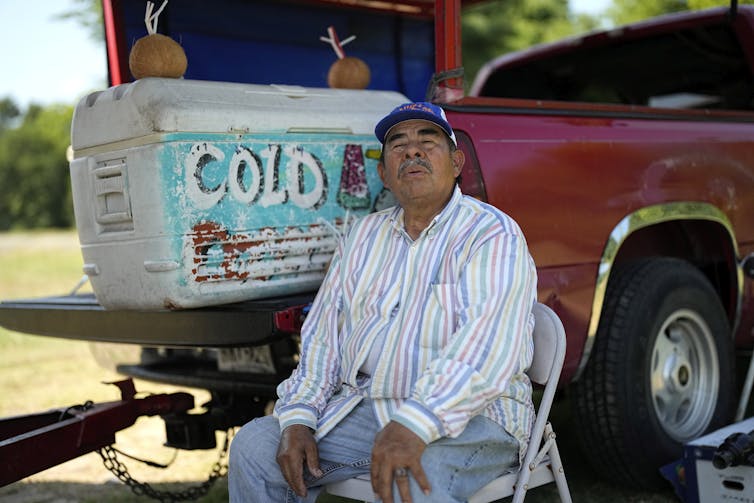
A man sits in chair closing his eyes next to a cooler on the back of a truck.
Summer 2023 was the hottest summer on record globally. For people working outside, like this fruit seller in Texas, shade was often the only respite from the heat. AP Photo/David J. Phillip

Regardless of where or when a heat wave strikes, one pattern is a constant: Older adults are the most likely to die from extreme heat, and this crisis will worsen in the coming years.

We study climate change and population aging. Our research documents two global trends that together portend a dire future.

More older adults will be at risk of heat stress

First, temperatures are hotter than ever. The nine-year period from 2015 and 2023 had the highest average temperatures since global records began in 1880.

Second, the population is aging worldwide. By 2050, the number of people ages 60 and older will double to nearly 2.1 billion, making up 21% of the global population. That proportion is 13% today.

These combined forces mean that ever-rising numbers of vulnerable older adults will be exposed to intensifying heat.
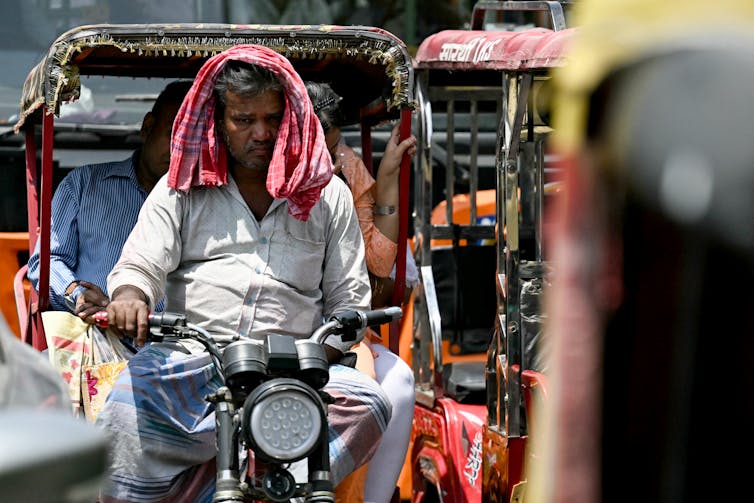
A older man driving an electric rickshaw with two passenger sits in direct sunlight in traffic on a hot day. He had a bandana over his head for shade.
Rickshaw drivers have little escape from the sun in New Delhi on May 3, 2024. Arun Sankar/AFP via Getty Images

To understand the risks ahead, we developed population projections for different age groups and combined them with climate change scenarios for the coming decades. Our analyses show that by 2050, more than 23% of the world population ages 69 and older will be living in regions where peak temperatures routinely surpass 99.5°F (37.5°C), compared with just 14% today.

That means that as many as 250 million additional older adults will be exposed to dangerously high temperatures.

Mapping the data shows that most of these older adults live in lower- and middle-income countries with insufficient services and limited access to electricity, cooling appliances and safe water.

Made with Flourish

In historically cooler regions in the Global North, including North America and Europe, rising temperatures will be the main force driving older adults’ heat exposure. In historically hotter regions in the Global South such as Asia, Africa and South America, population growth and increases in longevity mean that steeply rising numbers of older adults will be exposed to intensifying heat-related risks.

Policymakers, communities, families and older residents themselves need to understand these risks and be prepared because of older adults’ special vulnerabilities to heat.

Extreme heat is especially harmful to older adults

High temperatures are oppressive for everyone, but for older adults they can be deadly.

Extreme heat worsens common age-related health conditions such as heart, lung and kidney disease and can cause delirium. Older people don’t sweat as much as younger people, which makes it harder for their bodies to cool down when temperatures spike. These problems are intensified by common prescription medications, such as anticholinergics, which further reduce the capacity to sweat.

Spending time outdoors in hot humid weather can cause dehydration, a problem worsened by the side effects of prescription medications such as diuretics and beta-blockers. Dehydration can make older adults weak and dizzy, increasing their risk of falls and injury. These threats are even worse in regions lacking access to safe and affordable drinking water.

An older woman holds a glass of water next to a list of safety tips for older adults facing heat waves.
Tips for avoiding heat illness can save lives, but they can be difficult to follow, even in wealthy countries. Ohio Department of Aging

Poor air quality makes it difficult to breath, especially for those who already have lung problems such as chronic obstructive pulmonary disease, or COPD.

For older adults with physical health problems, temperatures as low as 80 F (26.7 C) can pose significant danger. And when humidity is as high as 90%, even 78 F (25.6 C) can be hazardous to older adults.

Nighttime heat is especially harmful for older adults whose homes lack air conditioning or who can’t afford to run their air conditioners for long periods. The ideal temperature for older adults’ restful sleep is between 68 and 77 F (20 and 25 C), and sleep quality diminishes as temperatures rise. A night of restless sleep can make an older adult more depressed and confused during their waking hours. Medications also can lose their effectiveness if stored in places much warmer than 77 F (25 C).

Older adults also may suffer emotionally during stifling heat waves

Being stuck indoors when temperatures are unbearable can make older adults bored, depressed and isolated. People with cognitive impairments may underestimate the dangers of extreme heat or may not understand the heat advisories.

Those who have physical mobility limitations or lack access to transportation can’t easily travel to public cooling centers – if there is one nearby – or find relief in nearby “green and blue areas,” such as parks and lakes.

Made with Flourish

These threats are especially dire in low- and middle-income nations, where older adults are more likely to live in substandard housing and lack access to high-quality health care or ways to cool down in the heat. We talk about this as “systemic cooling poverty.”

What can be done?

Policymakers can work to cut greenhouse gas emissions from fossil fuels in vehicles, power plants and factories, which drive global warming, and develop effective plans to protect older people from heat risk. Older adults and their caregivers also can take steps to adapt.

But efforts to help need to be tailored to each region and population.

Wealthy municipalities can increase public investments in early warning systems and ride services to cooling centers and hospitals. They can use geographic information systems to identify neighborhoods with high concentrations of older adults and expand power grids to manage increasing demand for air conditioning.

A woman and young girl sit in shade outside a small building with slats in the doors and a precarious looking roof.
In poorer countries, many homes and businesses lack ways for people to cool off in the heat. Sudipta Das/NurPhoto via Getty Images

In regions with substandard housing, limited access to clean water and few public supports such as cooling centers, much larger changes are necessary. Providing better health care, water and housing and reducing air pollution that can mitigate health problems during heat waves require significant changes and investments many countries struggle to afford.

The World Health Organization and Pan American Health Organization warn that this decade will be critical for preparing communities to handle rising heat and the risk to aging populations. Across all regions, researchers, practitioners and policymakers could save lives by heeding their call.The Conversation

Deborah Carr, A&S Distinguished Professor of Sociology and Director of the Center for Innovation in Social Science, Boston University; Enrica De Cian, Professor of Environmental Economics, Ca' Foscari University of Venice; Giacomo Falchetta, Research Scholar in Energy, Climate and Environment, Ca' Foscari University of Venice, and Ian Sue Wing, Professor of Earth and Environment, Boston University

This article is republished from The Conversation under a Creative Commons license. Read the original article.
Details
Written by: Deborah Carr, Boston University; Enrica De Cian, Ca' Foscari University of Venice; Giacomo Falchetta, Ca' Foscari University of Venice, and Ian Sue Wing, Boston University
Published: 27 May 2024

April 2024 was Earth’s warmest on record

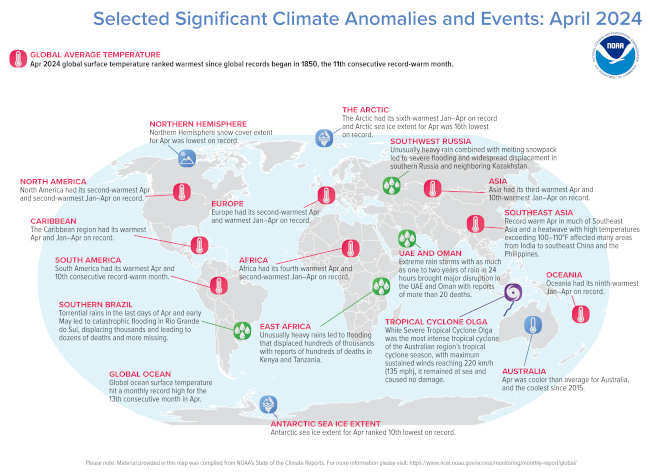
An annotated map of the world plotted with the most significant climate events of April 2024. See the story below as well as the report summary from NOAA NCEI at http://bit.ly/Global202404 (Image credit: NOAA NCEI).


Last month continued our planet’s feverish pace to the year, with April 2024 ranking as the warmest April on record.

April was also the 11th month in a row of record-warmth for the world, according to scientists and data from NOAA’s National Centers for Environmental Information.

Climate by the numbers

April 2024

The average global temperature in April was 2.38 degrees F (1.32 degrees C) above the 20th-century average of 56.7 degrees F (13.7 degrees C), making it the warmest April in the global climate record. April 2024 also marked the 11th-consecutive month of record-high global temperatures.

Regionally, South America had its warmest April on record, and Europe had its second warmest. Meanwhile, much of Australia, Scandinavia and northwest Russia were cooler than average.

Year to date (YTD) | January through April 2024

The YTD global temperature ranked as the warmest such period on record at 2.41 degrees F (1.34 degrees C) above the 20th-century average.

According to NCEI’s Global Annual Temperature Rankings Outlook, there is a 61% chance that 2024 will rank as the warmest year on record and a 100% chance that it will rank in the top five of warmest years recorded.

Other notable climate events in the report

Earth’s sea ice coverage was low at both poles: Globally, April 2024 saw the 10th-smallest April sea ice extent (coverage) in the 46-year record. Arctic sea ice extent was 80,000 square miles below average, while Antarctic sea ice came in at 290,000 square miles below average.

Activity in the tropics was below average: Two named storms formed in April, which was below the 1991–2020 average of four. The sole major storm was Severe Tropical Cyclone Olga, which brought high surf conditions to northwestern Australia. The only other storm during the month was Tropical Cyclone Paul that remained off the coast of northeastern Australia.
Details
Written by: NATIONAL OCEANIC AND ATMOSPHERIC ADMINISTRATION
Published: 27 May 2024

Tuleyome Tales: The clever California scrub-jay

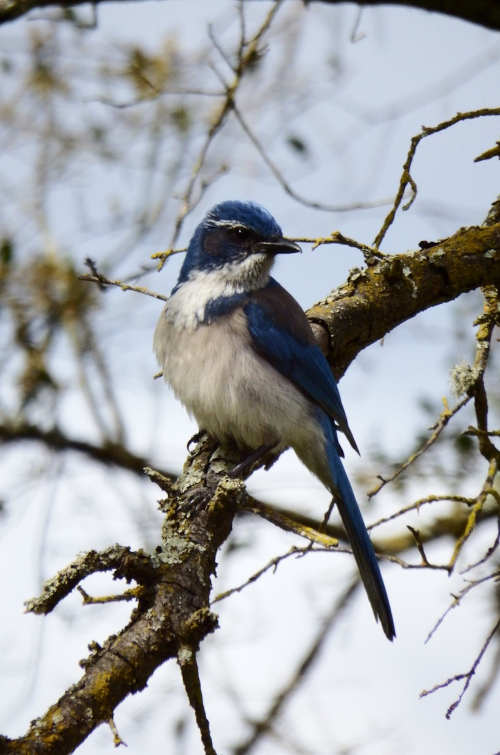
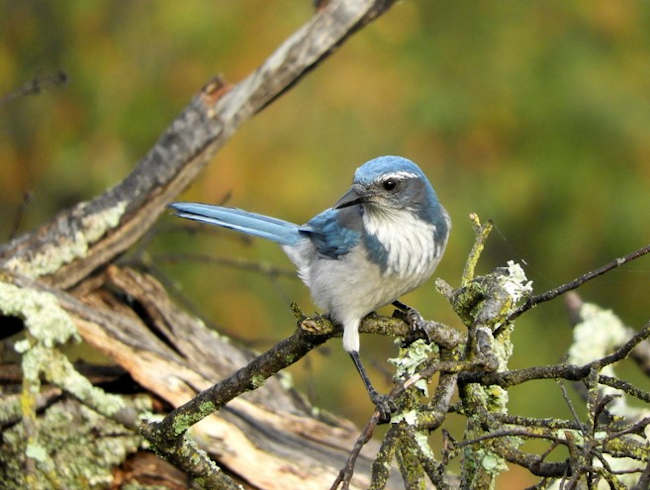
California scrub-jay (Aphelocoma californica). Photo by Tuleyome.

NORTHERN CALIFORNIA — California scrub-jays are a joy to watch — they are confident, inquisitive and animated, thoughtful, and vocal and can authentically mimic other birds.

They’ve been observed imitating the calls of red-tailed and red-shouldered hawks either to deter other jays from their food stash or as a warning of danger. Their call is described as buzzy and raucous which could make them irritating neighbors.

The California scrub-jay (Aphelocoma californica) was once lumped with Woodhouse’s scrub-jay (Aphelocoma woodhouseii) and together were called Western scrub-jays but have since been separated into two distinct species.

California scrub-jays are native to California and common throughout their range from southern British Columbia south to Baja California and includes the valleys of California.

They are relatively large for a songbird (the word “song” is used lightly in this case), somewhere between a crow and a robin and have a rich azure blue and gray back, head, tail and wings, a pale gray belly, white throat bordered by a streaked, broken neckband.

Their cheeks are dark, and they have a long, white hairstreak above their dark eyes. Their tails are long and their stout, hooked bills are black. Their adult brain to body mass ratio is similar to that of dolphins and chimpanzees, placing California scrub-jays among the most intelligent animals on Earth.

They are primarily permanent residents and usually don’t migrate unless food is extremely scarce. They can be found in low scrub habitats, oak woodlands, mixed evergreen forests but are also common inhabitants of urban backyards and parks. They can live from 9 to 15 years in the wild and pairs typically remain together for several years.

Nesting begins in March and lasts through most of the summer. Both partners help select the nest location, but construction is primarily up to the female while the male oversees the job. Nests are well-hidden and made of twigs and are lined with soft plant fibers, roots and livestock or pet hair.

One to five pale green or gray eggs splotched with olive or brown are laid in March or April and hatch in about 18 days. The nestlings remain in the nest for about the same amount of time and once they fledge, they hang around and mooch off their parents for a couple more months.

Almost anything is considered food and favorites change with the seasons. When the demands of a young family are at their peak during spring and summer, favorite meals include protein rich insects, small animals such as lizards, other nestling birds and juvenile mice and voles along with fruits and nuts. In fact, adult scrub-jays have been observed following other birds and then raiding their nests.

Acorns are always a favorite and jays will hold them with their feet and hammer at them with their bills using the hooked tip to extract the nut from the shell. They will also drop them from up high hoping the impact will crack them and they’ve been observed wedging them in places to peck at them.

They will also pillage cultivated crops like corn, almonds, walnuts, and fruit when available. If you have bird feeders you have probably noticed California scrub-jays can be bullies and outcompete larger birds like crows over their love of sunflower seeds and peanuts.

The jays that visit me always beat the crows to the peanuts and when there’s a lot to pick from, they weigh each peanut and make off with the heavier ones — gluttons. Crows on the other hand, can fit two peanuts in their beaks each trip so I’m not sure who the real winner is.

California scrub-jays are masters at hoarding and stashing food. They are known as “planters of acorns” because they collect and stash them by the thousands and then don’t always return to collect them. If they were hidden in a suitable place those acorns may sprout and produce additional oak trees.

California scrub-jays are also sly and often shoplift from other jays or Acorn Woodpeckers’ stockpile. These shifty birds have even been seen checking over their shoulders before raiding another bird’s inventory.

California scrub-jays, with their big brains, also have the cognitive ability to plan ahead (metacognition). They carefully choose where to hide their food hoard and then later, with their highly accurate and complex memories, recall where they put it.

They also check to make sure they aren’t being watched by other crafty jays before retrieving their emporium, so they don’t get swindled themselves. They’ve even been observed hiding rocks instead of food in order to discourage others from pirating from them and they will relocate their storehouse if it is discovered.

The California scrub-jays in my neighborhood have grown to know me and fully expect to be recognized and acknowledged. When my garage door goes up, they frantically squawk at me from across the street in case I might forget that they’re waiting.

As soon as I put the peanuts down, they call to others with trills and clicks and swoop in with speed and accuracy. They’re some of my favorite neighbors.

Kristie Ehrhardt is Tuleyome’s Land conservation and Stewardship Program Director. Tuleyome is a 501(c)(3) nonprofit conservation organization based in Woodland, California. For more information visit www.tuleyome.org.

California scrub-jay (Aphelocoma californica). Photo by Tuleyome.
Details
Written by: Kristie Ehrhardt
Published: 26 May 2024
  1. Helping Paws: Shepherds, Chihuahuas and mastiffs
  2. I want to keep my child safe from abuse − but research tells me I’m doing it wrong
  3. PG&E plans May 29 virtual town hall

Subcategories

Community

  • 661
  • 662
  • 663
  • 664
  • 665
  • 666
  • 667
  • 668
  • 669
  • 670
How to resolve AdBlock issue?
Refresh this page
Copyright © 2026 Lake County News,California. All Rights Reserved.