 How to resolve AdBlock issue?
News
The Clearlake Animal Control website lists 34 adoptable dogs.

This week’s dogs include “Romeo,” a male German shepherd mix with a tricolor coat.
And of course there is “Juliet,” a 2-year-old chocolate Labrador retriever mix.

The shelter is located at 6820 Old Highway 53. It’s open from 9 a.m. to 6 p.m. Tuesday through Saturday.
For more information, call the shelter at 707-762-6227, email
This week’s adoptable dogs are featured below.
Email Elizabeth Larson at
- Details
- Written by: Elizabeth Larson

Curious Kids is a series for children of all ages. If you have a question you’d like an expert to answer, send it to
If the James Webb telescope was 10 times more powerful, could we see the beginning of time? - Sam H., age 12, Prosper, Texas
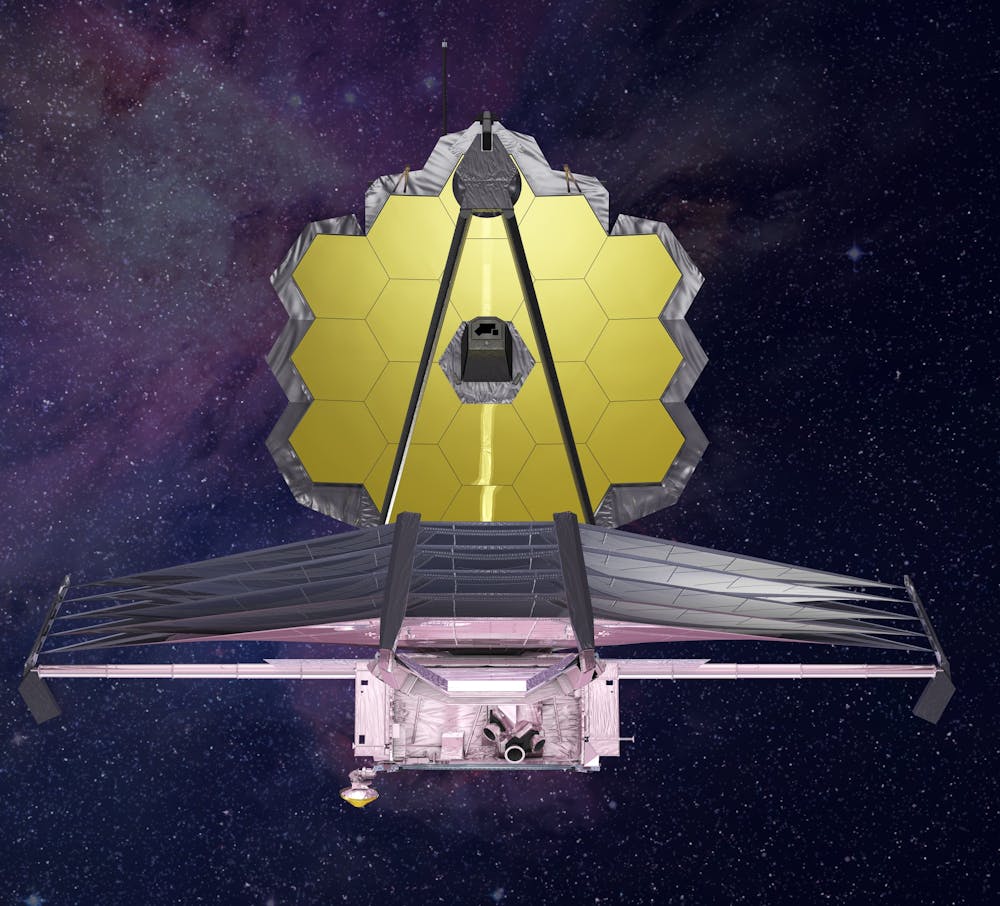
The James Webb Space Telescope, or JWST for short, is one of the most advanced telescopes ever built. Planning for JWST began over 25 years ago, and construction efforts spanned over a decade. It was launched into space on Dec. 25, 2021, and within a month arrived at its final destination: 930,000 miles away from Earth. Its location in space allows it a relatively unobstructed view of the universe.
The telescope design was a global effort, led by NASA, and intended to push the boundaries of astronomical observation with revolutionary engineering. Its mirror is massive – about 21 feet (6.5 meters) in diameter. That’s nearly three times the size of the Hubble Space Telescope, which launched in 1990 and is still working today.
It’s a telescope’s mirror that allows it to collect light. JWST’s is so big that it can “see” the faintest and farthest galaxies and stars in the universe. Its state-of-the-art instruments can reveal information about the composition, temperature and motion of these distant cosmic objects.
As an astrophysicist, I’m continually looking back in time to see what stars, galaxies and supermassive black holes looked like when their light began its journey toward Earth, and I’m using that information to better understand their growth and evolution. For me, and for thousands of space scientists, the James Webb Space Telescope is a window to that unknown universe.
Just how far back can JWST peer into the cosmos and into the past? About 13.5 billion years.
Time travel
A telescope does not show stars, galaxies and exoplanets as they are right now. Instead, astronomers are catching a glimpse of how they were in the past. It takes time for light to travel across space and reach our telescopes. In essence, that means a look into space is also a trip back in time.
This is even true for objects that are quite close to us. The light you see from the Sun left it about 8 minutes, 20 seconds earlier. That’s how long it takes for the Sun’s light to travel to Earth.
You can easily do the math on this. All light – whether sunlight, a flashlight or a light bulb in your house – travels at 186,000 miles (almost 300,000 kilometers) per second. That’s just over 11 million miles (about 18 million kilometers) per minute. The Sun is about 93 million miles (150 million kilometers) from Earth. That comes out to about 8 minutes, 20 seconds.
But the farther away something is, the longer its light takes to reach us. That’s why the light we see from Proxima Centauri, the closest star to us aside from our Sun, is 4 years old; that is, it’s about 25 trillion miles (approximately 40 trillion kilometers) away from Earth, so that light takes just over four years to reach us. Or, as scientists like to say, four light years.
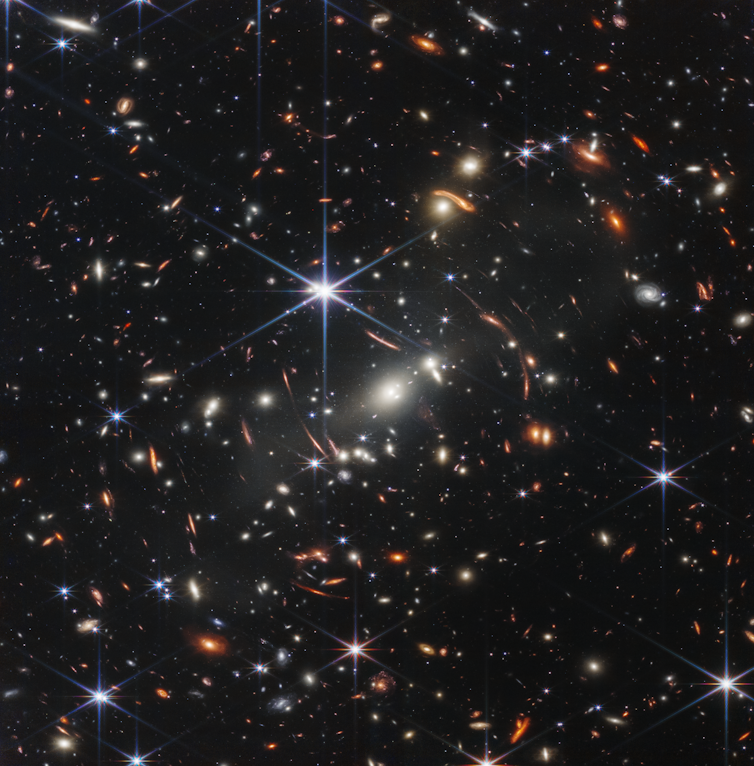
Most recently, JWST observed Earendel, one of the farthest stars ever detected. The light that JWST sees from Earendel is about 12.9 billion years old.
The James Webb Space Telescope is looking much farther back in time than previously possible with other telescopes, such as the Hubble Space Telescope. For example, although Hubble can see objects 60,000 times fainter than the human eye is able, the JWST can see objects almost nine times fainter than even Hubble can.
The Big Bang
But is it possible to see back to the beginning of time?
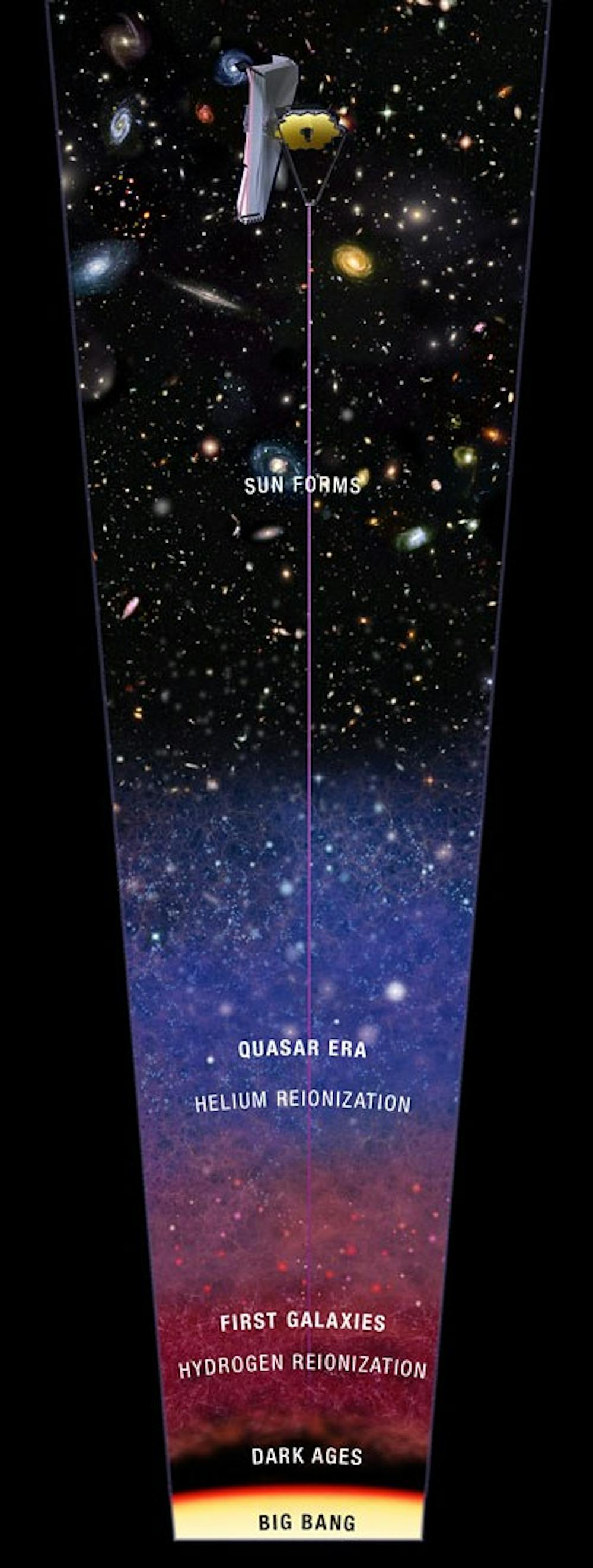
The Big Bang is a term used to define the beginning of our universe as we know it. Scientists believe it occurred about 13.8 billion years ago. It is the most widely accepted theory among physicists to explain the history of our universe.
The name is a bit misleading, however, because it suggests that some sort of explosion, like fireworks, created the universe. The Big Bang more closely represents the appearance of rapidly expanding space everywhere in the universe. The environment immediately after the Big Bang was similar to a cosmic fog that covered the universe, making it hard for light to travel beyond it. Eventually, galaxies, stars and planets started to grow.
That’s why this era in the universe is called the “cosmic dark ages.” As the universe continued to expand, the cosmic fog began to rise, and light was eventually able to travel freely through space. In fact, a few satellites have observed the light left by the Big Bang, about 380,000 years after it occurred. These telescopes were built to detect the splotchy leftover glow from the Big Bang, whose light can be tracked in the microwave band.
However, even 380,000 years after the Big Bang, there were no stars and galaxies. The universe was still a very dark place. The cosmic dark ages wouldn’t end until a few hundred million years later, when the first stars and galaxies began to form.
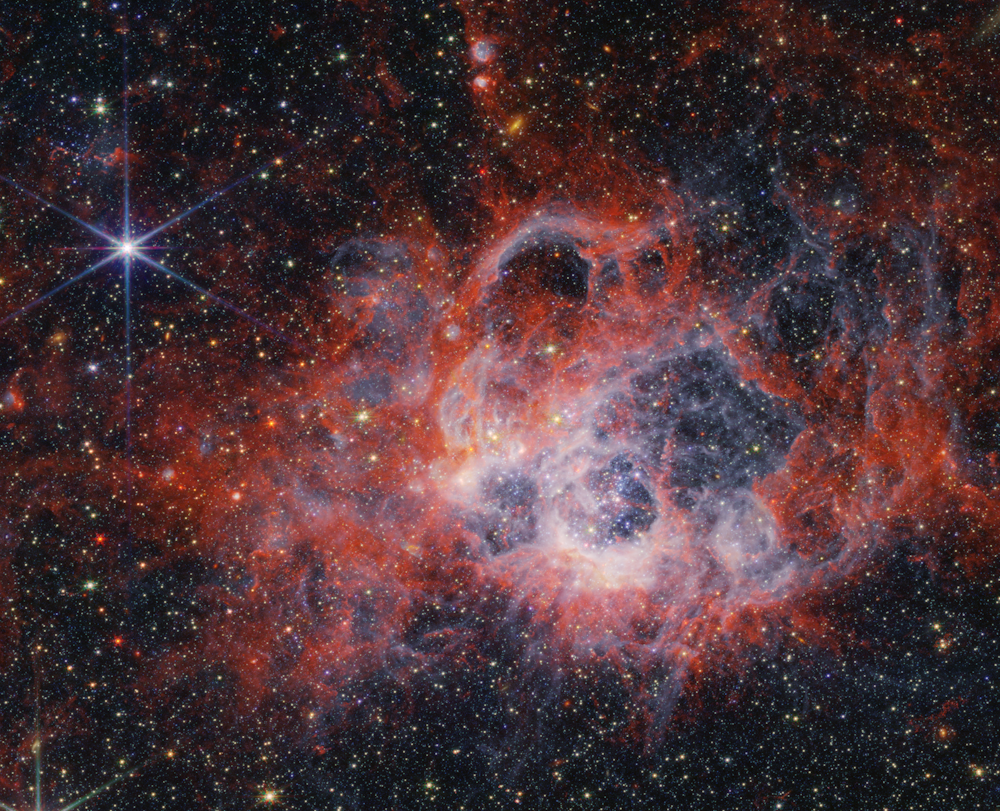
The James Webb Space Telescope was not designed to observe as far back as the Big Bang, but instead to see the period when the first objects in the universe began to form and emit light. Before this time period, there is little light for the James Webb Space Telescope to observe, given the conditions of the early universe and the lack of galaxies and stars.
Peering back to the time period close to the Big Bang is not simply a matter of having a larger mirror – astronomers have already done it using other satellites that observe microwave emission from very soon after the Big Bang. So, the James Webb Space Telescope observing the universe a few hundred million years after the Big Bang isn’t a limitation of the telescope. Rather, that’s actually the telescope’s mission. It’s a reflection of where in the universe we expect the first light from stars and galaxies to emerge.
By studying ancient galaxies, scientists hope to understand the unique conditions of the early universe and gain insight into the processes that helped them flourish. That includes the evolution of supermassive black holes, the life cycle of stars, and what exoplanets – worlds beyond our solar system – are made of.
Hello, curious kids! Do you have a question you’d like an expert to answer? Ask an adult to send your question to
And since curiosity has no age limit – adults, let us know what you’re wondering, too. We won’t be able to answer every question, but we will do our best.
Adi Foord, Assistant Professor of Astronomy and Astrophysics, University of Maryland, Baltimore County
This article is republished from The Conversation under a Creative Commons license. Read the original article.
- Details
- Written by: Adi Foord, University of Maryland, Baltimore County
At its April 2 meeting, the Board of Supervisors selected the five members and one alternate to fill the seats on the council, which will represent the Kelseyville planning area.
The council was officially formed at the board’s March 12 meeting.
The supervisors voted unanimously to appoint Angel Acosta, Megan Lankford, Big Valley Tribal Chair Flaman McCloud, Brian Hanson and Joy Merrilees to the general membership seats, and Greg Panella as the alternate.
Acosta, Lankford, Hanson, Merrilees and Panella were all part of the group involved with drafting the new council’s bylaws.
At the March 12 Board of Supervisors meeting, it was reported that the advisory council would hold its first meeting on April 17.
However, so far, an agenda has not been released or posted on the county’s website, and the new council isn’t listed on the county webpage for board-appointed councils and commissions.
Email Elizabeth Larson at
- Details
- Written by: Lake County News reports
“Today’s rule is a leap forward in closing dangerous, decades-old loopholes that have allowed many firearm buyers to bypass background checks,” said Thompson in a statement released early Thursday morning. “There’s no doubt this rule will help save lives by keeping guns out of dangerous hands.”
Chairman Thompson has long supported expanding background checks for firearm sales. Rep. Thompson has introduced background check legislation every Congress since the 2012 Sandy Hook Elementary shooting which killed 20 children and six adult staff members.
The Justice Department announced Wednesday that it has submitted to the Federal Register the “Engaged in the Business” Final Rule, which makes clear the circumstances in which a person is “engaged in the business” of dealing in firearms and thus required to obtain a federal firearms license, in order to increase compliance with the federal background check requirement for firearm sales by federal firearms licensees.
Previously, only sellers “engaged in the business” of firearm dealing were required to register as a Federal firearm licensee, or FFL, and therefore conduct background checks for firearm sales.
The new rule expands the definition of "engaged in the business" of dealing firearms to anyone who sells firearms to earn a profit, greatly expanding the number of firearms dealers legally required to register as FFLs.
Firearms sellers previously operating without running background checks will be obligated to perform them before selling a firearm to a buyer.
“Under this regulation, it will not matter if guns are sold on the internet, at a gun show, or at a brick-and-mortar store: if you sell guns predominantly to earn a profit, you must be licensed, and you must conduct background checks,” said Attorney General Merrick B. Garland. “This regulation is a historic step in the Justice Department’s fight against gun violence. It will save lives.”
This rule was made possible by the Bipartisan Safer Communities Act, the most consequential gun violence prevention legislation signed into law in decades which Rep. Thompson said he was proud to help pass.
“The Bipartisan Safer Communities Act enhanced background checks and closed loopholes, including by redefining when a person is ‘engaged in the business’ of dealing in firearms. Today’s rule clarifying application of that definition will save lives by requiring all those in the business of selling guns to get a federal license and run background checks — thus keeping guns out of the hands of violent criminals,” said Deputy Attorney General Lisa Monaco. “I applaud the hard work of ATF in drafting this rule and reviewing the hundreds of thousands of public comments, which overwhelmingly favored the rule announced today. Because of that work, our communities will be safer.”
“This is about protecting the lives of innocent, law-abiding Americans as well as the rule of law. There is a large and growing black market of guns that are being sold by people who are in the business of dealing and are doing it without a license; and therefore, they are not running background checks the way the law requires. And it is fueling violence,” said Director Steven Dettelbach of the Bureau of Alcohol, Tobacco, Firearms and Explosives (ATF). “Today’s Final Rule is about ensuring compliance with an important area of the existing law where we all know, the data show, and we can clearly see that a whole group of folks are openly flouting that law. That leads to not just unfair but, in this case, dangerous consequences.”
The Bipartisan Safer Communities Act (BSCA), enacted June 25, 2022, expanded the definition of engaging in the business of firearms dealing to cover all persons who devote time, attention, and labor to dealing in firearms as a regular course of trade or business to predominately earn a profit through the repetitive purchase and sale of firearms.
On March 14, 2023, President Biden issued Executive Order 14092, which, among other things, directs the Attorney General to develop and implement a plan to clarify the definition of who is engaged in the business of dealing in firearms and thus required to obtain a federal firearms license.
The Final Rule conforms the ATF regulations to the new BSCA definition and further clarifies the conduct that presumptively requires a license under that revised definition, among other things.
Federally licensed firearms dealers are critical to federal, state, local, tribal, and territorial law enforcement in our shared goal of promoting public safety. Licensees submit background checks on potential purchasers to the FBI’s National Instant Criminal Background Check System, which helps to keep firearms out of the hands of prohibited persons.
Further, licensees keep records of sales transactions to help ensure that when a gun is used in a crime and recovered by law enforcement it can be traced back to the first retail purchaser; they help identify and prevent straw purchasers from buying firearms on behalf of prohibited persons and criminals; and they facilitate safe storage of firearms by providing child-safety locks with every transferred handgun and offer customers other secure gun storage options.
Unlicensed dealing, however, undermines these public-safety features — which is why Congress has long prohibited engaging in the business of dealing in firearms without the required license.
To increase compliance with the statutes Congress has enacted, the Final Rule identifies conduct that is presumed to require a federal firearms license. And, in addition to implementing the revised statutory definition discussed above, the Final Rule clarifies the circumstances in which a license is — or is not — required by, among other things, adding a definition of “personal firearms collection” to ensure that genuine hobbyists and collectors may enhance or liquidate their collections without fear of violating the law. The Final Rule also provides clarity as to what licensees must do with their inventory when they go out of business.
The Final Rule goes into effect 30 days after the date of publication in the Federal Register.
On Sept. 8, 2023, the Justice Department published a notice of proposed rulemaking, and during the 90-day open comment period, ATF received nearly 388,000 comments.
- Details
- Written by: Lake County News reports