 How to resolve AdBlock issue?
News
- Details
- Written by: Elizabeth Larson
The city of Lakeport is the only place in Lake County where safe and sane fireworks can be bought, sold and used for a four-day period each July.
The city previously had attempted to stop the sales of safe and sane fireworks. However, in November 2009, city voters approved Measure C, which requires the city to allow the sales by a group of designated nonprofits.
At the council’s March 19 meeting, Police Chief Brad Rasmussen said a new Assembly bill, AB 1403, which went into effect on Jan. 1, allows cities to implement a 2% surcharge, or permit fee, on gross sales in order to recover more of the actual costs to respond to and deal with fireworks impacts.
“There’s a lot of different work that goes into dealing with that,” Rasmussen said of the fireworks sales and use.
Rasmussen explained that the city’s handling of fireworks begins with the city clerk processing the permits by the nonprofits to sell them, then work in the field to enforce rules, setting up a special discharge area on Fourth Street during the Independence Day festivities and, finally, cleanup of the debris left behind by the fireworks.
“Annually the costs just for police and public works — not counting any other department — is between $25,000 and $30,000 a year for us to deal with and respond to fireworks issues,” Rasmussen told the council.
Measure C allowed for a 5% surcharge. However, Rasmussen said that doesn’t come close to covering the city’s costs to deal with fireworks.
Over the past six years, Rasmussen said the 5% surcharge averaged $4,000 to $6,000 annually. Then, in 2023, that amount went up to $11,200 because one nonprofit vendor did very well and sold more than previous years. Also, the Lakeport Police Department worked with TNT Fireworks and Revell Communications, who voluntarily gave another 2% over that 5% surcharge.
Rasmussen said last year the city had planned to hire a private company to do fireworks enforcement due to not having capacity. However, that contractor couldn’t provide the necessary insurance documents.
The city has put that additional 2% from last year aside to use this year, Rasmussen said.
“We only recover a very small percentage of our costs to deal with the impacts,” he said.
Rasmussen reported that all current fireworks permit holders — Clear Lake High School Boosters, Lake County Channel Cats, Lake County Realtors Scholarship & Community Fund and Terrace School Parent Teacher Organization — were notified of the proposed fireworks sales permit fee for sales within the city and were invited to give public input.
Dennis Revell of Revell Communications, who represents TNT Fireworks, said the fireworks company and the nonprofits who sell the fireworks in the city support the new surcharge.
Jen Richardson, representing the Clear Lake High Boosters and Terrace Middle School Parent Teacher Organization, confirmed those groups also are on board.
The only person speaking against the surcharge was business owner Nancy Ruzicka, who had been a proponent of the ballot measure to allow fireworks sales in the city. She said it would dip into the nonprofits’ profits.
District 4 Supervisor Michael Green — also a former Lakeport City Council member — said he respectfully disagreed with Ruzicka, that the city needed to be able to cover the impacts. He called fireworks sales in the city “an attractive nuisance.”
Green — referencing the city’s new Xabatin Park — said there is now twice as much park area to patrol as before. He said he wasn’t swayed by Ruzicka’s claims, although he understands the difficulties of fundraising.
The surcharge, he added, “in no way is a responsive to the larger issue of the disconnect between the city's policy and the county's policy on fireworks, and I know we're not here to talk about a ballot measure that would be needed to change that but that's front and center on my mind, and has been for several years.”
Lakeport Fire Chief Patrick Reitz said the surcharge is needed to help the city. He recounted how last year outside and partner agencies came in to help assist the city with enforcement, which he called “a tremendous effort.”
Reitz said they did a lot of confiscations, with a number of citations and a handful of arrests resulting. He said it takes a very big team to make that happen.
He also clarified that the fire district does not receive any of the mitigation funds. “An event like this is an out of pocket expense for the district.”
Reitz said they tried to trace the illegal fireworks confiscated in the city to find out where they were purchased. He said they found that quite a few of them had been purchased in Colusa County on “sovereign nation property,” referencing tribal lands. Some also came from outside of the state.
He encouraged the council to accept the surcharge, adding, “I don't see a significant impact to the nonprofits.”
Mayor Michael Froio said the surcharge would help the city offset the costs, and Councilwoman Stacey Mattina agreed that it would help.
Councilman Brandon Disney moved to adopt the resolution establishing a 2% permit fee for permit processing inspections, public awareness and education, campaigns and fire operations and suppression efforts related to the sale of safe insane fireworks, with councilman Kenny Parlet seconding and the council voting 5-0.
Also at the March 19 meeting, the council met new city employees Bryan Carlson, Mel Olea, Jen Baker and Michelle Brown, adopted a resolution to submit an application to the California State Department of Housing and Community Development for funding under the HOME Investment Partnership Program and got a progress update from staff on accomplishments and progress toward the fulfillment of the city’s 2023-24 departmental goals.
Email Elizabeth Larson at
- Details
- Written by: Lake County News reports

UPDATE: The Clearlake Police Department reported that she has been located.
LAKE COUNTY, Calif. — The Clearlake Police Department is asking for the community’s help in locating a missing woman.
Police are seeking information about 47-year-old Leslie Likens.
Likens was last known to be in Oregon on her way to California.
She is described as a white female adult, 5 feet 5 inches tall and 130 pounds with blonde hair and blue eyes.
If you have any information regarding her whereabouts please contact the Clearlake Police Department at 707-994-8251, Extension 1 for dispatch.
- Details
- Written by: Lake County News reports
The legislation is intended to help address the ongoing insurance crisis in California and other states, as the rising frequency and intensity of natural disasters has led insurers to raise rates and, in several cases, exit certain markets entirely.
“Property insurance has quickly become one of the single biggest issues I hear about in my district. People can’t get covered: either the available options are completely unaffordable, or there are no options available at all. It’s an untenable situation — which is why this legislation is necessary,” said Thompson. “By incentivizing homeowners to mitigate disaster risks on their property, we aim to bring insurers back into the market and bring rates back into more affordable territory.”
“Homeowners must be able to harden their property as they see fit, especially as the risk of wildfires due to poor forest management escalates,” said LaMalfa. “With this bill, we’re bolstering resilience, but this will also hopefully reduce overall insurance rates and bring back suppliers that have left California entirely because of the risks.”
The legislation includes four main provisions.
The first creates a grant program, administered through state governments, through which individual households in designated disaster-prone regions (with certain limitations) are eligible for up to $10,000 for specified disaster resiliency work on their homes.
The second and third provisions (Sections 3 and 4 of the legislation) mirror existing legislation (H.R. 4070) stipulating that payments from state-run disaster resiliency programs and payments from various federal emergency agricultural programs are not considered income for federal tax purposes.
The final section, which also mirrors legislation previously introduced by Rep. Thompson, provides a 30% tax credit for qualified disaster risk mitigation activities conducted by individuals or businesses. The credit is meant to complement the grant program by providing meaningful assistance to larger property owners for whom mitigation activity costs would far exceed $10,000.
The text of the legislation is published below.
THOMCA_048_xml by LakeCoNews on Scribd
- Details
- Written by: Charlie Hunt, Boise State University
Congress has once again been making headlines for all the wrong reasons, with multiple news outlets in recent months touting the current 118th Congress as possibly the least productive in the institution’s history. In 2023, Congress only passed 34 bills into law, the lowest number in decades.
Congress was only recently able to pass a budget bill that will keep the government open until the fall of 2024 after months of delay and stopgap measures.
As a result, House Speaker Mike Johnson’s gavel seems to be hanging in the balance yet again, as conservative Republicans revolt over his support for the bill.
Even so, the dire warnings from the media, and even from members of Congress, about the legislative branch’s lack of productivity frequently lack context and are often misleading. Let’s drill down into the numbers and see what political science has to say about it.
What makes Congress productive?
Historically, there’s been significant variation in the amount of legislating Congress does from year to year. There are a few well-understood factors that influence this, and all help explain why 2023 wasn’t ever likely to be a banner year for congressional productivity.
One obvious factor is party control of Congress and the presidency. If the Senate, House and the presidency are controlled by the same party, then there is typically more policy agreement between them, smoothing the way for easier passage of bills. Both Democrats and Republicans enjoyed what political scientists like me call “unified government” control during the most productive initial years of the Biden, Trump and Obama administrations.
There’s also evidence that election years spur more, not less, legislative productivity. Members of Congress know each other better in the second year of their term; they have dispensed with many of the ceremonial duties that begin a congressional session; and members are eager to demonstrate their legislative action to constituents during their reelection campaigns.
It’s possible that Congress will pick up its pace in 2024. Last year, Congress passed a number of stopgap funding bills, along with smaller legislation on veterans and environmental issues. But crucial issues like foreign aid, social media regulation and immigration are still on the table.
Finally, and maybe most importantly, Congress is in the best position to succeed when it’s led by competent and experienced legislators with lots of political capital.
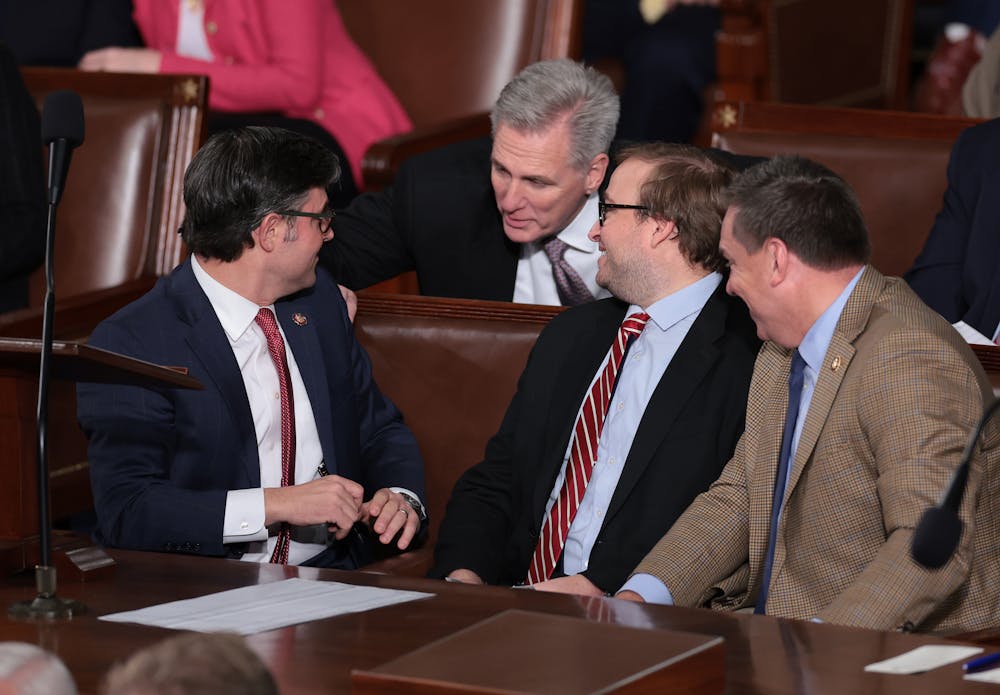
This hasn’t been the case so far in the current Congress. The House has had two brand-new speakers in the span of a year, and both lacked the political power, experience or acumen to command the chamber and produce passable legislation.
Speaker Kevin McCarthy, a Republican from California, was ousted in October 2023 due to lack of support within his own party. Johnson, a Louisiana Republican, has scant experience, having only served three complete terms in office.
Johnson’s job has been made even more difficult by the continually shrinking majority that Republicans have in the chamber. And rampant polarization between the two parties has made finding legislative agreement increasingly difficult.
How you measure productivity matters
Most of the media coverage of Congress’s historic lack of productivity tends to focus on the number of bills passed into law as a key measure. But this is a simplistic approach because it treats all bills as equally important regardless of substance.
Some bills that become law are purely ceremonial; for example, they rename Veterans Affairs facilities or mint commemorative coins.
Others take more substantive action, like regulating foreign trade. Others still are not just substantive, but are what policymakers dub “landmark” pieces of legislation, like the Affordable Care Act of 2010 – also known as Obamacare – or the Tax Cuts and Jobs Act of 2017.
Using the raw total of bills passed and enacted into law treats all of these as the same. More accurate counts might give less weight to, or remove, nonsubstantive legislation from the count, and give extra weight to landmark legislation.
A related issue is that the size and scope of the average piece of legislation has changed dramatically in recent decades. Congress increasingly engages in what’s called “omnibus legislating,” which combines multiple, sometimes unrelated, pieces of legislation into one megasized bill that receives one vote.
This process has led to fewer, and larger, substantive bills rather than a higher number of smaller pieces of legislation.
For example, the 2022 Inflation Reduction Act – price tag, US$800 billion – or the 2021 American Rescue Plan – price tag $1.9 trillion – only count as two bills. In prior decades, their substance would have been divided into dozens of bills.
There are other ways legislators can be productive. When today’s members introduce bills, hold committee hearings and advocate for their legislation, these actions can matter even if the bills don’t pass in the current Congress. Legislative effort undertaken today can lay the groundwork for legislative progress achieved in the future.
2023 was still a low point
All of this context is crucial for understanding whether Congress is doing an effective lawmaking job. Even so, it looks like the Congress of 2023 — particularly the House — was historically unproductive, no matter how you slice it.
Lawmakers introduced about as much legislation as usual, but due to 2023’s leadership chaos, along with the seemingly never-ending battles over the federal budget, very little of this legislation is getting any attention, much less votes on its final passage.
The 118th Congress lasts from January 2023 through the first few days of January 2025, so it still has time to make up this historic deficit. But at this point, it seems unlikely that Congress will be much more productive in the upcoming nine months than it has been for the last 15.
Charlie Hunt, Assistant Professor of Political Science, Boise State University
This article is republished from The Conversation under a Creative Commons license. Read the original article.




