 How to resolve AdBlock issue?
News
- Details
- Written by: Lake County News reports
On May 1 and 2, county agencies, Lake County tribes, nonprofit organizations and community advocates are coming together to plan for a severe heat wave in the area.
“Heat is a real problem in Lake County. In 2022, the emergency department visit rate for heat-related illness in Lake County was double the state rate,” said Susan Paulukonis, principal investigator for the Climate Health Adaptation and Resilience Mobilization, or CHARM, Lake County project, a collaboration between the Public Health Institute’s Tracking California program and the Big Valley Band of Pomo Indians. “We know that more severe heat waves are coming and want to create county-wide action plans to help keep residents and visitors healthy and cool when they do.”
In response, the CHARM Project and the California Tribal Emergency Response and Relief Agency are organizing a two-day activity that simulates coordination and response during a heat event.
“Tribes, county agencies, nonprofits, and other entities often have their own plans for responding to heat events. This simulation will help us to understand each other’s roles, identify gaps, and better coordinate during future heat waves,” said Sarah Ryan, environmental protection director at Big Valley Band of Pomo Indians.
The event will simulate different heat-related scenarios — such as power interruptions and wildfires — that could impact in-home temperature, demand on services, and human health.
The aim will be to determine how to better plan for these events and mitigate impacts on the community. Findings from this exercise will help inform an action plan for the county for severe heat events.
“The county of Lake has made climate resiliency and adaptation matters of strong priority,” said Terre Logsdon, Lake County’s chief climate resiliency officer and tribal liaison. “In collaboration with our Office of Emergency Services, we've revisited our planning documents for severe heat and cold events. We're also updating our general and area plans, and we're creating the county's first climate adaptation plan. Each of these efforts, including this
simulation, will further support identification of specific local needs, and plans to address them.”
Middletown Rancheria of Pomo Indians of California will host the event at Twin Pine Casino and Hotel.
The event is invitation-only; agencies or other stakeholders who are interested in attending or learning more may contact Susan Paulukonis at
- Details
- Written by: Lake County News reports
It will take place from 10 a.m. to 2 p.m. at Lucerne Elementary School, 3351 Country Club Drive.
The community preparedness event will include booths for organizations that help community members to be better prepared and informed about emergency situations, information on evacuation readiness and best practices, as well as preventative efforts such as chipping programs, firewise community involvement, defensible space and home hardening.
Community members will have the opportunity to meet Northshore Fire personnel and volunteers.
There also will be a jump house for kids and a free barbecue while supplies last.
The Northshore Fire Fund was formed to support the Northshore Fire District and works to raise the level of prevention and emergency preparedness in the Northshore communities.
Visit the Northshore Fire Fund’s website for more information.
- Details
- Written by: Lake County News reports
The proposed rule would require large banks to apply consumer protections, including interest rate disclosures, to overdraft fees. In doing so, the proposed rule would close a regulatory loophole that enables banks to extract billions of dollars from consumers by charging overdraft fees without adequately disclosing basic credit terms.
“Overdraft fees are a relic and should be left in the past. These fees harm low-income Californians the most, while lining the pockets of large financial institutions,” said Bonta. “The Consumer Financial Protection Bureau's proposed rule would protect consumers' pocketbooks and create more transparency about how overdraft fees are handled in the places where they bank. By closing this archaic loophole, we work toward a California where consumers are treated more equitably and fairly by financial institutions.”
TILA was enacted in 1968 when many families used the mail to send and receive checks and had little certainty about when their deposits and withdrawals would clear. When a bank clears a check and the consumer doesn’t have funds in the account, the bank charges an overdraft fee and in doing so is issuing a loan to cover the difference.
The Federal Reserve Board created an exemption to TILA protections if the bank was honoring a check when their depositor inadvertently overdrew their account. At the time, this was used infrequently and resulted in a small cost for consumers. It was not a major profit driver.
This exception no longer serves its original purpose given the automation of overdraft pay, prevalence of debit card transactions as an alternative to checks, and drastically increased amount of overdraft fees.
Approximately 23 million households pay overdraft fees in any given year. Banks usually charge $35 for an overdraft, most of which are repaid within three days — representing an annual percentage rate, or APR, of approximately 17,000%.
An APR is the yearly rate charged for a loan or earned by an investment and includes interest and fees. Typically, personal loan APRs are from 6% to 36%. In 2022, consumers paid over $7.7 billion in overdraft and non sufficient fund fees.
In the letter, the attorneys general endorse the proposed rule and request that the Consumer Financial Protection Bureau set the benchmark overdraft fee at $3, which would not trigger TILA disclosures and reduce overdraft fees for consumers.
The attorneys general also urge the Consumer Financial Protection Bureau to consider expanding the proposed rule to small financial institutions given that many are among the most frequent chargers of costly overdraft fees.
In submitting the letter, Attorney General Bonta joins the attorneys general of New York, Colorado, Connecticut, Delaware, Illinois, Maine, Maryland, Massachusetts, Michigan, Minnesota, Nevada, North Carolina, Oregon, Pennsylvania, Washington and the District of Columbia.
- Details
- Written by: Robin Chataut, Quinnipiac University
Have you ever wondered how an email sent from New York arrives in Sydney in mere seconds, or how you can video chat with someone on the other side of the globe with barely a hint of delay? Behind these everyday miracles lies an unseen, sprawling web of undersea cables, quietly powering the instant global communications that people have come to rely on.
Undersea cables, also known as submarine communications cables, are fiber-optic cables laid on the ocean floor and used to transmit data between continents. These cables are the backbone of the global internet, carrying the bulk of international communications, including email, webpages and video calls. More than 95% of all the data that moves around the world goes through these undersea cables.
These cables are capable of transmitting multiple terabits of data per second, offering the fastest and most reliable method of data transfer available today. A terabit per second is fast enough to transmit about a dozen two-hour, 4K HD movies in an instant. Just one of these cables can handle millions of people watching videos or sending messages simultaneously without slowing down.
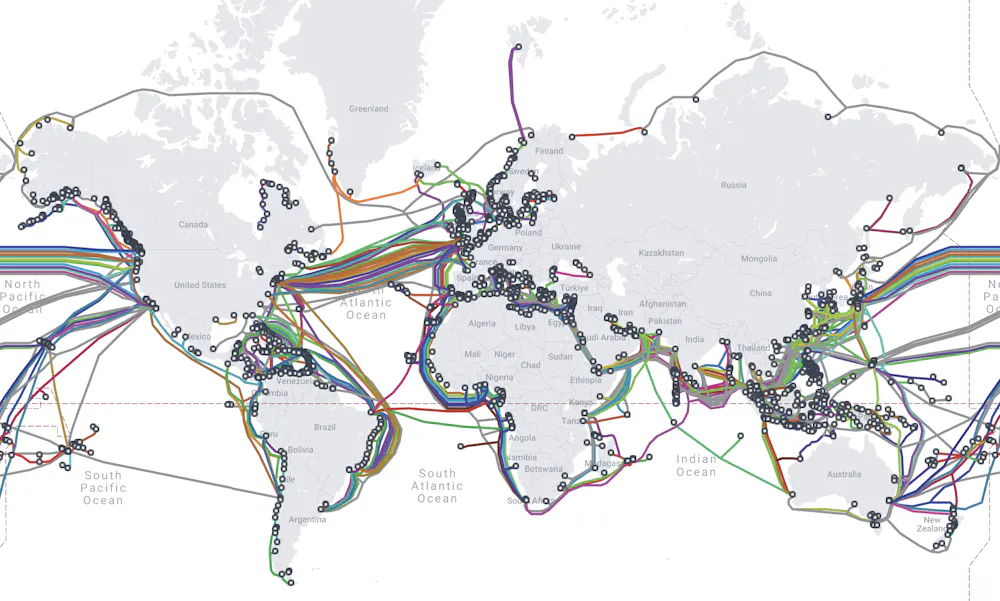
About 485 undersea cables totaling over 900,000 miles sit on the the ocean floor. These cables span the Atlantic and Pacific oceans, as well as strategic passages such as the Suez Canal and isolated areas within oceans.
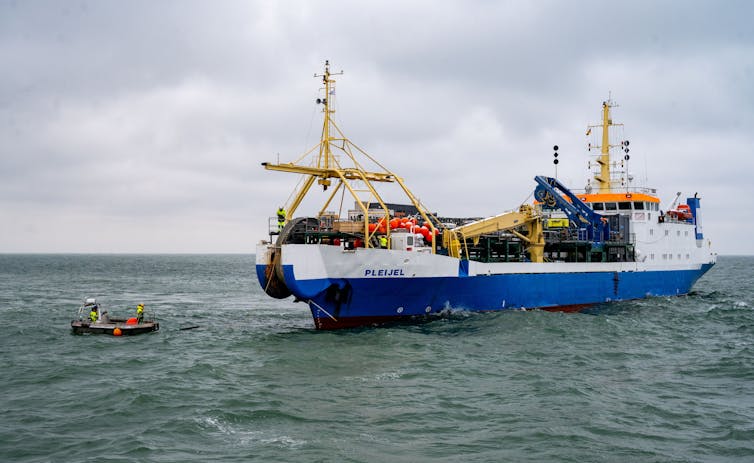
Laying cable under the sea
Each undersea cable contains multiple optical fibers, thin strands of glass or plastic that use light signals to carry vast amounts of data over long distances with minimal loss. The fibers are bundled and encased in protective layers designed to withstand the harsh undersea environment, including pressure, wear and potential damage from fishing activities or ship anchors. The cables are typically as wide as a garden hose.
The process of laying undersea cables starts with thorough seabed surveys to chart a map in order to avoid natural hazards and minimize environmental impact. Following this step, cable-laying ships equipped with giant spools of fiber-optic cable navigate the predetermined route.
As the ship moves, the cable is unspooled and carefully laid on the ocean floor. The cable is sometimes buried in seabed sediments in shallow waters for protection against fishing activities, anchors and natural events. In deeper areas, the cables are laid directly on the seabed.
Along the route, repeaters are installed at intervals to amplify the optical signal and ensure data can travel long distances without degradation. This entire process can take months or even years, depending on the length and complexity of the cable route.
Threats to undersea cables
Each year, an estimated 100 to 150 undersea cables are cut, primarily accidentally by fishing equipment or anchors. However, the potential for sabotage, particularly by nation-states, is a growing concern. These cables, crucial for global connectivity and owned by consortia of internet and telecom companies, often lie in isolated but publicly known locations, making them easy targets for hostile actions.
The vulnerability was highlighted by unexplained failures in multiple cables off the coast of West Africa on March 14, 2024, which led to significant internet disruptions affecting at least 10 nations. Several cable failures in the Baltic Sea in 2023 raised suspicions of sabotage.
The strategic Red Sea corridor has emerged as a focal point for undersea cable threats. A notable incident involved the attack on the cargo ship Rubymar by Houthi rebels. The subsequent damage to undersea cables from the ship’s anchor not only disrupted a significant portion of internet traffic between Asia and Europe but also highlighted the complex interplay between geopolitical conflicts and the security of global internet infrastructure.
Protecting the cables
Undersea cables are protected in several ways, starting with strategic route planning to avoid known hazards and areas of geopolitical tension. The cables are constructed with sturdy materials, including steel armor, to withstand harsh ocean conditions and accidental impacts.
Beyond these measures, experts have proposed establishing “cable protection zones” to limit high-risk activities near cables. Some have suggested amending international laws around cables to deter foreign sabotage and developing treaties that would make such interference illegal.
The recent Red Sea incident shows that help for these connectivity challenges might lie above rather than below. After cables were compromised in the region, satellite operators used their networks to reroute internet traffic. Undersea cables are likely to continue carrying the vast majority of the world’s internet traffic for the foreseeable future, but a blended approach that uses both undersea cables and satellites could provide a measure of protection against cable cuts.
Robin Chataut, Assistant Professor of Cybersecurity and Computer Science, Quinnipiac University
This article is republished from The Conversation under a Creative Commons license. Read the original article.




