How to resolve AdBlock issue?
News
- Details
- Written by: Major League Fishing
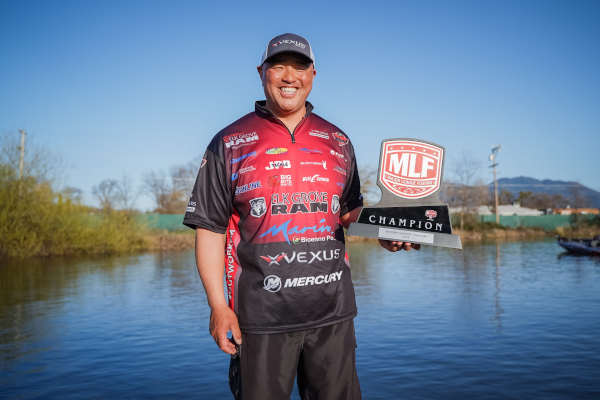
LAKEPORT, Calif. — In his 18th season fishing the Western Division Presented by Tackle Warehouse, Elk Grove, California’s Ken Mah has finished 11 times in the Top 10.
He’s been close so many times before, and Friday at Clear Lake, he finally added the big No. 1 to his MLF résumé.
Mah didn’t just eke by, either. The Toyota Series Presented by Phoenix Boats veteran went absolutely nuclear the final two days of the event, weighing in close to 30 pounds on Day 2 (29-12) and putting the cherry on top on Championship Friday with the largest bag of the tournament (31-10) that was anchored by a behemoth Clear Lake 11-pounder. In total, he weighed in 15 fish for 82 pounds, 6 ounces over three days.
As was the case for many anglers this week, Mah didn’t pile up big weights with big numbers – he had just nine bites on Day 1, 11 on Day 2 and seven on Day 3 — but he got the right bites at the right times, as evidenced by the tournament-best 11-pounder, which he caught mid-morning Friday.
What separated Mah from many in the field was the way he caught his fish, namely, flipping shallow cover. While the majority of anglers were casting big swimbaits offshore, Mah spent his time flipping, at first somewhat offshore and eventually near the bank.
“I [caught] my biggest one near the bank,” he said. “That was late in the day on Day 1. And that kind of clued me in a little bit. As the tournament went on, I started to catch less and less of them out of the brush and more and more on the bank. That was a key move for me.
He added, “I followed those big fish. They want to move shallow right now. Me being able to follow them shallow was a key adjustment.”
Adjusting on the fly was perhaps part of Mah’s plan, though. After snowfall during practice and with forecasts calling for increasingly warmer weather throughout the week, he knew he’d have to move with the fish and try something a little different at some point.
For his flipping setups, Mah relied on a black-and-blue jig with a 3-inch Big Bite Baits YoMama trailer tied to 65-pound-test braid spooled on a Shimano Chronarch 150 MGL reel paired with a G. Loomis GLX 894. He also flipped just the YoMama on 22-pound-test Sunline Shooter with the Chronarch and a G. Loomis GLX JWR895.
Mah isn’t one to play up his accomplishments (and despite this being his first MLF win, he’s won all over the place out West on other tournament trails), so he was somewhat understandably subdued about catching more than 61 pounds over the final two days of the tournament. Still, it wasn’t entirely lost on him what a crazy tournament he put together.
“I didn’t know what was going to happen,” he said. “I knew the weather conditions were getting better for what I wanted to do. Things came together. It was [just] one of those things.”
With the win, Mah not only finally has a shiny red trophy to add to his mantle but also finds himself in the driver’s seat for Western Division Angler of the Year. Of course, there’s still two tournaments to go — and he’s not overlooking either of them — but he’s experienced enough with the West Coast slate to really put an exclamation point on what has been a terrific FLW/MLF career to this point, not to mention the fact that the Western Division finale takes place on his home fishery of the California Delta.
First, though, is Havasu in May, which is a timeframe that presents some new challenges for Mah and the rest of the division.
“My attitude about the season and each tournament is a microcosm,” he said. “Getting off to a great start is a great thing, but it’s not about how you start – it’s how you finish.
“I’m cautiously optimistic. We’re going to Havasu at a different time of year that I’ve not been before. With that postspawn Havasu fishing, it should suit my style better than the usual pre-prespawn time. I’m looking forward to it.”
And why not? There’s a sense of relief that comes with notching your first MLF win.
“It’s one that was alluding me,” he admitted. “To close it out here against this field, it’s just amazing. I’m blessed. This is a trophy I’ve been chasing.”
The top 10 pros on Clear Lake finished:
1st: Ken Mah, Elk Grove, Calif., 15 bass, 82-6, $26,261
2nd: Joe Mariani, Winters, Calif., 15 bass, 76-4, $10,176
3rd: Jon Strelic, El Cajon, Calif., 15 bass, 74-1, $7,878
4th: John Pearl, Upper Lake, Calif., 15 bass, 73-13, $6,565
5th: Christian Melton, Menifee, Calif., 15 bass, 68-3, $5,909
6th: Nathan Phillips, Kelseyville, Calif., 15 bass, 67-15, $5,252
7th: Juarez Jackson, Kelseyville, Calif., 15 bass, 66-5, $4,596
8th: David Valdivia, Riverside, Calif., 15 bass, 65-4, $4,239
9th: J.D. Blackamore, Yorba Linda, Calif., 13 bass, 65-0, $3,283
10th: Patrick Touey, Santa Maria, Calif., 15 bass, 61-12, $2,626
Complete results can be found at MajorLeagueFishing.com.
Pro Daniel Shelton of Kelseyville, Nevada, earned the $500 Berkley Big Bass Award on Day 1 Wednesday with a largemouth weighing in at 9 pounds, 4 ounces. The Day 2 $500 Berkley Big Bass Award on Thursday was earned by pro Roy Hawk of Lake Havasu City, Arizona, with an 8-pound, 14-ounce largemouth bass.
Kirk Marshall of Discovery Bay, California, won the Strike King Co-angler Division Friday with a three-day total of 13 bass weighing 52 pounds, 2 ounces. Marshall took home the top co-angler prize package worth $33,500, including a new Phoenix 518 Pro bass boat with a 115-horsepower Mercury outboard motor.
The top 10 Strike King co-anglers on Clear Lake finished:
1st: Kirk Marshall, Discovery Bay, Calif., 13 bass, 52-2, Phoenix 518 Pro boat w/115-hp Mercury outboard
2nd: Jonathan Green, San Pablo, Calif., 13 bass, 50-7, $3,396
3rd: Blaine Christiansen, San Jose, Calif., 12 bass, 49-12, $2,716
4th: David Zavvar, Concord, Calif., 13 bass, 44-12, $2,377
5th: Jerimiah Valador, Kelseyville, Calif., 10 bass, 44-5, $2,187
6th: Mike Walsh, El Cajon, Calif., 10 bass, 42-13, $1,848
7th: Troy Diatte, Salinas, Calif., 12 bass, 42-1, $1,358
8th: Jose Juarez, Jr., Kelseyville, Calif., 11 bass, 41-0, $1,188
9th: Paul Buccola, Dayton, Nev., 12 bass, 40-10, $1,019
10th: Mike Alvarez, Clovis, Calif., 11 bass, 40-4, $849
Jerimiah Valador of Kelseyville, California, earned Wednesday’s $150 Berkley Big Bass co-angler award with a 6-pound, 7-ounce bass, while the Day 2 $150 co-angler award on Thursday went to Damon Witt of Riseville, California, with an 8-pound, 2-ounce bass.
The Toyota Series Presented by Phoenix Boats at Clear Lake was hosted by the Konocti Vista Casino Resort & Marina. It was the first of three regular-season tournaments for the Toyota Series Western Division Presented by Tackle Warehouse. The next event for the Toyota Series Western Division Presented by Tackle Warehouse anglers will be the Toyota Series at Lake Havasu, May 2-4, in Lake Havasu City, Arizona. For a complete schedule of events, visit MajorLeagueFishing.com.
The 2024 Toyota Series Presented by Phoenix Boats consists of six divisions – Central, Northern, Plains, Southern, Southwestern and the Western Division Presented by Tackle Warehouse – each holding three regular-season events, along with the International and Wild Card divisions.
Anglers who fish in any of the six divisions or the Wild Card division and finish in the top 25 will qualify for the no-entry-fee Toyota Series Championship for a shot at winning up to $235,000 and a qualification to REDCREST 2025. The winning Strike King co-angler at the championship earns a new Phoenix 518 Pro bass boat with a 115-horsepower Mercury outboard.
The 2024 Toyota Series Championship will be held Nov. 7-9 on Wheeler Lake in Huntsville, Alabama, and is hosted by the Huntsville/Madison County Convention & Visitors Bureau, the Madison County Commission, and the Huntsville Sports Commission.
Proud sponsors of the 2024 MLF Toyota Series include: 7Brew, Abu Garcia, B&W Trailer Hitches, Berkley, BUBBA, E3, Epic Baits, FX Custom Rods, General Tire, Lew’s, Mercury, Mossy Oak, Onyx, Phoenix, Polaris, Power-Pole, Strike King, Suzuki, Tackle Warehouse, T-H Marine, Toyota and YETI.
For complete details and updated information visit MajorLeagueFishing.com. For regular Toyota Series updates, photos, tournament news and more, follow the MLF5 social media outlets at Facebook, Instagram and YouTube.
- Details
- Written by: Robert Sanders
BERKELEY, Calif. — In late January, seven engineers from the Berkeley Seismological Laboratory helicoptered into the Farallon Islands, a wind-swept, nearly treeless chain of islands 30 miles off San Francisco's Golden Gate, on an eight-day mission to upgrade one of the lab’s most remote — yet most critical — seismic stations.
The station is one of few in Northern California located on the western side of the dangerous San Andreas fault and is vital to the University of California, Berkeley's 181-station seismic network, which ties in with the U.S. Geological Survey's network to monitor earthquakes and provide data to warn Californians of seismic activity.
The MyShake app developed at UC Berkeley uses this network to give Pacific coast residents an early warning about potential shaking.
Yet, torrential rains and ferocious winds have taken their toll on the 30-year-old outdoor station on Southeast Farallon Island, the largest island within the Farallon Islands National Wildlife Refuge, a U.S. Fish and Wildlife Service preserve that is off-limits to the public and the largest seabird nesting site on the Pacific coast outside of Alaska.
The outdated seismic sensors were encased in a rock cairn as protection from the wind, but small seabirds called ashy storm petrels appeared to have burrowed in for protection as well. Invasive house mice had nested in the sensors’ electronic components.
Over the years, equipment maintenance had been spotty, typically only possible via a six-hour round trip by boat through rough seas.
“This was one of the first instruments put here when Berkeley started to build the Berkeley Digital Seismic Network in the 1990s,” said seismology lab director Richard Allen as he accompanied his crew on a survey of the outdated station. “It's been upgraded a couple of times since, but this is our opportunity to really turn this into a state-of-the-art site where we have much lower noise levels and we can really detect all earthquakes that are occurring in the region.”
On Jan. 30, when Allen and the engineers arrived, the air was filled with the squawking of sea lions a stone's throw away in a churning inlet. Their stay on the island was timed to avoid the upcoming nesting season for seabirds, such as petrels and Cassin’s auklets, whose nests completely surround the walkway where the station’s cables are laid.
But they couldn't avoid bad weather. The winter's worst storm ripped through during their stay, with gusts up to 75-miles-per-hour. The crew had to work in storm suits, while salt spray and rain rusted their tools within days.
“The Farallon site was always a noisy one anyway, because of storms and maybe birds. The refurbishment — it's really the equivalent of a brand-new station — will provide higher quality data and more reliability,” said Allen, UC Berkeley professor of earth and planetary science. “We don't want the station to go down.”
A desperately needed upgrade
The Berkeley Seismological Laboratory team has been upgrading seismic stations in the Northern California network for the past six years, in the process navigating around off-the-grid marijuana grows, repairing wires ripped up by bears and occasionally fixing vandalized equipment.
But the upgrade to the Farallon Islands station was, by far, the most exotic location with unique challenges. And it was a critical improvement, considering the San Andreas Fault’s proximity to San Francisco and a densely populated Bay Area.
Earthquakes usually originate along a fault line, so pinpointing the epicenter requires having sensors on both sides of a fault — four stations must detect a quake before triggering a warning through MyShake.
The ShakeAlert system that underlies MyShake and provides quake warnings to agencies and businesses throughout California has had only three false alarms out of 115 alerts sent out since it started operating in October 2019.
Two of the false alerts were for quakes off Cape Mendocino, near Eureka, where the San Andreas Fault sits offshore without any close monitoring stations to accurately determine location and magnitude. The other false alert was at the California-Nevada border, where the Berkeley Seismological Lab also has few stations.
“That's a pretty spectacular performance overall, but we miss earthquakes all around the edges of the network,” Allen said, stressing the need to upgrade the Farallon Islands site.
The effort required so much equipment — including rock drills and cabling — that seven round-trip helicopter flights from the Half Moon Bay airport were needed to deliver it and the crew. Between Jan. 30 and Feb. 7, the engineers constructed the new Farallon station and tested the sensors, bunking down in one of two unheated clapboard houses on the island.
What they found on the island was a dusty rack of electronic equipment dating from 1994 pushed to the side of what is now a cluttered carpenter shop, the only remaining portion of a barracks that had been built of rocks and cement in 1905.
The equipment was connected to broadband sensors located outdoors a hundred yards away, hidden under a pile of rocks glued together with spray foam. Holes in the foam contained feathers, testifying to the fact that birds had carved out nests there over the years.
Rusty communication antennas and an old GPS Radome, a structure that protects radar antennae from weather, rounded out the station's network.
At the end of the team’s mission, all the old equipment except for the rock-encased seismometers were dismantled and returned to Berkeley.
A network for the next generation
In their place, the team installed two types of accelerometers — a state-of-the-art strong motion sensor, which is the centerpiece of most seismic stations, and a broadband seismometer able to detect small quakes that often go unnoticed.
These instruments are now bolted to cement foundations, packed with glass beads inside a protective aluminum cylinder and sheltered from wind and animals by shiny, stainless steel boxes bolted to the rocks.
A new GPS antenna to measure horizontal movement sticks six feet into the air, supported by four struts epoxied into granite; new cables have been laid; new electronic equipment now rests inside mouse-proof cabinets in the carpentry shop; and a new antenna peeks above the shop's roofline to send real-time data to a receiver at UC San Francisco.
Thanks to months of planning and great teamwork, “things went shockingly well,” said Jonah Merritt, who led the team. “This was the most involved project we have ever pulled off, honestly.”
Berkeley Seismological Laboratory scientists are now calibrating the sensors and reviewing the data, part of a monthslong commissioning process required before any station is put on line.
The revamped Farallon station is among the last of UC Berkeley's stations to be upgraded, and because access to it is difficult, it was the most expensive, costing an additional $90,000 for transportation above the typical cost of an upgrade on the mainland.
Only four more stations remain. All have been funded by grants from the federal government through the USGS and the California Governor’s Office of Emergency Services. The entire ShakeAlert network of 1,675 stations from California to Washington is now 91% complete, Allen said, incorporating networks managed by UC Berkeley, California Institute of Technology and the USGS, as well as the University of Washington and University of Oregon.
UC Berkeley's network is also optimized for basic research on global seismicity and to study incremental movement along underground portions of the state's faults. One major area of the lab’s interest is whether smaller quakes, called microquakes, can provide more information about the deeply hidden geometry of faults and, maybe someday, pinpoint areas most prone to a near-term rupture, narrowing the window within which a quake is expected from a generation to perhaps a decade.
“All of the Berkeley stations have two sensors at them: a strong motion instrument and a broadband instrument,” Allen said. “That's good for earthquake early warning because now we have two sensors, and we actually look for both sensors to agree about the earthquake that's underway. The broadband sensor is a much more sensitive instrument, so it allows us to detect much smaller magnitude earthquakes. That feeds into the research goals, where we can detect these smaller magnitude earthquakes and use that to image faults and to understand the statistical properties of earthquakes much more rapidly.”
The seismic station upgrades insure a robust early warning system into the future, Allen said.
“We wanted to build a network not only for earthquake sensing,” he said, “but for the next generation.”
Robert Sanders writes for the UC Berkeley News Center.
DWR celebrates the hidden water resource beneath our feet during National Groundwater Awareness Week
- Details
- Written by: Lake County News reports
Officials said 2024 marks the 10th anniversary of the signing of the Sustainable Groundwater Management Act, or SGMA. SGMA is California’s groundbreaking groundwater legislation, which passed in 2014, and established a statewide framework to protect the State’s precious groundwater resources.
Groundwater plays a critical role in water supply resilience for our state, our nation and worldwide.
Here in California, whether we are experiencing the weather extremes of drought or flood, or something in between, our groundwater basins provide a water supply for more than 15 million people, especially during dry years when surface water supplies are lacking.
As California adapts to a hotter, drier future, these groundwater supplies are becoming a more vital resource for local water agencies, communities and agriculture.
“In addition to promoting groundwater education during Groundwater Awareness Week, this year, we are celebrating the accomplishments that the local groundwater sustainability agencies have achieved over the first decade of SGMA, and the state-local partnerships we continue to build,” said Paul Gosselin, DWR deputy director of sustainable water management. “The local agencies are on the ground, in their communities, progressing towards a sustainable groundwater future for California, with support and guidance from DWR. In the first decade of SGMA, every ambitious milestone has been met, and we will continue to see progress as agencies implement their plans.”
Groundwater is nature’s hidden water resource that quenches our thirst and sustains our planet. Nearly 85 percent of Californians depend on groundwater and many communities are 100 percent reliant on groundwater for all their water needs, so chances are high that groundwater is a part of your life.
“Groundwater Awareness Week is a great opportunity to learn more about California’s vital water resource,” said Gosselin. “So, during this week, let’s all raise a glass to groundwater, the hardworking groundwater managers throughout the State, and the partnerships that are leading California to a sustainable water future.”
Whether you’re a groundwater guru, or you had no idea that there is water stored in the underground aquifers beneath your feet, there will be something for everyone during Groundwater Awareness Week. Please Join DWR as we host a series of webinars and share inspirational content on our social media channels, including videos that feature local groundwater managers.
You won’t want to miss our Monday webinar as they kick off Groundwater Awareness Week with DWR Director, Karla Nemeth, and DWR Sustainable Water Management Office Deputy Director, Paul Gosselin, talking about the progress made over the first 10 years of SGMA and the partnerships that have been built between state agencies, local water managers and communities.
They’ll also discuss the innovative projects that are putting more water into the ground, helping to ensure current and long-term water supply resiliency for communities, businesses, and environmental habitats that are dependent on groundwater.
Join them as they celebrate the 25th Annual Groundwater Awareness Week, and the upcoming 10th anniversary of SGMA, at the webinars listed below, and on social media.
Monday, March 11, 11 a.m. to 12:30 p.m.: “California Water Management and Progress Since the Signing of the Sustainable Groundwater Management Act.”
Tuesday, March 12, 10 to 11:30 a.m.: “Outreach and Engagement Training for Groundwater Sustainability Agencies.”
Wednesday, March 13, 10:00 a.m. to 11:30 a.m.: “Outreach and Engagement Training forGroundwater Sustainability Agencies.”
Thursday, March 14, noon to 1 p.m.: “Groundwater Sustainability Plan Reporting Process and Requirements.”
Friday, March 15, from noon to 1 p.m.: “Planning for the Future; Data, Tools, and Models.”
To register for DWR’s Groundwater Awareness Week webinars, visit the Events page for Groundwater Awareness Week.
- Details
- Written by: European Space Observatory
When a star like our Sun reaches the end of its life, it can ingest the surrounding planets and asteroids that were born with it.
Now, using the European Southern Observatory’s Very Large Telescope, or ESO’s VLT, in Chile, researchers have found a unique signature of this process for the first time — a scar imprinted on the surface of a white dwarf star. The results were published in The Astrophysical Journal Letters.
“It is well known that some white dwarfs — slowly cooling embers of stars like our Sun — are cannibalizing pieces of their planetary systems. Now we have discovered that the star’s magnetic field plays a key role in this process, resulting in a scar on the white dwarf’s surface,” says Stefano Bagnulo, an astronomer at Armagh Observatory and Planetarium in Northern Ireland, UK, and lead author of the study.
The scar the team observed is a concentration of metals imprinted on the surface of the white dwarf WD 0816-310, the Earth-sized remnant of a star similar to, but somewhat larger than, our Sun.
“We have demonstrated that these metals originate from a planetary fragment as large as or possibly larger than Vesta, which is about 500 kilometers across and the second-largest asteroid in the Solar System,” said Jay Farihi, a professor at University College London, UK, and co-author on the study.
The observations also provided clues to how the star got its metal scar. The team noticed that the strength of the metal detection changed as the star rotated, suggesting that the metals are concentrated on a specific area on the white dwarf’s surface, rather than smoothly spread across it.
They also found that these changes were synchronized with changes in the white dwarf’s magnetic field, indicating that this metal scar is located on one of its magnetic poles. Put together, these clues indicate that the magnetic field funneled metals onto the star, creating the scar.
“Surprisingly, the material was not evenly mixed over the surface of the star, as predicted by theory. Instead, this scar is a concentrated patch of planetary material, held in place by the same magnetic field that has guided the infalling fragments,” says co-author John Landstreet, a professor at Western University, Canada, who is also affiliated with the Armagh Observatory and Planetarium. “Nothing like this has been seen before.”
To reach these conclusions, the team used a ‘Swiss-army knife’ instrument on the VLT called FORS2, which allowed them to detect the metal scar and connect it to the star’s magnetic field.
“ESO has the unique combination of capabilities needed to observe faint objects such as white dwarfs, and sensitively measure stellar magnetic fields,” said Bagnulo. In their study, the team also relied on archival data from the VLT’s X-shooter instrument to confirm their findings.
Harnessing the power of observations like these, astronomers can reveal the bulk composition of exoplanets, planets orbiting other stars outside the Solar System. This unique study also shows how planetary systems can remain dynamically active, even after “death.”