 How to resolve AdBlock issue?
News
- Details
- Written by: Jared McDonald, University of Mary Washington
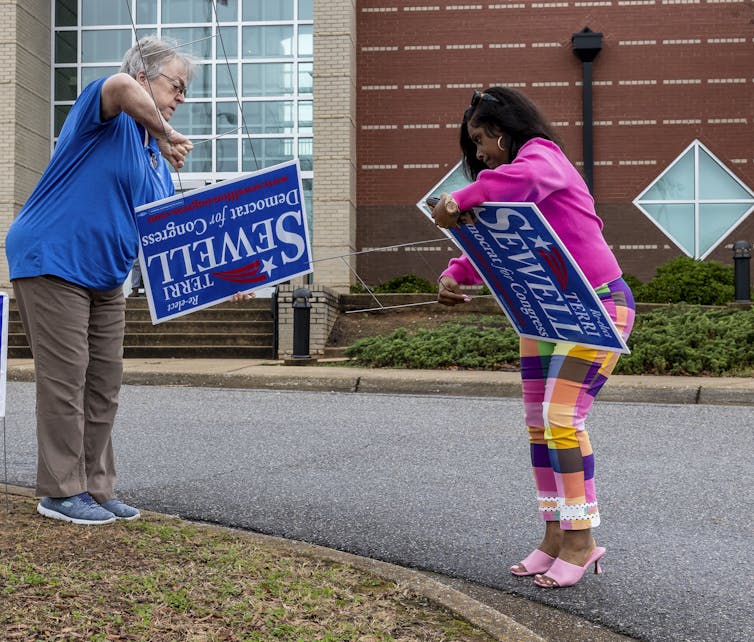
Now that Super Tuesday is over and the Democratic and Republican nominees are all but officially chosen, as everyone expected, voters can turn the page to the general election.
But they’re not excited about it, and they haven’t been for months.
A September 2023 Monmouth University poll showed no more than 40% of Americans said they were “enthusiastic” for either Biden or Trump to run again. That same month, the Pew Research Center found that 65% of Americans were exhausted with the current state of American politics. In February 2024, The New York Times said Democrats in particular were burned out by the seemingly endless avalanche of political crises.
You can listen to more articles from The Conversation, narrated by Noa.
It is not surprising that a rematch of the 2020 election is failing to inspire excitement in the American people. Yet, as a political scientist who studies citizen engagement and the public’s feelings toward the candidates, I find these trends disturbing. It’s not just polarization that’s driving voters’ malaise – it’s something else, which carries a stark warning for the health of American democracy.
There is another divide in politics
Most discussions of the current state of the American electorate have understandably focused on political polarization. Democrats and Republicans often express disdain for each other, even when they don’t actually disagree on specific policies for the nation to pursue.
Some of this disdain is rooted in identity. For example, people who hold unfavorable attitudes toward African Americans, feminists and other groups associated with the Democratic Party tend to identify more strongly with the Republican Party. People with unfavorable attitudes toward stereotypically Republican groups such as evangelicals and gun owners tend to be stronger Democrats.
From this perspective, Democrats and Republicans are pack animals motivated to protect their group and their group’s interests.
Often overlooked, however, is how the vitriol of modern American politics fuels what political scientists Yanna Krupnikov and John Barry Ryan call “The Other Divide.” This is the divide between people who engage in politics and those who don’t.
In short, a significant number of Americans don’t talk about politics, whether because they are not interested in politics or are turned off by the negativity. It’s a gradual trend dating back to the 1980s and 1990s that has continued for decades now. This weakens the fabric of democracy, because the only voices that are heard online and in the media are from those who are most willing to speak up. They tend to be the most dissonant and extreme views.
The public discussion about the country’s past, present and future therefore leaves out a wide range of people’s voices. What they might say is hard to know, specifically because they don’t engage in political discussions.
Young voter disengagement
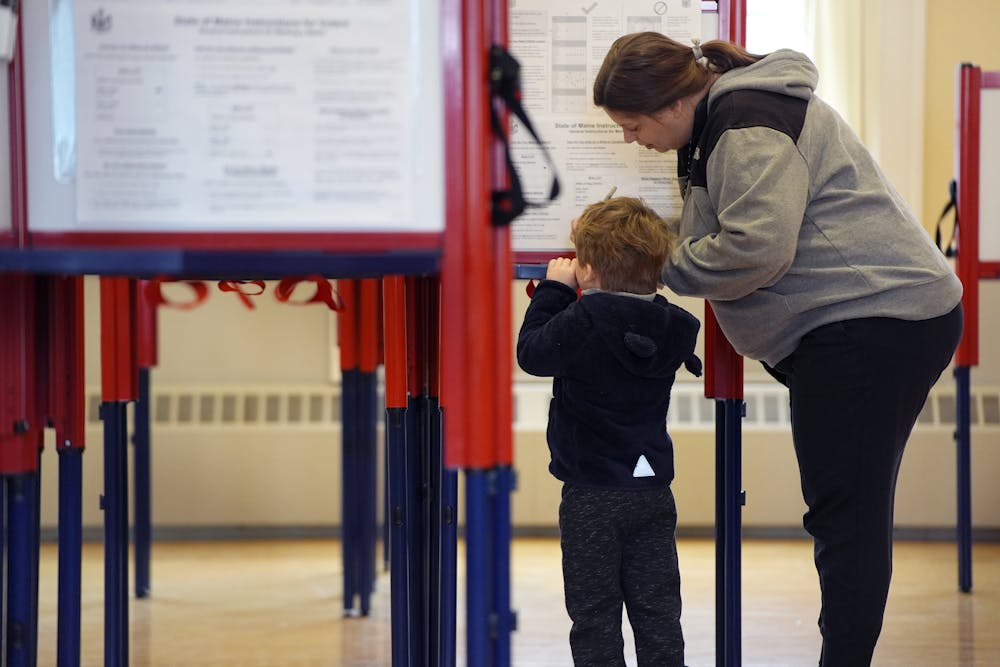
Especially troubling to me is the political disillusionment expressed by young people, who are the most likely group in the country to avoid identifying themselves as members of one party or the other. People who identify themselves as independents – especially if they don’t lean toward one party or the other – are also likely to lack interest in voting.
Having come of age during an era of high polarization, younger people are less likely to idealize politics and the right to vote. In prior research, my colleagues and I found that younger people worldwide were just as interested in politics as older citizens but were less likely to view voting as a civic duty. Protesting or joining an organization offers social benefits to young people – an opportunity to feel like they are part of something bigger. Voting, by contrast, is perceived as a more solitary act.
If younger American voters aren’t excited about the choices on the ballot, they may be more likely not to vote at all.
In a recent survey I conducted in collaboration with IGNITE National, an organization seeking to bolster young women’s engagement in the political process, we asked Gen Z Americans, adults born after 1996, what drove their disillusionment with American politics. Consistently, Gen Z respondents noted that the candidates appearing on the ballot did not look like them, contributing to their feeling of detachment from the political process.
Barack Obama’s race made 2008 a historic election. Hillary Clinton’s gender made 2016 a historic contest as well. By contrast, 2024 features the two oldest white men to ever seek the presidency, vying for second terms in office.
Burnout’s effects on democracy
Americans have many demands on their time. Between work, family and other activities, many struggle to watch or read the news, fact check what they see on social media or engage in productive political discussions. As a result, most of the American public is largely unaware of key aspects of important issues, and does not pay attention to the parties’ stances on those issues.
This lack of engagement is dangerous for democracy. Voters who cannot evaluate the merits of contrasting policy positions, or who cannot accurately assign blame and give credit for the state of the American economy, will ultimately fall back on cheap cues such as partisanship to make their choices.
Or they may abstain from politics altogether.
The campaign season offers an opportunity for voters who may be open to persuasion to engage in the political process for a short period of time, become sufficiently informed and make their voices heard. Though there are flaws in the many processes of political campaigning, media coverage and community involvement, the bottom line is simple: Deliberative democracy requires an American public that is willing to deliberate.
If Americans are too burned out to engage enthusiastically and provide feedback to political leaders, then there is little hope that any government could truly reflect the will of the people.
Jared McDonald, Assistant Professor of Political Science and International Affairs, University of Mary Washington
This article is republished from The Conversation under a Creative Commons license. Read the original article.
- Details
- Written by: Elizabeth Larson
LAKEPORT, Calif. — The Lakeport Unified School Board on Wednesday night voted to begin notifying several employees of the potential for layoff as part of district leadership’s plan to address a budget shortfall.
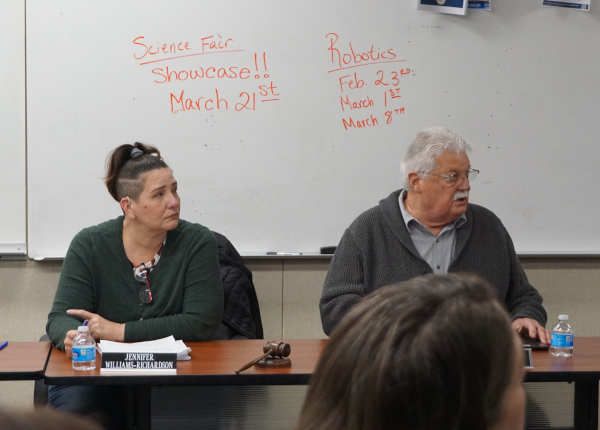
The decision came at the end of a special three and a half-hour meeting called for Wednesday evening at the district office, where dozens of people crowded into the boardroom, with the audience spilling into the lobby.
At the start of the meeting, Superintendent Matt Bullard gave a brief statement on the proposal to cut both certificated and classified staff — including key union representatives — and blamed the situation on the state’s dropping revenues.
The proposal in its original form included cutting 16 employees, as well as the district’s long-running day care and after school program.
Among the employees facing layoff is Rachel Paarsch, director of supplemental support. Several people spoke in support of Paarsch and her work to advance and expand the district’s alternative education program.
“Cutting Rachel’s position would be a very big mistake,” said parent Krystal Pasalo, explaining how Paarsch has helped her son, who has learning disabilities.
On the classified side, the plan included eliminating the head groundskeeper and skilled maintenance worker positions and creating two head custodians with less pay, for a savings of only about $12,000 a year.
While the final vote included Paarsch’s layoff, the groundskeeper and maintenance positions, along with the after school coordinator and day care assistant were spared in the end.
Certificated staff found out about the proposal on Feb. 20, but classified staff said it was only on Monday that they found out what was proposed.
Wednesday’s action is what Bullard and board members said is a “first step” in attempting to meet the district’s budget shortfall in the coming months. Layoff notices for educators must be made by March 15.
Bullard said the proposal was the best option in his opinion. He went on to explain that the district wants to have competitive wages and benefits to attract employees to the district and, once they’re here, to retain them. The goal is to pay a minimum of $20 per hour for hourly employees and $60,000 per year for salaried employees.
“Budget reductions, reducing expenditures, is not an easy task,” said Bullard, who noted that all positions in the district deliver value to students and faculty.
“The decisions that are going to be made in the next three months as the budgeting unfolds are incredibly difficult to make,” Bullard said.
After nearly an hour and a half hearing input from alarmed staff, parents and students, the board went into a closed session in Bullard’s office, where they stayed behind closed doors for just under two hours before emerging to announce their decision.
Need for reducing expenditures
In response to questions asked during the meeting by Lake County News, Bullard said the proposed staff cuts were aiming to reduce expenditures by $1.3 million.
He said the district is deficit spending by $1.6 million this year and if costs aren’t reduced, Lakeport Unified could be facing significant financial issues in the coming school year.
Staff and their supporters argued that, particularly when it came to maintenance and grounds staff, the cuts would impact campus safety.
Darren Wells, the skilled maintenance worker whose job was on the list for elimination, said he’s saved the district tens of thousands of dollars with his work across the campus. He said safety should be a top priority, adding he didn’t think Bullard was willing to take a cut in pay.
Wells also is the classified union president, a factor which several people Lake County News spoke to during and after the meeting raised as an issue that led them to conclude that Wells was potentially being targeted.
Additionally, the school board and administration faced heavy criticism from one of its own during the meeting.
Lynn Andre, a retired district employee and former board member, said she didn’t understand why they are cutting the day care program, which was making money for the district not just by revenue but by attracting students.
“Your district has a problem with declining enrollment and to cut services, I can guarantee, will continue that decline,” said Andre, who noted that in the 15 years she had managed the day care program, it never faced a reduction.
“So if it’s in the red now you’re doing something wrong. You’re doing something wrong,” she said.
One of the things the district is doing wrong, Andre suggested, is that it hasn’t raised the rates for the program. During the rest of the meeting, there were parents who said they would gladly pay more for the program’s services.
Dave Norris, who worked for Lakeport Unified for 38 years and is its former head of maintenance, bolstered the safety argument by pointing out that the district is spending very little money on maintenance and grounds when considering the vast amount of responsibility.
He explained the variety of needs, from keeping playing fields in safe and acceptable shape — including removing gophers from the football field — to maintaining the bleachers in the gym and on the fields.
Dan Camacho, who now is the head of maintenance, said the district needs to have a serious conversation about the money saved and safety.
Camacho then changed gears, saying he thought it was sad that teachers and coaches wanted to put things on Facebook about the situation, adding he wished they would get the facts first. He singled out longtime football coach Milo Meyer, who was standing in the foyer, and who had posted his concerns about the district’s planned cuts.
In response to Camacho, Meyer went to the podium and began to give his take on the situation, explaining that students bring money to the district. “We have declining enrollment. End of story.”
Meyer said there have been about a dozen quality teachers who have left for other districts because of Lakeport Unified’s situation.
He said they’ve lost students, a tennis court and a swimming pool, and are losing other space on the campus as well, pointing to a large number of containers behind the gym.
Meyer said he didn’t know what the answer was, but that, “We need to look at ourselves.” He also raised issues with the rapid turnover of administrators, a matter others referenced as well.
Paarsch, now in her 10th year as an administrator in the district — where she herself attended school and worked as a fledgling teacher — said alternative education has flourished over the past five years, under her leadership.
Alternative education is trending and is bringing in students, she added.
Waiting for a decision
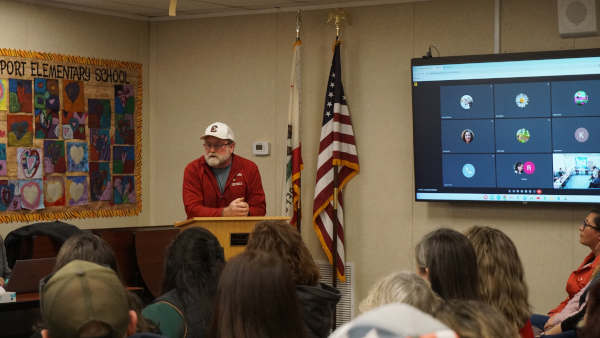
The school board went into closed session in Bullard’s office just before 7:30 p.m. About 20 people — parents, students and staff — stayed on and waited for the board to come out and announce its decision.
During that wait, Phillip Sparkes, a senior at Clear Lake High School who had spoken to the board about his concerns about the proposed cuts, told Lake County News that he thought that getting rid of the permanent substitute counselors is ridiculous.
That means the main counselor is trying to cover too much, and she has less time for seniors. “They’ve stretched her too far,” Sparkes said.
When the board finally emerged after two hours, Board President Jennifer Williams-Richardson was visibly emotional. She came into the boardroom and took a tissue and began to dab her eyes. The rest of the board looked somber.
Their first order of business was to report action including unanimously approving taking the required steps to terminate a number of temporary employees as they must do at the end of each year. Those employees can be added back in the next school year, Bullard said.
They then took action to release Paarsch. That vote was 3-0, with two abstentions, reported Board member Phil Kirby, who also is Paarsch’s father.
The board then took up the first of the two resolutions regarding staff layoffs.
That resolution, for certificated staff, called for laying off nine full-time positions: three instructional coaches, three permanent substitutes, one permanent substitute counselor, one school psychologist and Paarsch’s position, director of supplemental support. The vote for that unchanged resolution was 3-0, with Kirby and Carly Alvord recusing themselves.
When it came to the classified layoffs, however, the board amended the proposed resolution. One bus monitor and two paraprofessionals will be laid off, but the head groundskeeper, the after school coordinator, Wells’ skilled maintenance worker position and the day care assistant were spared for now in a unanimous board vote.
“Obviously, these decisions are extremely difficult,” said Bullard, who thanked everyone for attending the meeting.
Bullard emphasized that they have not eliminated the positions but that what the board did was complete its ability to continue the process.
“This was just simply the first step” to provide employees the notice required by the education code and potentially eliminate the positions this spring, he said.
“This is the first step in this process, a process that we don’t want to do,” said Board member Dan Buffalo, adding that people could tell due to the emotions.
He said they have very little control over their revenues and they are trying to create space in their budget in order to give the best compensation packages for staff. The board has committed to an additional $1 million in its budget next year to do that while also right-sizing the district.
“It’s been a difficult night so maybe we’ll leave it at that,” Buffalo said.
Alvord said all of the board members have had really productive conversations over the past couple of days, although it doesn’t always feel that way when sitting in the boardroom.
“We really, truly sit here because we want what’s best for kids and we want what’s best for the district,” Alvord said.
Email Elizabeth Larson at
- Details
- Written by: Elizabeth Larson
Lauren Berlinn, spokesperson for the Lake County Sheriff’s Office, identified the crash victim as Gregory Allen Van Gundy, 58.
The California Highway Patrol’s Clear Lake Area office said Van Gundy was driving eastbound on Highway 20 east of Blue Lakes Road just before 1 p.m. on Sunday when he lost control in a curve and crossed into the opposing lane of traffic, hitting another vehicle head-on.
The CHP said Van Gundy died of his injuries at the scene. Two people in the car with which he collided had minor injuries.
The crash remains under investigation, the CHP said.
Email Elizabeth Larson at
- Details
- Written by: Lake County News reports
CLEARLAKE, Calif. — The Clearlake Police Department is working to find a 65-year-old man who was reported missing.
Police are seeking Kenneth Nicholson, 65.
His last known location was near the Travelodge in Clearlake.
Nicholson is described as a white male adult, 5 feet 9 inches tall, 165 pounds, with blond hair and blue eyes.
If you have any information regarding his whereabouts please contact the Clearlake Police Department at 707-994-8251, Extension 1 for dispatch.




