 How to resolve AdBlock issue?
News
- Details
- Written by: Chelsea Gohd

A glowing cosmic cloud has revealed a cataclysmic collision.
Even within our own solar system, scientists have seen evidence of giant, planetary collisions from long ago.
Remaining clues like Uranus’ tilt and the existence of Earth’s moon point to times in our distant history when the planets in our stellar neighborhood slammed together, forever changing their shape and place in orbit. Scientists looking outside our solar system to far off exoplanets can spot similar evidence that, across the universe, planets sometimes crash.
In this new study, the evidence of such an impact comes from a cloud of dust and gas with a strange, fluctuating luminosity.
Scientists were observing a young (300-million-year-old) sun-like star when they noticed something odd: the star suddenly and significantly dipped in brightness.
A team of researchers looked a little closer and they found that, just before this dip, the star displayed a sudden spike in infrared luminosity.
In studying the star, the team found that this luminosity lasted for 1,000 days. But 2.5 years into this bright event, the star was unexpectedly eclipsed by something, causing the sudden dip in brightness. This eclipse endured for 500 days.
The team investigated further and found that the culprit behind both the spike in luminosity and the eclipse was a giant, glowing cloud of gas and dust. And the most likely reason for the sudden, eclipse-causing cloud? A cosmic collision between two exoplanets, one of which likely contained ice, the researchers think.
In a new study detailing these events, scientists suggest that two giant exoplanets anywhere from several to tens of Earth masses crashed into one another, creating both the infrared spike and the cloud. A crash like this would completely liquify the two planets, leaving behind a single molten core surrounded by a cloud of gas, hot rock, and dust.
After the crash, this cloud, still holding the hot, glowing remnant of the collision, continued to orbit the star, eventually moving in front of and eclipsing the star.
Fun facts:
This study was conducted using archival data from NASA’s now-retired WISE mission – the spacecraft continues to operate under the name NEOWISE.
This star was first detected in 2021 by the ground-based robotic survey All-Sky Automated Survey for Supernovae, or ASAS-SN.
While this data revealed remnants of this planetary collision, the glow of this crash should still be visible to telescopes like NASA’s James Webb Space Telescope. In fact, the research team behind this study is already putting together proposals to observe the system with Webb.
The study, “A planetary collision afterglow and transit of the resultant debris cloud,” was published Oct. 11, 2023, in Nature by lead author Matthew Kenworthy alongside 21 co-authors.
- Details
- Written by: Lake County News reports
This month so far, there have been seven traffic fatalities — three of them involving pedestrians.
Lt. Dan Fansler, commander of the California Highway Patrol’s Clear Lake Area office, said that some of the recent fatal crashes have been anomalies.
However, when it comes to the two recent pedestrian fatalities along Highway 20, there is a commonality — little to no street lighting and inclement weather during the hours of darkness, Fansler said.
Fansler said he’s in the process of meeting with Caltrans and other traffic safety partners to try and come up with realistic strategies to help combat these types of events.
The Highway 20 corridor “has an off and on history with these types of tragic incidents, partially due to the large amount of pedestrian and bicycle traffic” and the fact that it’s a major thoroughfare from Interstate 5 to U.S. Highway 101, he explained.
“We are routinely discussing options and possible solutions to these problems,” he said.
Meanwhile, Fansler reported that the CHP Clear Lake Area will be conducting increased enforcement this Presidents Day weekend on the Highway 20 corridor with a focus on pedestrian safety and searching for impaired and aggressive driving.
“Please be mindful that motorists and pedestrians share the responsibility to ensure the safety of one another within our small unincorporated townships and our scenic Lake County highways,” the agency said.
The CHP offered the following safety guidance.
Safety tips for pedestrians:
• Before stepping in front of a car, make eye contact with the driver. Make sure they see you, they plan on stopping, and they have time to stop.
• Most fatal crashes involving pedestrians occur during hours of darkness. Increase your visibility at night by carrying a flashlight and wearing light-colored or reflective clothing.
• It is safest to walk on a sidewalk, but if you must walk in the street, walk facing traffic.
• Pay attention. Always be aware of your surroundings and watch for vehicles when crossing a street or stepping off a curb.
Safety tips for motorists:
• Watch for people walking and people bicycling, obey all speed limits, avoid distraction, and know the laws regarding pedestrian right of way.
• Be prepared to yield to pedestrians in crosswalks (marked or unmarked).
• Never pass a vehicle that is stopped for pedestrians.
• Slow down in areas where you are likely to find people walking, and during stormy weather when your visibility is reduced by rain or fog.
Email Elizabeth Larson at
- Details
- Written by: Lake County News reports
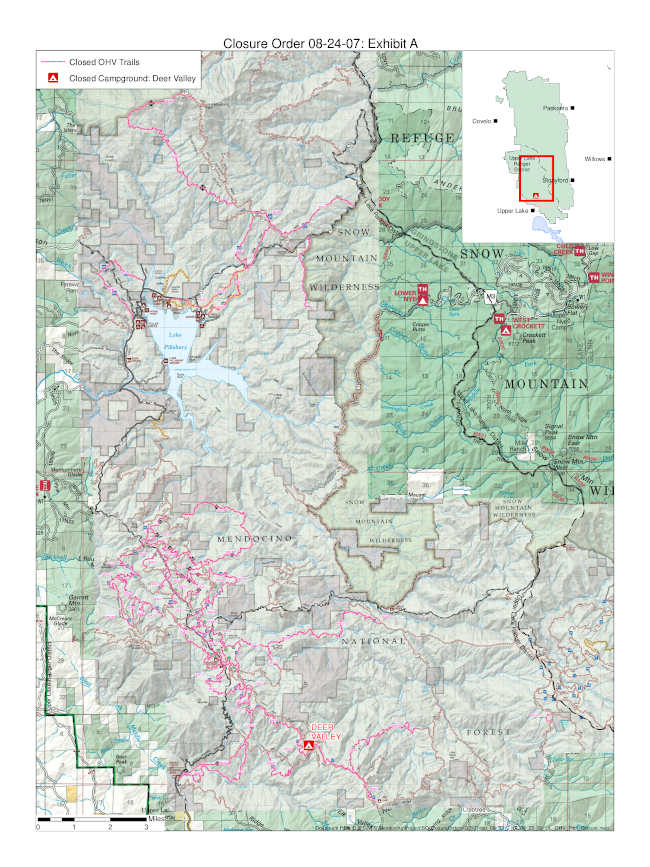
Out of concern for public safety, forest officials are closing National Forest System trails designated for off-highway vehicle use on the Upper Lake Ranger District and the Deer Valley Campground.
The closure is in effect from Feb. 15 through June 30, per Forest Order 08-24-07.
“The Upper Lake District has experienced severe wildfire, including the 2018 Ranch Fire, back-to-back winters where annual average rainfall is exceeded in just a few weeks, and hurricane-force winds recorded at weather stations,” said Forest Supervisor Wade McMaster.
Winter storms and the forest’s post-fire conditions resulted in extensive damage and downed trees.
Trails are unsafe for public use, with additional concerns of possible resource damage from riding around obstacles on trails. Downed trees and stump holes are making travel impossible and unsafe.
“Right now, we wouldn’t be able to get emergency vehicles into the area in the event of an accident or search and rescue,” McMaster said.
More fire-damaged and live trees are expected to fall as saturated soils may no longer be able to support the weight of the trees. Future storms and snowmelt may also cause additional damage to roads and trails.
“The post-fire conditions of the forest combined with these strong winter storms are challenging. I want to commend our OHV recreation program and volunteers who are actively working to assess damage and restore safe, sustainable access to our campground and trail system,” said McMaster. “Protecting trails now gives us time to repair and recover from the storm damage sustained during this wet winter.”
Last year volunteers mobilized to help the Forest Service reopen trails after a storm damage closure. Several volunteer work days are planned for this spring, weather permitting. Those interested in volunteering can email
Forest orders and updates can be found at www.fs.usda.gov/alerts/mendocino/alerts-notices.
- Details
- Written by: LAKE COUNTY NEWS REPORTS
“Many fires are caused by sparks and burning debris from cars that ignite dry brush near our roads,” Sen. Dodd said. “We must make it easier for firefighters to clear this vulnerable land and remove these flammable materials. It will help keep the public safe and defend our exposed forests.”
Under current state law, brush clearing for fire-prevention purposes is exempt from provisions of the California Environmental Quality Act if it is conducted within 30 feet of a structure.
That distance can be extended to 100 feet of a structure if extra-hazardous fire conditions exist.
Sen. Dodd’s new proposal, Senate Bill 1159, would require the Natural Resources Agency to consider granting a CEQA exemption to roadside vegetation management projects undertaken solely for wildfire risk reduction.
Expediting these projects would reduce the possibility of roadside fires and improve evacuation routes, among other benefits.
Also, eliminating red tape would decrease costs to treat roadside areas that currently present a financial burden to small agencies and under-resourced communities.
SB 1159 is expected to be supported by fire agencies statewide.
“Wildfire is a peril that threatens both lives and homes throughout,” said Dave Winnacker, chief of the Moraga-Orinda Fire District and member of the California Fire Chiefs Association. “Few areas are more critical than roadsides near populated areas. Commonsense legislation that streamlines the approval process to maintain these areas will allow more of our limited wildfire risk-reduction resources to be used for fuel mitigation work while reducing the time required for planning and approvals. We appreciate Sen. Dodd’s continued leadership in this area and look forward to this legislation being enacted.”
Dodd represents the Third Senate District, which includes all or portions of Napa, Yolo, Sonoma, Solano, Sacramento and Contra Costa counties.




