How to resolve AdBlock issue?
News
- Details
- Written by: Elizabeth Larson
The council will meet in a closed session at 5 p.m. before the regular meeting begins at 6 p.m. Tuesday, Feb. 20, in the council chambers at Lakeport City Hall, 225 Park St.
The agenda can be found here.
The council chambers will be open to the public for the meeting. Masks are highly encouraged where 6-foot distancing cannot be maintained.
If you cannot attend in person, and would like to speak on an agenda item, you can access the Zoom meeting remotely at this link or join by phone by calling toll-free 669-900-9128 or 346-248-7799.
The webinar ID is 973 6820 1787, access code is 477973; the audio pin will be shown after joining the webinar. Those phoning in without using the web link will be in “listen mode” only and will not be able to participate or comment.
Comments can be submitted by email to
On the agenda is a traffic safety update from City Manager Kevin Ingram and an update on the 2023 communications team activity from Administrative Services Director Kelly Buendia.a
Public Works Director Ron Ladd will share with the council the latest on the Hartley Culvert and
Forbes Creek Headwall Project, which resulted from storm damage in 2019.
On the consent agenda — items considered noncontroversial and usually accepted as a slate on one vote — are ordinances; minutes of the regular meeting on Feb. 6 and the special meeting on Feb. 13; approval of application 2024-008, with staff recommendations, for reserved parking on Forbes Street for the March 5 election; adoption of an ordinance of the City Council of the city of Lakeport amending Section 2.10.110 of Chapter 2.10 of Title 2 of the Lakeport Municipal Code to authorize city manager to sign written contracts and conveyances and have design approval authority.
Email Elizabeth Larson at
- Details
- Written by: Camille Stevens-Rumann, Colorado State University and Jude Bayham, Colorado State University
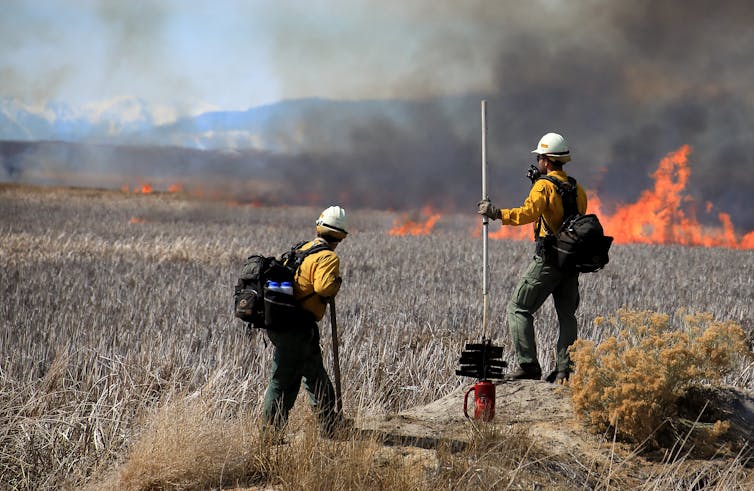
A wet winter and spring followed by a hot, dry summer can be a dangerous combination in the Western U.S. The rain fuels bountiful vegetation growth, and when summer heat dries out that vegetation, it can leave grasses and shrubs ready to burn.
In years like this, controlled burns and prescribed fire treatments are crucial to help protect communities against wildfires. Well-staffed fire crews ready to respond to blazes are essential, too.
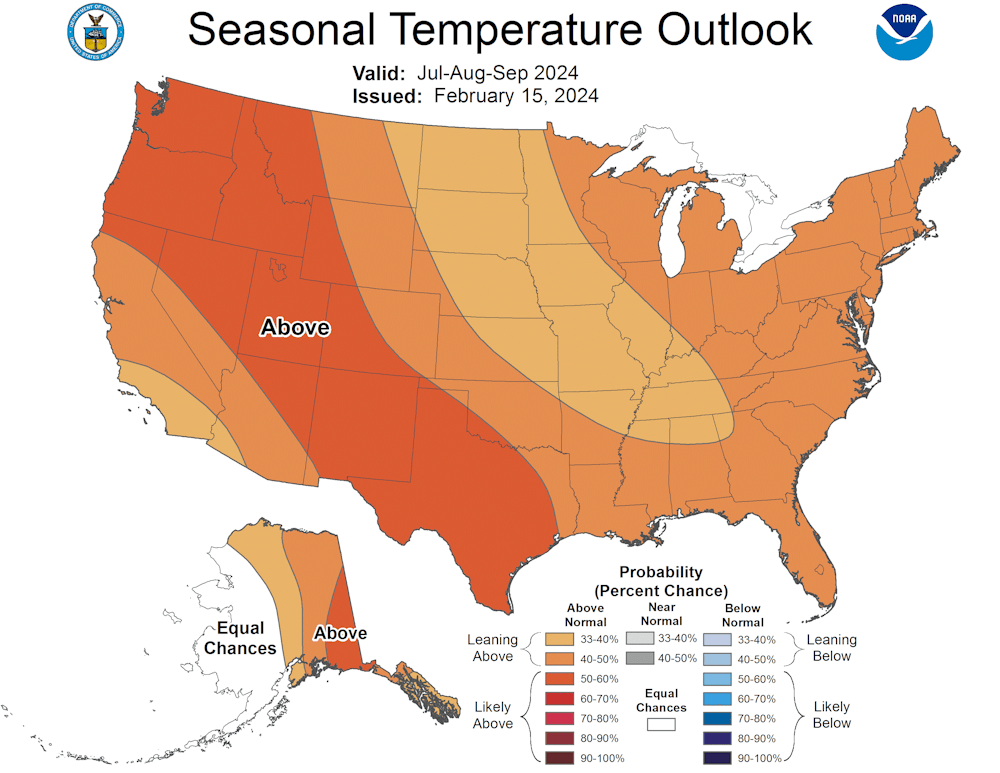
These are some of the reasons why an announcement from U.S. Forest Service Chief Randy Moore on Feb. 8, 2024, is raising concerns. Moore told agency employees to expect budget cuts from Congress in 2024. His letter was thin on details. However, taken at face value, budget cuts could be interpreted as a reduction in the firefighting workforce, compounding recruitment and retention challenges that the Forest Service is already facing.
So what does this mean for the coming fire season? We study wildfire policy and fire ecology, and one of us, Camille Stevens-Rumann, has worked as a wildland firefighter. Here are a few important things to know.
The fire funding fix
While Moore’s letter raises concerns, the financial reality for fighting fires this year is likely less dire than it might otherwise be for one key reason.
The 2018 Consolidated Appropriations Act included what is known as the “fire funding fix.” It introduced a new budget structure, creating a separate disaster fund accessible during costly wildfire seasons. The fire funding fix allows federal firefighting agencies to access up to US$2.25 billion in additional disaster funding a year starting in 2020 and increasing to $2.95 billion in 2027.
Prior to the fire funding fix, fighting fires – suppression expenditures – consumed nearly 50% of the U.S. Forest Service budget. As bad fire years worsened, that left less funding for the agency’s other services, including conducting fuel treatments, such as prescribed burns, to reduce the risk of wildfires spreading.
The fix protects agency budgets, ensuring that a high-cost fire season will not completely consume the budget, and that allows more funding for preventive efforts and all the other programs of the Forest Service.
Prevention is a rising priority
The Forest Service has also made fire prevention a higher priority in recent years.
In 2022, it released a Wildfire Crisis Strategy and Implementation Plan that included ramping up fuel treatments to reduce the potential for large uncontrollable fires, as the West had seen in previous years. It called for treating up to an additional 50 million acres over 10 years.
That work won’t be completed before the 2024 fire season, but fuel treatments will be underway. They include prescribed burning to remove dry grasses, twigs, logs and other fuels in a controlled way and the use of heavy equipment to thin dense forest areas and create fire breaks by removing trees and vegetation.
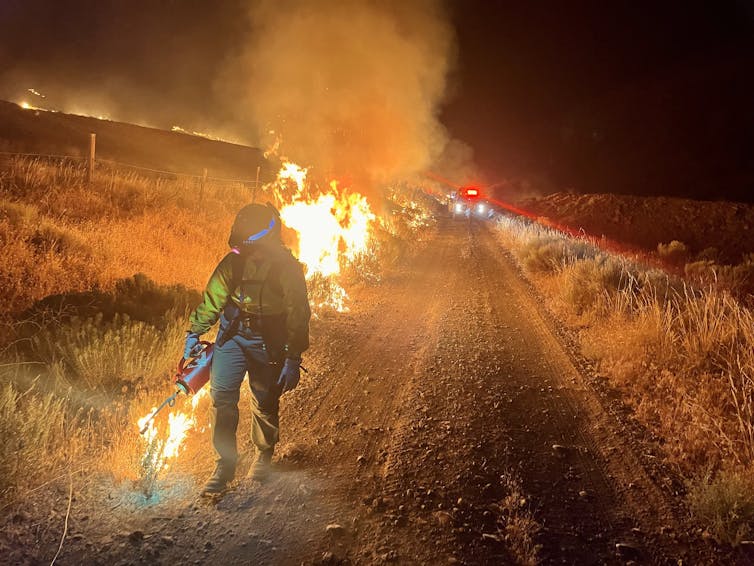
Prescribed burning must be done when conditions are safe to limit the potential for the fire to get out of control, usually in the spring and early summer. However, climate change is expected to shorten the prescribed burning window in the western U.S.
Staffing is still a concern
Doing this work requires staff, and the Forest Service’s challenges in recruiting and retaining qualified firefighters may hinder its ability to accomplish all of its objectives.
In 2023, over 18,000 people were employed as federal wildland firefighters. While the Forest Service and Department of the Interior have not specified precise staffing targets, Moore has mentioned that “some crews have roughly half the staff they need.”
A recent Government Accountability Office report found that low wages and poor work-life balance, among other challenges, were barriers commonly cited by federal firefighting employees. The government boosted firefighters’ pay in 2021, but that increase is set to expire unless Congress votes to make it permanent. So far, firefighters have kept the same level of pay each time Congress pushed back acting on the 2024 budget, but it’s a precarious position.
The agency has started many initiatives to recruit and retain permanent employees, but it is too early to assess the results. A recent study involving one of us, Jude Bayham, found that highly qualified firefighters were more likely to remain with the agency after active seasons, during which they earn more money.
Everyone has a role in fire protection
Even with optimal funding and staffing, the firefighting agencies cannot protect every area from wildfire. Some of the defensive work will have to be done by residents in high-risk areas.
Homeowners can reduce the fire risk to their own properties by following defensible space recommendations.
These include keeping flammable vegetation away from buildings and reducing other fire hazards such as wood shingles, flammable debris in yards and pine needles in gutters. People should also pay attention to burn bans and avoid risky activities, such as leaving campfires unattended, setting off fireworks and using equipment that can spark fires on hot, dry, windy days.
The federal government and states have increased funds to help people reduce wildfire hazards on their property. The Bipartisan Infrastructure Law of 2021 included millions of dollars to support fire prevention on state, tribal and private lands. Several states also have programs, such as Colorado’s Forest Restoration and Wildfire Risk Mitigation Grant Program to support community investment in wildfire mitigation.
Recent disastrous wildfire seasons have shown how important it is to manage the fire risk. Consistent funding is crucial, and homeowners can help by taking defensive action to reduce wildfire risk on their property.
Camille Stevens-Rumann, Associate Professor of Forest and Rangeland Stewardship, Colorado State University and Jude Bayham, Associate Professor of Agricultural and Resource Economics, Colorado State University
This article is republished from The Conversation under a Creative Commons license. Read the original article.
- Details
- Written by: Lake County News reports
“Wildfires strike without regard to county lines or utility service areas, so we need a coordinated and comprehensive approach to keeping California safe,” Sen. Dodd said. “We’ve made a lot of progress in recent years, but climate change continues to compound challenges and underscores the need for us to be thoughtful about how we do the most good, as quickly as possible, with our investments.”
Catastrophic wildfires impose enormous costs on California and its residents. In the aftermath of the Camp Fire, Sen. Dodd coauthored AB 1054, which created a framework for electric utilities to evaluate their wildfire risk and plan for wildfire mitigation investments and activities, overseen by the Office of Electric Infrastructure Safety within the California Natural Resources Agency.
More recently, the California Wildfire and Forest Resilience Task Force, a multi-agency effort to identify needs and develop strategies to better manage wildfire risk, has produced plans to better manage wildfire risk.
Current spending on utility wildfire mitigation exceeds $10 billion per year while state budget wildfire expenditures have grown to $2.7 billion over several years.
Meanwhile, the U.S. Forest Service announced major wildfire mitigation investments in California and other western states wildfire mitigation activities that will total $930 million. No framework exists to evaluate how these multiple activities will interact and might be coordinated to maximize their effectiveness and cost-effectiveness.
Sen. Dodd’s proposed Wildfire Mitigation Planning Act would require the Office of Electric Infrastructure Safety to prepare a report every three years to quantify the potential benefits of actions taken by state and private actors to reduce wildfire risk.
The bill also would require the office to prepare a wildfire risk baseline, forecasting wildfire risk and risk mitigation potential over the next one to 10 years. It would also mandate another report on annual wildfire mitigation scenarios, quantifying actual risk reduction from all entities and investments within California.
Finally, Sen. Dodd’s measure would empower the Office of Electric Infrastructure Safety to coordinate utility spending with the new planning framework in order to maximize the effectiveness of all investments related to wildfires in California.
“Preventing catastrophic wildfire requires strong coordination between all of our investments,” said Michael Wara, director of the Climate and Energy Policy Program at Stanford University. “Building on current efforts, this bill would create a planning structure to maximize the effectiveness of California's work to reduce the impacts of wildfire. As California spends more to prevent catastrophic wildfire, we should also make sure that these investments go as far as possible in keeping residents safe. This bill creates a planning structure that does just that and ensures that all our efforts are well coordinated.”
The act, also known as Senate Bill 1014, is expected to receive its first committee hearing and vote next month.
Any costs of the bill would be covered by private funding, not taxpayer dollars.
Dodd represents the Third Senate District, which includes all or portions of Napa, Solano, Yolo, Sonoma, Contra Costa and Sacramento counties.
- Details
- Written by: Lake County News reports

LAKE COUNTY, Calif. — Lake County Adult School has announced the success of its in-person learning program with skilled instructors, offering flexible and adaptable instruction.
“When I walk across that stage, I’ll show everyone who told me that I couldn’t, that I could,” said Faydra Perkett, a Lake County Adult School student.
The Lake County Adult School opened in September at the Lake County Campus of Woodland Community College.
This is a free, in-person, high school diploma completion program for adults ages 18 and up.
“Everyone can learn and succeed, but not always on the same day in the same way. The Lake County Adult School offers an opportunity for all Lake County residents to earn their High School Diploma,” said Lake County Superintendent of Schools Brock Falkenberg.
The Lake County Adult School has a 130-credit graduation requirement, ensuring a comprehensive and well-rounded educational experience.
This school provides a dynamic learning environment with flexible instruction methods to cater to diverse student needs.
Students at the Lake County Adult School have the unique opportunity for co-enrollment with Woodland Community College, enhancing their educational experience.

At the end of December, there were 33 students enrolled in the school and 19 more students who were in the enrollment process.
Four students have already graduated since the opening of the school.
The student body spans throughout Lake County, with attendees from as far south as Middletown to as far north as Lucerne, reflecting the school's regional impact.
Student success stories:
• Faydra and Allan Perkett: Faydra and Allan Perkett have been married for 28 years. Inspired by an 80-year-old diploma recipient, they decided to returned to school. With 30 credits remaining, they dedicate themselves to bi-weekly assignments, determined to prove it's never too late to pursue education.
• Derric Blakesley: The first Lake County Adult School high school graduate, Derric Blakesley, plans to continue his education at Woodland Community College, focusing on Fire Science.
• Christine Celeri: Christine Celeri achieved her diploma at Lake County Adult School to become a paraeducator. She now serves as a paraeducator at Lower Lake Elementary School, where her students attend school, contributing to their education.
Lake County Adult School remains committed to empowering its students with education that is both accessible and transformative, celebrating the success stories of individuals overcoming challenges to achieve their academic goals.
For more information, visit the LCOE website.