How to resolve AdBlock issue?
News
- Details
- Written by: LAKE COUNTY NEWS REPORTS
LOWER LAKE, Calif. — Last week, the Konocti Unified School District and Blue Zones LLC celebrated the launch of the school district’s commitment to a transformative well-being journey to improve the health and happiness of their employees.
Over the next three years, Konocti Unified will implement a comprehensive well-being strategy designed to achieve Blue Zones Worksite Certification. This makes Konocti Unified the first school district to embark on this journey.
In the Worksite Certification model, Blue Zones works with employers to optimize working environments and sharpen policies so healthier choices are easier for their employees.
Konocti Unified Superintendent Becky Salato expressed her desire to empower her employees. “I’m so excited to leverage this innovative opportunity to enhance our workplace so that every employee feels a change in their own life — whether it’s caring for their mental health, taking time to move more, or finding new ways to nurture work-life balance. This transformation will not only impact our teams but will also positively impact our students, our families, and ripple throughout our entire community.”
Konocti Unified is receiving support from national Blue Zones worksite experts to implement a comprehensive, evidence-based plan for improving employee well-being.
Blue Zones is the nationally recognized leader in well-being transformation, and its Worksite Certification model draws upon 20 years of experience in community and longevity science to empower organizations to cultivate thriving work environments.
The rigorous, multiyear commitment integrates the Blue Zones approach into the organization’s culture, aligning people, spaces, and policies to foster lasting change.
The Blue Zones Approach
Blue Zones focuses on creating surroundings and systems that default to healthier behaviors. The model is rooted in lessons learned from the world's healthiest, longest-lived cultures in the original blue zones regions, where residents make healthy choices because those choices are easy — even unavoidable — in their surroundings.
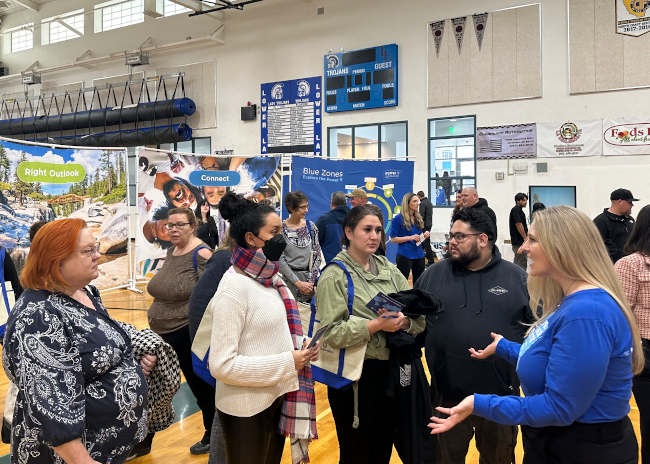
To celebrate the launch of their workplace transformation, Konocti Unified and Blue Zones celebrated with an all-employee interactive kickoff event — called Explore the Power 9 — on Thursday, Feb. 8.
Held in the Lower Lake High School gym, the event highlighted opportunities available to all KUSD employees to boost their well-being at home and at school through the various Power 9 principles — lifestyle habits from the world’s blue zones regions.
In the “Move Naturally” station, colleagues were inspired to incorporate movement throughout their workday and embrace their inner children with hopscotch.
A “Connect” area reminded colleagues of the energizing effects of joy and laughter with fun activities including a photo booth.
Blue Zones-inspired food dishes, provided by the local Blue Zones-inspired restaurant, Rosey Cooks, demonstrated how employees can incorporate more plant-based options into their meals.
During the presentation, guest speaker Margaret Brown, Blue Zones’ vice president of business development, spoke about the three-phased approach that will guide KUSD’s journey.
This approach focuses on people, places, and policy to tailor a blueprint for sustainable change. She emphasized KUSD’s recent diligent work with the Blue Zones worksite team and some of the best practices KUSD will implement to meet certification standards, including:
• Transform campus environments: Creating and mapping outdoor walking paths for each campus to encourage moving naturally, implementing breakroom initiatives to enhance private spaces for employees to downshift during the day, and other place-based optimizations.
• Improve employee policies: Developing a core work hours policy so employees can disconnect from work and connect with their families, friends, and purpose when they are not at work.
• Strengthen Social Connections: Building community through moais (social support groups), employee recognition, and volunteer opportunities.
• Enhanced well-being programming: Implementing purpose workshops; mental health, self-care, mindfulness training, and substance use prevention training.
• Improved food environment: Providing affordable and nutritious options throughout the workday so it’s easy for employees to eat wisely.
• Leadership development: Equipping leaders with skills to cultivate a thriving work environment.
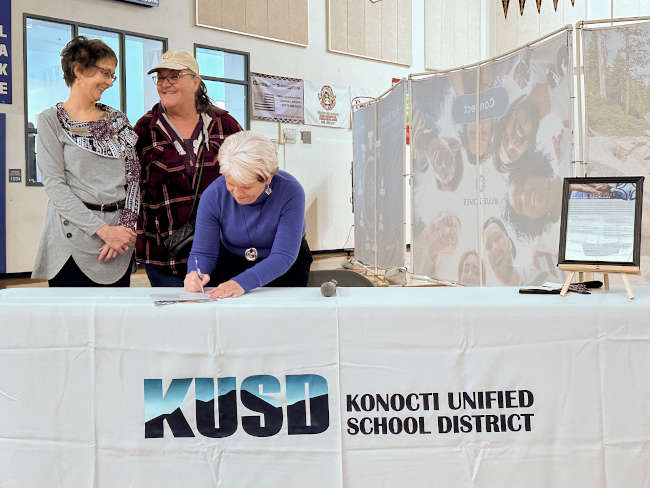
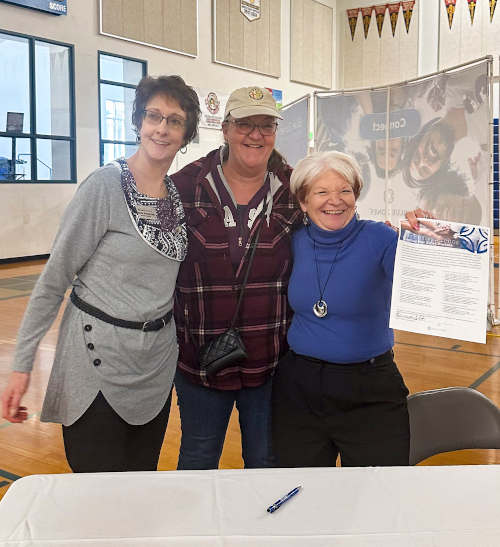
Surrounded by board members and leaders, Salato signed the Blue Zones Worksite Certification Pledge, which signifies Konocti Unified’s commitment to implement the strategies outlined in the blueprint.
Driven by a vision to create a healthier and more vibrant workplace, Konocti Unified secured a grant specifically dedicated to employee well-being.
The district will pursue Blue Zones Worksite Certification in addition to the student-focused work that they and other area school districts will participate in to become Blue Zones Project Approved Schools as part of Blue Zones Project — Lake County.
“KUSD’s commitment to employee well-being through Blue Zones Worksite Certification beautifully complements the ongoing efforts of Blue Zones Project — Lake County. This synergy will demonstrate the power of collective action and further strengthen the positive ripple effect of Blue Zones principles throughout the County to create a healthier, happier community for us all,” said Shelly Trumbo, Blue Zones national chief transformations officer and Lake County resident. “We’re grateful for the tremendous leadership and excitement of KUSD and look forward to celebrating improved well-being for KUSD and the entire community.”
- Details
- Written by: Elizabeth Larson
Oscar Rosas, 45, turned himself in a day after the crash, which occurred Wednesday night on Highway 20 east of Bridge Arbor Drive near Upper Lake.
The pedestrian who was injured was identified as 27-year-old Omar Romero of Lakeport, according to the California Highway Patrol’s Clear Lake Area office.
The agency said its officers responded to a report of a hit and run collision between a vehicle and pedestrian shortly after 8 p.m. Wednesday, during rainy and dark conditions.
The CHP said its preliminary investigation indicated a blue SUV struck Romero, who was walking south and was within the eastbound lanes of Highway 20.
After hitting Romero, the vehicle fled the scene on eastbound Highway 20, the CHP said.
Romero was transported to Sutter Lakeside Hospital in Lakeport with major injuries, which the CHP said included various blunt force trauma and a broken neck.
The CHP’s initial investigation efforts led officers to an address associated with the blue SUV, but no vehicle was located at that time.
At 5:25 p.m. Thursday, the CHP’s Ukiah Communications Center received a phone call from Rosas, who wanted to turn himself in to law enforcement, stating that his blue 2007 Ford Escape was involved in the collision.
The CHP said its officers responded to Rosas’ address in Clearlake where the Ford Escape was located with damage consistent with the hit and run traffic collision.
Rosas subsequently was arrested for felony hit and run just after 6:30 p.m. and transported and booked into Lake County Jail, the CHP said.
Email Elizabeth Larson at
- Details
- Written by: DENNIS FORDHAM

In California, people who own real property generally establish a revocable living trust, as settlors, and transfer title to their assets to themselves as trustees to avoid probate when they die.
While alive, a settlor retains the separate powers to revoke and amend their living trust, so long as they have the mental capacity to do so.
Trust amendments range from minor modifications to complete restatements of the entire trust itself.
Typically trust amendments may involve changes to who acts as successor trustee and/or who inherits what assets and/or share of the trust at the settlor’s death. To be valid, the trust amendment must be properly executed.
Sections 15401 and 15402 of the Probate Code say how a trust can be revoked or amended. Section 15402 provides that, “unless the trust instrument provides otherwise, if a trust is revocable by the settlor, the settlor may modify [amend] the trust by the procedure for revocation [in section 15401]." Trusts typically say how the settlor can validly revoke or amend the trust and typically require that the amendment be acknowledged by a notary public.
Until now, there was a longstanding disagreement amongst California’s appellate courts regarding whether a settlor had to follow the procedure stated in the trust itself to amend the trust or, alternatively, could follow the statutory procedure in section 15401 to revoke a trust that also applies to amending trusts.
Section 15401 provides that, “(a) A trust that is revocable by the settlor or any other person may be revoked in whole or in part by any of the following methods: (1) By compliance with any method of revocation provided in the trust instrument. (2) By a writing, other than a will, signed by the settlor or any other person holding the power of revocation and delivered to the trustee during the lifetime of the settlor or the person holding the power of revocation. If the trust instrument explicitly makes the method of revocation provided in the trust instrument the exclusive method of revocation, the trust may not be revoked pursuant to this paragraph.” Again, the rule in section 15401 applies to amending a trust and, importantly, does not require that the amendment be acknowledged by a notary public.
In Brianna Mckee Haggerty, v. Nancy F. Thornton S271483 (Cal. Feb 08, 2024) the California Supreme Court resolved the aforementioned legal disagreement — whether the amendment procedure in the trust must be followed to the exclusion of the statutory procedure in section 15401 — on a statewide basis.
The Supreme Court held that, “… under section 15402, a trust may be modified via the section 15401 procedures for revocation, including the statutory method, unless the trust instrument provides a method of modification and explicitly makes it exclusive, or otherwise expressly precludes the use of revocation procedures for modification.”
Typically speaking the statutory method in section 15401 is more easily fulfilled as the methods typically found in trusts all require an acknowledgement (as was the true in the Haggerty case) to be valid.
Of course, a trust may be drafted to require that its stated procedure for amending the trust is the only procedure that can be used and exclude the section 15401 statutory procedure which does not require a notarization of the amendment.
The foregoing brief discussion is not legal advice. Consult a qualified attorney for guidance.
Dennis A. Fordham, attorney, is a State Bar-Certified Specialist in estate planning, probate and trust law. His office is at 870 S. Main St., Lakeport, Calif. He can be reached at
- Details
- Written by: LAKE COUNTY NEWS REPORTS

As part of its evaluation of the Wolf-Livestock Compensation Pilot Program, the California Department of Fish and Wildlife is posting outstanding wolf depredation reports dating back to August 2023.
The depredation reports confirm 16 wolf depredations totaling a loss of 18 livestock. With this posting, CDFW can now finalize review of existing program applications and eligibility of livestock producers to receive payments for direct losses.
The Wolf-Livestock Compensation Pilot Program is the first of its kind in California and has thus far provided support to livestock producers in compensating for direct loss of livestock due to confirmed wolf depredation; supported non-lethal deterrence techniques such as the use of range riders, electrified fencing and flags (turbo fladry), camera surveillance, motion lights and guardian dogs; and compensated livestock producers for the impact of wolf presence on livestock.
CDFW received $3 million in funding from the Budget Act of 2021 and began receiving applications in February 2022. As of January 12, 2024, CDFW had received a total of 102 applications. At that time, CDFW notified the public that the applications received were projected to exhaust the current fund.
The efforts to implement the pilot program have been important to wolf conservation and supporting livestock producers in the state. Once the program is complete and evaluated, CDFW will make a summary public on its Gray Wolf webpage.