How to resolve AdBlock issue?
News
- Details
- Written by: Jack Burns, University of Colorado Boulder
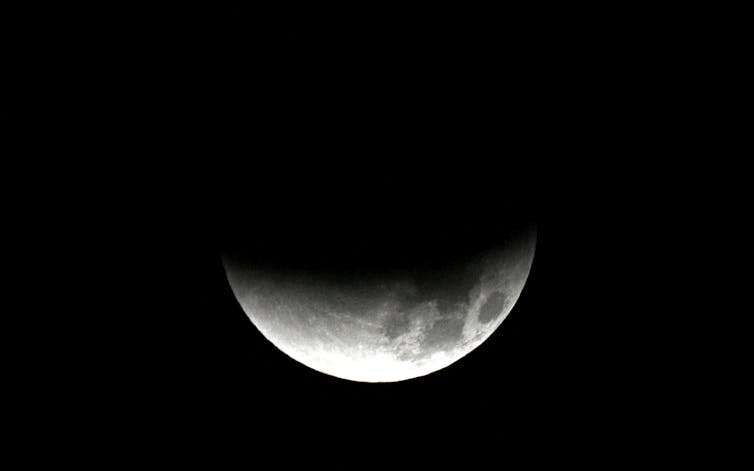
For the first time since 1972, NASA is putting science experiments on the Moon in 2024. And thanks to new technologies and public-private partnerships, these projects will open up new realms of scientific possibility. As parts of several projects launching this year, teams of scientists, including myself, will conduct radio astronomy from the south pole and the far side of the Moon.
NASA’s commercial lunar payload services program, or CLPS, will use uncrewed landers to conduct NASA’s first science experiments from the Moon in over 50 years. The CLPS program differs from past space programs. Rather than NASA building the landers and operating the program, commercial companies will do so in a public-private partnership. NASA identified about a dozen companies to serve as vendors for landers that will go to the Moon.
NASA buys space on these landers for science payloads to fly to the Moon, and the companies design, build and insure the landers, as well as contract with rocket companies for the launches. Unlike in the past, NASA is one of the customers and not the sole driver.
CLPS launches
The first two CLPS payloads are scheduled to launch during the first two months of 2024. There’s the Astrobotics payload, which launched Jan. 8 before experiencing a fuel issue that cut its journey to the Moon short. Next, there’s the Intuitive Machines payload, with a launch scheduled for mid-February. NASA has also planned a few additional landings – about two or three per year – for each of the next few years.
I’m a radio astronomer and co-investigator on NASA’s ROLSES program, otherwise known as Radiowave Observations at the Lunar Surface of the photoElectron Sheath. ROLSES was built by the NASA Goddard Space Flight Center and is led by Natchimuthuk Gopalswamy.
The ROLSES instrument will launch with Intuitive Machines in February. Between ROLSES and another mission scheduled for the lunar far side in two years, LuSEE-Night, our teams will land NASA’s first two radio telescopes on the Moon by 2026.
Radio telescopes on the Moon
The Moon – particularly the far side of the Moon – is an ideal place to do radio astronomy and study signals from extraterrestrial objects such as the Sun and the Milky Way galaxy. On Earth, the ionosphere, which contains Earth’s magnetic field, distorts and absorbs radio signals below the FM band. These signals might get scrambled or may not even make it to the surface of the Earth.
On Earth, there are also TV signals, satellite broadcasts and defense radar systems making noise. To do higher sensitivity observations, you have to go into space, away from Earth.
The Moon is what scientists call tidally locked. One side of the Moon is always facing the Earth – the “man in the Moon” side – and the other side, the far side, always faces away from the Earth. The Moon has no ionosphere, and with about 2,000 miles of rock between the Earth and the far side of the Moon, there’s no interference. It’s radio quiet.
For our first mission with ROLSES, launching in February 2024, we will collect data about environmental conditions on the Moon near its south pole. On the Moon’s surface, solar wind directly strikes the lunar surface and creates a charged gas, called a plasma. Electrons lift off the negatively charged surface to form a highly ionized gas.
This doesn’t happen on Earth because the magnetic field deflects the solar wind. But there’s no global magnetic field on the Moon. With a low frequency radio telescope like ROLSES, we’ll be able to measure that plasma for the first time, which could help scientists figure out how to keep astronauts safe on the Moon.
When astronauts walk around on the surface of the Moon, they’ll pick up different charges. It’s like walking across the carpet with your socks on – when you reach for a doorknob, a spark can come out of your finger. The same kind of discharge happens on the Moon from the charged gas, but it’s potentially more harmful to astronauts.
Solar and exoplanet radio emissions
Our team is also going to use ROLSES to look at the Sun. The Sun’s surface releases shock waves that send out highly energetic particles and low radio frequency emissions. We’ll use the radio telescopes to measure these emissions and to see bursts of low-frequency radio waves from shock waves within the solar wind.
We’re also going to examine the Earth from the surface of the Moon and use that process as a template for looking at radio emissions from exoplanets that may harbor life in other star systems.
Magnetic fields are important for life because they shield the planet’s surface from the solar/stellar wind.
In the future, our team hopes to use specialized arrays of antennas on the far side of the Moon to observe nearby stellar systems that are known to have exoplanets. If we detect the same kind of radio emissions that come from Earth, this will tell us that the planet has a magnetic field. And we can measure the strength of the magnetic field to figure out whether it’s strong enough to shield life.
Cosmology on the Moon
The Lunar Surface Electromagnetic Experiment at Night, or LuSEE-Night, will fly in early 2026 to the far side of the Moon. LuSEE-Night marks scientists’ first attempt to do cosmology on the Moon.
LuSEE-Night is a novel collaboration between NASA and the Department of Energy. Data will be sent back to Earth using a communications satellite in lunar orbit, Lunar Pathfinder, which is funded by the European Space Agency.
Since the far side of the Moon is uniquely radio quiet, it’s the best place to do cosmological observations. During the two weeks of lunar night that happen every 14 days, there’s no emission coming from the Sun, and there’s no ionosphere.
We hope to study an unexplored part of the early universe called the dark ages. The dark ages refer to before and just after the formation of the very first stars and galaxies in the universe, which is beyond what the James Webb Space Telescope can study.
During the dark ages, the universe was less than 100 million years old – today the universe is 13.7 billion years old. The universe was full of hydrogen during the dark ages. That hydrogen radiates through the universe at low radio frequencies, and when new stars turn on, they ionize the hydrogen, producing a radio signature in the spectrum. Our team hopes to measure that signal and learn about how the earliest stars and galaxies in the universe formed.
There’s also a lot of potential new physics that we can study in this last unexplored cosmological epoch in the universe. We will investigate the nature of dark matter and early dark energy and test our fundamental models of physics and cosmology in an unexplored age.
That process is going to start in 2026 with the LuSEE-Night mission, which is both a fundamental physics experiment and a cosmology experiment.
Jack Burns, Professor of Astrophysical and Planetary Sciences, University of Colorado Boulder
This article is republished from The Conversation under a Creative Commons license. Read the original article.
- Details
- Written by: Elizabeth Larson
The letter, dated Jan. 31, is the result of a regulation the State Water Resources Control Board approved in December that allows it to ask for information from a large area around Lake County, said Jessica Bean, assistant deputy for drought and water rights modernization in the Water Board’s Division of Water Rights.
Bean said the Water Board’s quest for information traces back to the Board of Supervisors’ unanimous approval, a year ago this month, of the proclamation of a local emergency as a step toward trying to save the Clear Lake hitch, a native minnow, from potential extinction. The board voted on Tuesday to continue that emergency.
The Board of Supervisors’ action was followed by a direction issued by Gov. Gavin Newsom in March that the Water Board begin to evaluate instream flows, work with tribes and other water users on voluntary actions, and consider emergency regulations to protect the hitch.
As a result, Bean said the Water Board started digging into the available information to see how water use is impacting the hitch.
She said that, often, there is a connection between groundwater and streamflow. “The problem is, we just don’t know much about that in Clear Lake, what is happening,” and the state is trying to understand how it could impact flows, she said.
The Water Board hired an environmental consultant to do a groundwater and surface water study. “We need data to do that,” Bean said.
So in September, the Water Board released draft emergency regulations, which were open for public comment for 60 days, that focused on streams and headwaters across Clear Lake’s watershed, although Bean said the study area doesn’t include the entire watershed. That led to the information regulation accepted in December.
Bean said the letter requesting information has been sent to about 1,300 property owners representing 2,300 parcels in Lake County.
The letter states, “The Order is being sent to people who own or are responsible for properties located within the Big Valley Groundwater Basin; within approximately 1,000 feet of Rodman Slough, Middle Creek, Lyons Creek, Clover Creek, Tule Lake, Blue Lakes, Scotts Creek, Adobe Creek, Kelsey Creek, Cole Creek, Manning Creek, and/or McGaugh Slough; upstream of hitch spawning habitat that may have substantial surface water diversions; and/or in areas where groundwater may be connected to key hitch spawning habitat.”
The Water Board’s information regulation went into effect on Jan. 22 and will continue through Jan. 21, 2025, unless the board readopts it, Bean said. That means that the information gathering going on now is not expected to continue beyond next year.
She said it’s a tight timeline for information gathering, and that it is unlikely that there will be additional reporting requirements from water users in the impacted areas in 2024.
Many of the people who received the order may only have domestic water usage, not usage for agriculture. In that case, Bean said, those with domestic water for home or hobby ranching can complete a simple certification by Feb. 29.
Those who are doing large commercial agricultural irrigation will be required to do more, including measuring groundwater extraction and completing reports. They must also certify that they received the order and choose a reporting pathway — either directly to the Water Board or through the Lake County Farm Bureau — by Feb. 29.
Larger water users must then submit two more reports.
The first, due by March 31, must report on water diversions, extractions and use for the month of March. The second report, due Aug. 31, will cover usage through July 31.
Detailed guidance is available in the information order letter and online at the Water Board’s webpage set up for the hitch order.
Bean emphasized a key point: “We're not requiring people to use meters,” she said, noting that people have been very concerned about that.
There also is guidance on how to calculate water usage without a meter on the webpage.
Bean said they have so far received a lot of calls and emails from people asking questions — especially domestic water users.
“The main people that have been reaching out to us are folks unfamiliar with the hitch issue,” said Bean.
At the same time, earlier this week the Water Board was still developing its guidelines. The weekend storm caused internet outages that resulted in tech issues for the rollout of their online guidance, Bean said.
Lake County News received reports from those who had received letters that the informational phone number was going immediately to voicemail. Bean said that’s because they don’t have a phone bank and only a small team that’s working on the process.
Bean said they are responding to people as quickly as they can, working with them one-on-one when necessary. Anyone with questions is encouraged to call or email and leave specifics about their concerns along with their parcel number.
“If people can be a little patient with us and know that we are actively working on it even if you haven’t heard back from us,” Bean said.
She said they are happy to walk people through the process. “We respect and understand the fact that it is complex” and that people would need help, Bean said.
Farm Bureau offers guidance and support
At the Lake County Farm Bureau, which is a second reporting pathway, Executive Director Rebecca Harper said she’s been inundated with calls and emails from people who are upset about the order, which is vague in its wording.
She said she’s been contacted by many older people who don’t have computer access to fill out the information online.
“That’s been a good chunk of what I’m hearing,” said Harper.
Harper explained that it’s important for people to read the entire order. She said that there is a tendency to start freaking out when opening a certified letter from the state, and it’s key to be familiar with what is required.
Once they’ve read the entire order, she said people should seek help from the listed resources — either the Water Board or the Farm Bureau.
She emphasized that while domestic water users have exemptions, they still must complete the outlined steps, including certification.
When it comes to the reporting pathways, Harper said those who use the Lake County Farm Bureau — instead of going direction to the Water Board — are given privacy protection.
Call Harper at 707-263-0911 or email
For additional help, an in-person compliance workshop will take place at 11 a.m. Friday, Feb. 16, in Room 109 at the Lake County Courthouse, 255 N. Forbes St. in Lakeport.
The text of the information order is below.
Email Elizabeth Larson at
Purpose of the Order
The purpose of the Order is to gather information from water users in the Clear Lake watershed to better understand how groundwater pumping and surface water diversions affect creek flows critical for the Clear Lake hitch (hitch). The hitch population, which is a threatened species under the California Endangered Species Act, has been declining for some time and recent droughts have further impacted the population. A primary threat to hitch survival is water availability in creeks where the hitch spawn and migrate. Degraded habitat, passage barriers, predation, competition with invasive species, and pollution also can affect the health of the species.
Whv You Are Receiving the Order
The Order is being sent to people who own or are responsible for properties located within the Big Valley Groundwater Basin; within approximately 1,000 feet of Rodman Slough, Middle Creek, Lyons Creek, Clover Creek, Tule Lake, Blue Lakes, Scotts Creek, Adobe Creek, Kelsey Creek, Cole Creek, Manning Creek, and/or McGaugh Slough; upstream of hitch spawning habitat that may have substantial surface water diversions; and/or in areas where groundwater may be connected to key hitch spawning habitat.
Where to Access Reporting Platforms and Resources
All information related to the Order is available on the State Water Board's Clear Lake Order webpage, which is located at waterboards.ca.gov/clearlakehitch/order. This webpage includes links to the Board's online reporting platform, guidance documents, and more. You can also access the webpage from the Board's main Clear Lake Hitch website at waterboards.ca.gov/clearlakehitch/order.
What You Need to Do
Recipients of the Order are required to complete the following activities:
(1) Certify receipt of the Order and confirm reporting pathway by February 29, 2024.
(2) Measure and record groundwater extractions by well from March 1, 2024 through July 31, 2024.
(3) Submit two reports that provide information related to diversion, extraction, and/or use of water relevant to the Board's Clear Lake hitch protection efforts: Report 1 is due by March 31, 2024. Report 2 is due by August 31, 2024. The information you must provide in each report and a list of items to gather before you report are available on the Clear Lake Order webpage.
Even if you are not currently pumping groundwater or diverting surface water, you must comply with the Order. If you fail to comply with the Order, you may be fined or subject to other enforcement action. This Order does not replace any other reporting requirements. Please continue to comply with all reporting requirements you may be subject to.
How to Comply
This section explains how to complete the required activities:
(1) How to Certify Receipt of the Order and Confirm Reporting Pathway
You must certify that you received the Order and confirm your reporting pathway through the State Water Board's online reporting platform. Reporting pathways are discussed below. The link to the Board's online reporting platform can be found on the Clear Lake Order webpage. The platform requires you enter the following access code: ClearLake.
(2) How to Measure Groundwater Extractions
You are required to measure and record weekly groundwater extractions by well from March 1, 2024, through July 31, 2024, using a method acceptable to the Board. You will provide these measurements in Report 2. For a list of acceptable measurement methods and templates for collecting measurements, please visit the Clear Lake Order Webpage.
(3) How to Report
There are two pathways for reporting. You can either directly report to the State Water Board or you can report through the Lake County Farm Bureau Education Corporation (LCFBEC) Alternative Compliance Pathway (Pathway).
• Pathway A: Directly report to the State Water Board
This is the default option for anyone who receives the Order. If you choose this option, you must submit your reports through the Board's online reporting platform. This is the same platform you will use to certify receipt of the Order and confirm your reporting pathway. However, the platform will open for Report 1 submissions no later than March 1, 2024, and Report 2 submissions no later than Aug. 1, 2024.
• Pathway B: Report through the LCFBEC Pathway
To report through the LCFBEC Pathway, you must register with the Lake County Farm Bureau (LCFB) by Feb. 29, 2024. Details are available on the Clear Lake Order webpage.
Once you register for the LCFBEC pathway, you will submit reports to the LCFB and the LCFB will submit report summaries and datasets to the Board. The LCFB will provide instructions on how to report after you register. You must call or email Rebecca Harper with the LCFB at (707) 263-0911 or
Due dates are the same no matter which reporting pathway you choose.
How to Learn More and Ask Questions
We understand these are new requirements and you may have questions. The following resources are available to help:
• Clear Lake Hitch Website — waterboards.ca.gov/clearlakehitch
Details on the Order, resources to help you comply, and information about other hitch activities are available on the State Water Board's Clear Lake Hitch website. You can access the Clear Lake Order webpage from this website.
• Compliance Workshop — Friday, Feb. 16, 2024, 11:00 am in Lakeport
Ask questions and receive details on reporting pathways, deadlines, resources, and more at the in-person workshop (255 N. Forbes St., Room 109, Lakeport, CA 95453).
• Virtual Office Hours
We will hold office hours to help you fill out reports. Dates and times will be posted on the State Water Board's Clear Lake Hitch website.
• Email Subscription List
Receive key updates from our email subscription list. Sign-up information is available on the Board's Clear Lake Hitch website.
• Email or call us at
- Details
- Written by: Lake County Association of Realtors
Over the month of December 2023, a total of 54 single family homes were sold through the multiple listing service, compared to 59 in November and 73 sold a year ago during the month of December 2022.
These include traditionally built “stick-built” houses as well as manufactured homes on land.
In 2023, the county offices were closed during the last two weeks of the year and there were home sales that were unable to close in December because the Recorder’s Office was not open. This may be part of the reason for the fewer number of sales in December.
There were six sales of mobile homes in parks in December, compared to four in November and five sold a year ago during the month of December 2022.
For bare land — lots and acreage — 16 were sold in December, compared to 25 closed land sales in November and the 15 sold during that time the previous year in December 2022.
There are 347 “stick built” and manufactured homes on the market right now. If the rate of sales stays the same at 54 homes sold per month, there are currently 6.4 months of inventory on the market at the moment. That means that if no new homes are brought to the market for sale, in 6.4 months, all of these homes would be sold and there would be no homes available for sale.
Less than 6 months of inventory is generally considered to be a “sellers’ market” while more than 6 months of inventory is often called a “buyers’ market.”
December’s data is substantially the same as November, when there was 6.6 months of inventory available.
Agents are currently reporting an uptick in requests for property tours in January, so perhaps the market will be picking up somewhat.
The total percentage of homes bought for all cash in December:
• 35%, compared to 41% for November and 34% for December 2022;
• 37% were financed by Fannie Mae or Freddie Mac (“conventional loans”) compared to 29% for November and 44% for December 2022;
• 20% were financed by FHA, compared to 17% in November and 10% in December 2022;
• 1% were financed by the VA or CalVet, compared to 7% in November and 4% for December 2022;
• 4% had other financing such as private loans, USDA, or seller financed notes, compared to 3% in November, and compared to 6% for December 2022.
None of the closed sales in December were reported as assumable loans that were assumed by the buyer.
The homes in December sold at an average of 94.6% of the asking price at the time the property went under contract, but an average of 88% when compared to the original asking price when the property first came on the market. This means that the asking home prices had been reduced from their original list prices on the homes that sold before they actually sold.
In November, homes also sold for 96% of the asking price at the time the property went under contract, and 89% of the original asking price.
In December 2022, homes were selling at 95% of the asking price at the time the property went under contract and at 88%when compared to the original asking price.
The median time on the market in December was 62 days, compared to 32 days in November and 54 days in December 2022.
The median sale price of a single family home in Lake County in December was $305,000, which is higher than the $269,000 median sale price for November but lower than the median sale price of $320,500 during December 2022.
This would indicate that last month, the higher priced homes were selling in greater numbers to bring the median sale price up compared to November 2023.
The median asking price of homes on the market right now is $360,000, which is about the same as November’s $357,000.
In December, 37% of homes sold had seller concessions for an average concession of $7,679; the rate of concessions is higher compared to November 2023’s numbers, when 31% of homes sold had seller concessions with an average concession of $11,286. In December 2022, 29% of homes sold had an average seller concession of $7,614.
In December 2023, average concessions were highest for FHA loans, with an average concession of $14,206.
VA loans had an average concession of $7,600; conventional loans had an average concession of $3,325.
The 19 cash sales had no seller concessions (rather, they show up this month as a lowered sale price instead of seller credits being given in escrow).
- Details
- Written by: Lake County News reports
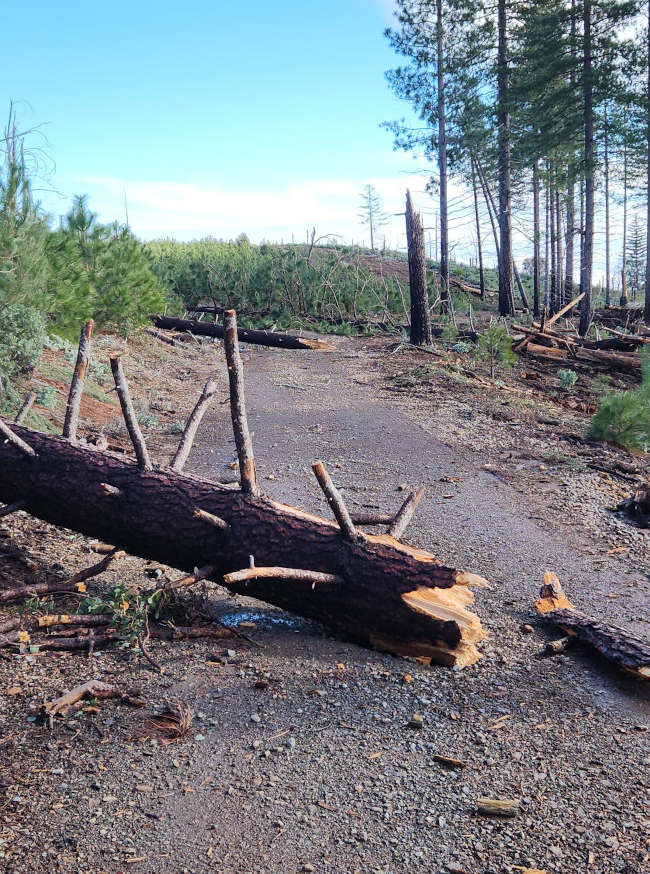
COBB, Calif. — Cal Fire reported this week that its Boggs Mountain Demonstration State Forest has experienced significant damage from the winter storms that began last month and culminated with the pineapple express that hit on Sunday.
The storms resulted in downed trees in recreation sites, on roads and trails, creating safety issues for the public, Cal Fire reported.
As a result, Cal Fire said vehicle access will be restricted to the main parking lot until further notice while crews work to clear the roads.
Cal Fire asked community members to use special caution due to the downed trees, limbs and debris.
Boggs has been in winter season management since Nov. 1 but remains open for day use only from sunrise to sunset by foot, bicycle and equestrian use. Forest roads are subject to temporary closure pending wet weather conditions.
Call the Boggs Mountain Demonstration State Forest office at 707-928-4378 or visit them online at www.fire.ca.gov for more information.