How to resolve AdBlock issue?
News
- Details
- Written by: Elizabeth Larson
Rain is expected to return on Valentine’s Day and continue on into the weekend when a larger storm system is expected to arrive over much of the state.
The National Weather Service’s Climate Prediction Center said hazardous rains, winds and flooding could return to California from Saturday, Feb. 17, through Wednesday, Feb. 21.
Lake County is in the area projected to receive heavy rainfall, based on the center’s mapping.
The Climate Prediction Center said the storms will bring significant flooding risk throughout California, especially those areas — including Lake County — where soils remain saturated by the storms that took place in late January and early February.
In addition to chances of flooding, the Climate Prediction Center said there is at least a 60% chance of “hazardous, heavy precipitation” across California, with heavy snow possible in higher elevations.
High winds are also in the forecast for Lake County during that time period, the Climate Prediction Center reported.
Email Elizabeth Larson at
- Details
- Written by: Elizabeth Larson
The council will meet Tuesday, Feb. 13, at 6 p.m. in the council chambers at Lakeport City Hall, 225 Park St.
The council chambers will be open to the public for the meeting. Masks are highly encouraged where 6-foot distancing cannot be maintained.
If you cannot attend in person, and would like to speak on an agenda item, you can access the Zoom meeting remotely at this link or join by phone by calling toll-free 669-900-9128 or 346-248-7799.
The webinar ID is 973 6820 1787, access code is 477973; the audio pin will be shown after joining the webinar. Those phoning in without using the web link will be in “listen mode” only and will not be able to participate or comment.
Comments can be submitted by email to
At Tuesday’s meeting, the council is set to adopt the resolution confirming the existence of a local emergency due to the February storms.
The full text of the resolution is below.
WHEREAS, Chapter 2.28 of the Lakeport Municipal Code, adopted as Ordinance Number 832 of the City of Lakeport empowers the Director of Emergency Services to proclaim the existence or threatened existence of a local emergency when the City of Lakeport is affected or likely to be affected by a public calamity and the City Council is not in session, subject to ratification by the City Council within seven (7) days; and
WHEREAS, conditions of extreme peril to the safety of persons and property have arisen within this City as a result of severe weather conditions including heavy rain, and extreme wind, commencing on or about February 4, 2023, which has resulted in significant damage to property, infrastructure, and public safety within the city limits; and at which time the City Council of the City of Lakeport was not in session; and
WHEREAS, the City Council does hereby find that aforesaid conditions of extreme peril did warrant and necessitate the proclamation of existence of a local emergency; and
WHEREAS, the Director of Emergency Services of the City of Lakeport did proclaim the existence of a local emergency within the City on the 7 th day of February, 2024; and
WHEREAS, the City Council does hereby find that aforesaid conditions of extreme peril did warrant and necessitate the proclamation of existence of a local emergency.
NOW, THEREFORE, IT IS HEREBY RESOLVED AND ORDERED that the City Council hereby proclaims a local emergency due to the existence or threatened existence of conditions of disaster or of extreme peril to the safety of persons and property within the City of Lakeport; and
IT IS FURTHER RESOLVED AND ORDERED that the Director of Emergency Services’ Proclamation of Existence of a Local Emergency is hereby ratified and confirmed; and
IT IS FURTHER RESOLVED AND ORDERED that the local emergency shall be deemed to continue to exist until its termination is proclaimed by the City Council of the City of Lakeport;
and
IT IS FURTHER RESOLVED AND ORDERED that during the existence of this local emergency the powers, functions and duties of the Disaster Council of the City of Lakeport and its Director of Emergency Services shall be those prescribed by state law, and by the ordinances and resolutions of this City; and
IT IS FURTHER ORDERED that a copy of this Resolution be forwarded to the State Director of the Office of Emergency Services; and
IT IS FURTHER ORDERED that Kevin Ingram, Director of Emergency Services of the City of Lakeport, is hereby designated as the authorized representative of the City of Lakeport for the purpose of receipt, processing, and coordination of all inquiries and requirements necessary to obtain available State and Federal assistance. This resolution shall be effective upon its adoption.
THIS RESOLUTION was passed by the City Council of the City of Lakeport at a regular meeting thereof on the 13th day of February 2024, by the following vote:
AYES:
NOES:
ABSTAINING:
ABSENT:
_________________________________
Michael Froio, Mayor
ATTEST:
_______________________________
Kelly Buendia, City Clerk
Email Elizabeth Larson at
- Details
- Written by: Justin de Benedictis-Kessner, Harvard Kennedy School

Elected representatives in government don’t always look like the people they serve.
The people who serve in local governments – cities, counties and other entities below the state level – represent the vast majority of elected officials in the U.S. My recent research with Diana Da In Lee, Yamil Velez and Chris Warshaw finds that, like in the federal and state governments, nonwhite people are drastically underrepresented in local government.
We gathered elections data on city, county and school district elections over the last three decades from medium and large places – any city with a population of at least 50,000 people and any county with a population of at least 75,000 in 2020. These 877 different cities and 1,005 different counties encompass more than half of the U.S. population. Using that data, we calculated the share of winning candidates who were members of several racial and ethnic groups.
In each place, we compared the percentage of the population from each of those demographic groups with the percentage of elected officials from those same groups. This allowed us to gauge whether each of these demographic groups was proportionally represented, or if they were overrepresented or underrepresented among their local politicians.
Municipal officials
Across cities in the U.S., we looked at the offices of mayor and city councilor. One commonality stands out: Nearly universally, the percentage of elected officials who are white is higher than the white share of the population. This overrepresentation persists from the early 1990s – the first time period from which we have data – to more recent years among mayors. Among city councilors, it’s a bit closer to parity with the population.

For mayors in recent years, there is a particularly large gap: On average, 78% of mayors are white, while only 68% of the population in the cities in our data is white. City councilors, on the other hand, tend to look much more like the population in their cities.
This overrepresentation of white residents comes at the expense of Hispanic and Asian residents. Nearly 17% of residents in cities are Hispanic and 5% are Asian. But only 6% of mayors are Hispanic and only 2% are Asian.
County officials
In medium and large counties where we collected elections data, we made similar comparisons for county executives, county legislators, sheriffs and prosecutors. Again, across these local elected offices, there are far more, as a percentage, white elected officials than there are white residents of these counties.
Just under 70% of residents of the counties in our data are white. But over 76% of county executives are white, over 85% of county legislators are white, 83% of sheriffs are white, and nearly 89% of prosecutors are white.
Again, the overrepresentation of white residents among local elected officials happens as other racial and ethnic groups are underrepresented in their county governments. Black residents make up 11% of the population in counties in our data, but only 9% of county legislators. And Hispanic and Asian residents are more drastically underrepresented in county offices. In our data, 11% of county residents are Hispanic, while 3% are Asian. But 5% or less of politicians holding office in any county elected position are Hispanic. And Asians make up 1% or less of elected county legislators, sheriffs and prosecutors.
School boards
Data on school boards’ representation is less clear because our data collection on school boards was less comprehensive than our data on city and county elections. But the apparent trend among the school districts where we gathered data is similar.
School boards have become a flashpoint for various political efforts, including teaching about race and racism and requests to ban books. And they are substantially more white than the communities they serve.
Less than half of the constituents in the school districts in our data are white, but more than two-thirds of school board members are white. Of the districts in our study, 22% of the residents were Black and 6% were Asian, but just 10% of board members are Black and just 3% are Asian. Hispanic residents, who made up 24% of the population, were more closely represented, but still not equally, with 20% of board members.
What does this mean for representation across the U.S.? Local elected officials make important and often contentious decisions governing the lives of millions of city and county residents. Race and other demographic features of both residents and elected officials do not, by any means, offer a conclusive picture of their respective policy preferences. But the fact that local governments look so different from their residents doesn’t paint a sunny picture of representation in local government.
Justin de Benedictis-Kessner, Assistant Professor of Public Policy, Harvard Kennedy School
This article is republished from The Conversation under a Creative Commons license. Read the original article.
- Details
- Written by: Lake County News reports
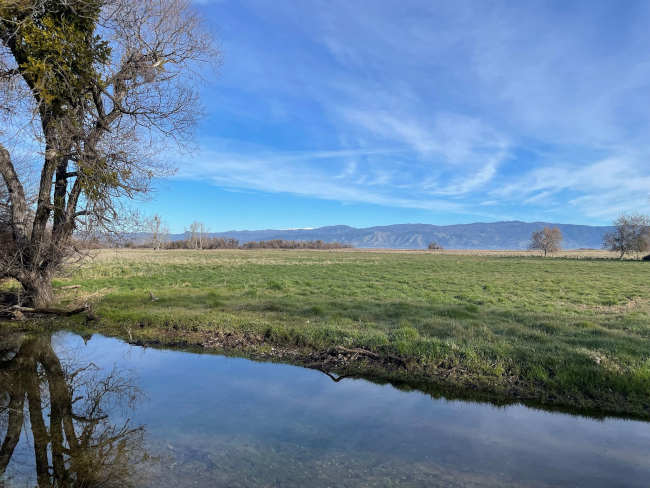
LAKEPORT, Calif. — In 2007, the Lake County Land Trust developed its first “Land Conservation Priority Plan,” which outlined the most critical and endangered lands that the Land Trust felt it should focus on.
At the top of the list was crucial shoreline habitat on Clear Lake, from the Clear Lake State Park down to south Lakeport.
In 2021 the Land Trust purchased the 200-acre Wright Ranch, now the Wright Wetland Preserve.
In December of 2023, the Land Trust closed escrow on the purchase of the 86-acre Keithly Ranch property in south Lakeport, adjacent to the Wright Preserve.
This means the Lake County Land Trust has now protected almost 300 acres of near shore, upland wetlands and riparian land in the south Lakeport area.
Another 30-acre parcel at Holiday Cove in Big Valley is also part of the Big Valley Wetlands project.
Both the Keithly and Wright acquisitions have created a combined area that will protect 16% of Clear Lake wetlands.
The Keithly acquisition is of utmost importance because of the existence of Manning Creek, which runs through the property and empties into Clear Lake.
The creek is a major spawning creek for the threatened Clear Lake hitch. The Land Trust is working with the California Department of Fish and Wildlife on funding to reconnect the creek to its original delta.
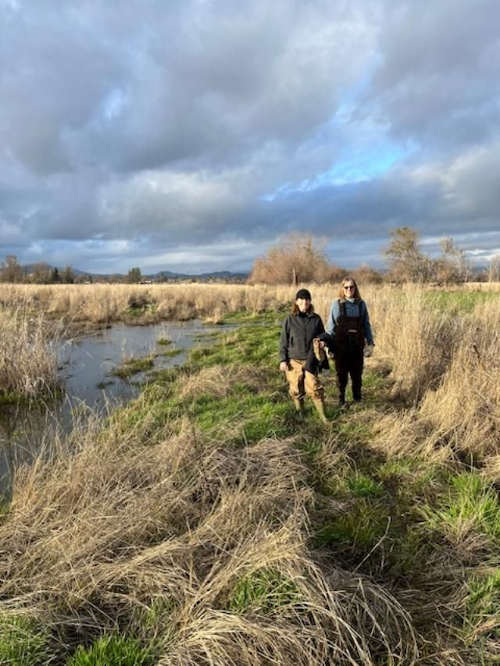
Many generous supporters contributed funds for this acquisition, the full cost of which was $900,000.
In addition to the required $50,000 match that the Wildlife Conservation Board required, expenses for a land agent, appraisals, title report, lawyer fees, a required environmental review, and closing costs were needed to complete this purchase.
The Land Trust will develop a comanagement plan with the nearby Big Valley Band of Pomo Indians as this area is a significant part of their tribal homeland.
The Land Trust thanks everyone who has supported this project and worked so hard to see it completed.
Founded in 1993, the Lake County Land Trust is a nonprofit, charitable 501 (c) (3) organization funded mostly by local contributions.
The Land Trust was founded to protect and conserve the land and water resources of Lake County with important natural, scenic, cultural and historical value.
The Land Trust owns and operates the Rodman Preserve that features a small nature center and is open every Saturday from 9 a.m. to 2 p.m. for visitors and hikers.
Other properties include Rabbit Hill Preserve in Middletown, the Melo Wetland Preserve in Big Valley, a chaparral preserve on Mt. Konocti and Monitor Island near Clearlake Park. The Land Trust also comanages the Boggs Lake Preserve with the Nature Conservancy.
For more information go to www.lakecountylandtrust.org.