 How to resolve AdBlock issue?
News
- Details
- Written by: Chris Impey, University of Arizona
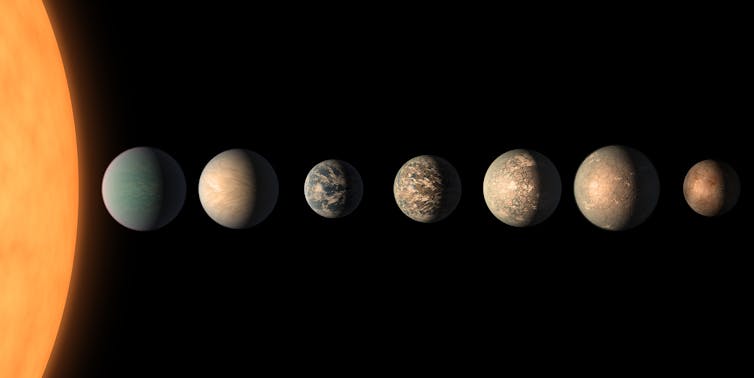
Planets orbit their parent stars while separated by enormous distances – in our solar system, planets are like grains of sand in a region the size of a football field. The time that planets take to orbit their suns have no specific relationship to each other.
But sometimes, their orbits display striking patterns. For example, astronomers studying six planets orbiting a star 100 light years away have just found that they orbit their star with an almost rhythmic beat, in perfect synchrony. Each pair of planets completes their orbits in times that are the ratios of whole numbers, allowing the planets to align and exert a gravitational push and pull on the other during their orbit.
This type of gravitational alignment is called orbital resonance, and it’s like a harmony between distant planets.
I’m an astronomer who studies and writes about cosmology. Researchers have discovered over 5,600 exoplanets in the past 30 years, and their extraordinary diversity continues to surprise astronomers.
Harmony of the spheres
Greek mathematician Pythagoras discovered the principles of musical harmony 2,500 years ago by analyzing the sounds of blacksmiths’ hammers and plucked strings.
He believed mathematics was at the heart of the natural world and proposed that the Sun, Moon and planets each emit unique hums based on their orbital properties. He thought this “music of the spheres” would be imperceptible to the human ear.
Four hundred years ago, Johannes Kepler picked up this idea. He proposed that musical intervals and harmonies described the motions of the six known planets at the time.
To Kepler, the solar system had two basses, Jupiter and Saturn; a tenor, Mars; two altos, Venus and Earth; and a soprano, Mercury. These roles reflected how long it took each planet to orbit the Sun, lower speeds for the outer planets and higher speeds for the inner planets.
He called the book he wrote on these mathematical relationships “The Harmony of the World.” While these ideas have some similarities to the concept of orbital resonance, planets don’t actually make sounds, since sound can’t travel through the vacuum of space.
Orbital resonance
Resonance happens when planets or moons have orbital periods that are ratios of whole numbers. The orbital period is the time taken for a planet to make one complete circuit of the star. So, for example, two planets orbiting a star would be in a 2:1 resonance when one planet takes twice as long as the other to orbit the star. Resonance is seen in only 5% of planetary systems.
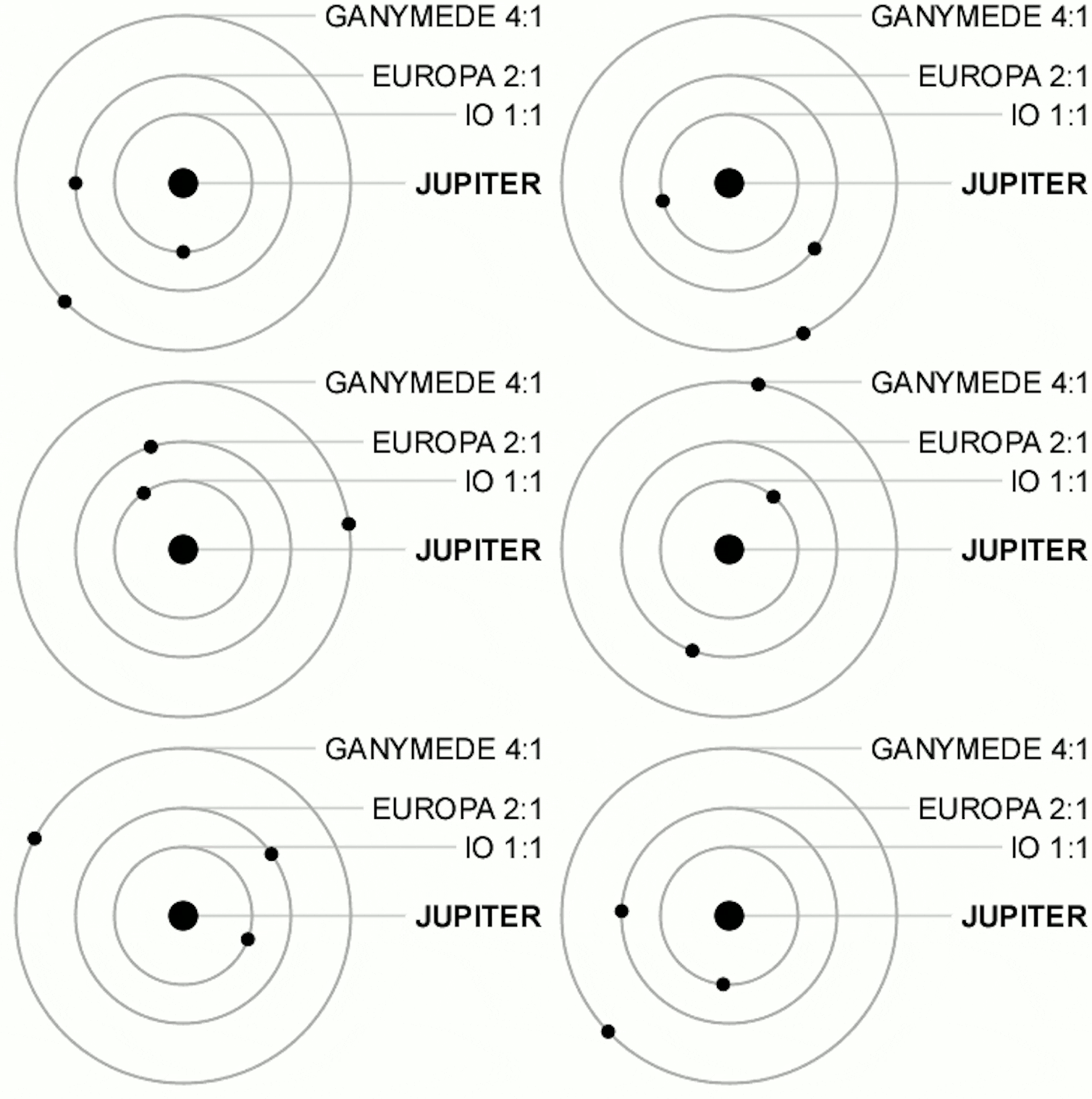
In the solar system, Neptune and Pluto are in a 3:2 resonance. There’s also a triple resonance, 4:2:1, among Jupiter’s three moons: Ganymede, Europa and Io. In the time it takes Ganymede to orbit Jupiter, Europa orbits twice and Io orbits four times. Resonances occur naturally, when planets happen to have orbital periods that are the ratio of whole numbers.
Musical intervals describe the relationship between two musical notes. In the musical analogy, important musical intervals based on ratios of frequencies are the fourth, 4:3, the fifth, 3:2, and the octave, 2:1. Anyone who plays the guitar or the piano might recognize these intervals.
Orbital resonances can change how gravity influences two bodies, causing them to speed up, slow down, stabilize on their orbital path and sometimes have their orbits disrupted.
Think of pushing a child on a swing. A planet and a swing both have a natural frequency. Give the child a push that matches the swing motion and they’ll get a boost. They’ll also get a boost if you push them every other time they’re in that position, or every third time. But push them at random times, sometimes with the motion of the swing and sometimes against, and they get no boost.
For planets, the boost can keep them continuing on their orbital paths, but it’s much more likely to disrupt their orbits.
Exoplanet resonance
Exoplanets, or planets outside the solar system, show striking examples of resonance, not just between two objects but also between resonant “chains” involving three or more objects.

This article is part of Art & Science Collide, a series examining the intersections between art and science.
You may be interested in:
Literature inspired my medical career: Why the humanities are needed in health care
Pictures have been teaching doctors medicine for centuries − a medical illustrator explains how
The star Gliese 876 has three planets with orbit period ratios of 4:2:1, just like Jupiter’s three moons. Kepler 223 has four planets with ratios of 8:6:4:3.
The red dwarf Kepler 80 has five planets with ratios of 9:6:4:3:2, and TOI 178 has six planets, of which five are in a resonant chain with ratios of 18:9:6:4:3.
TRAPPIST-1 is the record holder. It has seven Earth-like planets, two of which might be habitable, with orbit ratios of 24:15:9:6:4:3:2.
The newest example of a resonant chain is the HD 110067 system. It’s about 100 light years away and has six sub-Neptune planets, a common type of exoplanet, with orbit ratios of 54:36:24:16:12:9. The discovery is interesting because most resonance chains are unstable and disappear over time.
Despite these examples, resonant chains are rare, and only 1% of all planetary systems display them. Astronomers think that planets form in resonance, but small gravitational nudges from passing stars and wandering planets erase the resonance over time. With HD 110067, the resonant chain has survived for billions of years, offering a rare and pristine view of the system as it was when it formed.
Orbit sonification
Astronomers use a technique called sonification to translate complex visual data into sound. It gives people a different way to appreciate the beautiful images from the Hubble Space Telescope, and it has been applied to X-ray data and gravitational waves.
With exoplanets, sonification can convey the mathematical relationships of their orbits. Astronomers at the European Southern Observatory created what they call “music of the spheres” for the TOI 178 system by associating a sound on a pentatonic scale to each of the five planets.
A similar musical translation has been done for the TRAPPIST-1 system, with the orbital frequencies scaled up by a factor of 212 million to bring them into audible range.
Astronomers have also created a sonification for the HD 110067 system. People may not agree on whether these renditions sound like actual music, but it’s inspiring to see Pythagoras’ ideas realized after 2,500 years.
Chris Impey, University Distinguished Professor of Astronomy, University of Arizona
This article is republished from The Conversation under a Creative Commons license. Read the original article.
- Details
- Written by: Elizabeth Larson
AccuWeather’s meteorologists said the storm, which originated near Hawaii, will tap into moisture from atmospheric rivers, heightening flood risk.
Called a “pineapple express” because it brings moisture from the tropical pacific, the storm is forecast d to drop the heaviest rain from San Francisco south to Los Angeles.
However, at the same time heavy rain is expected throughout Lake County.
The National Weather Service has issued a flood watch and wind advisory for most of Lake County, as well as a winter storm warning for the northern third of the county, all of them in effect through Sunday.
The forecast calls for the storm to begin late on Saturday or early Sunday.
Moderate to heavy rain — up to 2.5 inches on Sunday in parts of the county — will fall along with strong and gusty winds and snow in the higher elevations. On Monday, close to another inch of rain could fall.
From Tuesday through the rest of the week, chances of showers remain in the forecast, although rain is expected to taper off during that time.
Due to the already saturated soils, the National Weather Service issued the flood watch for
southern Lake County, which will last much of the day on Sunday.
The rain so far this year has caused the level of Clear Lake to quickly rise.
Since Jan. 1, the lake has risen from 3.02 feet Rumsey — the special measure for Clear Lake to 6.16 feet Rumsey as of early Saturday. That’s more than a foot and a half higher than this time last year.
For context, the lake is full at 7.56 feet Rumsey.
Email Elizabeth Larson at
- Details
- Written by: Joan Donovan, Boston University and Sara Parker, McGill University

“You have blood on your hands.”
“I’m sorry for everything you have all been through.”
These quotes, the first from Sen. Lindsey Graham, R-S.C., speaking to Meta CEO Mark Zuckerberg, and the second from Zuckerberg to families of victims of online child abuse in the audience, are highlights from an extraordinary day of testimony before the Senate Judiciary Committee about protecting children online.
But perhaps the most telling quote from the Jan. 31, 2024, hearing came not from the CEOs of Meta, TikTok, X, Discord or Snap but from Sen. Graham in his opening statement: Social media platforms “as they are currently designed and operate are dangerous products.”
We are university researchers who study how social media organizes news, information and communities. Whether or not social media apps meet the legal definition of “unreasonably dangerous products,” the social media companies’ business models do rely on having millions of young users. At the same time, we believe that the companies have not invested sufficient resources to effectively protect those users.
Mobile device use by children and teens skyrocketed during the pandemic and has stayed high. Naturally, teens want to be where their friends are, be it the skate park or on social media. In 2022, there were an estimated 49.8 million users age 17 and under of YouTube, 19 million of TikTok, 18 million of Snapchat, 16.7 million of Instagram, 9.9 million of Facebook and 7 million of Twitter, according to a recent study by researchers at Harvard’s Chan School of Public Health.
Teens are a significant revenue source for social media companies. Revenue from users 17 and under of social media was US$11 billion in 2022, according to the Chan School study. Instagram netted nearly $5 billion, while TikTok and YouTube each accrued over $2 billion. Teens mean green.
Social media poses a range of risks for teens, from exposing them to harassment, bullying and sexual exploitation to encouraging eating disorders and suicidal ideation. For Congress to take meaningful action on protecting children online, we identify three issues that need to be accounted for: age, business model and content moderation.
How old are you?
Social media companies have an incentive to look the other way in terms of their users’ ages. Otherwise they would have to spend the resources to moderate their content appropriately. Millions of underage users – those under 13 – are an “open secret” at Meta. Meta has described some potential strategies to verify user ages, like requiring identification or video selfies, and using AI to guess their age based on “Happy Birthday” messages.
However, the accuracy of these methods is not publicly open to scrutiny, so it’s difficult to audit them independently.
Meta has stated that online teen safety legislation is needed to prevent harm, but the company points to app stores, currently dominated by Apple and Google, as the place where age verification should happen. However, these guardrails can be easily circumvented by accessing a social media platform’s website rather than its app.
New generations of customers
Teen adoption is crucial for continued growth of all social media platforms. The Facebook Files, an investigation based on a review of company documents, showed that Instagram’s growth strategy relies on teens helping family members, particularly younger siblings, get on the platform. Meta claims it optimizes for “meaningful social interaction,” prioritizing family and friends’ content over other interests. However, Instagram allows pseudonymity and multiple accounts, which makes parental oversight even more difficult.
On Nov. 7, 2023, Auturo Bejar, a former senior engineer at Facebook, testified before Congress. At Meta he surveyed teen Instagram users and found 24% of 13- to 15-year-olds said they had received unwanted advances within the past seven days, a fact he characterizes as “likely the largest-scale sexual harassment of teens to have ever happened.” Meta has since implemented restrictions on direct messaging in its products for underage users.
But to be clear, widespread harassment, bullying and solicitation is a part of the landscape of social media, and it’s going to take more than parents and app stores to rein it in.
Meta recently announced that it is aiming to provide teens with “age-appropriate experiences,” in part by prohibiting searches for terms related to suicide, self-harm and eating disorders. However, these steps don’t stop online communities that promote these harmful behaviors from flourishing on the company’s social media platforms. It takes a carefully trained team of human moderators to monitor and enforce terms of service violations for dangerous groups.
Content moderation
Social media companies point to the promise of artificial intelligence to moderate content and provide safety on their platforms, but AI is not a silver bullet for managing human behavior. Communities adapt quickly to AI moderation, augmenting banned words with purposeful misspellings and creating backup accounts to prevent getting kicked off a platform.
Human content moderation is also problematic, given social media companies’ business models and practices. Since 2022, social media companies have implemented massive layoffs that struck at the heart of their trust and safety operations and weakened content moderation across the industry.
Congress will need hard data from the social media companies – data the companies have not provided to date – to assess the appropriate ratio of moderators to users.
The way forward
In health care, professionals have a duty to warn if they believe something dangerous might happen. When these uncomfortable truths surface in corporate research, little is done to inform the public of threats to safety. Congress could mandate reporting when internal studies reveal damaging outcomes.
Helping teens today will require social media companies to invest in human content moderation and meaningful age verification. But even that is not likely to fix the problem. The challenge is facing the reality that social media as it exists today thrives on having legions of young users spending significant time in environments that put them at risk. These dangers for young users are baked into the design of contemporary social media, which requires much clearer statutes about who polices social media and when intervention is needed.
One of the motives for tech companies not to segment their user base by age, which would better protect children, is how it would affect advertising revenue. Congress has limited tools available to enact change, such as enforcing laws about advertising transparency, including “know your customer” rules. Especially as AI accelerates targeted marketing, social media companies are going to continue making it easy for advertisers to reach users of any age. But if advertisers knew what proportion of ads were seen by children, rather than adults, they may think twice about where they place ads in the future.
Despite a number of high-profile hearings on the harms of social media, Congress has not yet passed legislation to protect children or make social media platforms liable for the content published on their platforms. But with so many young people online post-pandemic, it’s up to Congress to implement guardrails that ultimately put privacy and community safety at the center of social media design.
Joan Donovan, Assistant Professor of Journalism and Emerging Media Studies, Boston University and Sara Parker, Research Analyst at the Media Ecosystem Observatory, McGill University
This article is republished from The Conversation under a Creative Commons license. Read the original article.
- Details
- Written by: Elizabeth Larson

CLEARLAKE, Calif. — Clearlake Animal Control has dozens of dogs waiting to be adopted this week.
The Clearlake Animal Control website lists 45 adoptable dogs.
The adoptable dogs include “Rock,” an American Staffordshire terrier mix with a white and brown coat. He has been neutered.
There also is “Dandelion,” a female Doberman pinscher mix with a tricolor coat. She has been spayed.

The shelter is located at 6820 Old Highway 53. It’s open from 9 a.m. to 6 p.m. Tuesday through Saturday.
For more information, call the shelter at 707-762-6227, email
This week’s adoptable dogs are featured below.
Email Elizabeth Larson at





