 How to resolve AdBlock issue?
News
- Details
- Written by: Charlie Hunt, Boise State University
Congress has once again been making headlines for all the wrong reasons, with multiple news outlets in recent months touting the current 118th Congress as possibly the least productive in the institution’s history. In 2023, Congress only passed 34 bills into law, the lowest number in decades.
Congress was only recently able to pass a budget bill that will keep the government open until the fall of 2024 after months of delay and stopgap measures.
As a result, House Speaker Mike Johnson’s gavel seems to be hanging in the balance yet again, as conservative Republicans revolt over his support for the bill.
Even so, the dire warnings from the media, and even from members of Congress, about the legislative branch’s lack of productivity frequently lack context and are often misleading. Let’s drill down into the numbers and see what political science has to say about it.
What makes Congress productive?
Historically, there’s been significant variation in the amount of legislating Congress does from year to year. There are a few well-understood factors that influence this, and all help explain why 2023 wasn’t ever likely to be a banner year for congressional productivity.
One obvious factor is party control of Congress and the presidency. If the Senate, House and the presidency are controlled by the same party, then there is typically more policy agreement between them, smoothing the way for easier passage of bills. Both Democrats and Republicans enjoyed what political scientists like me call “unified government” control during the most productive initial years of the Biden, Trump and Obama administrations.
There’s also evidence that election years spur more, not less, legislative productivity. Members of Congress know each other better in the second year of their term; they have dispensed with many of the ceremonial duties that begin a congressional session; and members are eager to demonstrate their legislative action to constituents during their reelection campaigns.
It’s possible that Congress will pick up its pace in 2024. Last year, Congress passed a number of stopgap funding bills, along with smaller legislation on veterans and environmental issues. But crucial issues like foreign aid, social media regulation and immigration are still on the table.
Finally, and maybe most importantly, Congress is in the best position to succeed when it’s led by competent and experienced legislators with lots of political capital.
This hasn’t been the case so far in the current Congress. The House has had two brand-new speakers in the span of a year, and both lacked the political power, experience or acumen to command the chamber and produce passable legislation.
Speaker Kevin McCarthy, a Republican from California, was ousted in October 2023 due to lack of support within his own party. Johnson, a Louisiana Republican, has scant experience, having only served three complete terms in office.
Johnson’s job has been made even more difficult by the continually shrinking majority that Republicans have in the chamber. And rampant polarization between the two parties has made finding legislative agreement increasingly difficult.
How you measure productivity matters
Most of the media coverage of Congress’s historic lack of productivity tends to focus on the number of bills passed into law as a key measure. But this is a simplistic approach because it treats all bills as equally important regardless of substance.
Some bills that become law are purely ceremonial; for example, they rename Veterans Affairs facilities or mint commemorative coins.
Others take more substantive action, like regulating foreign trade. Others still are not just substantive, but are what policymakers dub “landmark” pieces of legislation, like the Affordable Care Act of 2010 – also known as Obamacare – or the Tax Cuts and Jobs Act of 2017.
Using the raw total of bills passed and enacted into law treats all of these as the same. More accurate counts might give less weight to, or remove, nonsubstantive legislation from the count, and give extra weight to landmark legislation.
A related issue is that the size and scope of the average piece of legislation has changed dramatically in recent decades. Congress increasingly engages in what’s called “omnibus legislating,” which combines multiple, sometimes unrelated, pieces of legislation into one megasized bill that receives one vote.
This process has led to fewer, and larger, substantive bills rather than a higher number of smaller pieces of legislation.
For example, the 2022 Inflation Reduction Act – price tag, US$800 billion – or the 2021 American Rescue Plan – price tag $1.9 trillion – only count as two bills. In prior decades, their substance would have been divided into dozens of bills.
There are other ways legislators can be productive. When today’s members introduce bills, hold committee hearings and advocate for their legislation, these actions can matter even if the bills don’t pass in the current Congress. Legislative effort undertaken today can lay the groundwork for legislative progress achieved in the future.
2023 was still a low point
All of this context is crucial for understanding whether Congress is doing an effective lawmaking job. Even so, it looks like the Congress of 2023 — particularly the House — was historically unproductive, no matter how you slice it.
Lawmakers introduced about as much legislation as usual, but due to 2023’s leadership chaos, along with the seemingly never-ending battles over the federal budget, very little of this legislation is getting any attention, much less votes on its final passage.
The 118th Congress lasts from January 2023 through the first few days of January 2025, so it still has time to make up this historic deficit. But at this point, it seems unlikely that Congress will be much more productive in the upcoming nine months than it has been for the last 15.
Charlie Hunt, Assistant Professor of Political Science, Boise State University
This article is republished from The Conversation under a Creative Commons license. Read the original article.
- Details
- Written by: Elizabeth Larson
The board will meet beginning at 9 a.m. Tuesday, April 2, in the board chambers on the first floor of the Lake County Courthouse, 255 N. Forbes St., Lakeport.
The meeting can be watched live on Channel 8, online at https://countyoflake.legistar.com/Calendar.aspx and on the county’s Facebook page. Accompanying board documents, the agenda and archived board meeting videos also are available at that link.
To participate in real-time, join the Zoom meeting by clicking this link.
The meeting ID is 861 4314 8024, pass code 367719. The meeting also can be accessed via one tap mobile at +16694449171,,86143148024#,,,,*367719#. The meeting can also be accessed via phone at 669 900 6833.
In an untimed item, the board will consider making appointments to the newly formed Big Valley Advisory Committee, formed March 12 to serve the Kelseyville Planning Area.
There are five seats and one alternate. Applicants are Angel Acosta, Brian Hanson, Flaman McCloud Jr., Greg Panella, Joy Merrilees, Megan Lankford, Rachel White, Rick White, Sabrina Andrus and Stephanie Moranda.
In another untimed item, the board will consider forming eight local area plan advisory committees to support the “Lake County 2050” general plan update process.
The full agenda follows.
CONSENT AGENDA
5.1: Adopt proclamation designating April 2024 as Poetry Month in Lake County.
5.2. Adopt proclamation appointing Brenda Yeager as Lake County Poet Laureate for the years 2024-2026.
5.3: Adopt proclamation designating the month of April 2023 as Sexual Assault Awareness Month in Lake County.
5.4: Adopt proclamation designating the month of April 2024 As Celebrate Diversity Month.
5.5: Approve continuation of local emergency by the Lake County Sheriff/OES director for the 2024 late January, early February winter storms.
5.6: Approve continuation of proclamation declaring a Clear Lake hitch emergency.
5.7: Approve continuation of proclamation of the existence of a local emergency due to pervasive tree mortality.
5.8: Approve continuation of emergency proclamation declaring a shelter crisis in the county of Lake.
5.9: Approve continuation of proclamation of the existence of a local emergency due to low elevation snow and extreme cold.
5.10: Approve continuation of the second reading of ordinance amending Article XXVII of Chapter 2 of the Lake County Code to address membership of county of Lake Health Services in the existing Partnership Health Plan of California Commission to the April 9, 2024, Board of Supervisors meeting.
5.11: Adopt proclamation commending Christine Smith for her 23 years of service to the county of Lake.
5.12: Adopt resolution to establish two extra-help classifications – certified law clerk and legal intern – for the District Attorney's Office, Budget Unit 2110.
5.13: Adopt proclamation designating the week of April 1 to 7, 2024 as Public Health Week.
5.14: Approve waiver of 900-hour limit for extra-help accountant, Cindy Silva-Brackett.
5.15: (a) Waive the formal bidding requirement under Lake County Code chapter 2, section 2-38; and (b) authorize the IT director to issue a purchase order in the amount of $64,470.83 to ECS Imaging Inc. for Laserfiche Cloud renewal .
5.16: (a) Waive the formal bidding process under section 2-38(b) because the competitive bidding process would produce no economic benefit in this case; and (b) authorize the IT director to issue a PO to Berkeley Communications in the amount of $49,846.19 for the NS224 disk shelf, support and services.
5.17: Sitting as Board of Directors of Big Valley Groundwater Sustainability Agency, approve agreement between the California Department of Water Resources and Lake County Watershed Protection District for technical support services and license for groundwater monitoring station in order to drill groundwater monitor wells on county owned land within the Big Valley Basin to further monitor groundwater conditions and authorize chair to sign.
5.18: Adopt resolution expressing support for the Lower Lake Daze Parade and Street Fair and temporarily authorizing a road closure, prohibiting parking and authorizing removal of vehicles and ordering the Department of Public Works to post signs.
5.19: Approve amendment one to equipment repair and service contract between the county of Lake and Peterson Tractor Co. in the increased amount of $150,000 for a total not to exceed $450,000 for FY 23/24 and authorize the chair to sign.
5.20: (a) Approve amendment 13 to agreement between the county of Lake and Sun Ridge Systems Inc. for the purchase and installation of Timekeeping Systems software interface in the amount of $7,360; and (b) authorize the chair of the board to sign.
TIMED ITEMS
6.2, 9:03 a.m.: Pet of the Week.
6.3, 9:05 a.m.: Presentation of proclamation commending Christine Smith for her 23 years of service to the county of Lake.
6.4, 9:10 a.m.: Presentation of proclamation designating the month of April 2023 as Sexual Assault Awareness Month in Lake County.
6.5, 9:15 a.m.: Presentation of proclamation appointing Brenda Yeager as Lake County Poet Laureate for the years 2024-2026.
6.6, 9:20 a.m.: Presentation of proclamation designating April 2024 as Poetry Month in Lake County.
6.7, 9:25 a.m.: Presentation of proclamation designating the week of April 1 to 7, 2024 as Public Health Week.
6.8, 9:27 a.m.: Presentation of proclamation designating the month of April 2024 As Celebrate Diversity Month.
6.9, 9:30 a.m.: Presentation of update on 2024 drought conditions and drought-related projects.
6.10, 9:45 a.m.: Consideration of continuation of an emergency declaration for drought conditions.
6.11, 10 a.m.: Hearing, consideration of request for post-abatement hearing on account and proposed assessment of summary abatement – action of recreational vehicle on Feb. 2, 2024; located on State Highway 20, Clearlake Oaks.
6.12, 10:15 a.m.: Consideration of a letter of support for inclusion of Calpine’s The Geysers Facility in the California Leg of the Biden Administration’s “Investing in America” Tour, with U.S. Department of Energy Secretary Jennifer M. Granholm.
6.13, 10:30 a.m.: Consideration of an oppose unless amended position letter on SB 964 (Seyarto).
UNTIMED ITEMS
7.2: Presentation of Lake County Behavioral Health Services' external quality review organization report for fiscal year 2022-23.
7.3: Consideration of first amendment to the at-cost project reimbursement and indemnity agreement between the county of Lake and Lotusland Investment Holdings Inc. for county permit processing of the Maha Guenoc Valley Mixed-Use Development Project.
7.4: a) Consideration of changing seat designation from crop grower to organic farmer for committee member Bruce Merrilees on the Lake County Ag Advisory Committee; and b) consideration of appointments to the Lake County Ag Advisory Committee.
7.5: Consideration of appointments to the Big Valley Advisory Council and the Middletown Cemetery District.
7.6: Consideration of proposed formation of eight local area plan advisory committees to support the “Lake County 2050” update process.
7.7: Consideration to adopt resolution to approve the CalPERS 180-Day wait period exception for CalPERS retiree Richard F. Hinchcliff in order to hire him as an extra help deputy district attorney, senior.
CLOSED SESSION
8.1: Public employee evaluation: Air pollution control officer.
8.2: Public employee evaluation: Community Development director.
8.3: Public employee evaluation: Public Works/Water Resources director.
8.4: Conference with legal counsel: Significant exposure to litigation pursuant to Gov. Code section 54956.9(d)(2), (e)(1) – One potential case.
Email Elizabeth Larson at
- Details
- Written by: Elizabeth Larson
The council will meet Tuesday, April 2, at 6 p.m. in the council chambers at Lakeport City Hall, 225 Park St.
The agenda can be found here.
The council chambers will be open to the public for the meeting. Masks are highly encouraged where 6-foot distancing cannot be maintained.
If you cannot attend in person, and would like to speak on an agenda item, you can access the Zoom meeting remotely at this link or join by phone by calling toll-free 669-900-9128 or 346-248-7799.
The webinar ID is 973 6820 1787, access code is 477973; the audio pin will be shown after joining the webinar. Those phoning in without using the web link will be in “listen mode” only and will not be able to participate or comment.
Comments can be submitted by email to
On Tuesday the council will meet new city employee Melissa Carpenter and present a proclamation designating April 2024 as Arts, Culture and Creativity Month.
Under council business, City Manager Kevin Ingram will ask the council to authorize him to execute a professional services agreement with Willdan Financial Services for a comprehensive citywide cost of service fee study in an amount not to exceed $28,000.
Ingram also will lead the council in a strategic planning workshop to determine the citywide departmental goals for fiscal year 2024-25.
On the consent agenda — items considered noncontroversial and usually accepted as a slate on one vote — are ordinances; minutes of the City Council’s regular meeting on March 5; the March 22 warrant register; approval of the continuation of the proclamation declaring a local state of emergency due to severe weather conditions including heavy rain and extreme wind; approval of application 2024-013, with staff recommendations, for the 2024 Memorial Day Pancake Breakfast; approval of application 2024-015, with staff recommendations for the 2024 Autism Advocacy and Awareness Spring Carnival; authorization for out-of-state travel for two utility staff members to attend the California Rural Water Association’s Annual Expo.
Email Elizabeth Larson at
- Details
- Written by: Craig Benson
The U.S. national poverty rate declined significantly to 12.5% during the 5-year period from 2018 to 2022, according to American Community Survey, or ACS, 5-year estimates.
The rate was down from 14.6% during 2013-2017, the most recent nonoverlapping 5-year period.
Comparing the 2013-2017 and 2018-2022 5-year estimates offers a longer-term look at national and local economic trends.
The ACS 5-year estimates differ from the 1-year estimates released in September because they pool five consecutive years of 1-year ACS data, allowing Census Bureau researchers to estimate poverty rates for areas with smaller populations and all 3,144 U.S. counties.
How poverty is measured
Poverty status is determined by comparing annual income to a set of dollar values (called poverty thresholds) that vary by family size, number of children and the age of the householder.
If a family’s before-tax money income is less than the dollar value of their threshold, that family and every individual in it are in poverty. For people not living in families, poverty status is determined by comparing the individual’s income to their poverty threshold.
The poverty measure excludes children under age 15 not related to the householder and people living in institutional group quarters, college dormitories or military barracks.
The poverty rates in this article are based on the official poverty measure and are different from the Supplemental Poverty Measure, or SPM.
The SPM differs in a number of key ways such as the factoring in of additional resources and expenses not included in the official poverty measure as well as geographic variation in poverty thresholds.
County poverty rates
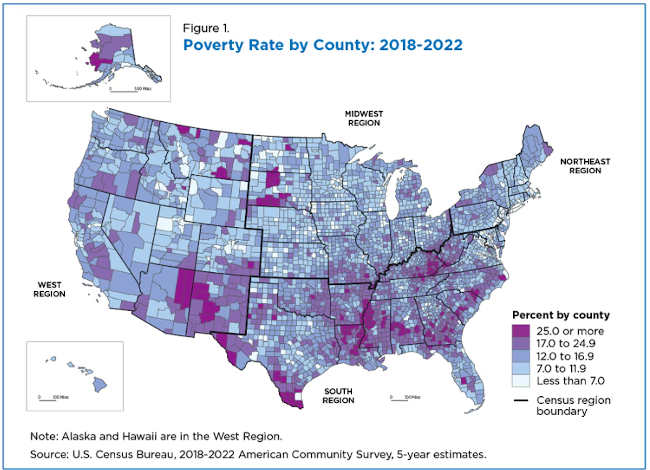
During the 2018-2022 period, county poverty rates ranged from 1.6% to 55.8% (Figure 1).
Counties with the lowest poverty rates in 2018-2022 included: Borden County, Texas (1.6%); Morgan County, Utah (1.7%); Sterling County, Texas (1.8%); Falls Church independent city (considered a county equivalent), Virginia (2.3%); McCone County, Montana (2.4%); Kenedy County, Texas (2.6%); Douglas County, Colorado (3.0%); and Stanley County, South Dakota (3.2%) among others. These estimates are not significantly different from one another at the 90% confidence level.
Three counties in South Dakota – Oglala Lakota County (55.8%), Todd County (52.2%) and Mellette County (49.1%) – were among those with the nation’s highest poverty rates. All three are in the western part of the state and are home to American Indian reservations. These estimates were not significantly different from one another at the 90% confidence level.
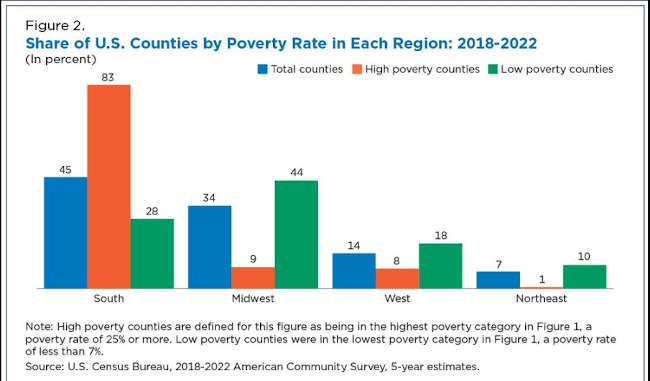
Figure 2 shows the share of total counties per census region along with the percentage of counties in the high and low map categories. The total counties category indicates the percentage of U.S. counties in the region.
Of the 172 counties in the highest poverty category (poverty rates of 25% or more), 142 (more than 80%) were in the South, compared to 45% of total counties.
The 219 counties in the lowest poverty category (poverty rates of less than 7.0%) were more evenly dispersed around the nation. Approximately 44% were in the Midwest, compared to 34% of total counties; 28% were in the South.
Just less than 10% of all counties in the South were in the high poverty category. No other region had more than 3.1% of its total counties with poverty rates of 25% or more. The four regions had a range of 4.4% (South) to 9.6% (Northeast) of its counties in the low poverty category.
Change from last five-year period
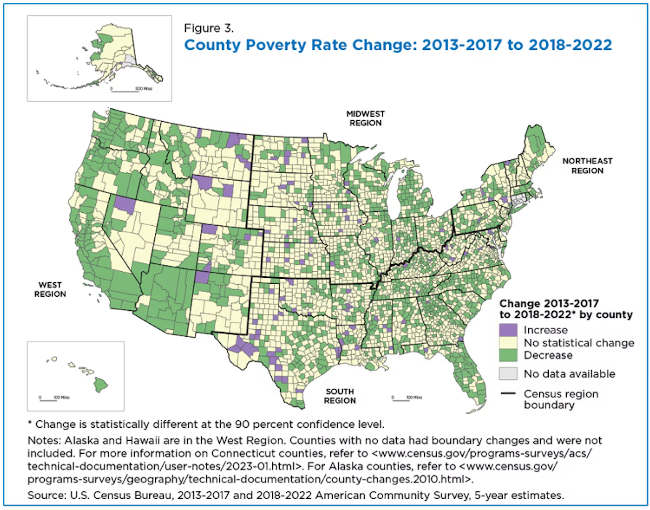
Changes in county poverty rates from the last 5-year period (2013-2017) to the most recent (2018-2022) show where and what economic changes have occurred over a longer period.
The national poverty rate decreased 2.0 percentage points to 12.5% and 1,144 counties — more than 36% — had a significant change in poverty rates (Figure 3).
Poverty rates decreased in more than one-third (1,042) of all counties. Only 102 counties experienced an increase in poverty rates compared to 2013-2017. It should be noted that counties that have had geographic changes over this period were not used in the comparison and are identified in Figure 3 as counties with no data available.
Where did changes occur?
Of the 1,042 counties that had lower poverty rates in the recent time period (2018-2022) 466 were in the South, 303 in the Midwest, 191 in the West and 82 in the Northeast.
In the West, 42.7% of all counties had lower poverty rates, while in the Northeast poverty rates decreased in 39.2% of all counties, 32.8% in the South and 28.7% in the Midwest.
Among the counties where poverty rates increased, 49.0% were in the South and 30.4% in the Midwest. There was less of a regional difference where poverty increased. In all regions, between 2.9% and 3.5% of counties experienced poverty rate increases from the 2013-2017 to 2018-2022 period.
Craig Benson is a survey statistician in the Census Bureau’s Poverty Statistics Branch.