 How to resolve AdBlock issue?
News
- Details
- Written by: Elizabeth Larson
The forecast calls for the main impacts to occur on Friday and Saturday, however, there are chances of rain until late next week.
The Lake County forecast anticipates close to an inch of rain on Friday and another half-inch on Saturday.
The rain will be coupled with high winds. Gusts topping 20 miles per hour are expected both days.
Forecasters said snow levels will remain above the 5,000-foot elevation mark on Friday, but could fall to lower levels on Saturday.
At the same time, the Sierras are forecast to get snow and a winter storm warning and winter weather advisory have been issued for eastern California.
After several days of warm and sunny weather, Lake County’s temperatures are expected to be in the low 50s during the day and low 40s at night into early next week, with nighttime temperatures set to drop into the 30s the middle of next week.
Email Elizabeth Larson at
- Details
- Written by: Yihsu Chen, University of California, Santa Cruz and Andrew L. Liu, Purdue University
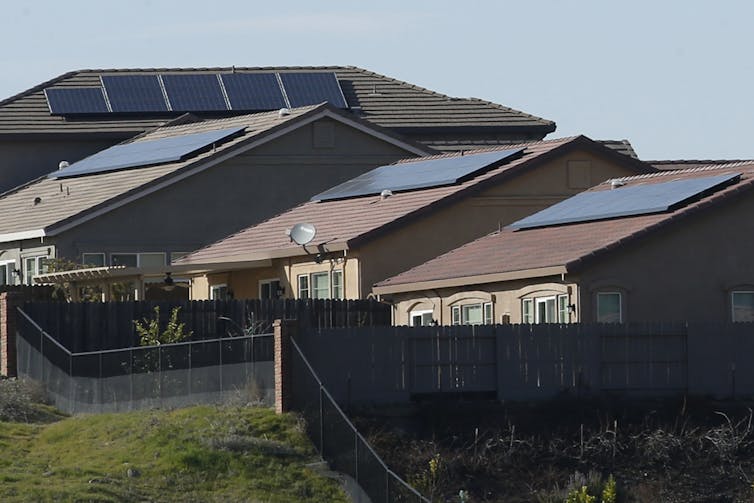
Small-scale solar power, also known as rooftop or distributed solar, has grown considerably in the U.S. over the past decade. It provides electricity without emitting air pollutants or climate-warming greenhouse gases, and it meets local energy demand without requiring costly investments in transmission and distribution systems.
However, its expansion is making it harder for electric utilities and power grid managers to design fair and efficient retail electricity rates – the prices that households pay.
Under traditional electricity pricing, customers pay one charge per kilowatt-hour of electricity consumption that covers both the energy they use and the fixed costs of maintaining the grid. As more people adopt rooftop solar, they buy less energy from the grid. Fewer customers are left to shoulder utilities’ fixed costs, potentially making power more expensive for everyone.
This trend can drive more customers to leave the system and raise prices further – a scenario known as the utility death spiral. One 2018 study calculated that two-thirds of recent electricity distribution cost increases at California’s three investor-owned utilities were associated with the growth of residential solar.
With abundant sun and solar-friendly policies, California has 36% of U.S. small-scale solar capacity, much more than any other state. And the state is engaged in a heated debate over pricing electricity in ways designed to make energy less expensive for low-income households.
We study energy markets and public policy affecting energy and the environment, and have analyzed various retail electricity rate structures and their economic impacts on power producers and consumers. Our key finding is that an income-based, fixed-charge rate structure of the type that California is currently considering offers the most efficient and equitable solution – if it is designed correctly.
Two-part power bills
The debate over fixed charges began in 2022, when the California Legislature enacted an energy bill that ordered state regulators to study income-based fixed charges and decide whether to adopt them by July 1, 2024. Then the state’s three largest utilities – Southern California Edison, Pacific Gas and Electric, and San Diego Gas & Electric – submitted a proposal to the state Public Utilities Commission in mid-2023 that would separate retail bills into two parts: a fixed charge and a variable charge.
The fixed charge would be a preset monthly fee, independent of energy usage but tied to income levels, so wealthier customers would pay a larger share of grid maintenance costs. The variable charge would be based on the amount of electricity consumed and would cover the actual costs of electricity production and delivery.
Historically, these actual costs have typically ranged between 4 to 6 cents per kilowatt-hour. Today, the average residential rate in California often exceeds 30 cents per kilowatt-hour because it covers fixed costs as well as electricity use.
Who benefits?
A two-part billing system that separates fixed costs from variable usage charges offers potential benefits for both consumers and utilities.
For utilities, the fixed charge offers a stable revenue stream. The companies know how many households they serve, and they can plan on the fixed amounts that those households will pay each month. Households that go solar would still pay the fixed charge, since most of them draw electricity from the grid when the sun doesn’t shine.
This approach provides financial stability for the utility and access to the grid for all. Consumers would benefit because with a certain amount of income guaranteed, utilities could charge significantly less per kilowatt-hour for the actual electricity that households use.
One significant concern is that if electricity costs less, people may use more of it, which could undermine efforts toward energy conservation and lead to an increase in emissions. In our view, the way to address this risk is by fine-tuning the two-part billing structure so that it covers only a portion of the utilities’ costs through fixed charges and incorporates the rest into the variable usage rates.
Put another way, combining a lower fixed charge with a higher variable charge would ensure that utilities can still cover their fixed costs effectively, while encouraging mindful energy use among consumers. Ensuring affordable electricity for consumers, fair cost recovery for utilities and overall fairness and efficiency in the energy market requires striking a delicate balance.
Another argument from critics, often labeled “energy socialism,” asserts that higher-income households might end up subsidizing excessive electricity use by lower-income households under the income-based rate structure. In our view, this perception is inaccurate.
Wealthy households would pay more to maintain the grid, via larger fixed charges, than poorer households, but would not subsidize lower-income households’ energy use. All income groups would pay the same rate for each additional kilowatt-hour of electricity that they use. Decisions on energy use would remain economically driven, regardless of consumers’ income level.
Fixed fees are too big
While our research supports California utilities’ approach in principle, we believe their proposal has shortcomings – notably in the proposed income brackets.
As currently framed, households with annual incomes between US$28,000 and $69,000 would pay a fixed fee of $20 to $34 per month. Households earning between $69,000 and $180,000 would pay $51 to $73 per month, and those earning more than $180,000 would pay $85 to $128.
The middle-income bracket starts just above California’s median household income. Consequently, nearly half of all California households could find themselves paying a substantial monthly fee – $51 to $73 – regardless of their actual electricity usage.
It could be hard to convince consumers to pay significant fixed fees for intangible services, especially middle-income residents who have either gone solar or may do so. Not surprisingly, the proposal has encountered considerable pushback from the solar industry.
Finding the sweet spot
In response to public outcry, California lawmakers recently introduced Assembly Bill 1999, which would replace the income-graduated fixed-charge requirement with fixed charges of $5 per month for low-income customers and up to $10 per month for others. In our view, this reaction goes too far in the other direction.
Capping fixed charges at such low levels would force utilities to hike their energy use rates to cover fixed costs – again, risking the death spiral scenario. Our research indicates that there is a range for the fixed charge that would cover a reasonable share of utilities’ fixed costs, but is not high enough to burden consumers.
Without utility cost data, we can’t pinpoint this range precisely. However, based on estimates of utilities’ costs, we believe the caps proposed in AB 1999 are too low and could end up unfairly burdening those the bill aims to protect.
In our research, based on a hypothetical case study, we found a sweet spot in which fixed charges cover about 40% of utilities’ fixed costs. Charges at this level provide maximum benefit to consumers, although they reduce energy producers’ profits.
Our findings are similar to an alternative proposal jointly presented by The Utility Reform Network, a nonprofit consumer advocacy organization, and the Natural Resources Defense Council, an environmental advocacy group. This plan suggests a two-part rate structure with an average fixed charge of about $36 per month. Low-income households would pay $5 per month, and those earning over $150,000 yearly would pay about $62.
We believe this proposal moves in the right direction by ensuring fair contributions to grid costs, while also encouraging efficient energy use and investment in clean energy infrastructure. It could act as a guide for other U.S. states searching for methods to balance utility fixed-cost recovery with fair pricing and continued growth of small-scale solar power.
Yihsu Chen, Professor of Technology Management in Sustainability, University of California, Santa Cruz and Andrew L. Liu, Associate Professor of Industrial Engineering, Purdue University
This article is republished from The Conversation under a Creative Commons license. Read the original article.
- Details
- Written by: Elizabeth Larson
The Clearlake Animal Control website lists 51 adoptable dogs.

This week’s dogs include “Layla,” a female American Staffordshire terrier mix with a black and white coat.
Also up for adoptin is “Chandler,” a 6-month-old male American pit bull terrier mix with a white and fawn coat.

The shelter is located at 6820 Old Highway 53. It’s open from 9 a.m. to 6 p.m. Tuesday through Saturday.
For more information, call the shelter at 707-762-6227, email
This week’s adoptable dogs are featured below.
Email Elizabeth Larson at
- Details
- Written by: Suzanne Leigh
The patients, whose average age in the study was 80, had lost their social networks as their failing memories made conversation difficult, and their family and friends grew uncomfortable.
Caregivers, whose average age was 67 and included spouses, adult children and others, became isolated as their responsibilities mounted. They also grieved the loss of their relationships with the patients when those relationships were good.
“Unmet social needs negatively impact quality of life, and that can lead to health outcomes like depression and cardiovascular disease, as well as high health-care use and early death,” said Ashwin Kotwal, MD, assistant professor of medicine in the UCSF Division of Geriatrics, and first author of the study.
“We know from previous research that older adults with higher levels of social isolation have more than double the odds of nursing home placement,” said Kotwal, who is also affiliated with the San Francisco VA Health Medical Center.
The study, which appears in The Gerontologist on March 18, 2024, included information from two dozen mainly male patients with dementia, and four dozen mainly female caregivers, some of whom were recently bereaved.
“Participating in support groups, in which patients and their caregivers can meet separately, may be low-stress places to socialize and get advice,” said Krista Harrison, PhD, of the UCSF Division of Geriatrics, Global Brain Health initiative and Philip R. Lee Institute for Health Policy Studies, the study’s senior author, noting that screenings take minutes and can be done by doctors, social workers or therapists.
“Clinicians should discuss options like community choirs that have been tailored for patients with dementia and their caregivers,” she said. “Prior research shows that meaningful activities can be enjoyed as the disease progresses. There may be simple ways of adapting activities, like switching attendance from a place of worship to participating in a service by Zoom with a small gathering at home.”
The interviews were conducted for two earlier studies: Dementia Palliative Care, led by Harrison, which examined patients with mild-to-moderate dementia and their caregivers; and Music and Dementia Caregiving, led by co-author Theresa Allison, MD, PhD, which looked at patients with any stage of dementia and their live-in caregivers, including those who had the assistance of professional caregivers.
Good relationships have the most to lose
A recent UCSF-led study of married couples, in which one partner had dementia, offered a fresh twist to the current study. The researchers found partners of people with dementia who were highly satisfied with their relationships experienced more loneliness than they had previously.
But those in poor-quality relationships were not impacted by their partner’s dementia, despite having higher rates of depression and loneliness overall.
“People who are really invested in their marriage or partnership have more to lose when one partner develops dementia,” said Kotwal, the study’s senior author. “But those with lower marital quality have already lost the emotional support from the marriage that can be protective against loneliness and depression.”
Co-Authors: Theresa A. Allison, MD, PhD; Madina Halim, BA; Sarah B. Garrett, PhD; Carla M. Perissinotto; and Alexander K. Smith, MD, MPH, all of UCSF, and Christine S. Ritchie, MD, MSPH, of Harvard Medical School.
Suzanne Leigh writes for the University of California, San Francisco.