How to resolve AdBlock issue?
News
- Details
- Written by: Elizabeth Larson
The board will meet beginning at 9 a.m. Tuesday, March 19, in the board chambers on the first floor of the Lake County Courthouse, 255 N. Forbes St., Lakeport.
The meeting can be watched live on Channel 8, online at https://countyoflake.legistar.com/Calendar.aspx and on the county’s Facebook page. Accompanying board documents, the agenda and archived board meeting videos also are available at that link.
To participate in real-time, join the Zoom meeting by clicking this link.
The meeting ID is 898 7006 8634, pass code 694057. The meeting also can be accessed via one tap mobile at +16699006833,,83106989699#,,,,*694057#. The meeting can also be accessed via phone at 669 900 6833.
In an item timed for 9:10 a.m., the board will get a report on the current status of the Konocti Gardens project and the Special Districts sewer improvement project on Alvita Avenue in Clearlake to mitigate the development impacts.
The staff report said Konocti Gardens is a 102-unit multifamily apartment complex development off of Old Highway 53 near Highlands Way.
Construction on Special Districts’ improvement project is anticipated to occur this summer and to be completed by fall, staff reported.
The full agenda follows.
CONSENT AGENDA
5.1: Approve revised letter of support for California Coastal Conservancy LiDAR Derivatives Funding and authorize the chair to sign.
5.2: Approve Amendment No. 2 to the agreement between county of Lake and Redwood Community Services Inc. for the Lake County WRAP Program, Foster Care Program, and Intensive Services Foster Care (ISFC) Program for Specialty Mental Health Services with no change to the contract maximum for fiscal years 2022-23, 2023-24, and 2024-25 and authorize the board chair to sign.
5.3: Approve Board of Supervisors minutes from March 5 and March 12, 2024.
5.4: Approve purchase of one vehicle from Downtown Ford through the state contract, in the amount of $57,374.76, and authorize the probation chief to issue purchase order.
5.5: Approve purchase of two vehicles from Downtown Ford – Sacramento in the amount of $57,347.76 each for the Central Garage fleet and authorize the Public Works director/assistant purchasing agent to issue the purchase orders.
5.6: Approve Change Order No. 2, for FEMA FMAG Culvert Replacement No. 3 Project, Federal Project No.’s FMAG DR 5189-FM-CA, Bid No. 21-04, for an increase of $17,524.28 and a revised contract amount of $264,261.58, and authorize the chair to sign.
5.7: Approve Judicial Advocate General Grant #15PBJA-21-GG-01104-JAGX decline letter and authorize chair to sign.
TIMED ITEMS
6.2, 9:03 a.m.: Pet of the Week.
6.3, 9:04 a.m.: Presentation considering annual delinquent sewer and water tax roll schedule and established staff direction from Board of Supervisors.
6.4, 9:10 a.m.: Consideration of report to the board on the current status of the Konocti Gardens project and the Special Districts sewer improvement project on Alvita Avenue in Clearlake to mitigate the development impacts.
6.5: Continued from Feb. 6, 9:45 a.m., public hearing, consideration of an ordinance amending the Purchasing Ordinance: Article X of Chapter Two of the Lake County Code to include increased purchasing limits, additional definitions, modify requirements for exemptions from competitive bidding and additional procedures for informal and formal bidding.
6.6, 10 a.m.: Consideration of a presentation from Nielsen Merksamer on the 2024 legislative session, state budget and potential bills of interest.
6.7, 10:15 a.m.: Public hearing, (a) consideration of resolution approving an application for funding and the execution of a grant agreement and any amendments thereto from the 2023-2024 Funding Year of the State CDBG Mitigation Resilience Infrastructure (MIT-RIP) Program; and (b) authorize the county administrative officer or designee to submit the grant application.
UNTIMED ITEMS
7.2: Consideration of appointment to the East Region Town Hall.
7.3: Consideration of general fund loan request of $3,000,000 and loan of $1,000,000 from Department of Social Services Realignment Fund.
7.4: Consideration of resolution approving a short-term loan from the general fund by way of the Technology Reserve, Fund 154, to Behavioral Health Services, Fund 145, in the amount of $3,000,000.
7.5: Consideration of Amendment No. 2 to the agreement between the Lake County Behavioral Health Services as lead administrative entity for the Lake County Continuum of Care and Adventist Health Clear Lake Hospital Inc. in the amount of $443,000 for fiscal years 2021-2024 and authorize the board chair to sign.
CLOSED SESSION
8.1: Public employee evaluation: Public Services director.
8.2: Addendum, conference with legal counsel: Existing Litigation pursuant to Gov. Code sec. 54956.9 (d)(1) – FERC Project No. 77, Potter Valley Hydroelectric Project.
Email Elizabeth Larson at
- Details
- Written by: Elizabeth Larson
The council will meet Tuesday, March 19, at 6 p.m. in the council chambers at Lakeport City Hall, 225 Park St.
The agenda can be found here.
The council chambers will be open to the public for the meeting. Masks are highly encouraged where 6-foot distancing cannot be maintained.
If you cannot attend in person, and would like to speak on an agenda item, you can access the Zoom meeting remotely at this link or join by phone by calling toll-free 669-900-9128 or 346-248-7799.
The webinar ID is 973 6820 1787, access code is 477973; the audio pin will be shown after joining the webinar. Those phoning in without using the web link will be in “listen mode” only and will not be able to participate or comment.
Comments can be submitted by email to
On Tuesday, the council will start off the evening with the introduction of new employees Bryan Carlson, Mel Olea, Jen Baker and Michelle Brown.
The council will hold a public hearing ahead of its consideration of adopting a 2% permit fee for permit processing, inspections, public awareness and education campaigns, and fire operations and suppression efforts related to the sale of safe and sane fireworks.
City documents indicate the city already has a 5% permit fee on the fireworks.
The city of Lakeport is the only place in Lake County where fireworks are permitted. That’s because voters passed Measure C in November 2009 after the council had attempted to end fireworks sales.
In council business, staff will ask council members to adopt a proposed resolution authorizing the submittal of an application to the California State Department of Housing and Community Development for funding under the HOME Investment Partnership Program.
City Manager Kevin Ingram also will present a progress update on staff’s work to meet the 2023-24 departmental goals.
On the consent agenda — items considered noncontroversial and usually accepted as a slate on one vote — are ordinances; minutes of the City Council’s regular meetings on March 5; receipt and filing of the 2023 Housing Element Annual Progress Report; and receipt and filing of the 2023 2nd Quarter Community Development Report.
Email Elizabeth Larson at
- Details
- Written by: Lake County News reports
Places such as Mexico City, Peru and Bolivia had some of the largest drops in life expectancy from 2019 to 2021.
The research, which presents updated estimates from the Global Burden of Disease Study 2021, provides the most comprehensive look at the pandemic’s toll on human health to date, indicating that global life expectancy dropped by 1.6 years from 2019 to 2021, a sharp reversal from past increases.
Among other key findings from the Global Burden of Disease, or GBD, child mortality continued to drop amid the COVID-19 pandemic, with half a million fewer deaths among children under 5 in 2021 compared to 2019. Mortality rates among children under 5 decreased by 7% from 2019 to 2021.
“For adults worldwide, the COVID-19 pandemic has had a more profound impact than any event seen in half a century, including conflicts and natural disasters,” says co-first author Dr. Austin E. Schumacher, acting assistant professor of Health Metrics Sciences at the Institute for Health Metrics and Evaluation, or IHME, at the University of Washington. “Life expectancy declined in 84% of countries and territories during this pandemic, demonstrating the devastating potential impacts of novel pathogens.”
Researchers from IHME identified high mortality during the COVID-19 pandemic in places that were previously less recognized and/or reported.
For example, the study reveals that after accounting for the age of the population, countries such as Jordan and Nicaragua had high excess mortality due to the COVID-19 pandemic that was not apparent in previous all-age excess mortality estimates.
In analyzing subnational locations not previously investigated, the South African provinces of KwaZulu-Natal and Limpopo had among the highest age-adjusted excess mortality rates and largest life expectancy declines during the pandemic in the world.
Conversely, the places with some of the lowest age-adjusted excess mortality from the pandemic during this period included Barbados, New Zealand, and Antigua and Barbuda.
During the COVID-19 pandemic, mortality among older people worldwide rose in ways unseen in the previous 70 years. While the pandemic was devastating, killing approximately 16 million people around the globe in 2020 and 2021 combined, it did not completely erase historic progress — life expectancy at birth rose by nearly 23 years between 1950 and 2021.
GBD 2021 analyzes past and current demographic trends at global, regional, national, and subnational levels.
The study provides globally comparable measures of excess mortality and is one of the first studies to fully evaluate demographic trends in the context of the first two years of the COVID-19 pandemic.
In estimating excess deaths due to the pandemic, the authors accounted for deaths from the virus that causes COVID-19, SARS-CoV-2, as well as deaths associated with indirect effects of the pandemic, such as delays in seeking health care.
Employing innovative methods to measure mortality, excess mortality from the COVID-19 pandemic, life expectancy, and population, the study authors estimate that the pandemic caused global mortality to jump among people over age 15, rising by 22% for males and 17% for females from 2019 to 2021.
GBD 2021 goes beyond assessing the impact of the first two years of the COVID-19 pandemic. As the authors note, it also offers “implications for the future of health-care systems, economies, and societies and ... a valuable foundation for policy evaluation, development, and implementation around the world.”
GBD 2021 indicates that, despite early warnings that COVID-19 could threaten the gains that the world had made in saving children’s lives, these improvements continued during the pandemic, albeit at a slower pace.
Still, stark differences in child mortality persist between regions. In 2021, one out of every four children who died worldwide lived in South Asia, while two out of every four children who died lived in sub-Saharan Africa.
“Our study suggests that, even after taking stock of the terrible loss of lives the world experienced due to the pandemic, we have made incredible progress over 72 years since 1950, with child mortality continuing to drop globally,” said co-first author Dr. Hmwe Hmwe Kyu, Associate Professor of Health Metrics Sciences at IHME at the University of Washington. “Now, continuing to build on our successes, while preparing for the next pandemic and addressing the vast disparities in health across countries, should be our greatest focuses.”
The GBD 2021 study also assessed population trends. Beginning in 2017, the rate of global population growth began to drop following years of stagnation. Then, during the COVID-19 pandemic, these declines accelerated.
As of 2021, 56 countries have reached peak population. Now, these countries are seeing their populations shrink. However, rapid population growth has continued in many lower-income countries. In addition, populations around the world are aging.
Between 2000 and 2021, the number of people who were 65 and older grew faster than the number of people under age 15 in 188 countries and territories.
“Slowing population growth and aging populations, along with the concentration of future population growth shifting to poorer locations with worse health outcomes, will bring about unprecedented social, economic, and political challenges, such as labor shortages in areas where younger populations are shrinking and resource scarcity in places where population size continues to expand rapidly,” says Dr. Schumacher. “This is worth restating, as these issues will require significant policy forethought to address in the affected regions. As one example, nations around the world will need to cooperate on voluntary emigration, for which one source of useful guidance is the UN’s Global Compact for Safe, Orderly and Regular Migration.”
- Details
- Written by: Kendall Houghton, Ariel J. Binder, Amanda Eng and Andrew Foote
The gender wage gap — the difference between what men and women earn — is an often-cited marker of the progress women are making in the work force typically measured by comparing the average earnings of men and women.
Previous U.S. Census Bureau research has explored the gender wage gap and how it varies with social, economic and demographic characteristics.
Now, new U.S. Census Bureau research takes it a step further by comparing male and female earnings for graduates of similar educational programs. Rather than comparing male and female wages and controlling for education, it looks at the earnings of men and women with the same level and quality of education.
This research provides new information about the gender pay gap across a range of postsecondary education levels from graduates of the most selective bachelor programs to graduates of certificate programs.
The Census Bureau analyzed the earnings of graduates from certificate, associate and bachelor’s programs for up to 15 years. It estimated the magnitude of the earnings gap at these educational levels and three factors that may contribute to it: field of study; occupation and industry after graduation; and number of weeks and hours worked in a year.
This research was made possible by a partnership between the Census Bureau and state higher education systems, which provided student transcript records that can be linked to other datasets.
In this case, the student records were linked to the American Community Survey (ACS) to gauge post-graduation outcomes such as earnings, occupation, childbearing, and the number of weeks and hours worked. The ACS is the premier source of detailed population and housing information about our nation.
Researchers analyzed the gender pay gap using a statistical model that answered the following questions for each degree level considered:
• How large was the gap between men’s and women’s earnings, on average?
• How much of this gap was driven by women and men majoring in different fields?
• Among women and men with the same education level who graduated in the same field, how much of the gap stemmed from women and men working in different occupations and industries?
• Among men and women with the same education level, who graduated in the same field and worked in the same occupation, how much of the gap was caused by women and men participating in the workforce at different rates and working different numbers of weeks and hours-per-week during the year?
• How much of the gender pay gap was due to other factors?
Answers differed considerably depending on whether someone graduated from a certificate or selective bachelor’s program.
The size of the gender earnings gap
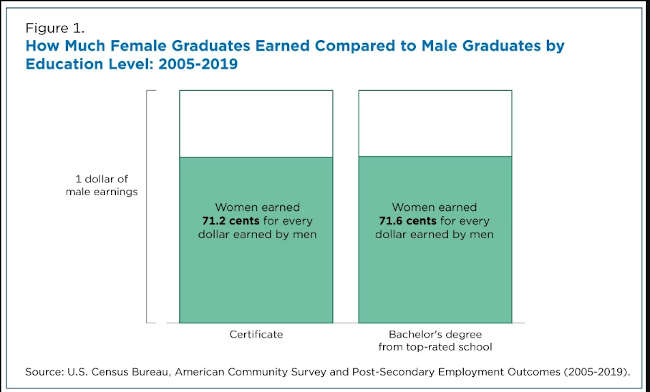
The gap in average earnings from 2005 to 2019 was consistent across all education levels. As shown in Figure 1, women with a certificate degree earned 71.2 cents for every dollar earned by men with a certificate degree. In other words, the gap was 28.8%. For graduates of the most selective bachelor’s institutions, as defined by the Barron’s Admissions Competitiveness Index, the gap was 28.4%.
This gap is larger than the 84 cents for every dollar earned figure reported by the White House, which compares full-time, year-round working men and women. The comparisons in this report are between graduates.
Field of study
College major or field of study accounted for a substantial portion of the gap at higher education levels but were less significant at lower levels.
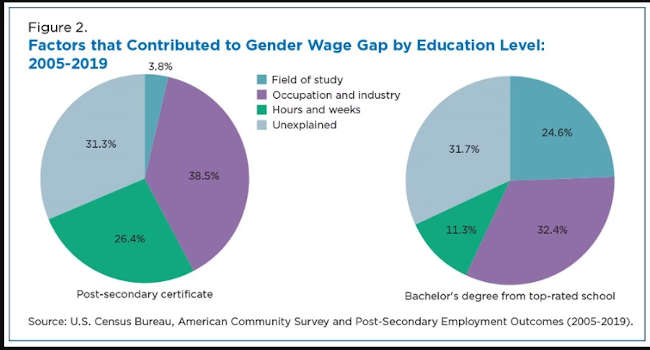
For example, 3.8% of the gender gap in earnings among those with certificate degrees was attributed to choice of major/field of study, compared to 24.6% among graduates of the most selective bachelor’s programs (Figure 2).
After accounting for differences in choice of major, the share of the gap due to occupation and industry chosen was nearly the same regardless of education level.
Occupational choices accounted for 38.5% of the gap among certificate degree graduates and 32.4% of the gap among graduates of selective bachelor’s programs (Figure 2).
Differences in labor supply — which reflect a combination of gender differences in employment rates as well as gender differences in the number of weeks and hours-per-week worked in a year of those employed — had a greater impact on the pay gap among graduates of certificate and associate programs than among those with bachelor’s degrees.
Labor supply accounted for 26.4% of the pay gap among certificate holders but only 11.3% among graduates of the most selective bachelor’s programs (Figure 2).
In Figures 2 and 4, the “unexplained” is the share of the gap that is not explained by differences in field of study, occupation and industry, or hours and weeks worked.
The children factor
Previous research has shown that having children contributed significantly to the gender pay gap.
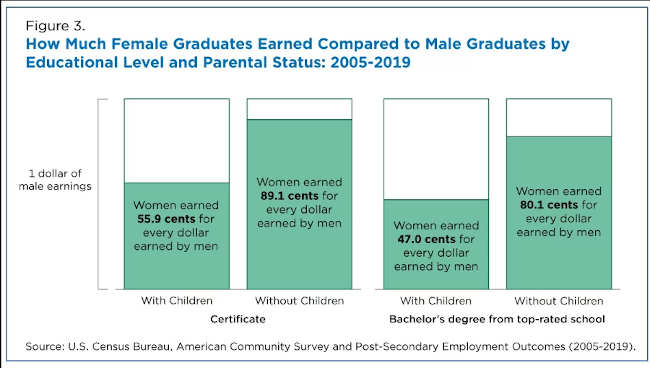
And as Figure 3 shows, this study found the wage gap was considerably wider among men and women with than without children — more than double for top bachelor’s holders and quadruple for certificate graduates.
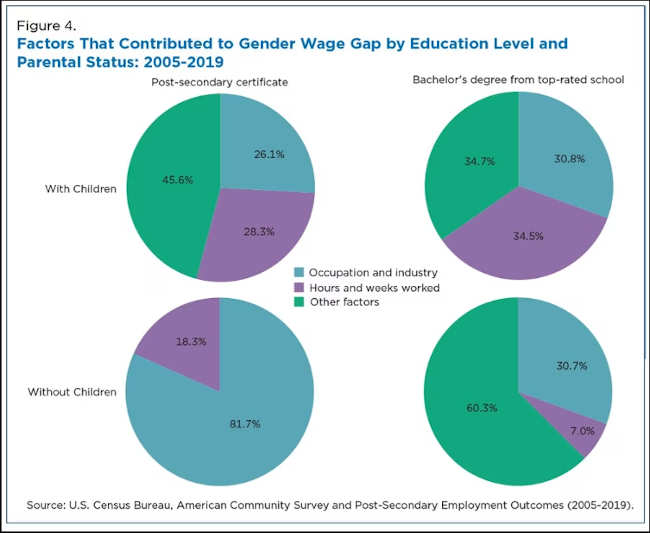
Figure 4 illustrates this jump was mostly fueled by labor supply among graduates of certificate programs and by occupation and labor supply choices among grads of highly selective bachelor’s programs.
Gender pay gap varied across the educational attainment distribution
Until recently, data limitations prevented researchers from investigating variations in the gender pay gap across different types of degrees and paths taken by graduates.
Thanks to our partnership with higher education systems, we can now get to the bottom of whether and how the gender pay gap relates to types of degrees earned.
The results paint a more complex portrait of the gender pay gap, found to exist at every level. College graduates and policymakers can use this more detailed information to better understand and dismantle contemporary barriers to gender equality.
Ariel Binder, Amanda Eng and Kendall Houghton are economists in the Center for Economic Studies Demographic Research Area. Andrew Foote is a principal economist in the Center for Economic Studies LEHD Research Area. All are U.S. Census Bureau staffers.