 How to resolve AdBlock issue?
News
- Details
- Written by: Elizabeth Larson
The council will meet at 5 p.m. Thursday, March 21, in the council chambers at Clearlake City Hall, 14050 Olympic Drive, for a closed session for a performance evaluation of City Manager Alan Flora and discussion of a claim against the city before the regular meeting starts at 6 p.m.
The agenda can be found here.
The meeting will be broadcast live on the city's YouTube channel or the Lake County PEGTV YouTube Channel.
Community members also can participate via Zoom. The pass code is 064363. One tap mobile is available at +16694449171,,84845472024#, or join by phone at 669-444-9171 or 253-205-0468.
Under business, council members will consider a resolution supporting the application of Chelsea Investment for the HOME Investment Partnerships Grant Program for development of affordable housing at 15837 18th Ave.
The project in question is on a property the county of Lake traded to the state in exchange for the former Lakeport Armory, which is slated to become the new headquarters of the Lake County Sheriff’s Office.
Chelsea Investments, the developer the state selected for the project, wants to build an 80-unit project but the staff report said the developer has “struggled to complete the funding stack needed to begin construction and is looking to apply for $10 million in HOME funds to fill part of
the gap. The City would be the applicant for the funds on behalf of the project and Chelsea Investment.”
Also on Thursday, the council will hold a public hearing to consider Clearlake Municipal Code section updates to modify Lake County Fire Protection District fire mitigation fees and set the first reading on April 4.
The council also will receive presentations on March's Adoptable Dogs and the annual report from the Lake County Public, Education, and Government Channel, or PEG TV.
On the meeting's consent agenda — items that are considered routine in nature and usually adopted on a single vote — are warrants, minutes of the Feb. 14 Lake County Vector Control District Board meeting, authorization for the police chief to dispose of three vehicles through a
dismantler, sell one vehicle at auction and adopt Resolution No. 2024-12, the Clearlake Waste Solutions 2022 Annual Solid Waste and Recycling Report and adoption of Resolution 2024-13 approving an amendment to the standard agreement issued under the 2020 Community Development Block Grant Program Coronavirus Response.
Email Elizabeth Larson at
- Details
- Written by: Elizabeth Larson
The National Weather Service is predicting the dry and “unseasonably mild weather” will continue during the first half of the week.
Rain is then forecast to arrive on Friday and continue with chances of showers into Monday.
Temperatures will drop to the high 40s during the day and into the high 30s at night during that time, according to the forecast.
Throughout the North Coast region, there also will be chances of snow in the higher elevations, beginning at between 5,000 and 6,000 feet on Thursday and dropping to the range of 3,500 to 4,500 feet.
Email Elizabeth Larson at
- Details
- Written by: Lake County News reports
El Centro Latino Del Lago is an ongoing business advising program, and its inaugural six-week training program launches March 27.
The training will include two networking events and six classroom training workshops and will be delivered exclusively in Spanish.
Program participants who successfully complete the courses, along with their families, will be invited to attend a graduation celebration on May 30th.
The first mixer will be March 27 at 6 p.m. at La Chilanguita in Clearlake. This free event will allow business owners to learn more about the program, meet the consultants from the California Hispanic Chamber of Commerce, or CAHCC, that will lead the workshops, and network with other Lake County Latino business owners. Refreshments will be provided.
Workshop topics include how to start a business, business planning, marketing, cost analysis and strategies for success.
For more information, and to sign up, visit: https://lakecountycaedc.org/centro-latino-del-lago/.
This program is supported by the FHL of San Francisco, in partnership with Vocality Credit Union.
Funded in part through a Grant or cooperative agreement with the U.S. Small Business Administration and the Governor’s Office of Business and Economic Development.
La Corporación de Desarrollo Económico del Condado de Lake (Lake EDC), en asociación con la Cámara de Comercio del Condado de Lake (LCCC) y la Cámara de Comercio Hispana de California (CAHCC), se complace en anunciar el lanzamiento de un nuevo programa para ayudar a los propietarios y potenciales empresarios latinos.
El Centro Latino Del Lago es un programa continuo de asesoramiento empresarial y su programa inaugural de capacitación de seis semanas se lanza el 27 de marzo. La capacitación incluirá dos eventos de networking y seis talleres de capacitación presenciales que se impartirán exclusivamente en español. Los participantes del programa que completen exitosamente los cursos, junto con sus familias, serán invitados a asistir a una celebración de graduación el 30 de mayo.
La primera reunión será el 27 de marzo a las 6:00 de la tarde, en La Chilanguita en Clearlake. Este evento gratuito permitirá a los dueños de negocios aprender más sobre el programa, conocer a los consultores de CAHCC que dirigirán los talleres y establecer contactos con otros dueños de negocios latinos del condado de Lake. Se proporcionarán refrigerios.
Los temas del taller incluyen cómo iniciar un negocio, planificación empresarial, marketing, análisis de costos y estrategias para el éxito. Para obtener más información y registrarse, visite: https://lakecountycaedc.org/centro-latino-del-lago/.
Este programa cuenta con el apoyo de FHL de San Francisco, en asociación con Vocality Credit Union.
Financiado en parte a través de una subvención o acuerdo cooperativo con la Administración de Pequeñas Empresas de EE. UU. y la Oficina de Desarrollo Económico y Empresarial del Gobernador.
- Details
- Written by: Anna Localio, University of Washington and Jessica Jones-Smith, University of Washington
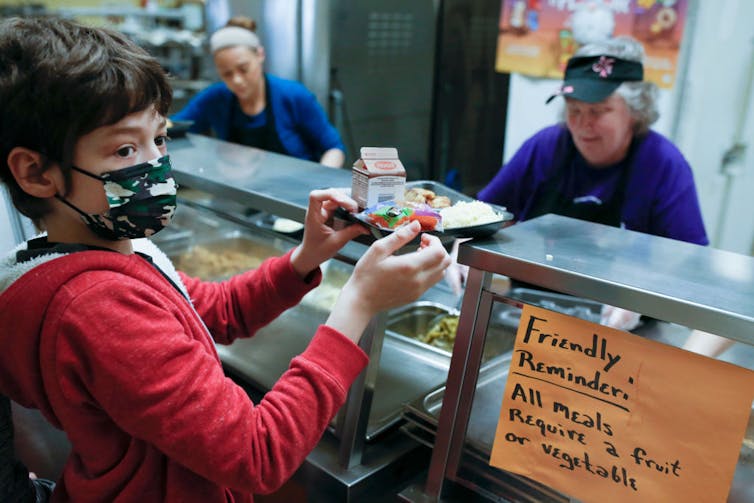
School meals are critical to child health. Research has shown that school meals can be more nutritious than meals from other sources, such as meals brought from home.
A recent study that one of us conducted found the quality of school meals has steadily improved, especially since the 2010 Healthy, Hunger-Free Kids Act strengthened nutrition standards for school meals. In fact, by 2017, another study found that school meals provided the best diet quality of any major U.S. food source.
Many American families became familiar with universal free school meals during the COVID-19 pandemic. To ease the financial and logistical burdens of the pandemic on families and schools, the U.S. Department of Agriculture issued waivers that allowed schools nationwide to provide free breakfast and lunch to all students. However, these waivers expired by the 2022-23 school year.
Since that time, there has been a substantial increase in schools participating in the Community Eligibility Provision, a federal policy that allows schools in high poverty areas to provide free breakfast and lunch to all attending students. The policy became available as an option for low-income schools nationwide in 2014 and was part of the Healthy, Hunger-Free Kids Act. By the 2022-23 school year, over 40,000 schools had adopted the Community Eligibility Provision, an increase of more than 20% over the prior year.
We are public health researchers who study the health effects of nutrition-related policies, particularly those that alleviate poverty. Our newly published research found that the Community Eligibility Provision was associated with a net reduction in the prevalence of childhood obesity.
Improving the health of American children
President Harry Truman established the National School Lunch Program in 1946, with the stated goal of protecting the health and well-being of American children. The program established permanent federal funding for school lunches, and participating schools were required to provide free or reduced-price lunches to children from qualifying households. Eligibility is determined by income based on federal poverty levels, both of which are revised annually.
In 1966, the Child Nutrition Act piloted the School Breakfast Program, which provides free, reduced-price and full-price breakfasts to students. This program was later made permanent through an amendment in 1975.
The Community Eligibility Provision was piloted in several states beginning in 2011 and became an option for eligible schools nationwide beginning in 2014. It operates through the national school lunch and school breakfast programs and expands on these programs.

The policy allows all students in a school to receive free breakfast and lunch, rather than determine eligibility by individual households. Entire schools or school districts are eligible for free lunches if at least 40% of their students are directly certified to receive free meals, meaning their household participated in a means-based safety net program, such as the Supplemental Nutrition Assistance Program, or the child is identified as runaway, homeless, in foster care or enrolled in Head Start. Some states also use Medicaid for direct certification.
The Community Eligibility Provision increases school meal participation by reducing the stigma associated with receiving free meals, eliminating the need to complete and process applications and extending access to students in households with incomes above the eligibility threshold for free meals. As of 2023, the eligibility threshold for free meals is 130% of the federal poverty level, which amounts to US$39,000 for a family of four.
Universal free meals and obesity
We analyzed whether providing universal free meals at school through the Community Eligibility Provision was associated with lower childhood obesity before the COVID-19 pandemic.
To do this, we measured changes in obesity prevalence from 2013 to 2019 among 3,531 low-income California schools. We used over 3.5 million body mass index measurements of students in fifth, seventh and ninth grade that were taken annually and aggregated at the school level. To ensure rigorous results, we accounted for differences between schools that adopted the policy and eligible schools that did not. We also followed the same schools over time, comparing obesity prevalence before and after the policy.

We found that schools participating in the Community Eligibility Provision had a 2.4% relative reduction in obesity prevalence compared with eligible schools that did not participate in the provision. Although our findings are modest, even small improvements in obesity levels are notable because effective strategies to reduce obesity at a population level remain elusive. Additionally, because obesity disproportionately affects racially and ethnically marginalized and low-income children, this policy could contribute to reducing health disparities.
The Community Eligibility Provision likely reduces obesity prevalence by substituting up to half of a child’s weekly diet with healthier options and simultaneously freeing up more disposable income for low-to-middle-income families. Families receiving free breakfast and lunch save approximately $4.70 per day per child, or $850 per year. For low-income families, particularly those with multiple school-age children, this could result in meaningful savings that families can use for other health-promoting goods or services.
Expanding access to school meals
Childhood obesity has been increasing over the past several decades. Obesity often continues into adulthood and is linked to a range of chronic health conditions and premature death.
Growing research is showing the benefits of universal free school meals for the health and well-being of children. Along with our study of California schools, other researchers have found an association between universal free school meals and reduced obesity in Chile, South Korea and England, as well as among New York City schools and school districts in New York state.
Studies have also linked the Community Eligibility Provision to improvements in academic performance and reductions in suspensions.
While our research observed a reduction in the prevalence of obesity among schools participating in the Community Eligibility Provision relative to schools that did not, obesity increased over time in both groups, with a greater increase among nonparticipating schools.
Universal free meals policies may slow the rise in childhood obesity rates, but they alone will not be sufficient to reverse these trends. Alongside universal free meals, identifying other population-level strategies to reduce obesity among children is necessary to address this public health issue.
As of 2023, several states have implemented their own universal free school meals policies. States such as California, Maine, Colorado, Minnesota and New Mexico have pledged to cover the difference between school meal expenditures and federal reimbursements. As more states adopt their own universal free meals policies, understanding their effects on child health and well-being, as well as barriers and supports to successfully implementing these programs, will be critical.
Anna Localio, Ph.D. Candidate in Health Services, University of Washington and Jessica Jones-Smith, Associate Professor of Health Systems and Population Health, Epidemiology, University of Washington
This article is republished from The Conversation under a Creative Commons license. Read the original article.