 How to resolve AdBlock issue?
News
- Details
- Written by: Lake County News reports
Researchers have known that those who reach higher levels of schooling live longer than others, but they didn’t know to what extent until now.
What they found was that the risk of death drops by two percent with every additional year of education.
That means those who completed six years of primary school had a lower risk of death by an average of 13 percent. After graduating from secondary school, the risk of dying was cut by nearly 25 percent and 18 years of education lowered the risk by 34 percent.
Researchers also compared the effects of education to other risk factors such as eating a healthy diet, smoking, and drinking too much alcohol, and they found the health outcome to be similar.
For example, the benefit of 18 years of education can be compared to that of eating the ideal amount of vegetables, as opposed to not eating vegetables at all.
Not going to school at all is as bad for you as drinking five or more alcoholic drinks per day or smoking ten cigarettes a day for 10 years.
“Education is important in its own right, not just for its benefits on health, but now being able to quantify the magnitude of this benefit is a significant development,” said Dr. Terje Andreas Eikemo, co-author and head of Centre for Global Health Inequalities Research at the Norwegian University of Science and Technology, or NTNU.
While the benefits of education are greatest for young people, those older than 50 and even 70 years still benefit from the protective effects of education.
Researchers found no significant difference in the effects of education between countries that have reached different stages of development. This means that more years of education is just as effective in rich countries as in poor countries.
“We need to increase social investments to enable access to better and more education around the globe to stop the persistent inequalities that are costing lives,” said Mirza Balaj, co-lead author and postdoctoral fellow at NTNU’s Department of Sociology and Political Science. “More education leads to better employment and higher income, better access to healthcare, and helps us take care of our own health. Highly educated people also tend to develop a larger set of social and psychological resources that contribute to their health and the length of their lives.”
“Closing the education gap means closing the mortality gap, and we need to interrupt the cycle of poverty and preventable deaths with the help of international commitment,” said Claire Henson, co-lead author and researcher at Institute for Health Metrics and Evaluation, or IHME, at the University of Washington’s School of Medicine. “In order to reduce inequalities in mortality, it’s important to invest in areas that promote people’s opportunities to get an education. This can have a positive effect on population health in all countries.”
The study identified data from 59 countries and included over 10,000 data points collected from over 600 published articles. Most of the studies reviewed for this study were from high-income settings, highlighting the need for more research in low- and middle-income countries, particularly from sub-Saharan and north Africa where data are scarce.
“Our focus now should be on regions of the world where we know access to schooling is low, and where there is also limited research on education as a determinant of health,” said Dr. Emmanuela Gakidou, co-author and professor at IHME.
- Details
- Written by: Lake County News reports
The state has surpassed 100,000 public and shared private electric vehicle chargers installed statewide, just weeks after unprecedented funding was approved to build a bigger, better network of charging and refueling infrastructure for zero-emission cars, trucks and buses — reported to be the most extensive network in the nation.
This is on top of more than 500,000 at-home chargers that Californians have installed for personal use.
Sales of zero-emission vehicles, or ZEV, have skyrocketed more than 1,000% in the last decade.
One in every four new cars sold last year in California were zero-emission. Last year, the state also surpassed its goal of selling 1.5 million zero-emission vehicles and its goal to install 10,000 fast chargers for electric vehicles — both ahead of schedule.
“No other state in the nation is doing as much as California to make our tailpipe-free future a reality,” said Gov. Gavin Newsom. “With more zero-emission vehicles sold last year than ever before and more than 100,000 public chargers installed, California dominates in this space.”
Building a bigger, better network
This milestone follows approval of a $1.9 billion investment plan that accelerates progress on the state’s electric vehicle charging and hydrogen refueling goals.
The plan details how the money will be spent with at least 50% dedicated to benefiting communities disproportionately impacted by pollution.
With this funding, the state expects to reach its goal of 250,000 public chargers in the next few years.
Also on Friday, Caltrans broke ground for a $450,000 Clean California transit project in Blythe that will transform a litter-strewn public space into a transportation hub that features a solar-powered EV charging station, among other things.
And last week, California celebrated the grand opening of a truck charging depot and 50 battery electric trucks, supported by $27 million in state funding.
The funding is part of the $48 billion dollar California Climate Commitment, which includes more than $10 billion for ZEVs and ZEV infrastructure.
The state has also received billions from the Biden-Harris Administration for clean transportation.
Last year, Gov. Gavin Newsom signed a bill to provide a dedicated source of funding for ZEV infrastructure through 2035.
On Thursday, Tesla announced that it opened its Supercharger network to non-Teslas for the first time, beginning with Ford, and will be opening to more in the coming months. This significantly expands public access to fast, reliable chargers in the state.
To improve the EV charging experience, the California Energy Commission (CEC) is developing first-in-the-world state regulations for charger reliability and reporting.
A stringent performance standard will apply to all new publicly funded infrastructure and the chargers will be required to disclose operational data to help drivers make more informed choices.
California’s ZEV record
Since the governor’s executive order in 2020 calling for a rule to require all new car sales to be zero-emission by 2035, ZEV sales have risen dramatically.
• 25% of all new cars sold in California last year were ZEVs, according to the California Energy Commission (CEC).
• 1,846,874 total ZEV sales to date.
• 34% of new ZEVs sold in the U.S. are sold in California, according to the Veloz EV Market Report.
• If California were a country, we’d rank 4th in EV sales behind China, the U.S. and Germany.
• Thousands of dollars in grants and rebates available for low-income Californians; learn more at www.ClimateAction.ca.gov.
- Details
- Written by: Mara Johnson-Groh
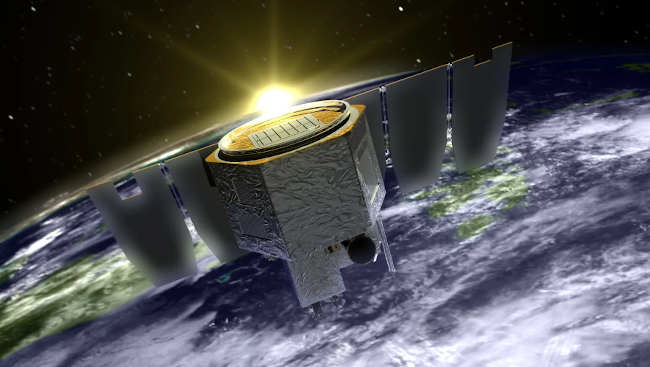
After 16 years studying Earth’s highest clouds for the benefit of humanity — polar mesospheric clouds — from its orbit some 350 miles above the ground, NASA’s Aeronomy of Ice in the Mesosphere, or AIM, mission has come to an end.
Initially slated for a two-year mission, AIM was extended numerous times due to its high science return. While AIM has faced hurdles over the years — from software hiccups to hardware issues — an incredibly dedicated team kept the spacecraft running for much longer than anyone could have anticipated.
On March 13, 2023, the spacecraft’s battery failed following several years of declining performance. Multiple attempts to maintain power to the spacecraft were made, but no further data could be collected, so the mission has now ended.
“AIM was dedicated to studying the atmospheric region that borders between our atmosphere and space,” said AIM mission scientist Diego Janches, of NASA’s Goddard Space Flight Center in Greenbelt, Maryland. “AIM’s help understanding this region has been of critical importance to providing insights on how the lower atmosphere affects space weather.”
Known as night-shining or noctilucent clouds, they are seen at twilight in the summer months, typically at high latitudes near the North and South Poles. Before the mission, scientists knew these types of clouds varied with latitude, season, and solar activity, but didn’t know why.
This mission was launched to understand the variations and study why the clouds form and their links to climate change by measuring the thermal, chemical, and other properties of the environment in which the clouds form.
“NASA’s AIM has been an incredibly successful mission,” said Scott Bailey, AIM principal investigator and professor at Virginia Tech. “It has answered core questions that have helped us understand how noctilucent clouds and atmospheric gravity waves vary over time and location.”
Over the years, AIM made many big discoveries. Data from the mission has thus far led to nearly 400 peer-reviewed publications. This includes findings on how these clouds can be created by meteor smoke and water vapor from rocket exhaust, how events near Earth’s surface can trigger changes in the clouds, and how ice high in the atmosphere can cause mysterious radar echoes, which are created in certain regions of the atmosphere during the summer.
As the mission progressed, scientists realized AIM’s data could also be used to study undulations in the air called atmospheric gravity waves. These waves transfer momentum and energy as they travel through the atmosphere. They link weather events at Earth’s surface with atmospheric disturbances that occur far away from the initial event, including in the uppermost part of the atmosphere where they can disrupt GPS signals.
“We’ve had many difficulties, but we’ve still gotten an incredible amount of data from AIM because of our really excellent, heroic, and hardworking team that comes through every time,” Bailey said.
AIM’s first hurdles started only months after launch in 2007, when the telecommunication receiver started to malfunction intermittently. With a clever use of radio signals, the team was able to reprogram the spacecraft to communicate in Morse code, which allowed it to maintain communications even after the receiver stopped working.
While communication with the spacecraft became thousands of times slower than planned, AIM was still able to make its measurements and send home 99% of the data it collected.
Shortly thereafter, the spacecraft again encountered a mission-threatening issue. The spacecraft repeatedly sent itself into safe mode, which effectively shut down the spacecraft and required a time-consuming series of tasks to reboot.
But again, the engineers were able to upload new software to the spacecraft to circumvent the issue and keep AIM functional. The new software patch has prevented over a thousand such incidents on the spacecraft since.
In 2019, AIM’s battery started to decline, but through great effort and ingenuity, the mission operations team maintained the battery power, enabling the spacecraft to continue returning data. In early 2023, the battery experienced a significant drop-off in performance which meant the spacecraft could not regularly receive commands or collect data.
Unfortunately, this hardware issue was not one that could be repaired remotely, and the satellite finally ceased collecting data in March 2023.
“We’re saddened to see AIM reach the end of its lifetime, but it’s been amazing how long it has lasted,” Bailey said. “It’s given us more data and insight into noctilucent clouds and atmospheric gravity waves than we could ever have hoped for.”
Though the spacecraft has seen its last night-shining clouds, scientists will continue to study AIM’s data for years to come. As for the spacecraft itself, it will slowly lose orbital height and burn up upon atmospheric re-entry in 2026.
“There are still gigabytes upon gigabytes of AIM data to study,” said Cora Randall, AIM deputy principal investigator and senior research scientist at the Laboratory for Atmospheric and Space Physics in Boulder, Colorado. “And as our models and computational capabilities continue to improve, people will make many more discoveries using the AIM datasets.”
For more information about the mission, visit https://go.nasa.gov/3TgIDwD.
Mara Johnson-Groh works for NASA’s Goddard Space Flight Center in Greenbelt, Maryland.

- Details
- Written by: Elizabeth Larson
The vote was 4-0 to purchase the 13-acre property at 16540 State Highway 175 for $300,000, with a second unanimous vote to approve a resolution accepting the grant deed recordation. Supervisor Moke Simon was absent.
Public Services Director Lars Ewing said the Cobb area is one of the few, if not the only, general plan areas in Lake County without a community park.
As an introduction to the brief public hearing for the purchase, Ewing gave an overview of the process that led to the final action at Tuesday’s meeting.
In February 2023, the board granted conceptual approval of the property purchase and appointed a negotiating team, Ewing said.
The Cobb community has had an ongoing desire to have a park of their own, which Ewing said is referenced in their draft area plan along with a draft parks, recreation and trails master plan.
After the board’s conceptual approval of the purchase, Ewing said Public Services staff worked on a variety of things — including a preliminary title report, an appraisal that valued the property at $390,000, septic and building inspections, hazard tree assessments and removal of abandoned vehicles.
Ewing said that, ultimately, the property’s owner, the Robert Vardanega Revocable Trust, accepted the county’s $300,000 purchase offer.
He thanked county staffer Celia Hoberg, — who has a background in real estate work — for her efforts in the process.
Ewing said that in June the Lake County Planning Commission determined the acquisition to be in conformity with the Lake County General Plan and categorically exempt from the California Environmental Quality Act.
County staff has had tribal consultation with the Middletown Rancheria and the Big Valley Band of Pomo Indians at a conceptual level and also have worked with a landscape architecture firm to prepare a preliminary concept plan for potential park development, Ewing reported.
The board approved $1 million for the project. With the purchase, closing costs and appraisals, Ewing said they have $650,000 to $670,000 left over, which won’t cover all of the construction costs. There also are planning, environmental studies and design still to do.
Ewing said the intent is to get it to a point that infrastructure and other necessities are in place so they can open the park to the public. That will be phase one. For phase two, Ewing hopes to secure grant funding.
Following the purchase approval, Ewing said Public Services staff will initiate a public outreach process to develop both an interim and long-term park use plan, continue consultation with both tribal nations, refine the concept design for future park use by the public, and perform appropriate environmental resource surveys/studies, all with the intent to progress to a public opening of the property.
Ewing said the property is in an area where the county doesn’t have a maintenance yard, so there will be an impact with annual costs, which he said he would discuss with county administration.
Supervisor Jessica Pyska, in whose district the park site is located, said there has been a “big push” to complete the process. She recognized Hoberg for her work, with Ewing adding that Hoberg was “the workhorse” of the project.
Supervisor Michael Green said he was excited to support it. Sabatier agreed.
“Parks is economic development and it’s what attracts people to want to live in areas,” Sabatier said, adding that not having one is definitely a disservice to attracting people to want to build and live in a community. He said he’s looking forward to seeing how it develops.
During the discussion, Sabatier noted wanting to try to connect the new park’s trails to Boggs Mountain Demonstration State Forest. Pyska said county staff is working on that.
The only public comment at the meeting came from longtime Cobb resident Robert Stark, who assured the board that the park project is thoroughly supported in the community.
In the 49 years he’s lived there, Stark said it had been a longtime wish. “The community is very enthusiastic about this.”
Pyska moved to approve the purchase agreement, which Green seconded and the board approved 4-0. Pyska then offered the resolution to accept the grant deed recordation, also approved unanimously.
Email Elizabeth Larson at